
Inside this guide
- Why this matters
- Can you rent an apartment in Texas with an eviction on your record?
- What should you do before applying?
- Why approval varies between Texas apartments
- How long does an eviction stay on your record in Texas?
- Can you rent after paying off an eviction-related debt?
- Will a guarantor help you get approved?
- What if a landlord rejects your application?
- How to keep an Austin, DFW, or Houston search realistic
- FAQ
- One last thing
- Related guides
Yes, you can rent an apartment in Texas with an eviction on your record; an eviction does not create a statewide ban on renting. Approval depends on the property's written screening criteria, the outcome of the eviction case, and your current application. Before applying in 2026, distinguish an eviction filing from a judgment and ask whether the property considers your specific circumstances.
- To rent apartment texas with eviction on record, check the property’s written screening criteria before applying.
- An eviction filing is not the same as a judgment awarding possession to a landlord.
- Paying a former landlord does not automatically remove an eviction case from court records.
- Taco Street Locating helps Texas renters compare apartments; the property makes the approval decision.
Why this matters
Your first task is checking eligibility, not booking tours. A suitable floor plan does not help if the property's rental-history policy excludes your application. Asking about that policy first keeps your search focused and helps you avoid applications that cannot succeed under the stated criteria.
The credit-check-to-approved-application guide covers the broader application process. With an eviction history, add an earlier checkpoint: confirm exactly what happened in court and what the prospective landlord will evaluate.
This 2026 guide addresses ordinary Texas rental applications. Subsidized housing and other regulated programs have additional rules; get advice specific to the program rather than assuming the same screening process applies everywhere.
Can you rent an apartment in Texas with an eviction on your record?
Yes. Texas law does not automatically disqualify every renter with an eviction history. A landlord's screening policy and the facts of your record determine whether an application meets that property's requirements, subject to applicable housing and consumer-protection laws.
Texas Property Code Section 92.3515 addresses making tenant-selection criteria available to applicants. Those criteria can include rental history, current income, credit history, criminal history, and inaccurate or incomplete application information. Ask for the criteria before submitting your application.
Start by identifying which situation actually describes your record:
| Record or situation | What it establishes | Useful documentation | What it does not establish |
|---|---|---|---|
| Eviction filing | A landlord started a court case | Court docket and petition | That the landlord won |
| Dismissed case | The court case ended without a possession judgment in that case | Signed dismissal order | That every screening report reflects the dismissal |
| Possession judgment | The court awarded possession to the landlord | Judgment and any later orders | That a separate debt has been paid |
| Landlord collection account | A claimed rental debt is being reported | Account details and payment or settlement records | That an eviction judgment exists |
A filing, a judgment, and a collection account are different records. Do not describe them interchangeably on an application or in a conversation with leasing staff. Give the accurate case outcome, then provide the documents supporting it.
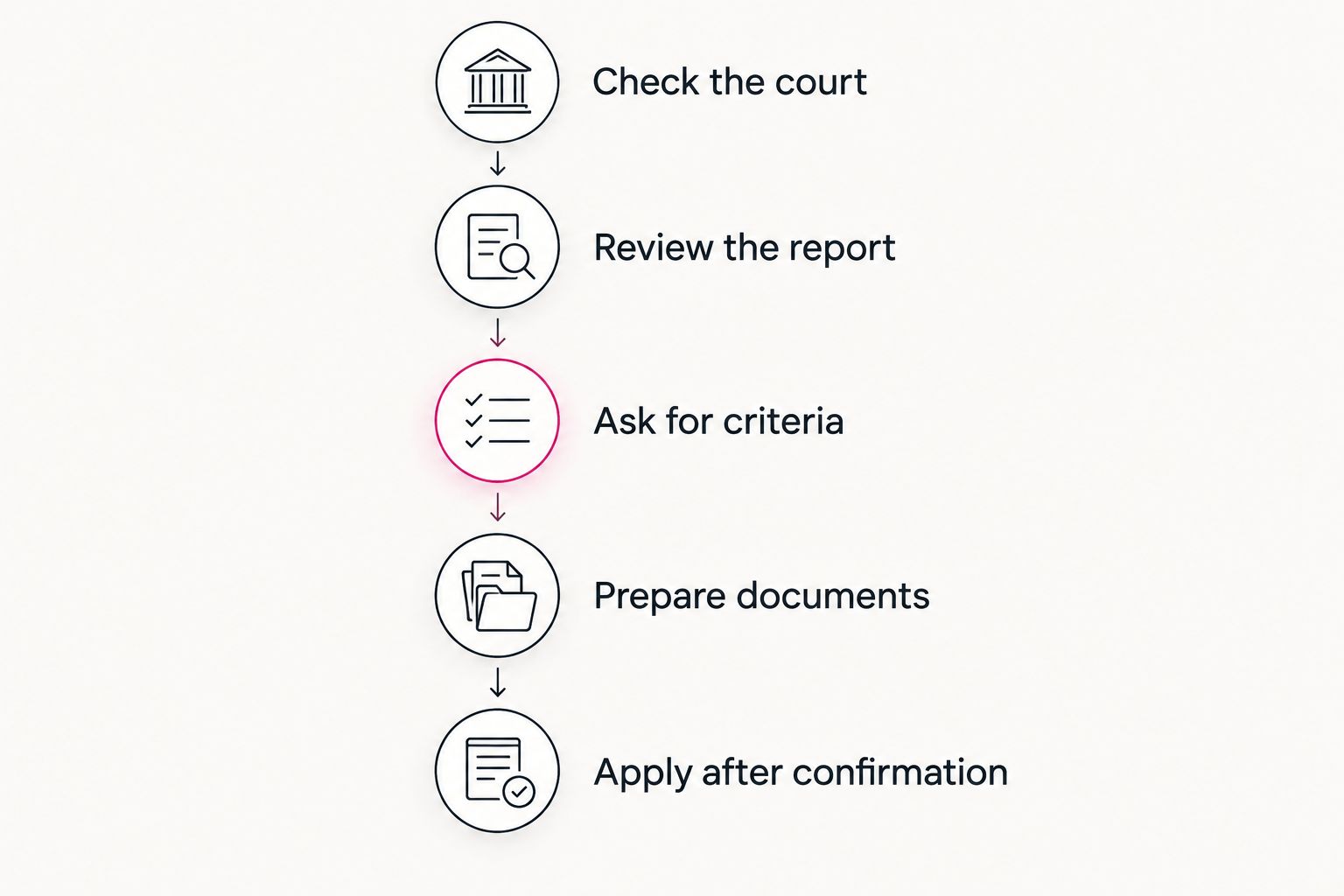
What should you do before applying?
Check the court record
Find the court that handled the case and obtain the disposition. Review the parties' names, filing date, case number, and final order. If you appealed, include the relevant later outcome rather than relying only on the original docket entry.
A notice to vacate is not itself a court judgment. Likewise, moving out after receiving a notice does not tell you whether a landlord later filed a case. Check the actual record instead of guessing from what happened during the move.
Review the screening report
If a landlord has already taken adverse action based on a consumer report, use the notice to identify the reporting company. Request the report and compare it with your court documents. Look for another person's case, duplicate entries, an incorrect balance, or a dismissal reported as a judgment.
Dispute factual errors with supporting documents. An explanation to a leasing agent does not correct the reporting company's file. Keep copies of the dispute, attachments, and response so you can show what was challenged and how it was resolved.
Ask for written criteria
Contact the property before applying. Explain whether your history involves a filing, dismissal, judgment, unpaid balance, or resolved balance, and ask whether the written policy permits consideration of that situation.
Ask who can confirm the answer. A general invitation to apply is not an eligibility determination, and a tour appointment is not approval. If staff cannot explain the policy, request clarification from the person responsible for screening.
Prepare supporting documents
Build a concise packet with the court outcome, any payment documentation, current income verification, and relevant rental references. Include a short factual explanation of the event and what has changed since then.
Keep sensitive documents secure. Ask how the property accepts them before emailing identification, account information, or court paperwork to an unverified address. Share what the application requires, not an unrestricted collection of personal records.
Apply after confirmation
Submit accurate answers that match the wording of the application. A question about eviction judgments is different from a question about eviction filings; read both carefully. If the question is unclear, ask for a written explanation rather than selecting an answer you cannot support.
Keep the selection criteria and application disclosures with your records. A property's willingness to review your application is not a promise of approval.
Why approval varies between Texas apartments
There is no single statewide eviction-acceptance policy for ordinary private-market apartments. For a 2026 search, compare the property's actual requirements rather than relying on a general claim that a building is flexible.
The relevant questions include:
- Case outcome: Does the policy distinguish a dismissed filing from a possession judgment?
- Timing: Does the property use a stated rental-history review period, and what date starts that period?
- Outstanding debt: Does the policy address unpaid landlord balances separately from court records?
- Current qualifications: What income, credit, and rental-reference requirements apply alongside eviction screening?
- Additional applicants: Does the policy permit a guarantor, and would that address this particular screening issue?
- Individual review: Who can review supporting documents, and what circumstances does the written policy allow them to consider?
Do not assume a smaller building, a different neighborhood, or an independently managed rental accepts eviction history. Management structure and location do not establish screening criteria. Ask the same questions regardless of the address.
How long does an eviction stay on your record in Texas?
Seven years is a general federal reporting limit for many negative consumer-report items, not a universal deletion deadline for Texas court records. The Fair Credit Reporting Act, including Section 605, governs reporting periods and contains exceptions. The rule applicable to a particular entry depends on what is reported and the relevant dates.
Court records and tenant-screening reports are separate systems. A reporting restriction does not itself seal or erase the underlying court case. Paying a balance also does not automatically remove the filing or judgment.
For a 2026 application, check the specific entry rather than assuming its age settles the issue. If you believe a report contains obsolete information, identify the item and dispute it with the reporting company. Ask a qualified attorney about any available court-record remedy for your circumstances.
Can you rent after paying off an eviction-related debt?
Paying an eviction-related debt does not guarantee approval or erase the court case. It addresses the balance, while the property's rental-history policy remains a separate screening question.
Get documentation showing whether the account was paid in full or settled under an agreement. Those outcomes are not interchangeable. If a judgment is involved, ask the creditor or a qualified attorney what documentation is needed to reflect satisfaction accurately.
Send the relevant proof when the property requests it, and check whether the reporting company has updated the balance correctly. Do not assume an update in one system changes every other record.
Will a guarantor help you get approved?
A guarantor helps only when the property's policy permits that solution for your specific screening issue. Meeting a guarantor requirement does not necessarily override a restriction on eviction history.
Before involving someone else, ask whether a guarantor addresses income qualification, rental history, or both. The prospective guarantor should review the agreement and understand the obligations before signing. Avoid treating this as a workaround until the property confirms it is an accepted option.
What if a landlord rejects your application?
If the decision relied wholly or partly on a consumer report, federal law generally requires an adverse-action notice. That notice identifies the reporting company and explains rights associated with the report; the reporting company did not make the landlord's rental decision.
You generally have 60 days after receiving the notice to request a free copy of that report from the identified reporting company. Review it promptly, especially if the stated reason does not match your court documents or payment history.
Under the Fair Credit Reporting Act's dispute process, a consumer reporting company generally has 30 days to investigate a dispute, with extensions permitted in certain circumstances. That is a reporting-dispute timeline, not an apartment-approval deadline. Keep alternative housing plans separate from the dispute's expected completion.
For 2026 applications, the relevant federal references include Fair Credit Reporting Act Sections 605, 611, and 615. For advice about a judgment, discrimination, or a contested legal obligation, contact a qualified Texas attorney or legal-aid organization. This guide provides general information, not legal advice.
How to keep an Austin, DFW, or Houston search realistic
Taco Street Locating is a fit for renters who want help comparing apartments in Austin, Dallas–Fort Worth, and Houston. The free apartment locating service supports apartment research and neighborhood comparisons; it does not replace the property's screening decision or legal advice.
Be clear about your record before building a shortlist. For an Austin move, compare Hyde Park, South Austin, or another neighborhood against your actual commute only after checking screening eligibility. For Dallas, apply the same sequence before choosing between Trinity Groves and Victory Park. A neighborhood preference should narrow eligible options, not substitute for eligibility.
Give your locator a factual summary of the case outcome, current documentation, and move requirements. Ask which screening policies still need direct confirmation. Taco Street Locating's apartment locating service is useful for organizing the search, but no locator can promise that a landlord will disregard its criteria.
If employment documentation is another obstacle, the guide to applying with an Austin job offer before your first paycheck addresses that separate application issue. Resolving income verification does not automatically resolve rental-history screening.
FAQ
Can I rent an apartment in Texas if I have an eviction?
Yes, an eviction does not create a statewide ban on renting in Texas. Ask each property for its written screening criteria and explain the exact case outcome before applying.
Does a dismissed eviction count the same as an eviction judgment?
No, a dismissed case is not the same as a judgment awarding possession to a landlord. Obtain the dismissal order and check that any screening report states the outcome accurately.
Does an eviction disappear after seven years?
Seven years is a general federal reporting limit for many negative consumer-report items, subject to exceptions. It is not an automatic deletion deadline for the underlying Texas court record.
Can I dispute an eviction that belongs to someone else?
Yes, dispute an incorrectly matched eviction with the consumer reporting company. Include documents supporting the mismatch and keep copies of your submission and response.
How soon should I request a report after an apartment denial?
You generally have 60 days after an adverse-action notice to request a free report from the reporting company identified in the notice. Request it promptly so you can review the information used in the decision.
Does paying a landlord guarantee my next apartment application will pass?
No, paying a landlord does not guarantee approval or erase an eviction case. Keep proof of payment and ask whether the prospective property’s policy accepts your specific rental history.
Can Taco Street Locating guarantee approval with an eviction?
No, Taco Street Locating cannot guarantee a property’s approval decision. Its free apartment locating service helps renters find and compare apartments in Austin, Dallas–Fort Worth, and Houston.
One last thing
An inaccurate dismissal entry and an accurate possession judgment require different next steps. Correct the first through the reporting-dispute process; address the second by checking property criteria and preparing supporting documents. Before your next tour, make sure you know which problem you are solving.
Related guides
- How apartment locators work in Texas
- Choosing an Austin apartment around your commute
- Touring an Austin apartment from another city