
Inside this guide
- Is a month-to-month lease more expensive in Houston?
- Why this matters
- Month-to-month: best for an uncertain departure date
- Short fixed-term lease: best for a defined temporary stay
- Longer fixed-term lease: best for a settled housing plan
- Why the comparison varies
- How do you compare the total obligation?
- Does month-to-month mean I can leave whenever I want?
- Is extending my current lease the same as signing month-to-month?
- Should I choose month-to-month if I am new to Houston?
- FAQ
- One last thing
- Related guides
A month-to-month lease in Houston is not automatically more expensive than a fixed-term lease; compare written quotes for the same apartment and move-in date before choosing. The monthly rent alone does not settle the decision: required fees, notice obligations, and the cost of leaving a fixed-term lease early also affect what you pay.
- Is a month-to-month lease more expensive in Houston? Compare written quotes; the lease label alone does not establish the difference.
- Month-to-month flexibility still comes with termination and notice requirements.
- Compare the same apartment, move-in date, mandatory charges, and expected departure date.
- Taco Street Locating helps Houston renters compare apartments; the written lease controls your obligations.
Is a month-to-month lease more expensive in Houston?
A month-to-month lease is more expensive only when its actual charges exceed the comparable fixed-term option. A higher monthly payment can still make sense if you need a temporary home and the alternative requires a commitment you cannot keep.
Start with the Houston month-to-month apartment guide, then request property-specific terms. For your 2026 search, compare written offers rather than assuming every apartment uses the same approach to flexible leases.
| Lease arrangement | Best for | Main advantage | Main drawback | What to verify |
|---|---|---|---|---|
| Month-to-month tenancy | Renters with an uncertain departure date | No fixed end date extending across a longer term | Continuing terms and termination rules need close attention | Rent, required charges, notice, and renewal provisions |
| Short fixed-term lease | Renters with a defined temporary stay | A contract period aligned with a known assignment | Leaving before the agreed end date creates contract questions | End date, early-departure terms, and renewal process |
| Longer fixed-term lease | Renters confident about their stay | A defined commitment period | Less flexibility if plans change | Total obligation and any early-termination provision |
The strongest comparison holds the apartment constant. Comparing a furnished apartment near the Texas Medical Center with an unfurnished apartment in another neighborhood mixes location, furnishings, and lease length into one decision.
Why this matters
Your real question is not simply whether flexible rent is higher. It is whether the flexibility fits your stay well enough to justify the total obligation.
If you are relocating to Houston before settling on a neighborhood, a rolling arrangement and a longer lease solve different problems. One prioritizes an uncertain departure date; the other fits a stay you can already plan. Neither label proves that the apartment is the better financial choice.
Choose the commitment you can reasonably keep, then compare its written terms. Signing a longer lease solely because its monthly figure looks lower leaves the early-departure question unanswered.
Month-to-month: best for an uncertain departure date
A month-to-month arrangement fits a renter whose move-out timing remains unsettled. That includes situations such as waiting for a permanent move or working around a changing assignment, provided the actual notice terms fit those plans.
The advantage is the absence of a longer fixed end date. The trade-off is that you need to understand how the tenancy continues, how terms change, and how either party ends it.
Do not confuse flexibility with permission to leave immediately. Ask the leasing office to identify the termination clause and explain exactly how notice must be delivered. An informal conversation about your plans is not a substitute for following the agreement.
For a 2026 move, distinguish these questions before you apply:
- Can you sign a month-to-month agreement from the start?
- Does the apartment instead offer a fixed short term?
- Does an existing lease continue month-to-month only after its initial term?
- What written terms apply to that continuation?
These are different arrangements. A property’s explanation of what happens after a fixed lease ends does not establish that a new renter can begin on the same terms.
Short fixed-term lease: best for a defined temporary stay
A short fixed-term lease fits a stay with a known end date. If your assignment ends on a specific date, ask for a contract ending when you actually need to leave rather than assuming a rolling tenancy is necessary.
Its advantage is alignment: the agreement can match a defined period. Its drawback is that a fixed end date still creates a commitment, even when the term is shorter than another option.
Request written comparisons for terms such as 6 months and 12 months if those lengths suit your plans. These are comparison requests, not a statement that a particular Houston property offers either term.
Read what happens at expiration. Ask whether the agreement ends, requires notice, or continues under another arrangement. A known end date does not answer every renewal or move-out question.
Longer fixed-term lease: best for a settled housing plan
A longer fixed-term lease fits renters who know they want to stay through the contract period. Its strongest practical benefit is a defined agreement covering that planned stay.
The drawback is the commitment itself. A change in job location, household plans, or preferred neighborhood does not by itself explain what the contract permits or requires.
Before choosing a longer term for your 2026 move, read the provisions covering early departure, reletting, and any contractual termination option. Do not treat those terms as interchangeable. Ask the property to identify which provision applies to your situation.
A lower monthly quote is not enough reason to sign beyond your expected stay. Compare the full agreement with your realistic timeline, including what happens if that timeline changes.
Why the comparison varies
Lease length is only one part of an apartment quote. These factors determine whether two offers are genuinely comparable:
- Apartment identity: Compare the same unit when possible. Different floor plans, locations within a building, or included features introduce other differences.
- Move-in date: Use the same proposed start date. Otherwise, you are comparing different offers rather than isolating lease length.
- Included services: Confirm whether furnishings, utilities, parking, or other services appear in either agreement.
- Required charges: Separate recurring charges from one-time charges and refundable deposits. They affect your cash requirements differently.
- Departure obligations: Read notice and early-departure provisions alongside the monthly payment.
- Continuation terms: Establish what happens when the initial agreement ends and what terms govern any continued occupancy.
Ask each property for the same written information. A useful 2026 comparison should show the lease term, apartment, start date, required charges, and termination language together—not scattered across a listing, email, and conversation.
How do you compare the total obligation?
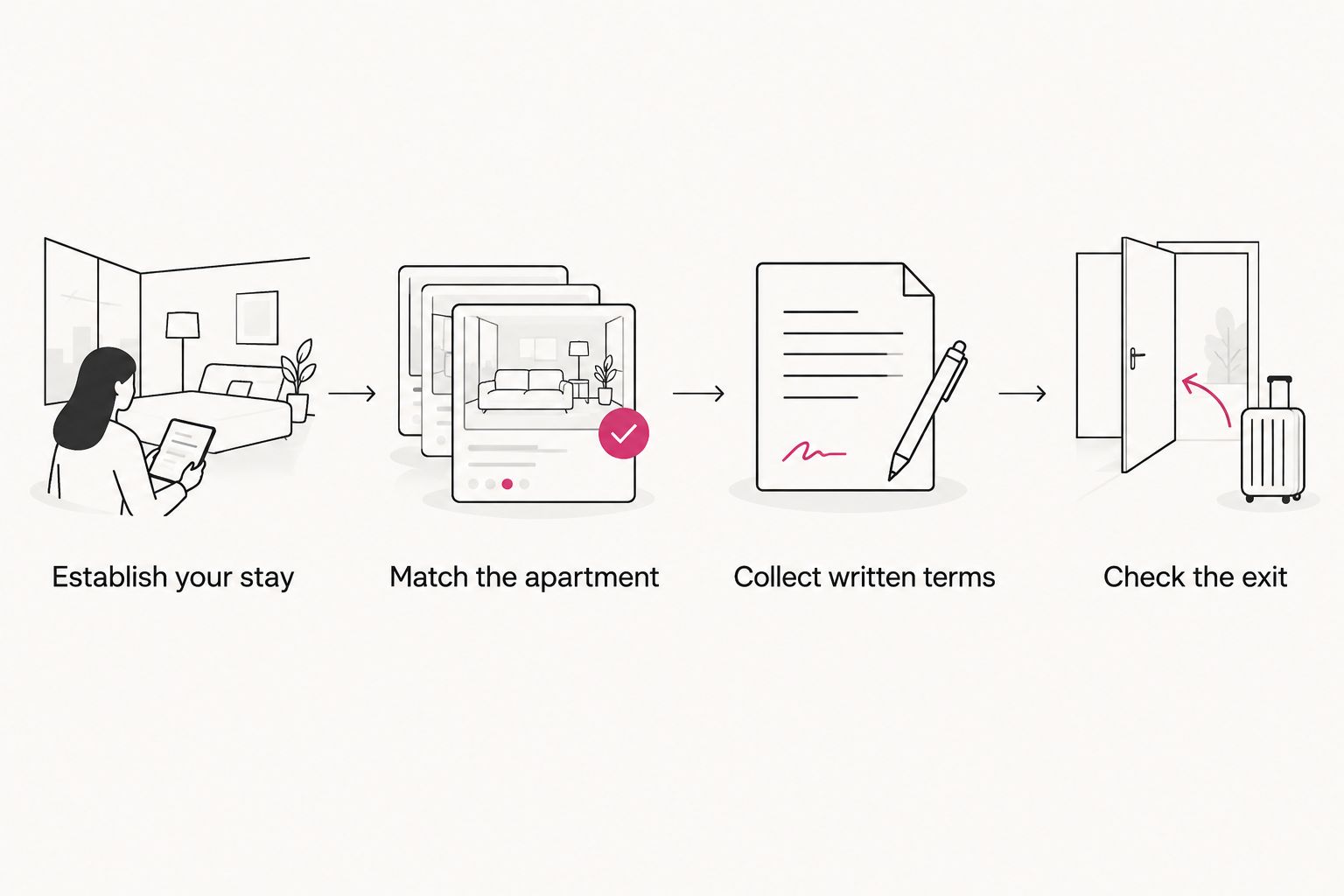
Use a consistent sequence before choosing between flexible and fixed-term housing. The goal is to separate the apartment decision from the contract decision, then put them back together.
Establish your stay
Write down your expected move-in date, likely departure date, and the event that could change either. A firm assignment end date calls for a different comparison than a move with no settled timeline.
Also decide whether you would accept moving again. Temporary housing is less useful if a second move conflicts with your work schedule or household needs.
Match the apartment
Request different lease terms for the same apartment whenever possible. If that is not possible, document differences in neighborhood, furnishings, parking, and included services.
For example, keep the commute destination consistent when comparing Midtown and the Texas Medical Center area. Compare actual addresses and your actual travel schedule rather than assuming a neighborhood name settles the commute.
Collect written terms
Ask for the lease documents and a written explanation of required charges before committing. Keep refundable deposits separate from nonrefundable charges so your comparison does not treat them as the same expense.
If a verbal explanation differs from the documents, resolve the difference before signing. Save the final written clarification with your lease records.
Check the exit
Find the notice method, deadline, and contractual rules for departure. For a fixed term, identify what the agreement says about leaving before expiration; for month-to-month, identify how termination takes effect.
Compare both options over your intended stay. Do not assume an early-departure obligation disappears simply because you stop occupying the apartment.
Does month-to-month mean I can leave whenever I want?
Month-to-month does not mean notice-free. For a 2026 Houston rental decision, Texas Property Code §91.001 is the relevant state-law starting point for terminating a monthly tenancy without a fixed term.
Under the statute’s default rule for a rent-paying period of at least 1 month, termination occurs on the later of the date specified in the notice or one month after notice is given. The statute also recognizes different termination periods in signed written agreements.
That makes the lease language essential. Do not substitute 30 days for one calendar month without checking the governing terms; those periods are not always identical. Follow the required delivery method, keep proof of notice, and obtain legal advice if the lease and the property’s explanation conflict.
Is extending my current lease the same as signing month-to-month?
Extending your current lease is not automatically the same as entering a month-to-month tenancy. A written extension can establish another fixed term, while a continuation provision can describe a different arrangement after expiration.
Before your current agreement ends, request the proposed renewal or continuation terms in writing. Identify the new term, required charges, notice requirements, and effective date.
Do not rely on an old conversation about what would happen at expiration. Read the document that will govern the period you actually plan to occupy the apartment.
Should I choose month-to-month if I am new to Houston?
Choose month-to-month when an uncertain timeline is central to your decision and the written terms fit your needs. Being new to Houston alone does not make it the right choice.
A renter comparing Midtown, Montrose, and the Texas Medical Center area should first identify the workplace address, transportation needs, and preferred daily routine. Then compare lease arrangements for apartments that satisfy those priorities.
Taco Street Locating is best for Houston renters who want personalized apartment research and neighborhood guidance. The free apartment locating service helps renters find and compare apartments; use that help to build a shortlist, not as a substitute for reviewing your agreement. The service does not replace legal advice about a disputed lease provision.
FAQ
Is a month-to-month lease more expensive in Houston in 2026?
A month-to-month lease in Houston is not automatically more expensive; compare written quotes for the same apartment and move-in date. Include required charges and departure obligations rather than judging the monthly rent alone.
What’s the best lease type if I don’t know when I’m leaving Houston?
Month-to-month is the arrangement to investigate when your departure date is uncertain. Check the notice provisions and continuing terms before deciding that its flexibility fits your plans.
Can I move out of a month-to-month apartment without notice?
Do not assume you can move out without notice. Texas Property Code §91.001 provides a default termination rule for monthly tenancies, and a signed written agreement can specify a different termination period.
Is one month’s notice the same as 30 days in Texas?
One calendar month is not always the same as 30 days. Check the applicable lease language and termination rule before calculating your notice deadline.
Can I compare a 6-month lease with a 12-month lease?
Request a 6-month and a 12-month quote if both periods fit your plans and the property offers them. Keep the apartment and move-in date the same so other differences do not distort the comparison.
Does my apartment automatically become month-to-month when my lease ends?
Do not assume your apartment becomes month-to-month when the lease ends. Read the expiration, renewal, and continuation provisions and request written confirmation of the terms governing continued occupancy.
Can Taco Street Locating help me compare Houston apartments?
Taco Street Locating offers free apartment locating help for renters comparing Houston apartments. Personalized apartment research and local neighborhood knowledge help you organize the search; review each property’s lease terms before signing.
One last thing
Before signing, ask the leasing office: What must I do if I want to leave on my expected departure date? Request an answer tied to the actual agreement, including notice delivery and any remaining obligations.
That question turns an abstract debate about flexibility into a practical decision. For your 2026 Houston search, choose the apartment and contract that work together—not a lease label that sounds convenient.
Related guides
- How much does it cost to break an apartment lease in Texas?
- Apartment locating for Houston energy workers
- Apartment locating for Houston Med Center staff