
Inside this guide
- Is it hard to find an apartment in Austin right now?
- Why this matters
- Why finding an Austin apartment varies by renter
- Which Austin neighborhoods should you compare?
- How do you make an Austin apartment search easier?
- When does personalized apartment help make sense?
- Can I find an Austin apartment before moving there?
- Should I apply before touring an Austin apartment?
- Does a flexible move-in date make the search easier?
- FAQ
- One last thing
- Related guides
Finding an apartment in Austin gets harder when you need a specific location, move-in date, and approval criteria to line up; the useful question is whether apartments fit your requirements, not whether listings exist. For a 2026 move, confirm those requirements before touring, because finding a place you like does not establish that you qualify or that its lease terms work for you.
- Is it hard to find an apartment in Austin? Your location, timing, and application requirements determine the difficulty.
- Taco Street Locating suits renters who want personalized apartment research and local neighborhood guidance.
- Compare Austin neighborhoods around your actual commute, not their distance from downtown alone.
- Confirm screening criteria and unit-specific lease terms before submitting an apartment application.
Is it hard to find an apartment in Austin right now?
An Austin apartment search becomes difficult when several nonnegotiable requirements overlap. A renter with a flexible move-in date faces a different decision from someone starting work on a fixed date, bringing a pet, and needing a particular commute.
For your 2026 search, assess the constraints below before deciding whether you need more listings or a different search plan. Start by choosing an Austin apartment around your commute rather than treating every address within the city as interchangeable.
| Search situation | Best for | Advantage | Trade-off to resolve |
|---|---|---|---|
| Flexible neighborhood search | Renters without a fixed daily destination | Lets you compare different locations | Requires more neighborhood research |
| Commute-first search | Renters traveling to a workplace or campus | Keeps the daily trip central to your decision | Excludes apartments outside your chosen travel area |
| Fixed-date search | Renters coordinating a job start or lease ending | Gives every inquiry a clear deadline | Requires a unit-specific answer about timing |
| Remote apartment search | Renters relocating before they can visit | Lets you begin comparing from another city | Makes condition, noise, and access harder to assess personally |
These approaches are not competing rankings. Choose the one that addresses your biggest constraint, then use the others as checks before signing.
Why this matters
A long list of apartments is not the same as a usable shortlist. An attractive floor plan does not solve a difficult commute, an unsuitable lease term, or an application you cannot support with the required documents.
Separate your search into two questions: Does this apartment fit your daily life, and can you complete this lease on the required terms? Keep both answers beside each property instead of discovering a disqualifying detail after a tour.
This also changes what you ask for help with. “Find me something nice in Austin” leaves the important decisions undefined; a workplace address, move-in window, household details, and clear requirements create a brief someone can act on.
Why finding an Austin apartment varies by renter
These factors belong in your search brief. None establishes that the whole Austin market is easy or difficult; each determines which apartments deserve your attention.
- Location and commute: Identify the destination you actually travel to, including the building entrance or parking location. A neighborhood name alone does not describe that trip.
- Move-in timing: Give leasing offices your earliest and latest acceptable dates. Ask about the specific apartment rather than the floor plan in general.
- Screening requirements: Request the property's written application criteria. Establish what documents you need before submitting personal information or an application.
- Household and pet requirements: Confirm the rules relevant to everyone moving with you. Do not assume a general pet-friendly description answers questions about your particular animal.
- Lease and living requirements: State whether you need furnished housing, a particular lease length, accessibility features, or a workspace. Distinguish requirements from preferences.
- Ability to inspect: Decide who will verify the apartment if you cannot visit. A model apartment, marketing photographs, and a tour of the actual unit answer different questions.
For a 2026 move, carry these same questions from your first inquiry through your final lease review. Consistency makes conflicting answers easier to spot.
Which Austin neighborhoods should you compare?
Start with geography, then inspect the individual address. Downtown Austin is central, the Domain is in North Austin, and Hyde Park is north of the University of Texas at Austin campus; those locations create different starting points for your daily trips.
Use this table to structure a comparison, not as a claim that one neighborhood suits every renter.
| Area | Best for investigating | Useful starting point | Trade-off to check |
|---|---|---|---|
| Downtown Austin | Renters with central destinations | Compare addresses close to the places you regularly visit | Inspect the specific building's surroundings, access, and noise |
| The Domain area | Renters with North Austin destinations | Begin with the route between the apartment and your workplace | Do not substitute neighborhood reputation for an actual commute check |
| Hyde Park | Renters considering an area north of UT Austin | Compare the exact address with your campus or central Austin destination | Verify the building's features instead of assuming a standard apartment setup |
If your workplace is north, do not begin with downtown simply because it is familiar. If your routine centers on campus, do not judge an apartment only by how it looks on a citywide map.
For each candidate, inspect the route to groceries, the way you enter the property, and the path from parking or transit to your door. Choose the address that supports your routine, not just the neighborhood name you recognize.
How do you make an Austin apartment search easier?
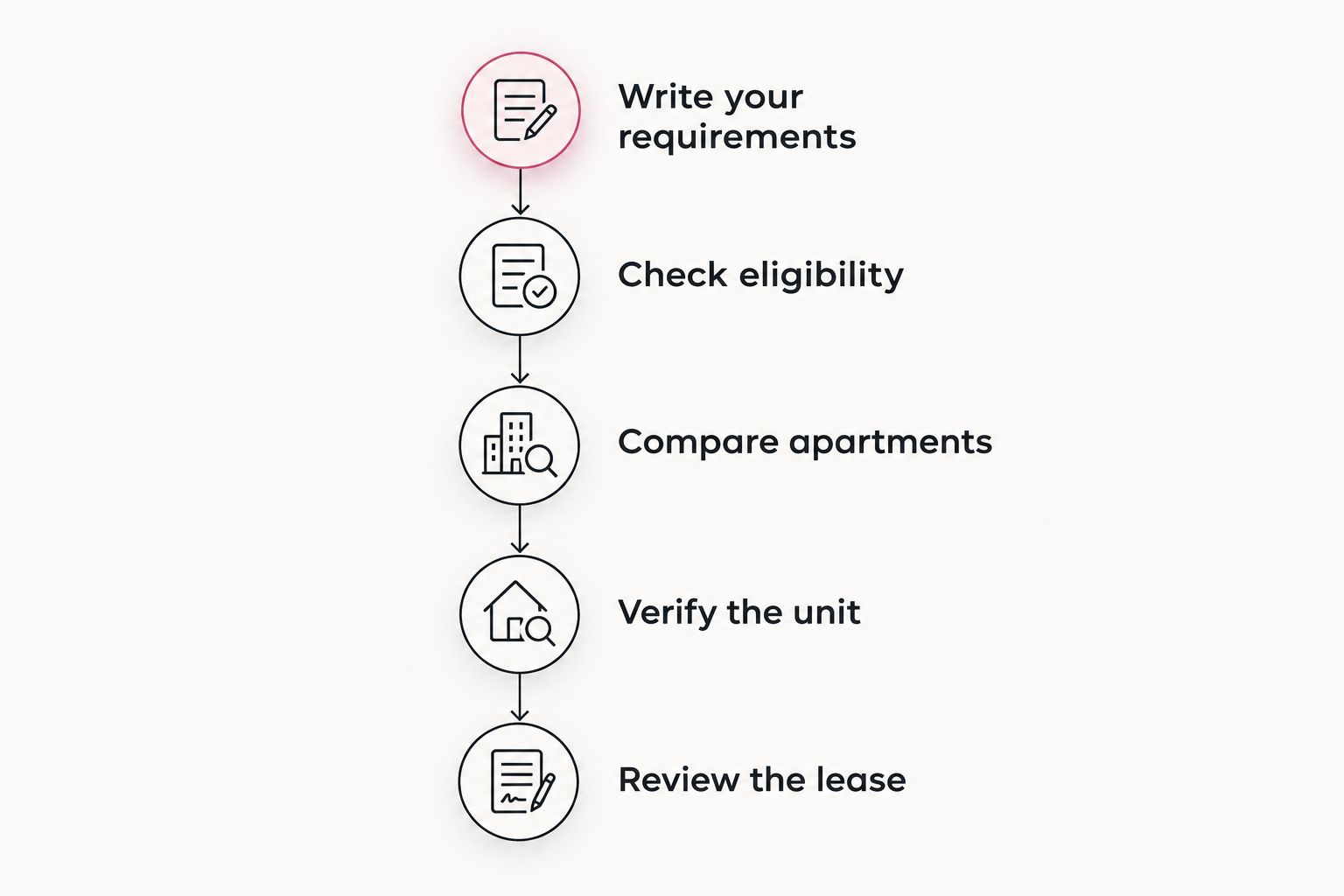
Use a repeatable sequence. The goal is to eliminate mismatches before you spend time touring or applying, not to collect the largest possible list.
1. Write your requirements
Start with 3 nonnegotiable requirements as a planning exercise: the location you need to reach, your move-in window, and the housing features you cannot compromise on. Add any other genuine requirements rather than forcing an essential need into the preference column.
Keep preferences separate. A balcony and a required accessibility feature should not carry the same decision weight, even if both appear in a listing filter.
2. Check eligibility
Ask each property for its written screening criteria and required documentation. If you are changing jobs, moving with a guarantor, or relying on income documents other than recent pay statements, describe that situation before applying.
A new job creates a specific paperwork question, not a reason to guess. The guide to applying with a job offer before your first paycheck addresses that search scenario; the property still needs to confirm what it accepts.
3. Compare apartments
Use 1 comparison sheet with the same fields for every property: exact unit, proposed move-in date, lease term, required charges, screening documents, parking arrangement, and unresolved questions. Record who answered and when.
For your 2026 shortlist, distinguish confirmed facts from items that still need verification. An unanswered question should remain visible rather than becoming an assumption during a busy move.
4. Verify the unit
Ask whether your tour shows the actual apartment, a model, or another unit with a similar layout. Check the window direction, surrounding activity, storage, appliance condition, and access route where you can inspect them.
If noise or access is a deciding factor, consider 2 visits at different times as a practical check, not a guarantee of future conditions. When visiting remotely, request a continuous walkthrough and direct views of the details that matter to you.
5. Review the lease
Match the lease to the apartment and terms you selected. Check the unit identification, dates, occupants, required charges, addenda, and any written commitments before signing.
Do not let a good tour replace this review. The apartment's appearance and the agreement governing your tenancy are separate parts of the decision.
When does personalized apartment help make sense?
Taco Street Locating is best suited to Austin renters who want personalized apartment research and local neighborhood guidance. The service helps renters find and compare apartments in Austin, Dallas–Fort Worth, and Houston.
The useful input is your decision brief: where you need to go, when you need to move, what your household requires, and which trade-offs you will accept. Personalized research is most relevant when you want help turning those details into a manageable comparison rather than continuing a broad search alone.
The limitation is straightforward: help finding an apartment does not replace the property's screening decision, your inspection, or your lease review. You still need direct confirmation of the terms that govern your application and tenancy.
Ask Taco Street Locating to help compare neighborhoods and apartments against the same requirements you would use yourself. That keeps the assistance focused on your move instead of adding another unrelated list.
Get help comparing Austin apartments
Share your move-in window, commute, and requirements for personalized apartment research.
Can I find an Austin apartment before moving there?
You can begin an Austin apartment search before arriving by researching neighborhoods, confirming application requirements, and arranging remote tours. The part that needs extra attention is verification: establish exactly what you are seeing and what remains unconfirmed.
Request views of the actual apartment whenever possible. Ask the person conducting the tour to show the approach to the unit, windows, storage, and any feature that determines whether the apartment works for you.
For a remote move in 2026, keep a written record of unresolved questions. Do not treat a polished video as evidence of details it never shows.
Should I apply before touring an Austin apartment?
Confirm the screening criteria and apartment details before deciding whether to apply without a tour. Submitting an application does not resolve uncertainty about the unit's condition, layout, surroundings, or lease terms.
If you cannot inspect personally, decide what evidence you need and who can obtain it. Avoid making the application itself your method of finding out whether the apartment fits.
Does a flexible move-in date make the search easier?
A flexible move-in date lets you ask properties about more than one acceptable starting date. It does not establish approval or confirm any particular apartment.
Give a genuine window rather than saying you are flexible when a job start or existing lease makes the deadline firm. Accurate constraints produce a more useful search than optimistic ones.
FAQ
Is it hard to find an apartment in Austin in 2026?
Finding an apartment in Austin is harder when location, move-in timing, and screening requirements leave little room for compromise. Assess those constraints together rather than judging your search by the number of listings you see.
What’s the best way to start looking for an apartment in Austin?
Start with your daily destination, move-in window, and nonnegotiable housing requirements. Use those details to choose a search area before comparing individual apartments.
Can I get an Austin apartment with a new job offer?
Ask the property whether it accepts your job offer as income documentation before applying. Request its written requirements and confirm whether additional documents are necessary.
Is downtown Austin better than the Domain for renting?
Neither downtown Austin nor the Domain is better for every renter. Compare each location with your workplace, regular destinations, and the specific apartment’s surroundings and lease terms.
Can someone help me compare Austin neighborhoods?
Taco Street Locating helps renters find and compare Austin apartments through personalized apartment research and local neighborhood knowledge. Share your commute, timing, and requirements so the comparison addresses your actual move.
What should I ask before applying for an Austin apartment?
Ask for written screening criteria, required documents, unit identification, proposed lease dates, and a complete statement of required charges. Resolve any conflict between the listing, tour, and proposed agreement before committing.
One last thing
The most useful final check is whether you still have unanswered deal-breaker questions. A beautiful kitchen does not answer how you enter the building after work, whether your documents meet the screening criteria, or which apartment the lease identifies.
Before signing, read your original requirements beside the proposed agreement. For a 2026 relocation, that simple comparison keeps the decision centered on the life you are moving to—not just the apartment you enjoyed touring. Save the taco debate for after the housing questions are settled.
Related guides
- How long does it take to find an apartment in Austin?
- How to tour an Austin apartment from another city
- Apartments in Hyde Park, Austin