
Deciding between Downtown Houston and Midtown depends on your lifestyle priorities. Both neighborhoods offer urban living, but they cater to different needs. Here’s a quick breakdown:
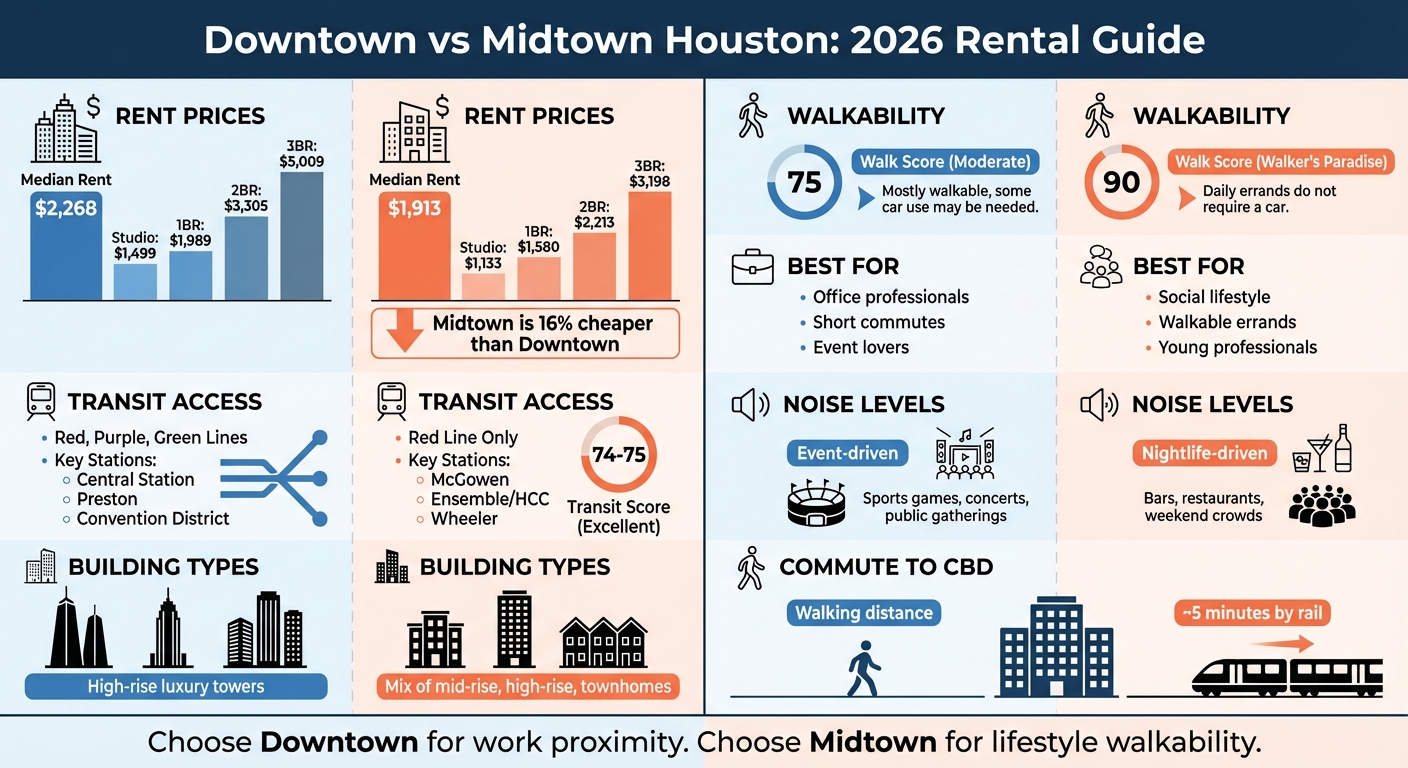
- Downtown Houston: Perfect for professionals working in the business district. You’ll enjoy proximity to office towers, sports venues (like Minute Maid Park and Toyota Center), and the Theater District. Expect high-rise apartments with luxury amenities. Median rent is $2,268, with one-bedrooms averaging $1,989. However, daily errands can be less convenient, and event-related noise is common.
- Midtown Houston: Ideal for those seeking a vibrant social scene and walkable living. Midtown offers trendy bars, brunch spots, parks, and grocery stores all within reach. It’s more budget-friendly, with a median rent of $1,913 and one-bedrooms averaging $1,580. The nightlife buzz is constant, so noise levels can be higher near Milam Street’s bar district.
Both areas are connected by the METRORail Red Line, making commuting easy. If you value a short commute and being near work, Downtown is the way to go. If walkability and a lively community matter more, Midtown is your best bet.
Quick Comparison
| Feature | Downtown Houston | Midtown Houston |
|---|---|---|
| Median Rent | $2,268 | $1,913 |
| 1-Bedroom Average | $1,989 | $1,580 |
| Walkability | Moderate (Walk Score ~75) | High (Walk Score 90) |
| Transit Access | Red, Purple, Green Lines | Red Line Only |
| Best For | Professionals near offices | Social, walkable lifestyle |
| Noise Levels | Event-driven | Nightlife-driven |
Your choice boils down to whether you want to live closer to work or closer to the action. Both neighborhoods offer plenty of perks, but the right fit depends on what you prioritize in daily life.
Downtown vs Midtown Houston Rental Comparison 2026: Rent Prices, Walkability & Transit
Downtown vs Midtown: 60-Second Overview
Downtown is Houston’s bustling hub of office towers, sports arenas, and the Theater District. It’s a hotspot for high-rise apartments and historic loft conversions. As of January 2026, the median rent here is $2,268, with studios averaging $1,499 and one-bedrooms coming in at $1,989. Perfect for professionals who enjoy the convenience of the 6-mile climate-controlled tunnel system and catching weeknight games right in the heart of the city.
Midtown, on the other hand, offers a more laid-back vibe just south of Downtown. This neighborhood leans into a residential, socially vibrant atmosphere. With a WalkScore of 90 out of 100, Midtown is labeled one of Houston’s most walkable neighborhoods, packed with bars, brunch spots, and boutique gyms. Housing options range from mid-rise apartments to townhomes and a handful of high-rises. The median rent here is $1,913 – about 16% less than Downtown – with studios averaging $1,133 and one-bedrooms at $1,580. Midtown appeals to those who value neighborhood amenities and an active social scene over being right next to the office.
Both areas are linked by the METRORail Red Line, making commuting between them a breeze. Downtown stands out for its tunnel system and shorter commutes for office workers, while Midtown shines with its proximity to grocery stores, parks like Midtown Park and Baldwin Park, and street-level conveniences. Notably, in 2025, rents in Downtown dipped by 2.5%, and Midtown saw a 2.2% decrease, making early 2026 a promising time for renters.
Ultimately, your choice boils down to lifestyle: a work-focused, event-filled Downtown or a socially active, neighborhood-oriented Midtown. Each offers a distinct rhythm – one built for professionals, the other for those who embrace a balanced, community-driven life.
sbb-itb-b58f532
Neighborhood Feel and Daily Life
Downtown: A Blend of Business and Entertainment
Downtown operates on two distinct tempos. During the weekdays, the area is dominated by professionals – energy sector executives, lawyers, and bankers – who fill the streets and make use of the efficient transit system. But as the workday ends and the weekend approaches, Downtown transforms. The focus shifts to entertainment, with major league sports and cultural events bringing the area to life. This dual personality makes it ideal for renters who value being close to both their workplaces and a vibrant nightlife, even if it means navigating the hustle and bustle of event crowds.
"Downtown’s 9-to-5 reputation has been revamped as a place Houstonians can call home due to community-minded public and private investment." – Neighborhoods.com
Meanwhile, Midtown offers a more laid-back vibe, where daily routines seamlessly blend with a lively social atmosphere.
Midtown: A Community That Balances Life and Leisure
Midtown stands apart from Downtown with its ability to merge work and leisure in a community-centered environment. Throughout the week, Midtown hums with a relaxed yet active energy. Mornings bring joggers to Baldwin and Midtown Parks, while coffee shops fill with remote workers and freelancers. Residents stroll with their dogs, enjoy brunch at trendy eateries, or unwind with friends at happy hour.
Come the weekend, Midtown truly comes alive. From bustling patios to live music venues, the neighborhood’s vibrant nightlife takes center stage. But there’s more to Midtown than its party reputation. With a growing number of restaurants, visual arts spaces like MATCH, and welcoming community spots, it offers a well-rounded urban experience. The neighborhood’s "work hard, play hard" ethos appeals to those looking for a dynamic yet balanced city lifestyle, complete with a genuine sense of community.
Building Types and Construction Trends
Downtown: Mostly High-Rise Towers
Downtown’s skyline is a showcase of luxurious high-rise apartments designed for urban professionals. These high-rises are packed with features that cater to city living: expansive windows with stunning views, luxury amenities like rooftop lounges, and business centers for remote work or meetings.
"Downtown Houston is truly the heart of the city… Filled with gorgeous skyscrapers, lavish condos, and upscale apartments with jaw-dropping views." – Apartments.com
Of course, living in Downtown comes with a price tag. As of January 2026, renting a one-bedroom unit in these high-rise buildings starts at approximately $3,025. Most leases run for 12 to 15 months, reflecting the premium nature of this urban lifestyle.
Midtown: A Blend of Mid-Rises and Newer Builds
Midtown offers a more diverse range of housing options, blending modern high-rises with mid-rise buildings and even some low-rise, garden-style apartments. This approach gives renters more choices, catering to different tastes and budgets.
Recent developments in Midtown are especially appealing to young professionals who value walkability and a laid-back vibe. You’ll find boutique-style buildings alongside taller options like Skyhouse Houston, which combines skyline views with convenient access to local dining and nightlife. For those seeking a quieter, townhome-style environment, properties like Midtown Arbor Place provide a more tranquil, garden-focused setting. One-bedroom units in Midtown’s mid-rise buildings generally range from $2,400 to $2,900, offering sleek finishes and amenities like resort-style pools at a slightly lower cost than Downtown.
This variety in building styles plays a key role in shaping Midtown’s rent trends, making it a dynamic choice for renters.
What Rent Costs in 2026
Downtown Rent Ranges
Living in Downtown offers a mix of luxury and convenience, but it comes at a price. As of January 2026, rents in this bustling area reflect its central location and high-rise lifestyle. Studios start at $1,499, while one-bedroom apartments average $1,989. For more space, two-bedroom units average $3,305, and three-bedrooms reach $5,009.
Downtown apartments often feature upscale amenities like 24/7 concierge services, rooftop pools, and floor-to-ceiling windows. The typical one-bedroom unit measures around 835 square feet. Across all property types, the median rent is $2,268, showing a slight 2.5% decrease from last year.
If you’re looking for a similar vibe but at a lower price point, Midtown offers a compelling alternative.
Midtown Rent Ranges
Midtown provides a more budget-friendly option without sacrificing many of the perks. Studio apartments start at $1,133, with one-bedrooms averaging $1,580. Larger units, like two-bedrooms, average $2,213 – a significant $1,100 savings compared to Downtown – and three-bedrooms average $3,198.
The median rent in Midtown is $1,913, approximately 16% less than Downtown. Nearly half of Midtown rentals fall between $1,501 and $2,250, making it a popular choice for young professionals. Luxury buildings like Metro Midtown even offer "Essential Housing" programs, where qualified renters can find one-bedroom units starting at $1,175. Move-in specials, such as 4–6 weeks of free rent, are also common.
However, renters in both neighborhoods should budget for additional costs. Common extras include valet trash services ($25/month), pest control ($5/month), and reserved parking (starting at $30/month). Pet owners should also plan for a $500 pet fees and monthly pet rent.
Getting Around on Foot vs by Car
Downtown: Walking Works for Work, Less for Errands
Downtown Houston is built with business-hour convenience in mind, making it great for walking between office buildings but less ideal for running daily errands. With a Walk Score ranging from 72 to 78, the area’s pedestrian appeal lies in its practicality for professionals. One of its standout features is the 6-mile underground tunnel system, which sits about 20 feet below street level. This climate-controlled network connects 95 city blocks and over 80 office towers, allowing workers to grab lunch, pick up dry cleaning, or attend meetings while avoiding Houston’s intense heat and humidity.
However, grocery shopping is a challenge here. Many residents opt for delivery services or drive to nearby Midtown for better options. While the free Greenlink bus service helps with getting around within the district, having a car is still essential for errands that go beyond the office.
Midtown: More Walkable for Daily Needs
Midtown, on the other hand, is far better suited for handling daily errands on foot. This compact 1.24-square-mile area is known for its walkability, making it easy to accomplish most tasks without needing a car. Major grocery stores like Whole Foods Market and Randall’s are conveniently located, alongside pharmacies, cafes, and boutique fitness studios.
"Walkability is more than a continuous sidewalk that allows people to get from one place to another. While safety is a critical component of walkability, so is comfort and interest." – Margaret Wallace Brown, Director, City of Houston’s Planning & Development Department
That said, Midtown’s walkability comes with a few drawbacks. Parking can be a hassle, especially near nightlife spots where street parking is limited. Renters who own cars should consider securing a reserved parking space, which typically costs around $30 per month. Additionally, weekend traffic in entertainment areas can get congested, and vehicle-related crimes remain a concern. These factors make Midtown a pedestrian-friendly neighborhood, but they also highlight the importance of public transit options, which will be explored next.
Public Transit and Commute Times
Downtown: Shortest Commutes for Office Workers
Downtown Houston is a dream for office workers looking to cut down on commute times. With the Red, Purple, and Green METRORail lines all converging at Central Station, getting around is straightforward. Add to that a network of climate-controlled tunnels connecting office towers and retail spaces, and you’ve got a setup that can completely bypass Houston’s average 34-minute commute. This convenience can also save workers an average of $4,864 annually in commuting costs.
Key stops like Preston and Convention District link directly to office buildings, often making a car unnecessary. And if you need to head out of Downtown, you’re in luck – most bus and rail routes start here, and major interstates (I-10, I-69, and I-45) are easily accessible for reverse commutes.
Midtown, on the other hand, offers a slightly different experience, balancing residential comfort with solid rail connections.
Midtown: Good Rail Access, More Residential
Midtown earns a Transit Score of 74–75 out of 100, ranking it in the "Excellent Transit" category. Located along the METRORail Red Line, this neighborhood features stations like McGowen, Ensemble/HCC, and Wheeler, which provide quick links to Downtown and the Texas Medical Center – both just about a 5-minute ride away. Trains run frequently during peak hours, every 6–18 minutes, with a budget-friendly fare of $1.25 per ride.
"Catch the Red Line along Main Street for quick access to anywhere in the city, hassle-free." – Apartments.com
This excellent rail access makes Midtown particularly appealing to medical professionals, HCC students, and Downtown commuters who prefer a quieter, more residential vibe. However, Midtown functions more as a pass-through area than a major transit hub. That means trips requiring transfers or heading to destinations off the Red Line might take longer compared to starting from Downtown.
Here’s a quick breakdown of how the two neighborhoods compare when it comes to transit:
| Feature | Downtown Houston | Midtown Houston |
|---|---|---|
| Primary Rail Lines | Red, Purple, Green | Red Line |
| Key Stations | Central Station, Preston, Convention District | McGowen, Ensemble/HCC, Wheeler |
| Transit Score | N/A (Central Hub) | 74–75 (Excellent) |
| Best For | CBD office workers | Medical Center workers, HCC students |
| Commute to CBD | Walking distance | ~5 minutes by rail |
Both neighborhoods cater to different lifestyles – Downtown is all about convenience for office workers, while Midtown offers a more residential feel with solid transit options for those working or studying nearby.
Event Activity and Noise Levels
Downtown: Sports Venues and Concert Crowds
Living near Toyota Center or Minute Maid Park means you’ll experience the ebb and flow of event-driven noise. On quieter nights, Downtown can feel almost serene, but game days and concerts completely shift the atmosphere. Major events like the Super Bowl or NBA All-Star Game have also brought massive crowds, turning the area into a hub of excitement and late-night celebrations.
"Downtown Houston is truly the heart of the city… perfect for renters who want to be in the mix at all times." – Apartments.com
Outdoor concerts at Discovery Green add to the lively scene, especially on event nights. If you’re thinking about renting near these venues, it’s a smart move to check the Astros or Rockets schedules ahead of time. Expect traffic jams and parking headaches during major events. This rhythm of activity defines Downtown’s energetic vibe, which contrasts with Midtown’s nightlife-driven buzz.
Midtown: Bar District and Weekend Crowds
Midtown holds the crown as Houston’s nightlife hotspot. Its bars, clubs, and karaoke joints – especially along Milam Street – draw steady weekend crowds. With a WalkScore of 90, Midtown thrives on foot traffic, attracting professionals who embrace the "work hard, play hard" lifestyle.
"Midtown Houston is definitely a great location for folks who like to work hard and play hard." – Apartments.com
The neighborhood’s energy doesn’t stop when the clock strikes midnight. Late-night revelers keep the area buzzing well into the early hours. Recently, Midtown has expanded its appeal with more brunch spots and coffeehouses, creating a balance of daytime and nighttime activity. If you’re considering an apartment here, soundproofing is a must. Look for units on upper floors or away from the bar district to minimize noise. Midtown’s lively atmosphere naturally transitions into broader considerations like safety and comfort on the streets.
Safety and Street Comfort
Downtown: Business Hours vs. Late Night
Downtown Houston’s sense of safety shifts dramatically depending on the time of day. During business hours and on event nights, the area comes alive with professionals, theater enthusiasts, and sports fans, creating a natural sense of security through increased foot traffic. When the Astros or Rockets have games, thousands of people flood the sidewalks near Toyota Center and Minute Maid Park, adding to the area’s vibrant atmosphere.
However, this bustling energy doesn’t last around the clock. Late nights and quiet weekends can leave Downtown feeling deserted once office workers head home. To address this, Houston has upgraded over 60,000 streetlights to 45-watt LED bulbs, which enhance visibility compared to the older yellow sodium lights.
"The clarity and direction of LED bulbs allows them to bring an equal amount of light to the street as the more energy-intensive models… allowing easier sidewalk passage for pedestrians." – Kyle Shelton, Kinder Institute
While these lighting improvements help, Downtown’s "event-driven" nature means comfort levels can change quickly within just a few blocks. Staying on well-traveled streets is key to feeling secure.
Stick to busy corridors like Main Street near the METRORail Red Line for evening strolls. Spaces like Market Square Park and Discovery Green maintain steady foot traffic even outside typical business hours, serving as dependable social hubs. But note that safety can drop off sharply as you move away from these high-activity zones.
Midtown: Residential Areas vs. Nightlife Zones
Midtown, in contrast, offers a more consistent level of street activity throughout the day. With a population density of about 6,930 people per square mile, the neighborhood benefits from a steady flow of residents who create natural street surveillance by running errands, grabbing coffee, or heading to brunch. This constant activity is reflected in Midtown’s WalkScore of 90, which highlights its pedestrian-friendly nature.
That said, Midtown isn’t without its challenges. Areas near the former Greyhound station still face issues with homelessness and crime. Meanwhile, the bar district along Milam Street can feel chaotic on weekends, especially late at night when crowds spill onto the sidewalks.
"Midtown is close to downtown proper, but much safe and walker friendly, day or night." – JoBoxer555, Houston Resident
Location plays a big role in Midtown’s safety and comfort. Residential blocks near Bagby Park and Whole Foods Market offer a quieter, more neighborhood-like vibe compared to the lively, party-centric atmosphere closer to Milam and Travis Streets. Well-lit transit stations also contribute to safer walking routes. For the best experience, consider living a few blocks away from the nightlife hotspots – close enough to enjoy the energy when you want it, but far enough to avoid the chaos.
Both Downtown and Midtown require situational awareness, but Midtown’s steady activity provides a more consistent sense of security.
Best Modern Apartments in Downtown
Downtown Houston is a hub of high-rise apartments, offering residents proximity to offices, sports arenas, and the Theater District. These sleek, modern buildings come with breathtaking city views, embodying the upscale urban lifestyle of Downtown. Of course, this premium lifestyle often comes with higher costs and some urban compromises.
Here are some standout options for modern apartments in Downtown:
Brava (777 Preston St) is a prime choice near Discovery Green. Its residences feature polished finishes and floor-to-ceiling windows, with one-bedroom units starting at $3,025 and two-bedroom options ranging from $3,716 to $4,256. Residents can enjoy rooftop amenities, though occasional event noise and parking fees ($150–$250/month) are worth noting.
For a more budget-friendly option, Caroline Lofts (2515 Caroline St) offers two-bedroom units starting at $1,799. Conveniently located near the METRORail Red Line, it provides easy access to Midtown and the Medical Center. Its smaller scale offers a more residential feel compared to larger high-rise buildings.
If you’re looking for savings on the outskirts of Downtown, Hardy Yards (1550 Leona St) and Canal Street Flats (2104 Canal St) are excellent options. Hardy Yards features one-bedroom units around $1,500, while Canal Street Flats starts at $1,281. Both provide affordable alternatives while keeping you connected to Downtown, though they come with trade-offs in location and convenience.
These choices offer a range of pricing and amenities to suit different preferences, making it easier to find your perfect Downtown lifestyle.
Best Modern Apartments in Midtown
Midtown is a vibrant neighborhood that combines the buzz of city life with the comfort of walkable, community-focused living. With METRORail access and an array of bars, restaurants, and parks nearby, it’s an ideal spot for renters seeking a lively urban atmosphere paired with everyday convenience. Here’s a look at some of the top apartment communities in Midtown that blend style and practicality.
Metro Midtown (2350 Bagby St) is perfect for budget-conscious renters. It offers "Essential Housing" floor plans, with one-bedroom apartments starting at $1,175 and two-bedroom units at $1,359. Residents enjoy access to resort-style pools, a cutting-edge fitness center, and even a credit-building program. However, keep in mind that extra fees for services like trash, pest control, and parking can add over $200 to your monthly costs.
The Hopkins (3101 Smith St) delivers a resort-like experience. Highlights include a 24-hour athletic club, an iCafe equipped with Apple computers, and a rooftop pool complete with an outdoor kitchen and TV. The main drawback? The location’s street noise, thanks to nearby traffic and rail activity.
For those who prioritize modern finishes and rail access, Camden McGowen Station (2727 Travis St) and Skyhouse Houston on Main Street are excellent options. Both offer luxury amenities like floor-to-ceiling windows and private balconies. However, their proximity to Midtown’s nightlife scene means you’ll likely encounter higher noise levels.
Mid Main (3550 Main St) is a standout for its mixed-use design, with apartments situated directly above shops and restaurants along the rail line. Meanwhile, Pearl @ the MIX (2912 Milam St) boasts an infinity pool with cabanas and sleek quartz countertops, all located in the heart of Midtown’s dining district.
If you’re seeking a quieter retreat, Midtown Arbor Place (10 Oak Ct) might be the answer. It offers a serene garden setting with a waterfall pool and townhome-style units. The trade-off? You won’t get the high-rise skyline views. Lastly, 3800 Main caters to fitness enthusiasts, featuring a 24/7 athletic center and a private yoga studio.
These communities offer something for everyone, whether you’re drawn to luxury amenities, urban convenience, or peaceful surroundings.
Which Neighborhood Fits Your Lifestyle
Now that you have a clearer sense of both neighborhoods, it’s time to decide which one aligns better with your lifestyle.
Choose Downtown if your work is in the business core and you want to enjoy a near-zero commute. Living here means you can walk to your office in minutes – arguably Downtown’s biggest perk. You’ll also be just steps away from Minute Maid Park for Astros games, the Toyota Center for Rockets matchups, and the Theater District for Broadway shows. Downtown is ideal if you love high-rise living with breathtaking skyline views and don’t mind putting a little extra effort into planning your daily errands. It’s a great fit for urban professionals who value convenience and proximity to work.
Choose Midtown if a lively social scene and walkability are high on your priority list. Ranked in the top 3% of "Best Neighborhoods for Millennials in America" by Niche, Midtown offers a true neighborhood vibe where bars, brunch spots, and coffee shops blend seamlessly with residential areas. With a Walk Score of 90, you can handle most of your errands on foot, and the quick rail access means you can get to Downtown offices in just a few minutes. As one Niche reviewer put it, "Midtown is within walking distance to so many things. The livability is great, there is a very diverse population and the neighborhood is becoming the place to live near downtown". Midtown is perfect for those who enjoy a social, walkable lifestyle.
For budget-conscious renters: Midtown may offer more bang for your buck. Its median rent is median rent is $1,913 – about 16% lower than Downtown’s $2,268.,913 – about 16% lower than Downtown’s $2,268, reflecting the broader Houston cost of living. That means you could opt for a larger unit or save a bit more each month. Plus, Midtown’s steady social buzz might feel like a better value compared to Downtown’s event-driven energy bursts.
For those seeking quiet: Downtown comes with event-related noise, while Midtown has a constant hum of nightlife. If you work from home, think about whether you’d rather deal with occasional event crowds or the steady flow of nightlife activity.
Ultimately, the choice boils down to whether you want to live where you work or where you play. Downtown offers a super-short commute and easy access to major events, while Midtown delivers a walkable lifestyle with plenty of social energy. The best part? Both neighborhoods let you enjoy the rare Houston luxury of thriving without a car.
Making Your Decision
When weighing your options between Downtown and Midtown, your daily routine and lifestyle preferences will guide you. If cutting down on commute time is a top priority and your office is in the business district, Downtown could be the perfect fit. On the other hand, if being steps away from your favorite brunch spot or grocery store sounds appealing, Midtown might align better with your needs.
As of January 2026, rental prices in both neighborhoods have seen slight decreases – Downtown rents are down by 2.5%, while Midtown rents have dipped by 2.2%. To sweeten the deal, many luxury buildings are offering enticing move-in specials. For instance, The Travis in Midtown is giving up to two months of free rent, and 4001 Midtown has a six-week free rent special. These offers can lead to considerable savings over the course of your lease. With such incentives available, deciding between the two neighborhoods becomes a little easier, especially with professional guidance.
This is where Taco Street Locating steps in to make your search stress-free. They provide a free, personalized apartment locating service tailored to your needs, whether you’re drawn to Downtown’s luxury penthouse apartments or Midtown’s vibrant, walkable community. Their team handles everything – from researching the best options to organizing tours and assisting with applications. Plus, they stay on top of real-time availability and limited-time specials, like "look-and-lease" deals that require quick action within 24 hours.
Whether you’re captivated by Downtown’s bustling energy or Midtown’s charming social vibe, Taco Street Locating can help you find the best apartment and secure the most attractive deal for your budget. Reach out to them today to simplify your decision-making process.
FAQs
What’s the lifestyle difference between living in Downtown Houston and Midtown Houston?
Downtown Houston delivers a dynamic, high-energy lifestyle, centered around its bustling business district and iconic entertainment spots like the Toyota Center and Minute Maid Park. Living here means enjoying luxurious high-rise apartments, fine dining, and being steps away from corporate offices. However, residents should be prepared for the lively atmosphere, with more noise, heavier traffic, and a constant buzz, especially during major events. It’s a great match for those who thrive in a fast-paced urban setting.
Midtown Houston, by contrast, offers a more laid-back and socially engaging environment. With excellent walkability and easy access to the Red Line METRORail, it’s a favorite for young professionals and creatives. The area boasts boutique restaurants, live music venues, and a thriving arts scene. While its nightlife is lively, Midtown also features quieter residential areas and fosters a stronger sense of community compared to Downtown.
Downtown suits those craving high-energy city living with top-tier amenities, while Midtown appeals to those looking for a blend of work, social life, and a more neighborhood-oriented vibe.
What are the rent differences between Downtown and Midtown Houston in 2026?
In 2026, Midtown rents have a median price of $1,895 across all unit types. If you’re considering a studio, the average rent is about $1,400, while 1-bedroom high-rise units typically come in at around $3,025. Midtown rents have been on the rise, showing an 8% year-over-year increase, with an additional 2.6% uptick expected through the year.
For Downtown, exact rent figures for 2026 aren’t currently available. Downtown combines the appeal of high-rise living with close proximity to business hubs, but specific pricing details haven’t been published yet.
If you’re seeking the latest Downtown rental data, we can connect you with current listings and market insights tailored to your preferences.
Which neighborhood has better walkability and public transit options in Houston?
Downtown Houston stands out as a leader in public transit, thanks to METRO’s extensive network of buses, park-and-ride shuttles, and the METRORail system. As the heart of Houston’s transit operations, Downtown offers residents easy access to most parts of the city with minimal transfers. This makes it an excellent choice for those who depend on public transportation for their daily commute or errands.
Midtown, on the other hand, combines walkability with a vibrant mixed-use design, featuring widened sidewalks, bike lanes, and pedestrian-friendly streets. Transit options here revolve around the METRORail Red Line and a handful of bus routes, providing direct connections to Downtown and the Texas Medical Center. While Midtown offers a lively and convenient environment for walking and leisure, it doesn’t quite match Downtown’s extensive transit connectivity. For those who prioritize flexibility and comprehensive transit options, Downtown is the clear winner. Meanwhile, Midtown shines as a hub for walkable, everyday convenience.