

Inside this guide
- Why this matters
- At a glance
- Personalized help wins when your shortlist needs judgment
- Apartment List wins for a search beyond these Texas markets
- Personalized research wins when neighborhood fit is unresolved
- Apartment List wins when you want to drive discovery yourself
- Both require verification of the specific apartment
- Pricing: separate search help from the lease commitment
- Both leave the final lease decision with you
- How to choose your search approach in 2026
- Final verdict: choose by the work you want help with
- FAQ
- One last thing
- Related guides
Choose Taco Street Locating if you want personalized apartment research and neighborhood guidance in Austin, Dallas–Fort Worth, or Houston; choose Apartment List if you prefer an online apartment-matching platform and want to direct the search yourself. This 2026 comparison separates help choosing a neighborhood from help discovering listings, so you can pick the approach that solves your actual problem.
- Taco Street Locating vs Apartment List comes down to personalized Texas apartment locating versus platform-led rental discovery.
- Choose Taco Street Locating for apartment research and local neighborhood guidance in Austin, Dallas–Fort Worth, or Houston.
- Choose Apartment List for a self-directed apartment search, especially when comparing locations beyond those Texas markets.
- Neither search approach replaces checking the specific apartment, written lease terms, and your everyday commute.
Why this matters
An apartment search has separate jobs: finding properties and deciding which ones fit your life. A matching platform helps with discovery; a locating service adds personalized research and local context.
Taco Street Locating is best for renters who want personalized apartment research in Austin, Dallas–Fort Worth, or Houston. Start with Taco Street Locating when your question is less about finding another listing and more about choosing between plausible options.
For your 2026 move, identify the decision you cannot make alone. You might already know your neighborhood but need more properties to compare. Or you might have plenty of listings and no useful way to distinguish them. Those situations call for different starting points.
At a glance
| Dimension | Taco Street Locating | Apartment List |
|---|---|---|
| Best for | Renters seeking personalized help in its Texas markets | Renters who prefer platform-led discovery |
| Geographic scope | Austin, Dallas–Fort Worth, and Houston | Broader, multistate apartment discovery |
| Standout feature | Personalized research and local neighborhood knowledge | Online apartment matching |
| Search control | Collaborative search with human help | Self-directed platform search |
| Neighborhood decisions | Local guidance for comparing areas | A starting point for researching locations independently |
| Apartment verification | Confirm specific details with the property | Confirm specific details with the property |
| Pricing model | Free apartment locating service | Review current platform terms |
| Final decision | You assess the apartment and lease | You assess the apartment and lease |
Personalized help wins when your shortlist needs judgment
The local locating service fits a renter who needs help interpreting choices, not just collecting them. That includes someone relocating to Austin who knows a workplace address but has not decided where to live.
Useful personalized research starts with specific instructions. Explain your commute, preferred surroundings, household needs, and deal-breakers. Ask how those requirements change the neighborhoods and apartments you should consider.
The trade-off is participation: helpful human guidance requires a clear brief and a conversation. If you enjoy researching properties yourself and already know your priorities, that extra discussion is not necessarily your preferred starting point.
Apartment List fits the independent researcher. You can use a matching platform to discover possibilities, then decide which properties deserve more attention. The limitation is that discovering a plausible match does not settle questions about the surrounding area or your daily routine.
Apartment List wins for a search beyond these Texas markets
Apartment List is the better starting point when your search spans locations outside Austin, Dallas–Fort Worth, and Houston. Its broader geographic scope suits someone comparing rental options across states rather than choosing within a single Texas market.
The local service has an explicitly defined focus: those Texas markets. That focus is useful when you need neighborhood-level help there, but it is not a reason to use it for an unrelated destination.
For a 2026 relocation with an undecided destination, separate the city decision from the apartment decision. Establish where you intend to move before asking a local specialist to refine your options.
For example, comparing Austin with another state's job market is a different task from comparing Hyde Park with Downtown Austin. Use broad discovery for the former; seek local context for the latter.
Personalized research wins when neighborhood fit is unresolved
A property can meet your apartment requirements without meeting your neighborhood requirements. Those are different decisions, and a polished listing does not make them interchangeable.
In Austin, give a locator specific areas to discuss, such as Hyde Park, Downtown, and the Domain area. In Dallas, ask about Trinity Groves and Victory Park in relation to your actual destinations. Naming neighborhoods makes the conversation more useful than asking for somewhere nice.
The advantage of local guidance is the opportunity to discuss why an area belongs on your shortlist. The limitation is that your preferences still need to be explicit: someone else's ideal surroundings are not a substitute for your own.
For your 2026 search, use the guide to choosing an Austin apartment around your commute to turn a workplace address into practical search criteria. Verify the route yourself before committing.
Apartment List wins when you want to drive discovery yourself
Apartment List is best for renters who want to lead their own apartment discovery. A platform-led search suits someone who likes reviewing matches, refining preferences, and deciding independently which properties to investigate.
That approach works especially well when you can explain your requirements without needing help defining them. You know the intended area, understand your commute, and have a firm list of apartment essentials.
The drawback is responsibility for interpretation. You still need to distinguish a meaningful match from an attractive listing that misses something important.
Personalized locating offers a different division of work. You contribute the requirements and ask for research and local guidance. Neither approach removes your involvement; the difference is whether you want a human collaborator during the search or prefer to start with the platform.
Both require verification of the specific apartment
Neither approach replaces checking the apartment you would actually lease. A property-level description is not enough to establish the condition, layout, location, or terms of a particular unit.
Use the same verification standard regardless of where you found the property:
- Confirm that the floor plan matches the apartment under discussion.
- Ask which amenities and features apply to that specific unit.
- Request written lease terms and a breakdown of required charges.
- Inspect the apartment, or request a unit-specific walkthrough when searching remotely.
For a 2026 move, keep correspondence tied to the exact apartment rather than relying on a general property description. Neither a locator's recommendation nor a platform match should replace written confirmation from the property.
This is an honest tie. Discovery and guidance are useful, but the property must answer questions about what you are applying for.
Pricing: separate search help from the lease commitment
Taco Street Locating offers a free apartment locating service. That describes the locating service, not the financial obligations attached to an apartment application or lease.
For Apartment List, review the current platform terms before using the service. Keep that review separate from the property documents: a rental-search platform and an apartment lease serve different purposes.
The practical trade-off is how you organize the search. Personalized locating gives you someone to discuss research and neighborhood choices with; platform-led discovery gives you a starting point for conducting the comparison yourself.
Do not assume either route changes a property's application requirements, required charges, or lease conditions. Ask the property to put those details in writing, then compare the same categories across your shortlist. A clearer search process is valuable, but it is not a substitute for understanding the agreement you sign.
Both leave the final lease decision with you
You remain responsible for deciding whether an apartment fits. A recommendation can narrow the field; it cannot decide how much you value quiet, a particular route, or a workable home-office layout.
Before applying, choose 3 apartments to compare using the same written criteria. This is a suggested shortlist size, not a claim about either service's results.
Give each apartment a short explanation: why it fits, what it compromises, and what still needs verification. If you cannot explain those points, you are not ready to rank it.
Both approaches can support this decision, but neither should become an authority you follow without checking the details. Your strongest option is the one that satisfies your requirements after verification, not simply the first recommendation or the most appealing photograph.
How to choose your search approach in 2026
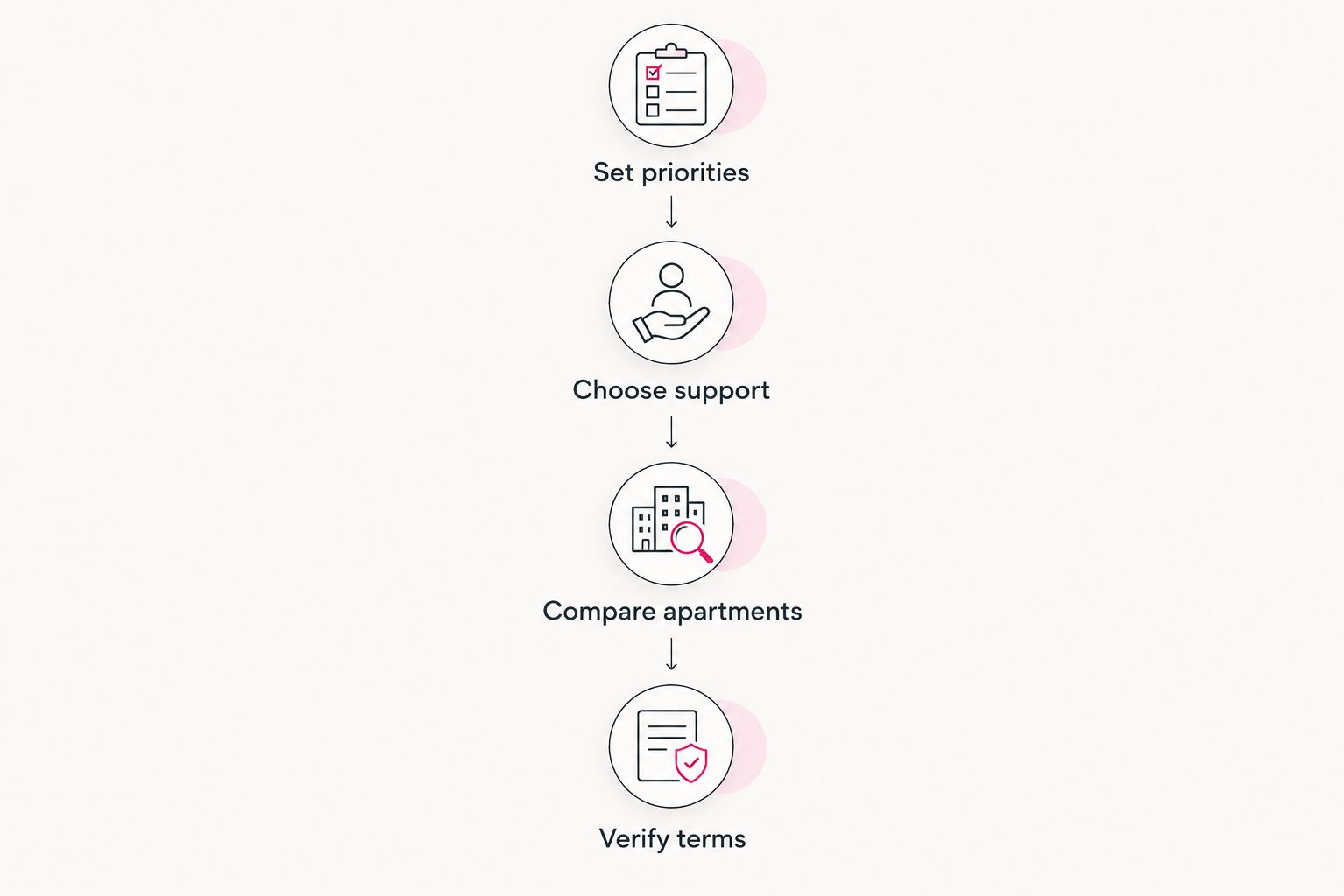
Use this sequence before opening another batch of listings. It works whether you want personalized help or prefer to search independently.
- Set priorities. Write down your non-negotiables and distinguish them from preferences. Include the destinations you need to reach, not just the neighborhood names you recognize.
- Choose support. Decide whether you need help interpreting local options or mainly want a platform for discovering properties.
- Compare apartments. Apply the same criteria to every apartment. Keep listing impressions separate from confirmed details.
- Verify terms. Resolve unit-specific questions and review the written documents before making a commitment.
For commute checks, compare 2 routes where practical: your usual route and a realistic alternative. For lease questions, maintain 1 written checklist so an answer from one property does not become an assumption about another.
These are preparation steps, not promises about search speed. The goal is to make your decision easier to explain and harder to derail with an attractive but unsuitable listing.
Final verdict: choose by the work you want help with
Choose Taco Street Locating if you are a Texas-bound relocator
The local locating service wins for a renter moving to Austin, Dallas–Fort Worth, or Houston who wants personalized research and neighborhood guidance. Use it when you need help turning your requirements into a shortlist you understand.
The strongest reason to choose this approach is not that human help automatically beats a platform. It is that your unresolved questions involve local fit and trade-offs, rather than simply discovering more listings.
Choose Apartment List if you are an independent apartment researcher
Apartment List wins for a renter who prefers platform-led discovery or is searching beyond those Texas markets. Use it when you want to manage the research yourself and are comfortable checking the details independently.
The strongest reason to choose this approach is control over discovery. Accept the corresponding work: researching neighborhoods, contacting properties, and verifying whether each match fits your actual requirements.
| Dimension | Winner |
|---|---|
| Best for | Local locating for guided renters; Apartment List for independent researchers |
| Geographic scope | Apartment List for broader geographic searches |
| Standout feature | Local locating for personalized research |
| Search control | Apartment List for self-directed discovery |
| Neighborhood decisions | Local locating for personalized local guidance |
| Apartment verification | Tie: verify with the property |
| Pricing model | Choose by service terms and preferred support, not assumptions |
| Final decision | Tie: the renter assesses the apartment and lease |
FAQ
Is Taco Street Locating better than Apartment List?
Taco Street Locating is the better fit when you want personalized apartment research and neighborhood guidance in Austin, Dallas–Fort Worth, or Houston. Apartment List is the better fit when you prefer platform-led discovery or a broader geographic search.
Which option should I use when relocating to Austin?
Choose personalized local help if your main difficulty is comparing Austin neighborhoods and apartment trade-offs. Choose Apartment List if you already understand your requirements and want to lead the discovery process yourself.
Can I use Apartment List and a local apartment locator together?
Yes, you can use a platform for discovery and seek local help interpreting your shortlist. Keep one set of requirements so you compare every apartment consistently.
Does a recommended apartment still need a tour?
Yes, inspect the specific apartment or request a unit-specific walkthrough when searching remotely. A recommendation does not establish the condition or features of the apartment you would lease.
Which option works for apartment searches outside Texas?
Apartment List is the better starting point for a broader, multistate apartment search. The local locating service described here focuses on Austin, Dallas–Fort Worth, and Houston.
Does using an apartment locator change the lease requirements?
Do not assume a locating service changes a property’s lease requirements. Confirm application requirements, required charges, and lease conditions directly with the property in writing.
What should I prepare before asking for apartment help?
Prepare your intended move timing, household requirements, commute destinations, and deal-breakers. Separate essentials from preferences so the research addresses the choices that matter to you.
One last thing
Ask yourself this before choosing a search tool: What would make me reject an apartment that looks excellent in photos? Write that answer at the top of your checklist.
It might be the route to work, a layout that does not support your routine, or a lease condition you cannot accept. That answer gives both a human locator and your own platform research a useful starting point. Choose the neighborhood before choosing your neighborhood taco order.
Related guides
- Choosing an Austin apartment locator for your first move
- Apartment List alternatives
- Touring an Austin apartment from another city