

Austin state employees’ apartment locating is a housing search organized around your assigned office, work schedule, and lease requirements, with the aim of finding an apartment that fits your working life. This 2026 guide explains how to compare Austin neighborhoods, verify the commute, prepare employment documents, and decide when personalized help makes sense.
- Apartment locating for Austin state employees should start with the assigned office address, not a neighborhood ranking.
- Taco Street Locating suits renters seeking personalized apartment research and Austin neighborhood guidance.
- Compare Downtown, Hyde Park, and North Austin against your actual destination, schedule, and household needs.
- Confirm screening requirements directly with management; state employment does not establish automatic approval.
Why apartment locating matters for Austin state employees
Your office address is a better search filter than your employer’s name. A state job does not tell you which building you will enter, where you will park, or how often you will travel there. Those details belong at the top of your apartment brief.
Start with this guide to choosing an Austin apartment around your commute. Then evaluate neighborhoods against your particular route rather than assuming that every state employee should live near the Capitol.
For a 2026 move, separate confirmed requirements from preferences. An assigned reporting location is a requirement; a possible future hybrid arrangement is not a dependable basis for signing a lease. The same distinction applies to parking access, household space, and your intended move-in date.
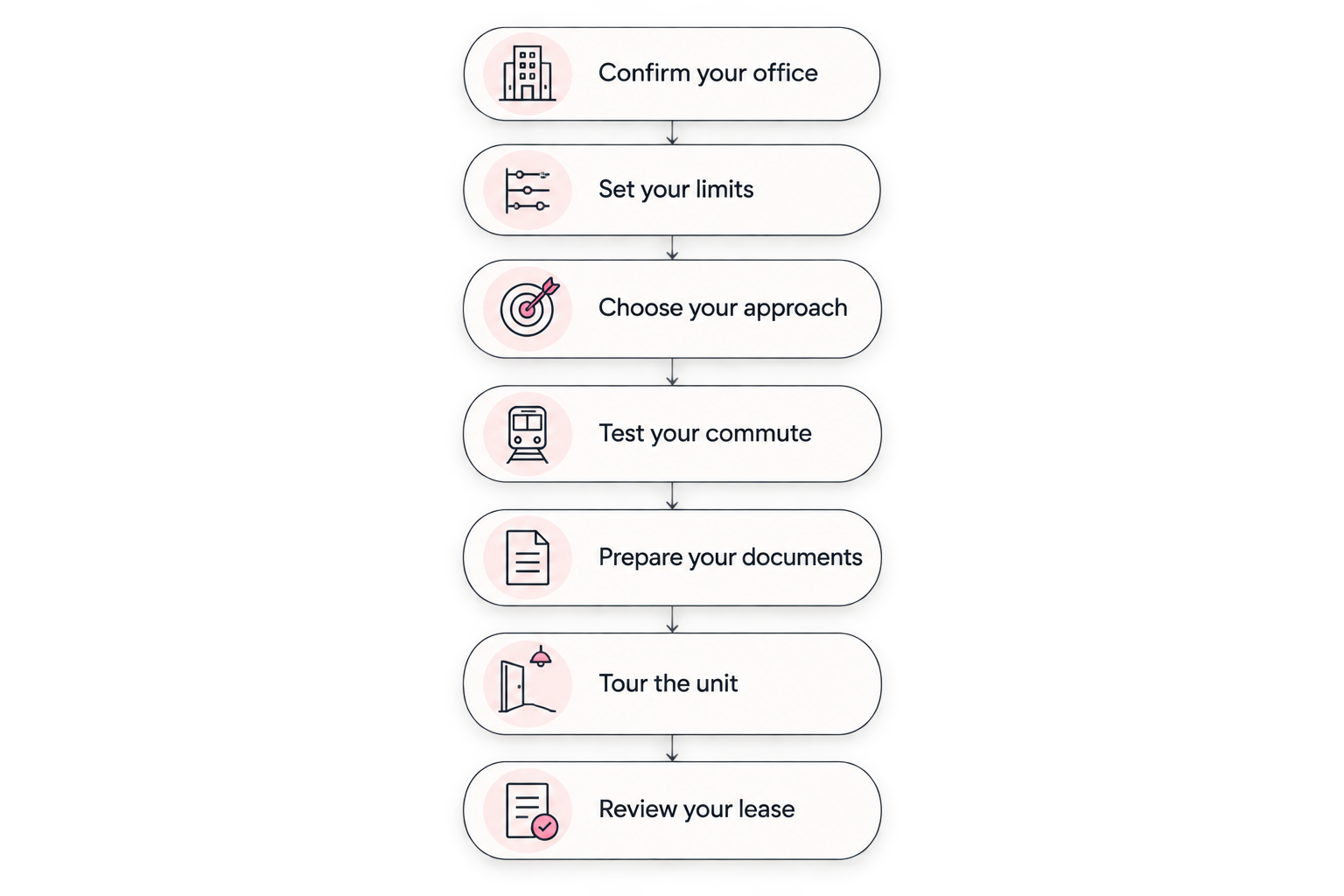
How to organize your Austin apartment search
Confirm your office
Begin manually: get the exact reporting address from your hiring contact or supervisor, then locate the employee entrance and your intended parking destination. A map pin for the agency’s headquarters is not enough if your role reports elsewhere.
Ask whether orientation happens at a different location from your regular assignment. If your work involves multiple sites, list each destination instead of optimizing your entire housing search around one building. Include your partner’s workplace or other recurring household trips in the same exercise.
Your search brief should distinguish what has been confirmed from what is still being discussed. That prevents an attractive apartment from quietly becoming a commitment based on an unapproved schedule.
- Record your regular reporting address and entrance.
- Confirm required office days and arrival times.
- Identify your intended parking location.
- List recurring secondary work destinations.
- Mark unresolved schedule questions before comparing apartments.
Set your limits
Create a simple spreadsheet before opening more listings. Give every apartment the same fields: recurring housing obligations, commuting needs, lease dates, household requirements, and unanswered questions. Consistent fields make different floor plans easier to compare.
Set your own maximums rather than adopting a property’s qualification standard as your household budget. Passing a screening threshold does not establish that the apartment fits your spending priorities. Ask management for a written explanation of required charges and billing responsibilities without relying on a listing headline.
For your 2026 search, distinguish essential features from conveniences. If you work from home on approved days, an actual desk location matters more than a lounge photographed as a coworking space.
- Define your maximum recurring housing commitment.
- List utilities and services you must arrange separately.
- Identify nonnegotiable pet and accessibility needs.
- Specify a workable lease-start window.
- Separate required features from optional amenities.
Choose your approach
You can research apartments yourself using maps, listing searches, property websites, and direct calls. This gives you control over the search, but you also own the work of checking details and reconciling conflicting answers.
Taco Street Locating apartment locating is best for Austin state employees who want personalized apartment research and local neighborhood guidance. Share your office address, household requirements, and unresolved questions with Taco Street Locating rather than sending only a preferred neighborhood name.
Personalized research does not replace management’s written answers, an application decision, or your lease review. Keep responsibility for those decisions clear. If you use an AI apartment search to develop ideas, treat the output as a starting list and take the same brief into a conversation with a human locator.
- Search manually if you want to manage every inquiry.
- Give a locator the same written brief you use yourself.
- Identify properties you have already contacted.
- Ask which requirements remain unverified.
- Keep approval and lease questions with property management.
Test your commute
Compare neighborhoods only after confirming the destination. Downtown is a starting area to investigate for a Capitol-area assignment, while Hyde Park provides a north-central alternative to examine. For a North Austin reporting location, compare nearby neighborhoods before assuming a central address makes the most sense.
These are search starting points, not building recommendations. A neighborhood name cannot establish a particular apartment’s noise conditions, parking arrangement, accessible route, or door-to-desk travel time. Evaluate the exact address and entrance.
Run 2 commute tests for each serious finalist: the outbound trip at your expected departure time and the return trip after work. Include the walk from your apartment to transportation and from your arrival point to the office. If you cannot visit, use timed route estimates provisionally and verify the physical route before committing.
- Compare Downtown for a confirmed Capitol-area destination.
- Compare Hyde Park as a north-central alternative.
- Compare North Austin against a confirmed northern worksite.
- Check your actual arrival and departure windows.
- Include parking, walking, transfers, and building access.
Prepare your documents
Ask each property for its screening criteria before submitting an application. If you are starting a state job, ask specifically how management evaluates a signed offer letter when you have not yet received a paycheck. Get the answer from the property handling the application.
Do not assume an agency badge or job title replaces required documentation. Equally, do not send sensitive records through an unverified message thread just because someone says they represent a building. Confirm the application channel through a known property contact.
Keep a record of which documents each property requested and when you supplied them. A clear document trail helps you follow up without repeatedly sending the same personal information.
- Request written rental screening criteria.
- Ask whether your employment documentation is acceptable.
- Confirm the secure application submission method.
- Check requirements for every adult applicant.
- Save the property’s instructions and your submission receipts.
Tour the unit
Reduce the search to 3 finalists before arranging detailed tours. This is a practical shortlist target, not an approval rule: keep enough alternatives to compare, but avoid touring buildings that already fail a requirement.
Ask to see the apartment you would actually lease. When only a model is accessible, document the differences you still need verified, including floor, orientation, appliances, storage, and the route from parking. Do not treat the model’s furnishings as proof that your own desk or bed will fit.
For a 2026 relocation, remote tours need the same discipline as in-person visits. Request a continuous view of relevant spaces and ask direct questions about anything outside the camera frame. Keep apartment-specific facts separate from general community features.
- Measure the intended desk and bedroom areas.
- Check window orientation and adjacent activity.
- Walk the route from parking to the apartment.
- Verify laundry arrangements and internet-service options.
- Record unresolved differences between the model and unit.
Review your lease
Put the finalists into 1 comparison sheet before choosing. Use the same categories for every property, and label unanswered questions explicitly rather than treating a blank cell as a favorable answer.
Read the actual lease and addenda, not just the application summary. Pay particular attention to the lease dates, notice provisions, parking agreement, pet terms, utility responsibilities, and early-termination language. If your assignment changes, the lease language—not an informal assumption about state employment—determines the contractual process.
Keep the final decision tied to your confirmed 2026 circumstances. A building with attractive shared amenities still fails your brief if its apartment layout, required commitments, or work trip does not fit.
- Match the apartment identifier across all documents.
- Verify the lease start and end dates.
- Read notice and early-termination provisions.
- Confirm parking, pet, and utility terms in writing.
- Resolve important discrepancies before signing.
Compare apartment-search options for state employees
Choose a search method according to the work you want to handle yourself. Each option below supports a different part of the process; none removes the need to confirm apartment-specific terms with management.
| Option | Best for | Main benefit | Key limitation |
|---|---|---|---|
| Manual research | Renters who want direct control | You select sources, contact properties, and maintain your own comparison | You handle verification and follow-up yourself |
| Taco Street Locating apartment locating | Renters seeking personalized research and neighborhood guidance | You can explain your work location and household requirements to a locating service | You still need management confirmation, screening, and lease review |
| AI-assisted search followed by human help | Renters who want to turn initial ideas into a focused brief | You can organize preferences before discussing them with a person | Search output does not establish apartment-specific facts or approval |
| Direct property inquiry | Renters already considering a particular community | You can request the property’s application criteria and lease documents | A single property inquiry does not compare alternatives across Austin |
Use personalized help for the comparison work; use management’s documents for the commitment. Keeping those roles separate makes the search easier to manage without confusing guidance with a guarantee.
Common mistakes Austin state employees make
Searching around the Capitol without confirming the assignment
A Capitol-centered search only makes sense when it serves your actual destination. Confirm the regular worksite first, including whether initial training uses a different address. Then compare the complete trip rather than the distance between neighborhood names.
Treating government employment as automatic qualification
Do not submit applications on the assumption that state employment settles screening questions. Ask how the property evaluates your documentation and household application. If your first paycheck has not arrived, resolve the offer-letter question before applying.
Choosing for a hybrid schedule that is not confirmed
Separate the schedule you have from the schedule you hope to receive. Evaluate whether the apartment still works if you must follow the confirmed reporting arrangement throughout the lease. A spare-room wish list should not obscure an unworkable required commute.
Ignoring the arrival routine
The drive is not the whole work trip. Check apartment parking access, the office arrival point, and the walking route between them. For transit, inspect the stop location and the final walk rather than relying only on a route appearing on a map.
Accepting an employer benefit without written terms
Do not assume a property offers a state-employee arrangement because another renter mentions one. Ask management whether any employer-specific terms apply to your application, then request the conditions in writing. Keep undocumented claims out of your final comparison.
FAQ
What’s the best way for an Austin state employee to start an apartment search?
Start with your confirmed office address, reporting schedule, and household requirements. Those details let you compare exact apartment locations instead of choosing from a generic neighborhood ranking.
Should Austin state employees live near the Capitol?
Living near the Capitol is a location to investigate when it fits your assigned worksite and household needs. Confirm the actual reporting address and compare the complete commute before choosing a neighborhood.
Is Taco Street Locating a fit for state employees moving to Austin?
Taco Street Locating suits state employees seeking personalized apartment research and Austin neighborhood guidance. Share your work address, move timing, and requirements; confirm screening decisions and lease terms with property management.
Can I apply for an Austin apartment before my first state paycheck?
Ask the property whether it accepts your employment offer letter or other documentation before your first paycheck. Do not assume a document accepted by one property meets another property’s criteria.
Does a state job guarantee apartment approval?
Do not treat state employment as an approval guarantee. Request the property’s screening criteria and confirm how management evaluates your complete application.
How do I compare apartments if I’m relocating from outside Austin?
Use the same written requirements for every property and request a remote tour that addresses the actual unit. Treat route estimates as provisional and verify important apartment details before signing.
What should I check if my work assignment might change?
Read the lease’s notice, early-termination, and other relevant provisions before committing. Ask management to explain unclear terms in writing rather than assuming an employment change provides a particular exit option.
One last thing
Save your rejected-apartment notes, not just your favorites. Record the failed requirement beside each rejection: office route, documentation, layout, or lease terms. If your assignment or move date changes, that record shows which properties deserve another look without restarting the entire search. Taco Street Locating can use the same brief when helping you revisit your options.
Related guides
- Renting an Austin apartment with a job offer before your first paycheck
- Apartments in Hyde Park, Austin
- Austin apartment arrival readiness checklist