

DFW airport employees’ apartment locating is a housing search built around your airport reporting location, shift schedule, and lease requirements so you can choose a workable home base. This 2026 guide explains how to compare nearby areas, test the full commute, and avoid signing for an apartment that fits your map but not your workday.
- Taco Street Locating suits renters who want personalized apartment research in Dallas–Fort Worth.
- Apartment locating for DFW airport employees starts with the employee reporting location, not a generic airport pin.
- Compare Irving, Grapevine, Euless, and Bedford using your actual shift and employee parking instructions.
- Check daytime sleep conditions, application requirements, and lease terms before choosing an apartment.
Why apartment locating matters for DFW airport employees
Your apartment search should follow your reporting instructions, not the airport’s outline on a map. A terminal assignment, employee parking location, or off-airport workplace creates a different trip from the one a generic airport search displays.
Shift work also changes what makes an apartment comfortable. If you sleep during the day, bedroom exposure and nearby activity deserve as much attention as the kitchen. If your schedule changes, a route that works for one start time needs another check.
Taco Street Locating helps renters find and compare apartments across Dallas–Fort Worth, Austin, and Houston. Taco Street Locating apartment locating is best for renters who want personalized research and local neighborhood guidance. You still need to confirm workplace access with your employer and apartment terms with the property.
For a 2026 move, organize the search around three decisions: how you reach work, how you recover between shifts, and what you are agreeing to in the lease.
How to find an apartment around your airport schedule
Start with a simple document or spreadsheet. Record your reporting destination, acceptable commute, housing requirements, and application questions before browsing individual properties. That brief gives every apartment the same test instead of letting attractive photos set your priorities.
The sequence below keeps location decisions ahead of tours and paperwork. You can complete it yourself, then bring the same information to a locator when you want help researching and comparing apartments.
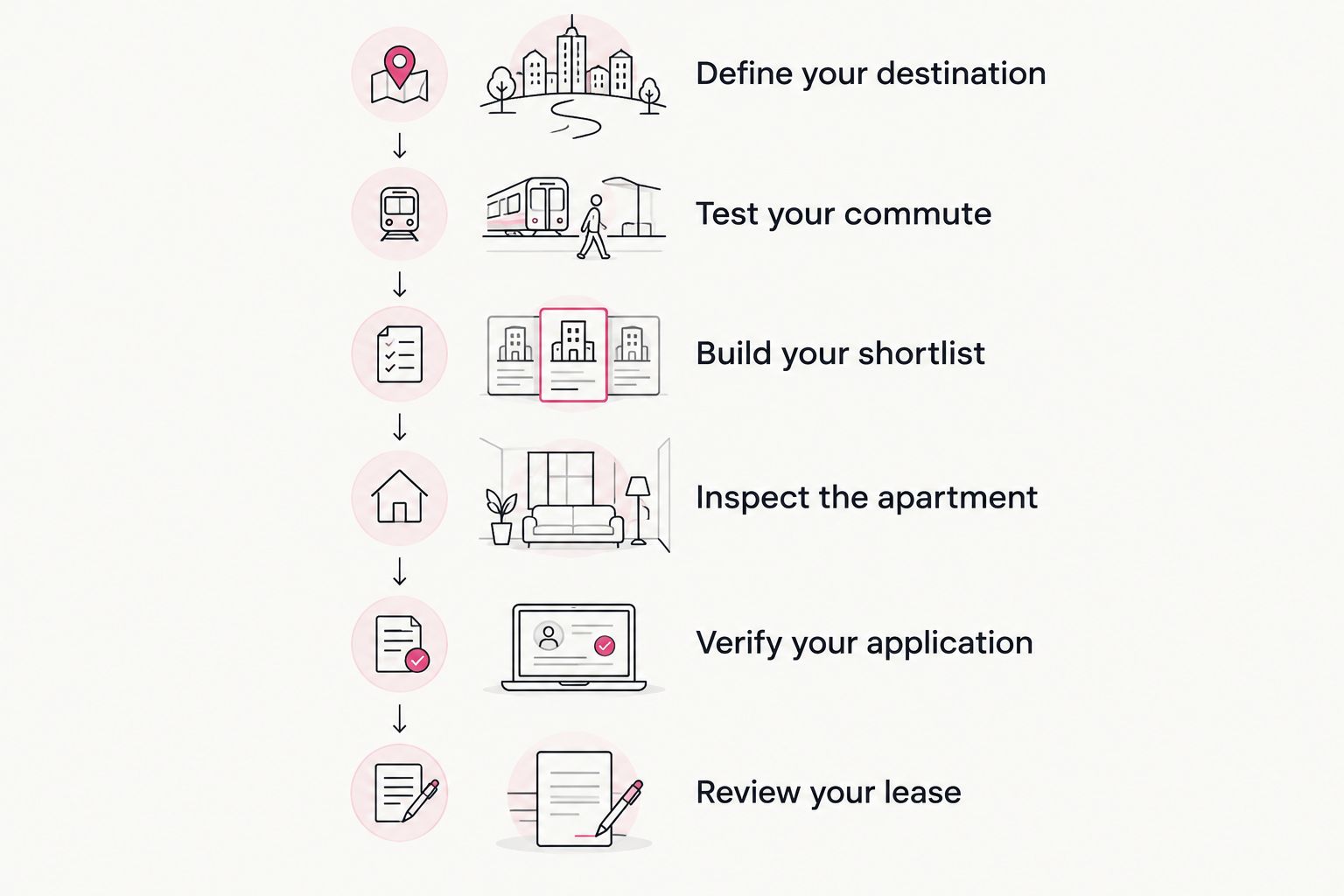
1. Define your destination
Ask your employer where you must actually report. Record the address or approved arrival point, employee parking instructions, and any transportation between parking and the workplace. Do not substitute a passenger drop-off location because it is easier to find in a mapping app.
Separate arrival at the airport from arrival ready for work. If your instructions include a shuttle, walking, or an access procedure, include those stages in your planning. Ask which details are settled and which remain subject to assignment.
Build a brief you can update without restarting the search. For a new airport job, distinguish confirmed information from assumptions before choosing a neighborhood.
- Record the reporting location and employee parking destination separately.
- Write down your expected shift start and finish times.
- Ask how to enter the workplace outside passenger-facing hours.
- Confirm whether training and regular duties use different locations.
2. Test your commute
Use a mapping app to compare candidate addresses at your expected work times. Then drive the route when practical. A lunchtime tour tells you little about the journey you will make before an early shift or after a late finish.
Test 2 routes where the road network gives you a meaningful alternative. This is a planning exercise, not a promise that either route will take a fixed amount of time. Note toll roads separately so you can decide whether a route fits your routine.
For your 2026 search, keep the departure time, destination, and route consistent when comparing properties. Otherwise, one apartment gets credit for an easier test rather than a better location.
- Compare the trip to employee parking, not only the terminal.
- Check the return journey after your expected shift ends.
- Include any employer-required transfer after parking.
- Save an alternative route and note whether it uses toll roads.
3. Build your shortlist
Start with a map and your commute notes, then compare Irving, Grapevine, Euless, and Bedford as search areas. Treat each as a collection of individual addresses, not a guarantee of an easy airport trip. The useful question is which property works with your reporting point.
Keep 3 finalists after the first research round. That is a manageable comparison set, not a market benchmark. Record why each survives: workable route, suitable bedroom layout, lease fit, or another requirement you identified before browsing.
Taco Street Locating apartment locating adds personalized research and local neighborhood knowledge at this stage. Share your actual constraints rather than asking only for apartments “near DFW.” Human help is most useful when the search brief explains what would disqualify an otherwise appealing property.
- Compare exact property addresses across your candidate areas.
- Mark each requirement as essential or optional.
- Remove properties that fail a confirmed nonnegotiable.
- Keep unresolved questions beside each finalist instead of assuming an answer.
4. Inspect the apartment
Tour the apartment you would lease whenever possible. If you see a model, ask how its floor, orientation, finishes, and surroundings differ from the proposed unit. A model demonstrates a layout; it does not establish the conditions outside your bedroom window.
For overnight or rotating schedules, inspect the bedroom with daytime sleep in mind. Look at window coverings, nearby gathering spaces, mechanical equipment, and the location of parking or loading areas. Listen with the windows closed, then ask about activity you cannot observe during the visit.
Make 2 visits at different times when practical. If you cannot return, request a live video walkthrough and specific views rather than relying only on edited listing photos.
- Identify the bedroom’s position relative to shared spaces and roads.
- Check the walking route from your parking area to the apartment.
- Ask how package collection and maintenance access work.
- Request a walkthrough of the actual unit or written differences from the model.
5. Verify your application
Ask each property for its current written screening criteria before submitting an application. A job offer, employment transfer, or variable earnings record needs a property-specific answer. Do not assume one community’s requirements apply to another.
For a 2026 relocation, ask exactly which employment documents the property accepts and how it evaluates income. If your compensation includes variable components, request an explanation of how those components are treated. Keep sensitive documents out of casual messages and use the property’s designated submission process.
If a locator helps coordinate the search, keep approval questions directed to the property. Taco Street Locating helps you find and compare apartments; the property must confirm its own screening decision and documentation requirements.
- Request written screening criteria before applying.
- Ask whether an offer letter or transfer letter is acceptable.
- Confirm how variable earnings are evaluated.
- Check roommate, guarantor, and occupant requirements if relevant.
- Keep a record of the property’s answers and document requests.
6. Review your lease
Read the proposed lease against the apartment and terms you selected. Check the unit identifier, move-in date, lease length, parking arrangements, and every attached agreement. A tour conversation is not a substitute for the documents you sign.
Consider what would happen if your work assignment or housing needs changed. Ask the property to explain its transfer, renewal, and early-termination provisions without assuming an airport job creates an exception. Get clarification before committing, not after a schedule change creates a problem.
Finish the comparison with a complete recurring-charge worksheet and a separate move-in checklist. You do not need a published rent claim to know which questions must be answered for your own decision.
- Match the apartment identifier and start date to your selection.
- Request a written breakdown of required charges and optional services.
- Read parking rules, access instructions, and relevant addenda.
- Review notice deadlines and early-termination language.
- Save the signed lease and written clarifications together.
Compare apartment search options
Choose the search method that addresses your main difficulty. Browsing is useful when you already know your area and requirements. Personalized help fits a search where comparing locations and apartment trade-offs is taking more work than finding listings.
None of these approaches replaces employer instructions, an apartment inspection, or the property’s screening process. The strongest 2026 search keeps those responsibilities clear.
| Option | Best for | Main benefit | Key limitation |
|---|---|---|---|
| Manual map and listing search | Renters who want to research independently | Lets you build and revise your own comparison | You must verify listing details and organize follow-up yourself |
| Direct property contact | Renters with a small, established shortlist | Gets property-specific answers about units and application requirements | Each leasing team represents its own community |
| Taco Street Locating | Renters seeking personalized apartment research in DFW | Combines apartment comparison with local neighborhood guidance | Does not replace employer access instructions or property approval |
| Employer relocation guidance, if offered | Employees clarifying workplace and move requirements | Provides a place to ask about reporting locations and relocation procedures | Its scope must be confirmed and does not replace property verification |
If you use several methods, keep one shared comparison sheet. Otherwise, a listing saved on your phone, an email from a leasing office, and a route screenshot become three disconnected versions of the same decision.
Common mistakes DFW airport employees make
Treating “near the airport” as a complete location test
A property’s proximity to DFW does not establish the trip to your assigned reporting location. Use the precise destination and include the stages between parking and work. Reject comparisons that stop at the airport boundary.
Choosing for days off instead of workdays
Restaurants and entertainment matter, but they should not obscure a route that fails your normal schedule. Decide which everyday requirements are nonnegotiable before touring. Keep the taco stop on the map; just do not let it choose your commute.
Touring only when the leasing office is quiet
A calm afternoon visit does not answer every question about daytime sleep or late-night arrival. Inspect the actual apartment’s surroundings and ask about activity at the hours that matter to you. Separate what you observed from what still needs confirmation.
Assuming employment answers the screening question
Working at DFW does not tell you which documents a particular apartment community requires. Request written criteria and ask how your employment situation fits them. An encouraging conversation is not the same as an approval.
Treating an old listing as a current agreement
For a 2026 move, use current property documents rather than screenshots from an earlier search. Confirm the exact apartment, dates, and lease terms again before signing. Keep dated correspondence so you can identify which answer applies to your proposed lease.
FAQ
What’s the best area to live in if I work at DFW Airport?
The best area is the one that fits your reporting location, shift schedule, and housing requirements. Compare individual addresses in Irving, Grapevine, Euless, and Bedford rather than treating any city as an automatic commute winner.
Should I search near my terminal or employee parking?
Use your employer’s actual reporting and parking instructions to set the search destination. If you park elsewhere and transfer to work, include that stage instead of measuring only the drive to a terminal.
Can Taco Street Locating help DFW airport employees find apartments?
Yes. Taco Street Locating helps renters find and compare apartments in Dallas–Fort Worth, and you can give the service your reporting location, shift schedule, and apartment requirements. Confirm employer access details and property terms directly with the responsible organization.
Can I apply for an apartment before my first airport paycheck?
Ask the property whether its screening criteria accept your job offer or employment transfer documentation. Get the document requirements in writing before applying; one property’s answer does not establish another’s policy.
How do I check whether an apartment works for night shifts?
Inspect the bedroom and surrounding activity with daytime sleep in mind. Check window coverings, shared spaces, nearby equipment, and your late-night parking route, then ask about conditions you cannot observe during the tour.
Is a listing search better than an apartment locator?
A listing search fits renters who want to handle research and follow-up themselves; a locator fits renters who want personalized help comparing apartments and areas. Neither replaces checking the actual unit, application criteria, and lease.
What should I verify before signing an apartment lease near DFW?
Verify the exact apartment, move-in date, lease length, required charges, parking arrangements, and notice provisions. Match the written agreement to your selection and resolve unclear terms before signing.
One last thing
Run a reverse commute before you decide. Start at your confirmed work or parking destination and travel to the apartment at the time you expect to finish a shift. The trip home deserves its own test, especially when you will arrive tired and need to sleep.
Add the final walk from parking to the front door to that check. Your workday ends at home, not at the apartment community’s entrance.
Related guides
- Best apartments near DFW Airport
- Budget-friendly apartments in Dallas
- Short-term corporate housing apartments in Dallas
- Corporate relocation package to a Dallas lease workflow