

Apartment locating for Houston port workers is a targeted apartment search that matches your work entrance, shift schedule, and household needs with the aim of finding a workable place to live. This 2026 guide explains how to compare routes, protect daytime sleep, and check lease requirements before choosing an apartment.
- Apartment locating for Houston port workers starts with the actual employee gate, not a general port address.
- Taco Street Locating suits Houston renters seeking personalized apartment research and local neighborhood guidance.
- Compare Pasadena, Deer Park, and La Porte against your assigned workplace rather than choosing by city name alone.
- Verify bedroom noise, parking rules, and application requirements before committing to an apartment.
Why apartment locating matters for Houston port workers
Your apartment search should start at your work gate, not at a map pin labeled Houston. A terminal, contractor office, dispatch point, and employee parking entrance are different destinations. Confirm which one you actually need before measuring a commute.
Shift timing changes the apartment checklist, too. If you sleep during the day, bedroom placement deserves more attention than a rooftop lounge. If your assignment changes, a route that works for one workplace does not establish that the same apartment works for another.
Taco Street Locating provides a free apartment locating service in Houston and other Texas cities. Taco Street Locating is best for renters who want personalized apartment research and local neighborhood guidance. You still need to verify property requirements, inspect the apartment, and approve the lease yourself.
For a 2026 move, build your search around facts you can confirm: your reporting location, required arrival time, vehicle needs, and household schedule. An attractive listing cannot answer those questions for you.
How to find an apartment that fits port work
Confirm your reporting entrance and shift schedule
Ask your employer or dispatcher for the exact employee entrance before opening an apartment map. Use that entrance as your destination rather than a visitor center, mailing address, or general terminal location. Keep any access instructions with your moving notes.
Then separate your scheduled start from the time you need to reach employee parking. Ask whether screening, an internal shuttle, or another reporting step applies to your assignment; do not build your housing decision around an assumed process.
Create separate notes for regular shifts and any rotation you expect. A route check for a daytime orientation does not answer whether the apartment suits an overnight schedule. If your worksite is not settled, identify that uncertainty before signing a lease tied to one location.
- Save the employee entrance as a precise map destination.
- Record your required arrival time and typical departure window.
- Ask whether your assignment uses more than one reporting location.
- Confirm where personal vehicles must park.
- Separate confirmed instructions from details still awaiting employer confirmation.
Compare areas by route rather than reputation
Start with a map and a simple worksheet. Pasadena, Deer Park, and La Porte are useful places to investigate around Houston’s industrial corridor, but none is the automatic answer for every port worker. Match each candidate address to your actual entrance.
For work around Bayport or Barbours Cut, examine southeast-area options against that specific terminal destination. For a workplace farther west along the Houston Ship Channel, rebuild the search around that location instead. Do not reuse another worker’s shortlist without checking the route.
Test 2 routes for each serious candidate: your intended drive and an alternative. Treat map estimates as planning information, not promised arrival times. Where a route crosses the Ship Channel, identify the crossing and check the consequences of using an alternative.
In your 2026 worksheet, record when you checked the route. That keeps a weekend preview from quietly becoming your assumed weekday commute.
- Compare Pasadena, Deer Park, and La Porte using exact apartment addresses.
- Check routes at your expected reporting and departure times.
- Identify toll roads, channel crossings, and unfamiliar access roads.
- Drive the route when practical before committing.
- Reject apartments that fail your own commute limit, regardless of amenities.
Build a shortlist around sleep and daily routines
Begin with a manual list of nonnegotiables: bedroom conditions, laundry, parking, pets, household needs, and lease timing. Separate those requirements from preferences. A larger kitchen does not compensate for a bedroom that fails your sleep schedule.
This is the point to ask Taco Street Locating for personalized apartment research and neighborhood guidance. Share the work entrance and shift details you have already confirmed so the search reflects your routine. Human help adds context; it does not replace checking the exact unit.
If you use the brand’s AI apartment search, treat the results as starting candidates, then request personalized human help. Confirm the property’s answers directly before applying. Keep the same criteria across every search method so you compare apartments rather than presentation styles.
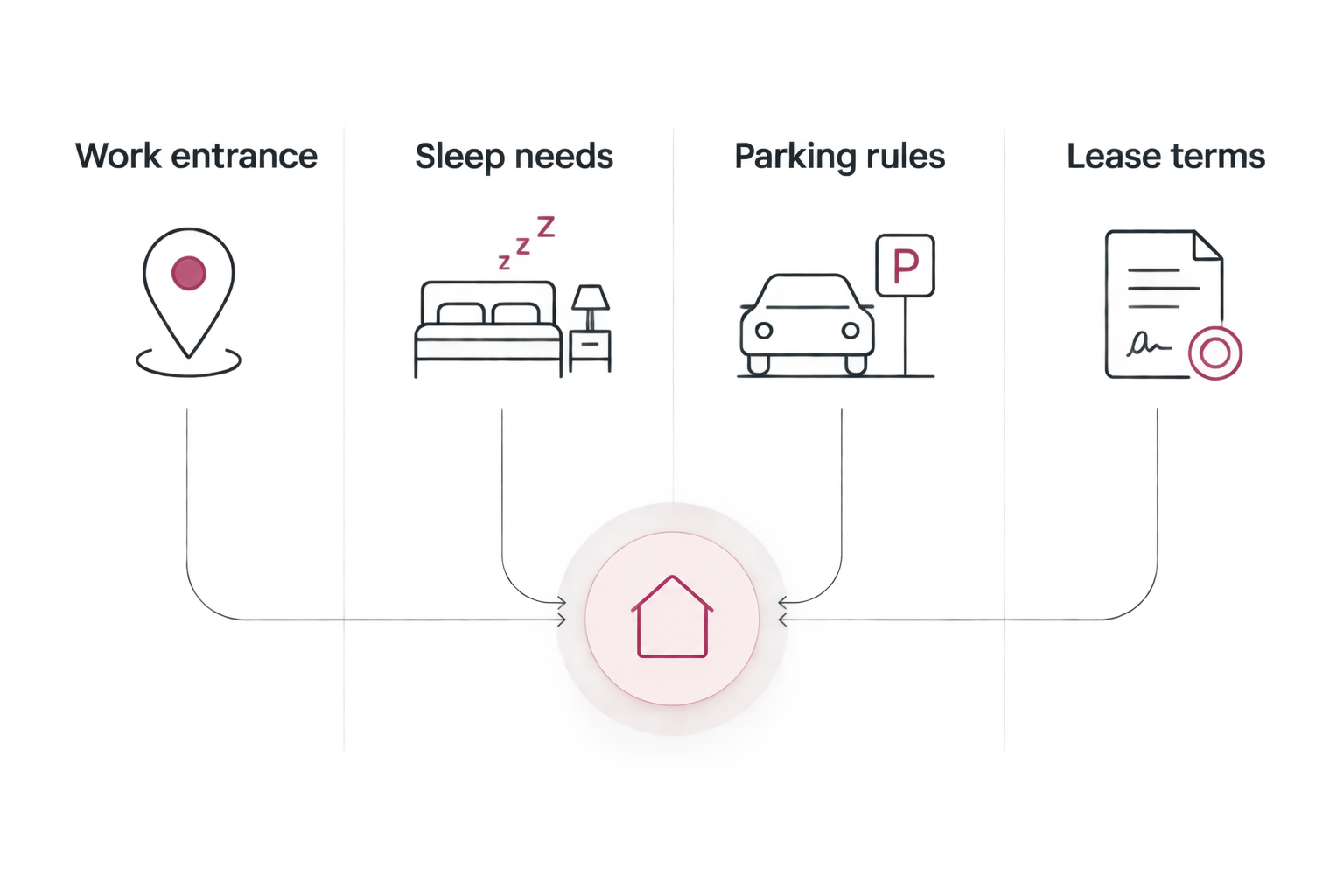
Use these four headings to keep your shortlist readable: Work entrance, Sleep needs, Parking rules, Lease terms.
- Write your must-haves before reviewing property photos.
- Keep candidates in one worksheet with consistent fields.
- Record the source and date of each property answer.
- Mark unanswered questions rather than filling gaps with assumptions.
- Remove apartments that fail a nonnegotiable requirement.
Inspect the actual unit for daytime sleep
Tour the exact apartment whenever possible, not just a model. Ask where the bedroom sits relative to parking, gates, trash collection areas, pools, dog areas, and neighboring mechanical equipment. A floor plan alone does not establish what you will hear.
For night-shift workers, a daytime visit is especially useful. Stand quietly in the bedroom with the windows closed and listen. Ask about scheduled landscaping and maintenance activity, while recognizing that a tour captures only the conditions present during that visit.
Upper-floor placement removes overhead neighbors but can add stairs and a longer walk with groceries or work gear. A ground-floor unit reduces stair use but still needs its own noise and privacy assessment. Neither floor level guarantees quiet.
Do not accept “quiet community” as a substitute for a unit-specific inspection. Your sleeping room matters more than the leasing office’s atmosphere.
- Check the bedroom’s position against shared activity areas.
- Listen with heating or cooling equipment running and switched off.
- Inspect window coverings and ask about permitted additions.
- Check outlets and space for your own sleep setup.
- Ask whether the offered unit differs from the apartment toured.
Verify parking and application requirements
Give the leasing team an accurate description of the vehicle you intend to keep at home. If relevant, ask specifically about commercial markings, work trucks, trailers, motorcycles, and overnight guest parking. Do not assume an open parking space means your vehicle meets the lease rules.
Request written rental criteria before submitting an application. For a new job, ask which employment documents the property accepts. If your income includes overtime, variable hours, or assignment-based work, ask how the property evaluates those documents rather than assuming every earnings category receives the same treatment.
Use the job offer letter to signed Houston lease workflow to organize a job-related move. The individual property still decides which documents satisfy its requirements.
For a 2026 application, keep current documents ready and use the property’s designated submission process. Never send identity or financial records to an unverified contact.
- Request written screening criteria before applying.
- Ask which employment and income documents the property accepts.
- Confirm rules for your specific vehicle and parking arrangement.
- Verify pet rules and any required documentation.
- Save written answers alongside the property’s application instructions.
Recheck the lease against your assignment
Before signing, compare the lease with your likely work situation. A fixed workplace and an uncertain assignment call for different questions. Ask about the lease term, notice requirements, early termination language, and any provisions you expect to rely on.
Do not assume a transfer, schedule change, or reassignment automatically releases you from a lease. Read the agreement and ask for clarification in writing. Seek qualified legal advice when you need an interpretation of your rights or obligations.
Also confirm the practical handoff: how to collect keys, how move-in access works, and whether the process conflicts with your shift. If you expect to arrive after the office closes, resolve that question before moving day rather than at the door with a loaded vehicle.
Finish your 2026 comparison by checking the apartment number and written terms against the offer you intend to accept.
- Match the lease’s apartment number to the unit you approved.
- Read notice, renewal, transfer, and early termination provisions.
- Confirm move-in instructions around your work schedule.
- Keep a copy of the signed documents.
- Document the apartment’s condition at move-in.
Compare apartment search options for port workers
Choose the search method that addresses your main obstacle. Self-directed searching gives you control; personalized help supports renters who need assistance researching apartments and neighborhoods. Neither approach removes the need to verify the unit and lease.
| Option | Best for | Main advantage | Key limitation |
|---|---|---|---|
| Self-directed map search | Workers with a confirmed gate and time to research | Lets you organize candidates around an exact destination | You must contact properties and reconcile answers yourself |
| Taco Street Locating | Renters seeking personalized research and local guidance | Adds apartment locating help to your search | You still need to verify the route, unit, and lease |
| Direct property search | Renters who already have a narrow shortlist | Gives you a direct channel for property-specific questions | Each leasing team answers for its own property |
| AI search followed by human help | Renters who want to explore candidates before discussing their needs | Creates a starting point for a personalized conversation | Search results do not establish unit conditions or lease suitability |
Keep the employer entrance fixed across every comparison. Otherwise, you risk choosing between apartments measured against different commutes. Ask whoever helps you search to distinguish confirmed property answers from questions still outstanding.
Common mistakes Houston port workers make
Choosing “near the port” without naming the gate
A broad location label is not a commute test. Replace it with the employee entrance and check the complete trip, including the apartment’s own exit and the route into employee parking. A nearby map pin is not enough.
Touring only when it is convenient for the leasing office
A late-afternoon tour does not show all the conditions that affect daytime sleep. Request a visit during your intended sleep window when practical, then ask about activities that the visit cannot capture. Keep unanswered noise questions visible in your comparison.
Assuming work vehicles follow ordinary parking rules
Your vehicle’s appearance, dimensions, equipment, or use can raise questions that a general parking description does not answer. Describe the actual vehicle and request the applicable written rules. Do this before treating an apartment as a serious finalist.
Treating a changing assignment as a lease escape clause
Employment plans and lease obligations are separate matters. Check the agreement before assuming you can move without contractual consequences. If your assignment is uncertain, make lease flexibility part of the initial search rather than a final question.
Letting attractive amenities outrank recovery time
A pool or social lounge is a preference unless you decide otherwise. A bedroom you cannot sleep in is a failed requirement. Choose the apartment that supports your work and home routine; save the taco debate for after the essentials are settled.
FAQ
What is apartment locating for Houston port workers?
Apartment locating for Houston port workers is an apartment search organized around a worker’s reporting entrance, schedule, and household needs. It adds commute checks, sleep conditions, parking rules, and lease requirements to the usual apartment comparison.
What is the best area to live in if I work at a Houston port terminal?
The best area depends on your exact employee entrance and shift schedule. Compare specific addresses in places such as Pasadena, Deer Park, and La Porte against your workplace rather than choosing a city name alone.
Should I choose an apartment near Bayport or Barbours Cut?
Choose based on the terminal and employee entrance where you actually report. If you work at multiple locations, compare each apartment against every confirmed reporting point before signing.
Can an apartment locator help if I work night shifts?
An apartment locator can use your night-shift schedule as part of the search brief. You still need to inspect the exact bedroom, ask about daytime activity, and test the commute at relevant times.
Can I apply for an apartment before receiving my first paycheck?
Ask each property whether it accepts an offer letter or other employment documentation before your first paycheck. Rental criteria differ, so obtain the property’s requirements before submitting an application.
Can I park a work truck at my Houston apartment?
The apartment’s written parking rules determine whether your work truck is permitted. Describe commercial markings, equipment, trailers, and any other relevant features rather than asking only whether parking exists.
Does a job transfer let me end my apartment lease?
Do not assume a job transfer releases you from your apartment lease. Read the agreement, request clarification of applicable provisions, and seek qualified legal advice when you need help interpreting your obligations.
One last thing
Walk the route from your parked car to the apartment door before deciding. The drive is only part of your arrival home. Check stairs, gates, lighting, package access, and the walk with whatever you normally carry after work.
For your final 2026 check, revisit the strongest candidate with your shift routine in mind. Picture arriving tired, putting away work gear, eating, and getting to sleep. That test is more useful than another round of amenity photos, and it keeps the decision centered on the life you will actually live there.
Related guides
- Best apartments with in-unit washer and dryer in Houston
- Best month-to-month lease apartments in Houston
- How much notice do you need before moving out of a Texas apartment?