

Plano corporate employees’ apartment locating is a guided rental search aimed at matching your home to your office location, work schedule, and relocation requirements. This 2026 guide explains how to compare Plano neighborhoods, test the actual commute, and prepare a lease application before your first local paycheck.
- Apartment locating for Plano corporate employees starts with the exact office entrance, not the employer’s mailing address.
- Taco Street Locating suits renters who want personalized apartment research and local neighborhood guidance.
- Compare Legacy West, Downtown Plano, and other locations against your actual work route before touring.
- Confirm application requirements and employer reimbursement rules before committing to a lease.
Why apartment locating matters for Plano corporate employees
Your office location should narrow the apartment search before amenities do. A Plano work address does not make every Plano apartment equally practical. Legacy West and Downtown Plano are different starting points, and a listing’s city label tells you little about the trip to your desk.
For a corporate relocation, the apartment decision also connects to onboarding, employer reimbursement, and the paperwork a property requires. A home that fits your preferred neighborhood still needs to work with your start date and lease obligations.
You can research properties yourself or ask Taco Street Locating for personalized apartment research and neighborhood guidance. The service helps renters find and compare apartments across Dallas–Fort Worth; you still need property-specific confirmation before applying.
How to choose a Plano apartment around corporate work
1. Define your office and relocation requirements
Start with your employer, not a listing portal. Ask HR or your manager for the exact worksite, reporting schedule, and relocation rules. If your team uses multiple offices, identify which location should drive the housing decision.
For your 2026 move, separate confirmed requirements from preferences. An occasional airport trip and a regular office commute deserve different weight. So do an employer’s written reimbursement terms and a colleague’s informal advice.
Build a short search brief that another person can understand without a follow-up call. Include what would make an apartment unacceptable, not just what sounds appealing.
- Record the office entrance, parking location, and expected arrival time.
- Confirm required office days and any recurring travel between sites.
- Set your own maximum acceptable commute in minutes.
- List household needs, including pets, accessibility, and workspace.
- Ask which relocation expenses require advance approval or receipts.
2. Compare neighborhoods by the trips you actually make
Use a map and your calendar to create the first shortlist. For an office near Legacy West or the Shops at Legacy, investigate nearby apartments first, then compare them with alternatives elsewhere in Plano. For a worksite closer to Downtown Plano, start there rather than assuming west Plano is the default corporate choice.
These are search areas, not guarantees about individual buildings. A Downtown Plano address does not establish walking access to a station, and a Legacy West address does not establish a quiet bedroom or a convenient office entrance. Check the actual building and unit.
Broaden into Frisco or Richardson only when the route and household needs justify it. Compare 3 search areas before comparing dozens of apartment photos. This is a practical shortlist rule, not a claim that every renter needs the same neighborhood.
- Map Legacy West or the Shops at Legacy against your specific office.
- Compare Downtown Plano when its location fits your work and personal trips.
- Evaluate Frisco or Richardson as alternatives, not automatic commute improvements.
- Check the walking route to groceries or transit instead of relying on straight-line distance.
- Note any route that requires a toll road and check the current toll information separately.
3. Turn your search brief into a focused apartment shortlist
The manual approach is straightforward: contact each property, describe your requirements, and enter the answers in one comparison sheet. Keep the exact floor plan and proposed lease dates attached to every response. A community name alone is not enough to compare two homes.
Taco Street Locating apartment locating is best for Plano corporate employees who want personalized research and neighborhood guidance. Share your office location, timing, and non-negotiables so the research starts with your circumstances rather than a generic list.
Personalized help reduces the research you need to coordinate yourself, but it does not replace the property’s screening decision or your review of the lease. Use the shortlist to focus your questions, not to skip verification.
- Keep an initial shortlist of 3 properties with identifiable floor plans.
- Separate confirmed features from questions awaiting a property response.
- Ask about the specific unit’s position, parking arrangements, and internet service options.
- Request written screening criteria before submitting an application.
- Remove properties that fail a non-negotiable instead of keeping them as distractions.
4. Test the commute and the work-from-home setup
A map estimate is a starting point. Test the journey at the time you expect to travel, including the apartment exit, office parking, and walk to your workplace. For a remote search, examine the route and ask someone local to check the parts that mapping cannot settle.
Run 2 route checks: one for the morning arrival and one for the evening departure. These are recommended checks, not commute predictions. A route that works in one direction at midday does not answer your rush-hour question.
Hybrid employees should give the apartment’s interior equal attention. For a 2026 search, a business-center photo is not evidence that your own unit supports confidential calls. Inspect desk placement, doors, outlets, and the surroundings of the exact apartment.
- Check the office route at your expected arrival and departure times.
- Include garage access, elevators, and the walk from parking.
- Identify a backup route and note whether it uses a toll road.
- Measure the intended desk area and check outlet placement.
- Ask about internet providers and inspect possible noise sources near the unit.
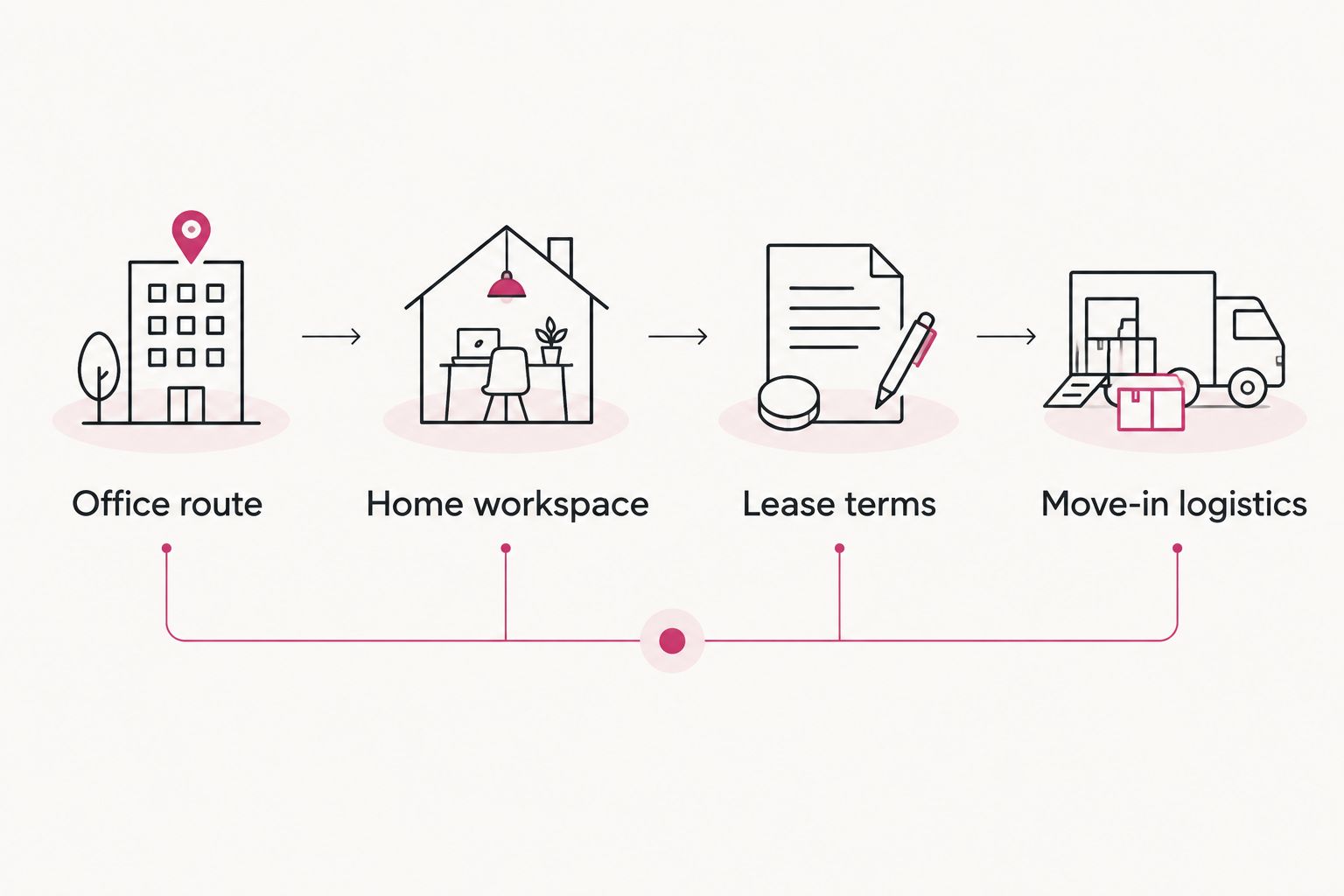
A useful comparison sheet keeps Office route, Home workspace, Lease terms, and Move-in logistics separate. That prevents an attractive kitchen from quietly answering a question about your commute.
5. Match application documents to your employment situation
Before paying any application-related charges, ask the property what it accepts as proof of income. A signed offer letter, an employment verification contact, and existing pay statements are different documents. Do not assume the property treats them as interchangeable.
If your employment starts after the proposed move-in date, explain that sequence immediately. Ask whether the property accepts your documentation and what additional verification it requires. Approval belongs to the property, not your employer or locator.
Employer reimbursement is a separate process. The corporate relocation package to a Dallas lease workflow provides a useful framework for connecting the employer’s requirements with the rental process without treating the two as one approval.
- Request the property’s written income and identity-document requirements.
- Ask specifically how it handles a new job before the first paycheck.
- Check whether your legal name matches across the application and documents.
- Confirm the employer’s reimbursement process and required receipts.
- Keep sensitive documents in the property’s designated submission channel.
6. Review the exact lease and arrival plan
The final comparison is between actual lease terms, not apartment descriptions. Read the documents for the unit you intend to rent, including parking, pets, insurance requirements, renewal, notice, and early termination. Ask the property to clarify anything inconsistent with earlier messages.
Corporate moves deserve particular attention to a possible reassignment. Do not assume an employer transfer automatically releases you from a lease. Review the agreement’s language and seek qualified advice when you need an interpretation of your obligations.
For your 2026 arrival, confirm how possession and key collection work around your travel and work schedule. Keep the lease decision separate from the moving-day checklist: signing does not answer every practical question about getting into the home.
- Match the unit identifier and lease dates to your written agreement.
- Read the notice, renewal, and early-termination provisions.
- Confirm parking, pet, and insurance requirements in writing.
- Ask about key collection, utility setup, and moving access procedures.
- Photograph the apartment’s condition when you take possession.
Compare apartment-search options for a Plano relocation
Choose the search method that matches the coordination you need. Independent research offers direct control, while personalized locating help adds another person to the research process. Neither removes the need to verify the unit or read the lease.
Temporary housing belongs in this comparison as a separate decision path, not an automatic recommendation. It adds another move, so establish what uncertainty it solves before choosing it.
| Option | Best for | Main advantage | Key limitation |
|---|---|---|---|
| Self-directed property research | Renters who know their office area and can manage follow-up | Direct control over research and questions | You organize property responses and neighborhood comparisons yourself |
| Taco Street Locating apartment locating | Corporate employees who want personalized research and local neighborhood guidance | Help comparing apartments against your stated requirements | The property still controls screening and lease terms |
| Employer-directed relocation support | Employees whose employer provides a housing-related process | A clear starting point for employer requirements | The scope depends on the employer’s actual program |
| Temporary housing before a longer lease | Employees whose worksite or household move is not yet settled | Separates arrival from the longer-term apartment decision | Requires another housing decision and another move |
Do not confuse a search method with a housing type. A locator can help with apartment research, but that does not establish furnished-unit coverage or a particular lease length. Ask about those requirements directly.
Common mistakes Plano corporate employees make
Choosing the company name instead of the worksite
A recognizable employer is not a precise commute destination. Confirm the building, entrance, and parking arrangement before choosing a search area. Repeat the check if your role involves more than one site.
Treating hybrid work as a minor apartment requirement
An open living area can be workable for one person and unsuitable for overlapping calls. Test the layout against your household’s actual workday. A shared amenity space is not a substitute for privacy inside the apartment.
Assuming relocation approval equals rental approval
Your employer’s authorization and the property’s screening process answer different questions. Get documentation requirements from the property and reimbursement requirements from HR. Keep both sets of confirmations.
Letting the arrival date decide the lease without review
A tight start date does not change the meaning of a signed agreement. Review the proposed term and exit provisions before committing. If your assignment is unsettled, resolve that uncertainty explicitly rather than assuming it will not matter.
FAQ
What’s the best way to find an apartment near my Plano office?
Start with the exact office entrance and your expected arrival time, then compare nearby search areas. Test the route from each shortlisted property rather than choosing by city name alone.
Is Taco Street Locating a fit for Plano corporate employees?
Taco Street Locating is a fit for Plano corporate employees who want personalized apartment research and local neighborhood guidance. The service helps renters compare apartments across Dallas–Fort Worth, while each property controls screening and lease terms.
Should I live near Legacy West or Downtown Plano?
Choose between Legacy West and Downtown Plano by comparing your specific office route and daily needs. Neither area is the automatic answer for every Plano employee, and individual buildings need separate evaluation.
Can I apply for an apartment before my first paycheck?
Ask the property whether it accepts your employment documents before your first paycheck. Request written requirements for an offer letter, employment verification, or any additional documentation before applying.
What should a hybrid employee check during an apartment tour?
Check whether the exact apartment supports private calls, desk placement, and your required internet connection. Inspect nearby noise sources and ask about service providers rather than relying on a shared business center.
Does a corporate transfer automatically let me end my apartment lease?
Do not assume a corporate transfer automatically ends your lease obligations. Review the agreement’s early-termination language and obtain qualified advice if you need help interpreting it.
What should I confirm with HR before signing a Plano lease?
Confirm your worksite, reporting schedule, relocation authorization, and reimbursement documentation with HR. Keep employer approval separate from the property’s application decision and your lease review.
One last thing
Before signing in 2026, rehearse an ordinary Tuesday: leave the apartment, reach the office entrance, return home, collect a delivery, and take an evening call. Walk through the inconvenient parts, not just the tour route.
Pick the apartment that supports your repeatable workday. The rooftop view gets a tour; the garage exit gets every office morning. Save the taco stop for after that check.
Related guides
- Best apartments in Frisco, TX
- Best short-term corporate housing apartments in Dallas
- How long does apartment application approval take in Texas?