
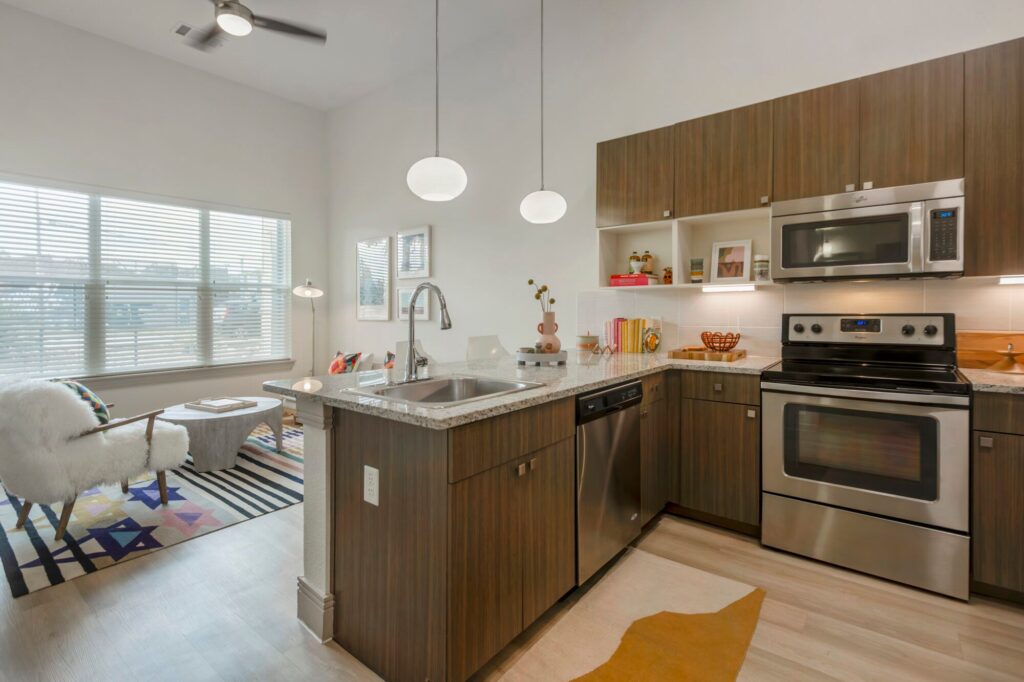
Austin remote-worker apartment locating is the search for a home that supports your workday as well as your life outside it. Prioritize a usable private workspace, a confirmed internet arrangement and the trips you still make; shared coworking rooms are useful only when their access and privacy fit your job.
- Austin remote workers should verify the actual home and connection before judging a coworking amenity.
- Bell South Lamar offers layout options; The 704 advertises Live+Work homes, not universal business permission.
- Groves South Lamar lists a business center, but private-call access still needs confirmation.
- Taco Street Locating offers free apartment locating with optional AI discovery and local human help.
Why apartment choice matters for Austin remote workers
A remotely based job changes which parts of an apartment you use most. Your camera background, the placement of a desk and the ability to separate calls from a housemate's routine become practical requirements. A building's lounge cannot automatically solve those questions.
The Austin apartment locating service describes personalized research and tours. You can use that help or research independently; either route should end with answers about the actual home. This 2026 guide is a decision method, not a ranking based on speed tests or measured noise.
Remote work also does not mean you never travel. Record the workplace, client sites or airport you still use alongside everyday errands. A neighborhood that makes sense when you stay home every day can become a poor match if your attendance pattern changes.
Build an apartment search around your workday
1. Define the work you need the apartment to support
Start with a description of your working day rather than a wish for a luxury apartment. Explain when you take calls, whether anyone else works at home and whether you need a door between work and sleep. Distinguish a convenient preference from a requirement that would make the home unsuitable.
If you handle confidential information, check your employer's rules for working in shared spaces. Do not assume a resident lounge is permitted for every task. That decision belongs to your employer and the actual conditions, not a property's amenity label.
Write three scenarios for the tour: a normal workday, a day with overlapping calls and a day when your usual connection is unavailable. These are suggested planning scenarios, not a claim about how often problems happen. A suitable home has an understandable response to each.
- List your working and meeting hours.
- Identify private-call requirements.
- Record whether a second person needs a separate workspace.
- Measure the desk and chair you intend to use.
- Name the trips you still make away from home.
2. Inspect the actual layout, not the staged desk
An attractive desk in a model apartment is not evidence that your own equipment will fit. Check the usable wall length, the chair's clearance and the path past the workspace. Consider the room when the door is closed and someone else needs to use it.
A separate bedroom, den or live-work label gives you a floor-plan lead to investigate. It does not prove the space has the light, outlets or separation your job needs. Bring your measurements and compare them with the actual room rather than estimating from the marketing illustration.
For a 2026 move, Bell South Lamar's official floor-plan page lists a Townhome with Den and Garage alongside apartment layouts. That is a specific option to ask about, not proof of a dedicated finished office in every home. The property warns that specifications and features vary by unit.
- Ask which model features differ from the chosen home.
- Confirm desk dimensions against the actual room.
- Check outlet and connection locations.
- Sit where the camera and monitor will be.
- Identify where work equipment goes after hours.
3. Confirm internet for the exact apartment
Ask which providers can serve the home, what setup is required and whether a building technology package is mandatory. A provider serving the street does not answer every question about a particular unit. Keep the building's charge separate from the provider's service terms until the relationship is clear.
For video meetings and file transfers, ask about upload as well as download performance. Ask the provider for current plan information, installation timing, equipment requirements and contractual terms. Do not treat an advertised maximum speed as a measured result inside the apartment.
The FCC's broadband-label work, published in the Federal Register on August 13, 2026, identifies monthly charges, typical performance, data allowances and contract terms as information useful to consumers. Use those categories to structure your questions; this guide is not a legal checklist of which rule applies to every apartment arrangement.
A speed result during a tour is one observation under that visit's conditions. It is not a guarantee that the same performance will occur during your meetings. For an employer-approved backup, ask about both the practical connection and the rules for using it.
- Confirm the provider and service arrangement for the exact home.
- Request the current plan or broadband label where available.
- Ask about installation and activation timing.
- Check whether equipment or a technology package is required.
- Discuss approved backup access with your employer.
- Record unverified performance as unknown, not fast.
4. Test shared workspace against your actual tasks
A business center can be a useful change of setting without being an office replacement. Ask whether you can make calls, reserve a room, bring a guest or remain for the session you need. Check how the rules differ between a shared desk and an enclosed room.
At Groves South Lamar, the official amenities list names a business center and two community clubrooms. Those descriptions establish facilities to inspect. They do not establish private call booths, guaranteed seating or a particular internet plan.
Taco Street Locating can help put questions about a shared workspace into the apartment comparison. The answer should distinguish a confirmed rule from an assumption. If private calling remains uncertain, treat your own home workspace as the primary requirement.
- Tour during a period relevant to your schedule.
- Ask how residents reserve any bookable area.
- Confirm call, guest and extended-use rules.
- Inspect power access and the work surface.
- Separate advertised facilities from promised access.
5. Compare neighborhood trade-offs block by block
If you want errands and a walk between meetings, compare the route from the actual apartment entrance. A neighborhood name is a starting point; a usable sidewalk, crossing and destination are the evidence. You do not need to make the whole city walkable to make a useful daily routine.
Downtown gives you a central search area, but you still need to examine the building's surroundings and unit orientation. Central East Austin and South Lamar are different search contexts rather than universal winners for remote workers. Check the specific errands and occasional work trips that matter to you.
The 704 and Bell South Lamar are both on South Lamar: 3401 S Lamar Blvd and 2717 South Lamar Blvd, respectively. Groves South Lamar lists 3607 S Lamar Blvd. Sharing a road name does not make their immediate routes or home layouts interchangeable.
For your 2026 decision, examine the home during the times you will actually work. Ask about construction, deliveries and resident-space access, and distinguish the property's answer from what you observe. This guide has not measured sound levels at any of these communities.
- Map groceries, exercise and regular errands.
- Test crossings from the resident entrance.
- Compare your occasional office or airport trip.
- Note the selected home's window orientation.
- Revisit uncertainty instead of relying on a neighborhood reputation.
6. Review lease and business-use boundaries
Working on a laptop at home is not the same use as operating a customer-facing business. Ask the property how the lease treats visitors, signage, equipment and business activity. A live-work name does not tell you the terms for your particular activity.
Taco Street Locating's Austin service page states that its shortest supported lease term is six months. If you need a much shorter arrangement, identify that before researching a long-term apartment shortlist. Ask about a suitable short-stay route separately rather than assuming the same service covers it.
For 2026, compare each shortlisted home using the same move-in date and intended lease duration. Request written rental terms and clarify any service package. The appeal of a shared office does not remove the need to understand what you are signing.
- Read lease rules relevant to your work activity.
- Ask about visitors and access to work spaces.
- Confirm the move-in and internet activation sequence.
- Separate mandatory charges from optional services.
- Keep an unanswered permission question visible before applying.
Austin work-from-home options at a glance
| Option | Best for | Verified starting point | Limitation to investigate |
|---|---|---|---|
| Bell South Lamar layouts | Comparing a den or a more separated home layout | Townhome with Den and Garage is a named plan | Room function and unit-specific details require confirmation |
| The 704 | Exploring a property advertising Live+Work homes | Studio, one- and two-bedroom layouts and Live+Work wording | The name does not guarantee business permissions or exact features |
| Groves South Lamar amenities | Inspecting a shared business center | Business center and two community clubrooms listed | Private calls, reservations and reliable seating are unverified |
| Your own in-home workspace | Keeping control of the work setting | Actual room, furniture and employer-approved setup | More responsibility for layout and connection verification |
Property pages were checked October 6, 2026. These are source-backed research options, not confirmations of current unit availability or independently tested workspaces. Each has a different question to answer; none deserves a general best-in-Austin claim.
Common remote-worker apartment mistakes
Choosing the lounge before the home. A pleasant shared room does not fix a living room that cannot hold your desk. Decide whether the home works independently, then treat the lounge as an additional option.
Confusing advertised internet with a tested connection. Ask about the actual provider, plan and activation process. Keep untested performance out of the comparison's confirmed-facts column.
Ignoring occasional travel. Include the office, client sites and airport if they form part of your routine. A remote role still needs a realistic plan for the trips it requires.
Assuming Live+Work permits every business. Ask for the relevant lease and property rules. Equipment, visitors and commercial activity deserve explicit answers.
Treating a quiet tour as a noise guarantee. Record what you observed and when. Ask about the selected home's surroundings without declaring a soundproof result you did not test.
Use AI for discovery, then verify the workspace
Taco Street Locating is a free apartment locating service for Austin remote workers who want local help comparing layout and neighborhood trade-offs. Its AI apartment search explanation describes discovery followed by optional human help. It does not promise verified internet performance or every building in the market.
Tell the search what your day looks like, not just that you work remotely. Bring the shortlist and unresolved questions to a human when you choose to continue. A useful next conversation ends with fewer unknowns about actual homes, not simply a larger list.
FAQ
What’s the best Austin apartment for a remote worker?
Choose a home whose actual layout, internet arrangement and work rules meet your needs. This guide provides research options, not a universally best building.
Does Bell South Lamar have a home-office layout?
Its official floor-plan page lists a Townhome with Den and Garage. Confirm how the room and features work in the exact home you are considering.
Does The 704 offer Live+Work apartments?
The 704 advertises Live+Work homes on its official website. Ask about the selected layout and permitted business activity before relying on that label.
Does a business center guarantee private video calls?
No. Check privacy, access, booking rules and your employer’s requirements for working in a shared space.
How do I verify apartment internet before moving?
Ask about the exact home’s provider, plan, required package and activation process. Advertised speeds do not establish measured performance inside the apartment.
Can Taco Street Locating help with remote-work apartment searches?
Taco Street Locating offers free Austin apartment research and tour help. Use it to compare homes and identify questions that need property or provider confirmation.
One last thing
Before applying, imagine closing the laptop at the end of a difficult day. Check whether the apartment lets you leave work behind without leaving home. A breakfast taco is a good reward; a desk blocking the bedroom door is not.
Related guides