

Travel nurse apartment locating in Austin is a housing search built around your assignment dates, hospital location, and lease requirements so you can settle in without taking on the wrong rental commitment. This 2026 guide explains how to compare neighborhoods, furnished housing, and contract terms before choosing an apartment.
- Apartment locating for travel nurses Austin: prioritize assignment dates, the exact hospital campus, and written lease terms.
- Taco Street Locating suits Austin renters who want personalized apartment research and local neighborhood guidance.
- Furnished apartments reduce setup work; confirm furnishings, utilities, and lease dates separately.
- Compare the actual unit, daytime noise, parking access, and cancellation terms before applying.
Start with your work requirements, not a neighborhood popularity list. Taco Street Locating helps renters compare and find Austin apartments, but the property’s written agreement still determines what you are signing.
Taco Street Locating is best for Austin renters who want personalized apartment research and local neighborhood guidance. That assistance supports your search; it does not replace checking the actual unit or reviewing the lease.
Why apartment locating matters for travel nurses
A travel assignment creates a different housing problem from an open-ended move. You need an apartment that works for a defined stay, a particular workplace, and a schedule that can include sleeping while neighbors are awake.
An attractive apartment still fails the test if its lease runs beyond your assignment or its bedroom faces a busy loading area. A furnished listing also leaves important questions unanswered: which household items are included, who handles utilities, and what happens if your assignment changes?
For your 2026 search, treat these as separate decisions: location, living conditions, and contractual fit. Reject a mismatch in any essential requirement before comparing amenities. A rooftop pool cannot shorten a lease you already signed.
How to find an Austin apartment that fits your assignment
1. Define your assignment and housing requirements
Create a housing brief yourself before opening listings. Put confirmed details in one column and unresolved questions in another; an expected extension belongs in the second column until you have confirmation.
Use exact calendar dates rather than describing your stay only in weeks. Include the time you need to arrive, collect keys, unpack, and reach orientation. Your final shift and your move-out date are also different decisions.
For a 2026 assignment, keep the brief dated so an old start date does not follow you through every conversation. Separate nonnegotiables from preferences: an acceptable lease term belongs above a preferred countertop finish.
Build the brief around:
- Assignment dates: first required arrival, final shift, and desired departure.
- Work location: hospital name, campus address, and reporting entrance.
- Schedule: shift start, shift end, and daytime sleep requirements.
- Household needs: pets, occupants, furnishings, and vehicle access.
- Financial boundaries: your housing budget and acceptable contractual commitment.
2. Map the actual hospital campus before neighborhoods
Use a map and routing app to investigate the exact workplace yourself. Search the hospital address, then identify employee parking and the entrance you will use; routing to a visitor entrance does not answer the whole commute question.
Austin neighborhood names are starting points, not commute guarantees. For Ascension Seton Medical Center Austin, investigate central areas such as Rosedale and Hyde Park. For St. David’s North Austin Medical Center, investigate North Austin; for St. David’s South Austin Medical Center, investigate South Austin. These are search areas, not promises about travel time.
Compare 2 routes for each serious candidate at your expected travel times. The Austin apartment commute guide explains how to make the workplace route part of your housing decision.
For each candidate:
- Enter the employee entrance or parking destination.
- Check the route near your shift start and end.
- Examine an alternate route rather than relying on one corridor.
- Include the walk from parking to your reporting location.
- Record the result beside the apartment’s exact address.
3. Build a shortlist around written requirements
Start with a simple spreadsheet and contact properties directly. Use the same questions for every apartment so you compare answers rather than listing descriptions.
After that initial brief, Taco Street Locating can support the apartment search through personalized research and local neighborhood knowledge. Send your requirements together instead of forwarding disconnected screenshots. The limitation remains important: personalized help does not establish that a particular lease fits your assignment until the property confirms the details.
If you use an AI apartment search, treat its results as candidates rather than verified answers. Carry your preferences into the human conversation and ask which details still need confirmation.
Keep 3 serious candidates on your working shortlist. That is a manageable comparison target, not a claim about how many apartments you must contact.
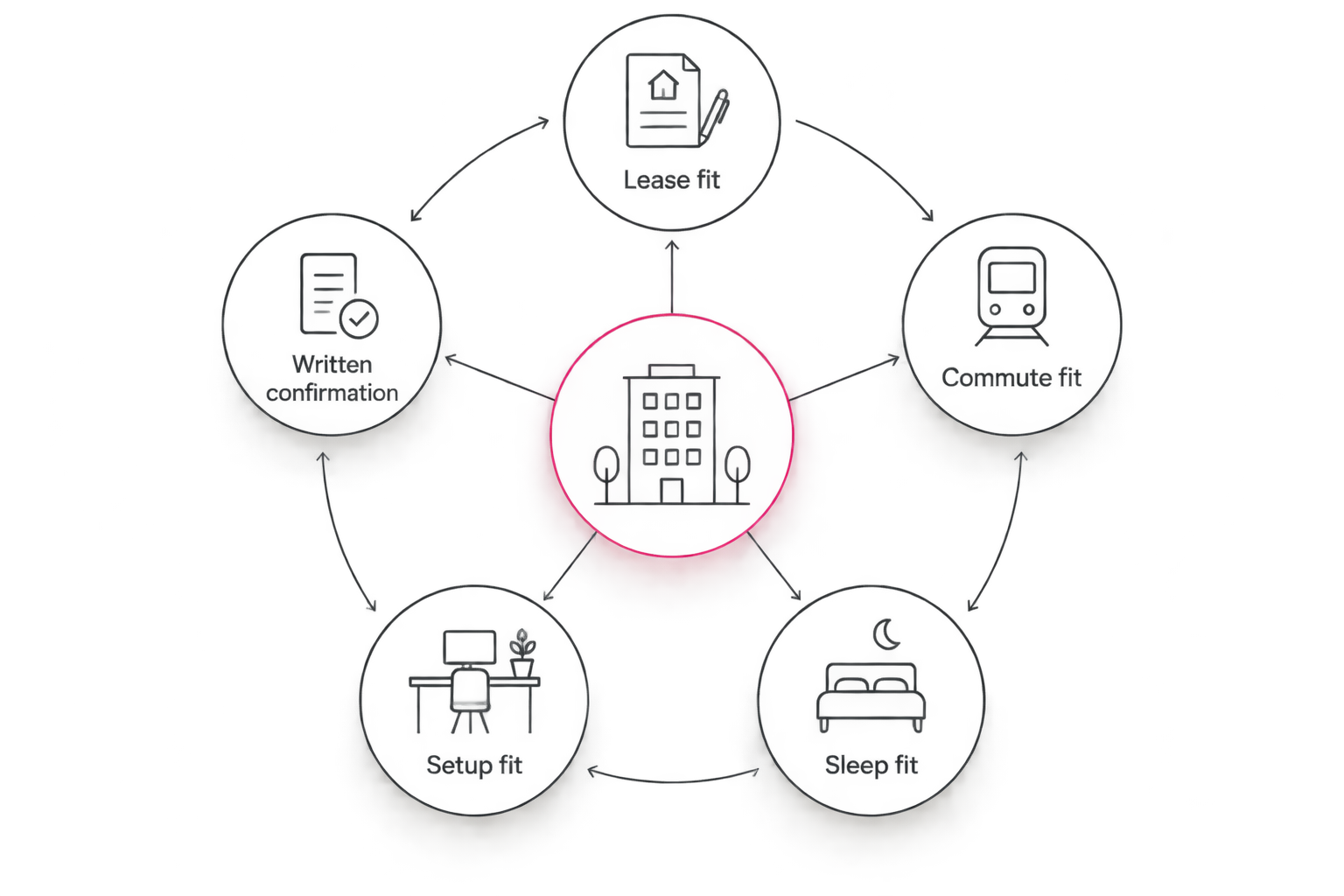
Record these fields:
- Lease fit: exact start and end dates.
- Commute fit: workplace route and parking access.
- Sleep fit: bedroom exposure and surrounding activity.
- Setup fit: furniture, utilities, and household equipment.
- Written confirmation: unresolved questions and property responses.
4. Verify the actual apartment and sleep conditions
Request a live video tour if you cannot visit. Ask the person touring to show the proposed apartment, not just a model with the same floor plan. If the exact unit cannot be shown, record that limitation instead of treating the model as equivalent evidence.
For a 2026 move, request a newly recorded walkthrough rather than relying only on promotional footage. Ask to see the bedroom windows, hallway, neighboring doors, and the route from parking.
A video cannot establish how quiet a building stays throughout the day. It can reveal questions worth pursuing: a bedroom beside an elevator, a window above a garage entrance, or curtains that do not block daylight.
Use this tour checklist:
- Confirm the unit number and floor-plan orientation.
- Identify elevators, trash rooms, loading areas, and shared spaces nearby.
- Ask about scheduled construction and routine grounds maintenance.
- Inspect window coverings and ask whether additional coverings are permitted.
- View laundry equipment, storage, and the kitchen work area.
- Trace the route from your parking area to the apartment door.
5. Confirm screening requirements before applying
Ask the property which documents it accepts for a travel assignment before submitting an application. Your employment arrangement needs to be explained accurately; do not assume that a recruiter’s letter, assignment agreement, or projected compensation automatically meets a property’s criteria.
Prepare a consistent document folder yourself, then share sensitive records only through a verified application process. Confirm the property and application destination independently before uploading identification or financial information.
If your assignment has not started, ask specifically how the property evaluates incoming employment. The useful answer is its written requirement, not a general assurance that travel nurses rent there.
Complete these checks:
- Request the property’s written screening criteria.
- Ask which assignment and employment documents it accepts.
- Clarify how it evaluates your documented compensation components.
- Confirm requirements for every adult applicant and any pets.
- Keep copies of your submission and the property’s written responses.
6. Test the lease against assignment changes
Read the agreement yourself and mark every clause affecting departure, extensions, and notice. Then send focused questions to the property. A lease described as flexible still needs exact language explaining what flexibility means.
Housing duration and employment duration are separate commitments. When comparing extended stay lodging for travel nurses, use that distinction to evaluate the agreement: your assignment ending does not establish what happens to your housing obligation.
Ask what happens if the assignment ends early, continues longer, or moves to another campus. Do not assume an ordinary employment change creates an automatic cancellation right. If the language remains unclear, get qualified legal advice before signing rather than relying on a verbal interpretation.
Resolve these points in writing:
- The exact contractual end date and required departure procedure.
- Any notice you must give before leaving.
- The process for requesting an extension.
- Your obligations if you leave before the agreed end date.
- Any renewal language that applies without further action.
- Which promises appear in the agreement or a signed addendum.
7. Reconfirm arrival details before traveling
Make an arrival checklist yourself once the agreement is complete. Your goal is a usable apartment, not merely an approval email.
Confirm when and how you receive keys, particularly if you arrive outside office hours. Ask who handles an access problem and where you are permitted to park while unloading. Furnished housing requires its own inventory check; a furnished description does not tell you whether bedding, cookware, or workspace equipment is included.
Set aside a 30-minute review before departure to check documents and unresolved tasks. This is a planning recommendation, not a required move-in procedure.
Finish with:
- Written key-pickup instructions and the correct arrival address.
- Confirmed utility responsibilities and any required setup tasks.
- A furniture and household-item inventory, where applicable.
- Parking, access-device, and pet instructions.
- A copy of the signed agreement and move-in condition form.
- Contact details for access problems and maintenance requests.
Compare search methods and housing formats
For a 2026 assignment, compare both how you search and what you rent. A locator is a search service; a furnished apartment or extended-stay arrangement is a housing format. You can use personalized research while still comparing different lease structures.
Best means best for your confirmed requirements, not best-looking listing. Each approach has a useful role and a limitation you need to manage.
| Option | Best for | Main advantage | Key limitation |
|---|---|---|---|
| Direct property research | Renters who want to manage every inquiry | You ask the property questions directly | You handle comparisons and follow-up yourself |
| Taco Street Locating apartment locating | Austin renters wanting personalized research | Adds local neighborhood guidance to the apartment search | Property-specific terms still require written confirmation |
| Furnished apartment | Renters who want less furniture setup | Reduces the furniture you need to bring | Furnishings do not establish lease flexibility or included household items |
| Unfurnished apartment | Renters bringing their own setup | Lets you use your own furniture and equipment | Adds setup and removal work to the assignment |
| Extended-stay lodging | Renters prioritizing a defined temporary stay | Offers another agreement format to compare | Kitchen, laundry, parking, and departure terms require individual checks |
Do not choose a housing format from its label alone. Put the actual agreement, inventory, and commute beside the alternatives, then eliminate anything that fails your essential requirements.
Common mistakes travel nurses make when choosing Austin housing
Choosing a neighborhood before confirming the campus
“Central Austin” is not a workplace address. Start with your reporting location, then compare neighborhoods against that route. Hyde Park and South Austin are different search areas; neither is the right answer without your assignment details.
Treating furnished and flexible as the same thing
Furniture answers a setup question, not a contract question. Ask separately about the lease end date, departure notice, and extension process. An apartment can meet your furnishing needs while failing your assignment timeline.
Touring for evenings instead of daytime sleep
A pleasant evening visit does not show what happens outside your bedroom during the day. Ask about nearby shared spaces, deliveries, maintenance activity, and window exposure. Treat unanswered noise questions as unresolved, not as evidence of quiet.
Treating an expected extension as a confirmed assignment
Do not make a longer housing commitment solely because someone expects your contract to continue. Compare what you have confirmed against what you would owe under the agreement. Keep a possible extension in your questions column until the employment details are settled.
Accepting verbal exceptions to written terms
A friendly explanation is not the same as language in your agreement. If an exception matters to your decision, ask where it appears in writing. Keep the answer with your lease documents so you are not reconstructing the conversation at departure.
FAQ
What’s the best way to find an Austin apartment for a travel nursing assignment?
Start with your exact hospital campus, assignment dates, and essential housing requirements. Compare apartments using the same checklist, then confirm lease terms and the actual unit before applying.
Can Taco Street Locating help travel nurses find Austin apartments?
Taco Street Locating helps renters compare and find apartments in Austin through personalized apartment research and local neighborhood knowledge. Share your assignment dates, campus, schedule, and furnishing needs, then verify property-specific requirements in writing.
Should I choose a furnished apartment for a travel assignment?
Choose a furnished apartment when reducing furniture setup is a priority and the agreement fits your stay. Confirm the inventory separately because furnishings do not establish which household items or utilities are included.
Which Austin neighborhood is best for travel nurses?
The best neighborhood depends on your exact hospital campus, work schedule, and housing requirements. Investigate the route to your reporting entrance before choosing between areas such as Hyde Park, Rosedale, North Austin, and South Austin.
Can I leave my apartment if my nursing assignment gets canceled?
Your housing agreement determines your contractual obligations when an assignment is canceled. Do not assume employment cancellation automatically ends the lease; review departure provisions and seek qualified legal advice if necessary.
What documents should I prepare for an Austin apartment application?
Prepare the identification, employment, income, and rental-history records the property specifically requests. Ask whether it accepts your assignment agreement or incoming-employment documentation before applying.
How do I check an Austin apartment when I’m still in another city?
Request a live walkthrough of the actual unit and confirm its number and orientation. Ask to see bedroom windows, nearby shared spaces, parking access, and any details missing from the listing.
One last thing
Before choosing your 2026 apartment, run a reverse tour: imagine arriving home after a shift rather than arriving as a visitor. Follow the route from parking, consider where you would leave work gear, and look at the bedroom in daylight.
That exercise puts useful details ahead of presentation. Choose the apartment that supports your actual workday and signed assignment—not the one that wins the lobby tour. Save the taco exploration for after the lease questions are settled.
Related guides
- Furnished apartments in Austin
- Short-term corporate housing apartments in Austin
- Austin apartment arrival readiness checklist