

UT Austin grad student apartment locating is a search process that matches housing to your campus routine, funding documentation, and lease needs so you can choose an apartment that fits graduate life. This 2026 guide focuses on the decisions that matter before you apply: where you need to be, how you qualify, and what you are agreeing to rent.
- Apartment locating for UT Austin grad students starts with campus destinations, funding documents, and lease requirements—not amenity photos.
- Taco Street Locating offers personalized apartment research for graduate renters who want local neighborhood guidance.
- Compare West Campus, North University, Hyde Park, and Mueller by actual routes and unit conditions.
- Confirm funding acceptance, roommate liability, and the exact apartment before submitting an application.
Why apartment locating matters for UT Austin grad students
A graduate housing search needs more than a pin near campus. Your department entrance, research schedule, funding dates, and study setup belong in the same decision as the apartment itself.
Taco Street Locating is best for UT Austin graduate renters who want personalized apartment locating help. You can use Taco Street Locating for apartment research and local neighborhood guidance; the property still decides whether your application meets its requirements.
For your 2026 move, separate three questions: Does the apartment support your routine? Does the property accept your documentation? Does the lease fit your plans? A good answer to one does not settle the others.
For example, proximity does not establish quietness, and an academic funding letter does not establish rental approval. Resolve those questions separately before choosing where to apply.
How to find an apartment that fits graduate life
Use the following sequence to eliminate mismatches before touring. Keep a shared document if you are moving with a partner or roommates, and record answers from each property rather than relying on memory.
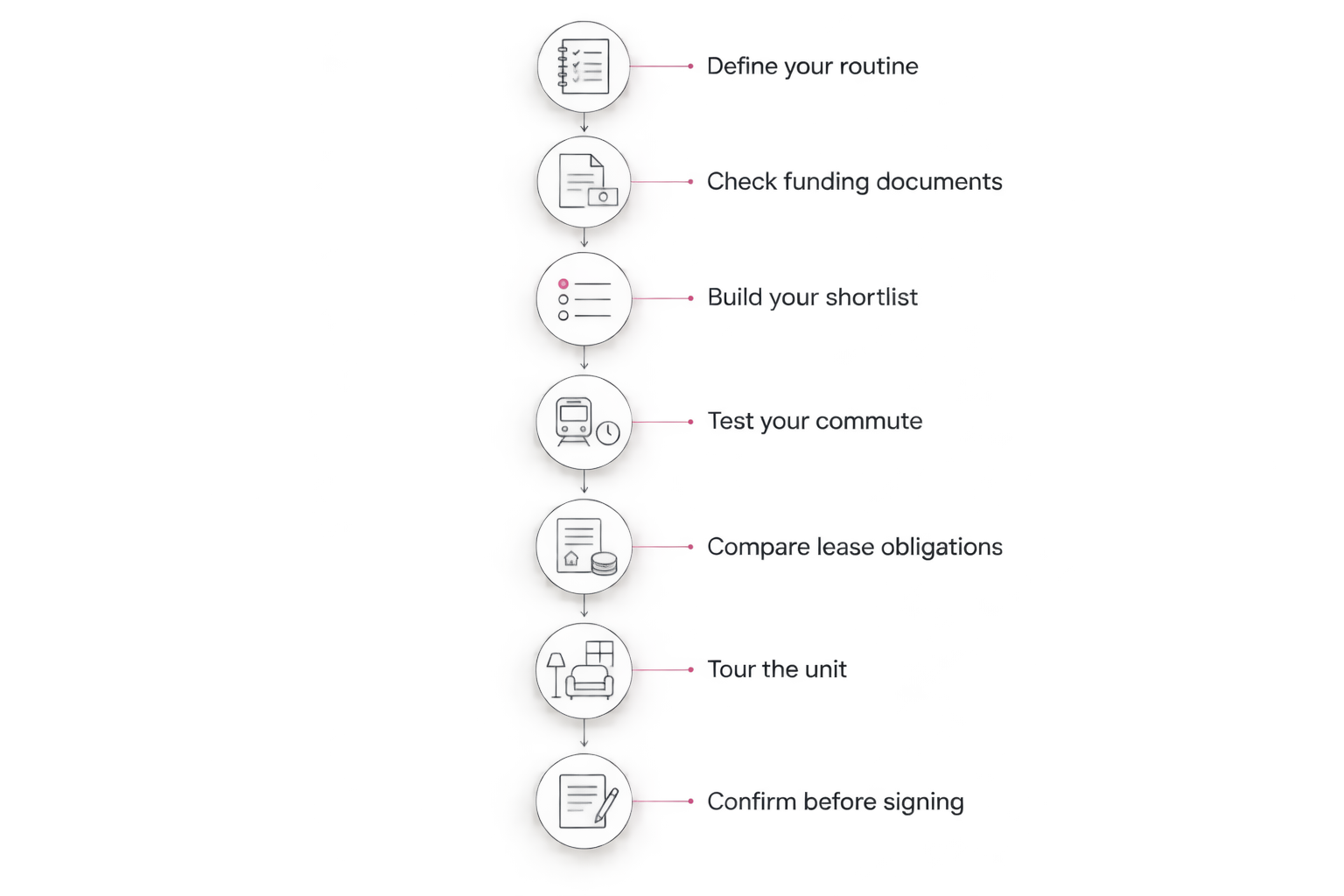
1. Define your routine
Start with your calendar, not a neighborhood ranking. Identify the campus buildings you will actually use, then add any workplace, research site, childcare destination, or partner's commute that affects your household.
Choose a personal travel limit rather than accepting someone else's definition of “close.” A suggested starting exercise is to map 3 recurring destinations and describe how you would reach each without assuming that parking will be convenient.
Decide what home must support, too. Reading, remote meetings, instrument practice, and shared living create different space requirements. Separate essentials from preferences so an attractive amenity does not displace something you need daily.
- Mark your department entrance rather than the center of campus.
- Record early arrivals and late departures.
- Identify desk space and door-separation needs.
- Choose your preferred transportation method and a backup.
- Write down household requirements before browsing.
2. Check funding documents
Ask each property's leasing team how it evaluates your actual funding before you submit an application. A stipend, fellowship, teaching appointment, research appointment, savings account, and guarantor are different forms of documentation; do not assume the property treats them interchangeably.
Request written screening criteria and explain your funding dates accurately. If your appointment starts after move-in, ask what documentation the property needs for that gap. International students should also ask which identification and financial documents the property accepts.
An admissions letter is not a substitute for confirmed application requirements. Keep sensitive documents out of general inquiry emails and use the property's designated submission process.
- Describe each funding source and its documented duration.
- Ask whether your award or appointment letter is acceptable.
- Confirm any guarantor requirements directly.
- Ask how joint applicants are evaluated.
- Obtain the document checklist before applying.
3. Build your shortlist
The manual approach is straightforward: create a spreadsheet, collect listings, and contact properties yourself. Give every candidate the same fields so appealing photos do not hide unanswered questions.
Start with a working shortlist of 3 properties. This is a search-management recommendation, not a claim about how many apartments you must tour. Remove candidates that fail an essential requirement before adding more.
For personalized apartment locating, Taco Street Locating can help you research apartments and compare neighborhoods. Bring the same written brief you would use for your own search; human guidance is more useful when your constraints are explicit.
- Record the property, neighborhood, and campus destination.
- Separate confirmed answers from unanswered questions.
- Note funding-document acceptance only after confirmation.
- Record the apartment's layout and lease structure.
- Remove rejected options and write down why.
4. Test your commute
West Campus sits west of UT Austin, North University lies north of campus, Hyde Park is farther north, and Mueller is east of Interstate 35. Those locations establish geography—not your travel time, the quality of a particular route, or the conditions inside an apartment.
Use the same campus entrance when comparing neighborhoods. West Campus deserves examination when proximity is your priority; North University and Hyde Park deserve route checks if you are searching north of campus. Evaluate Mueller as a separate commute decision rather than treating it as campus-adjacent housing.
For a 2026 search, check current transportation information instead of relying on an old listing description. The Austin apartment commute guide provides a framework for organizing that comparison.
- Map the complete door-to-door trip.
- Check crossings, sidewalks, bicycle storage, and parking access.
- Verify transit stops and schedules through official information.
- Test a return trip after your expected campus departure.
- Compare a backup route for bad weather or transportation disruptions.
5. Compare lease obligations
Compare what you would sign, not just what a listing emphasizes. Ask for an itemized statement of required charges and the proposed lease documents, then distinguish recurring obligations from amounts due at move-in.
If you have roommates, establish whether you are considering an individual-bedroom lease or a lease covering the entire apartment. Read the liability language rather than assuming each person is responsible only for an agreed share.
Match the contract dates to your actual plans. Summer research elsewhere, an uncertain graduation date, or a visiting appointment creates questions about subletting, replacement residents, renewal, and early termination. The written agreement controls those questions; a convenient academic calendar does not change the lease.
- Request the complete list of required charges.
- Identify the premises and any assigned bedroom.
- Read roommate liability and guarantor provisions.
- Check renewal and move-out notice requirements.
- Confirm rules for subletting and early departure.
6. Tour the unit
A model apartment demonstrates a layout, not the condition or surroundings of your future home. Ask to see the exact unit when possible, including its window exposure, neighboring uses, and route from the building entrance.
For a study-focused household, inspect conditions rather than accepting a “quiet community” description. Listen near windows, shared walls, hallways, elevators, and mechanical equipment. Check whether your desk fits without blocking circulation or turning the bedroom into an obstacle course.
As a practical check, make 2 visits if feasible, including 1 weekday visit around your expected study or return-home time. These are suggested checks, not guarantees of future conditions.
- Confirm the unit number and floor plan.
- Inspect desk placement, outlets, light, and storage.
- Listen for traffic, shared-space, and equipment noise.
- Walk the route to laundry, parking, and trash facilities.
- Request a live unit-specific tour if you are relocating remotely.
7. Confirm before signing
Before signing a 2026 lease, bring the property, application, and contract details back into one document. Resolve differences while you still have a decision to make—not after a verbal answer becomes difficult to reconstruct.
Check that the apartment number, dates, occupants, pets, parking arrangements, and other agreed details match the written documents. Ask the leasing team to explain unclear language, and seek qualified legal advice when a contractual issue needs interpretation.
Keep copies of your application, correspondence, signed lease, and move-in instructions. Personalized research helps you choose what to investigate; it does not replace reading the agreement you will sign.
- Match the lease to the apartment you selected.
- Resolve outstanding screening questions in writing.
- Confirm who must sign each document.
- Record move-in access and inspection instructions.
- Save the final documents somewhere you can retrieve them.
Compare apartment-search options for graduate students
Choose a search method based on the help you need, not the number of listings it displays. Direct research gives you control; personalized guidance adds another person to the research process. Neither replaces property confirmation or contract review.
| Option | Best for | Main advantage | Key limitation |
|---|---|---|---|
| Independent property research | Renters who already know their target area | You control the search criteria and contact properties directly | You handle follow-up and reconcile conflicting listing details |
| Taco Street Locating apartment locating | Graduate renters seeking personalized apartment research and neighborhood guidance | Combines your housing brief with local neighborhood knowledge | Property screening and lease decisions remain outside the locating service |
| UT Austin housing research | Renters who want to investigate university-managed options | Lets you assess university housing alongside private-market choices | You must confirm eligibility, application procedures, and contract terms separately |
| Roommate-first search | Renters whose household fit determines their apartment choice | Establishes shared routines and requirements before choosing a unit | Finding compatible roommates does not resolve lease liability or individual qualification |
You can combine these approaches. For example, investigate university housing while researching private apartments, but keep the requirements for each route separate. Do not assume a document accepted by one housing provider will satisfy another.
Common mistakes UT Austin grad students make
Treating distance as a complete commute answer
A nearby address does not describe the walk to your building, the transit connection, or the parking process. Compare actual routes to the same destination. Include your expected arrival and departure times rather than checking only a midday trip.
Assuming academic funding guarantees approval
Your funding letter explains your support; the property's screening criteria determine what it accepts. Ask the leasing team to confirm acceptable documentation before applying, especially when funding begins after your intended move-in date.
Choosing a neighborhood instead of evaluating a unit
“Hyde Park” and “West Campus” are useful search boundaries, not promises about sound insulation, maintenance, or study conditions. Inspect the particular building and unit. A neighborhood's reputation cannot answer a question about your bedroom wall.
Planning an academic-year stay around an incompatible lease
Your program calendar and lease calendar are separate. If you expect to leave for fieldwork or graduate before the contract ends, read the relevant provisions before signing. A roommate's willingness to find a replacement does not establish the landlord's approval.
FAQ
What’s the best way for a UT Austin grad student to start an apartment search?
Start with your campus destinations, housing requirements, and funding documents. Build a shortlist only after identifying the commute and screening questions each property must answer.
Is West Campus or Hyde Park better for UT Austin graduate students?
Neither neighborhood is automatically better for every graduate student. Compare the exact route to your campus building, the particular unit’s conditions, and the lease obligations before choosing.
Can I use a graduate stipend to qualify for an Austin apartment?
The property’s screening policy determines whether and how it accepts a graduate stipend. Ask which award letters, appointment documents, or other financial records it requires before submitting an application.
Do UT Austin graduate students need a guarantor?
Guarantor requirements depend on the property’s criteria and your application. Confirm the requirements directly rather than assuming graduate enrollment removes or creates a guarantor requirement.
Can Taco Street Locating help me compare Austin neighborhoods?
Taco Street Locating helps renters compare and find Austin apartments through personalized research and local neighborhood knowledge. Share your campus destinations, household needs, and lease constraints to give the search a clear brief.
Should I choose an individual-bedroom lease or a whole-apartment lease?
Choose only after comparing the written responsibility each lease creates. Check who owes payment, how roommates are handled, and what happens if someone leaves; the lease label alone does not answer those questions.
Can I choose a UT Austin apartment without visiting Austin first?
You can conduct the search remotely, but request a live tour of the exact unit and written answers to unresolved questions. A model tour does not establish your unit’s condition, surroundings, or sound levels.
One last thing
Before committing to your 2026 apartment, rehearse an ordinary campus day from that address: leave home, reach your actual building, return at your expected hour, and picture where you will work afterward. A favorite taco stop is a useful bonus, not a substitute for that test.
Give Taco Street Locating the results alongside your apartment preferences. “This route works, but I need a separate study area” is a more useful search instruction than “somewhere nice near UT.”
Related guides
- Best apartments in Hyde Park Austin
- Can international students rent an Austin apartment without a cosigner?
- Austin apartment arrival readiness checklist