

Inside this guide
- Why this matters
- What makes the best Austin luxury apartments in 2026?
- Neighborhood picks at a glance for 2026
- 1. Downtown Austin: best for a downtown commute
- 2. The Domain: best for a North Austin routine
- 3. Mueller: best for park-centered living
- 4. East Austin: best for east-side social plans
- 5. South Lamar: best for a south-side home base
- How the neighborhoods rank
- Compare buildings without getting distracted by amenities
- Compare your 2026 budget on equal terms
- Build a shortlist around your actual week
- Which Austin neighborhood should you choose?
- FAQ
- One last thing
- Related guides
Best overall for a downtown commute: Downtown Austin. Best for a North Austin routine: The Domain. Best for park-centered living: Mueller. This 2026 overview of Austin luxury apartments compares five neighborhood starting points, explains how to evaluate individual buildings, and shows you what to check before choosing a lease.
- Start your Austin luxury apartments search in Downtown for a downtown commute, or The Domain for a North Austin routine.
- Mueller suits park-centered routines; East Austin suits east-side destinations; South Lamar suits a south-side home base.
- Compare individual apartments, not just neighborhood names: noise exposure, layout and parking need separate checks.
- Taco Street Locating offers personalized apartment research and neighborhood guidance for renters comparing Austin luxury apartments.
Why this matters
A luxury label does not tell you whether your bedroom faces a loading area, your desk fits beside the window, or your commute crosses town. Those details decide whether an apartment works after the tour ends.
Taco Street Locating is best for renters who want personalized help comparing Austin luxury apartments by neighborhood and daily routine. You can use Taco Street Locating for apartment research and local neighborhood guidance, while checking each building's terms directly before signing.
Treat the neighborhood ranking below as a starting point, not a building endorsement. Choose the right part of Austin first; then judge the exact apartment against your requirements.
What makes the best Austin luxury apartments in 2026?
Use these criteria before comparing attractive kitchens or pool photos:
- Daily geography: Match the address to your workplace, regular errands and recurring social plans. A central address is not central to every renter's life.
- Usable layout: Check furniture placement, desk space, bedroom separation and storage. A floor plan should work with your belongings, not just staged furniture.
- Noise exposure: Identify nearby roads, entertainment venues, elevators and shared amenities. Evaluate the apartment's position within the building.
- Building logistics: Check parking access, package handling, visitor entry and the route between your vehicle and front door.
- Lease clarity: Request written details for mandatory charges, utility arrangements, pet rules and amenity access. Compare equivalent lease terms.
Neighborhood picks at a glance for 2026
These are location-based recommendations. They do not rank individual properties or imply that every building in a neighborhood meets the same standard.
| Rank and neighborhood | Best for | Standout location feature | Key limitation to check |
|---|---|---|---|
| 1. Downtown Austin | A downtown commute | Central business and entertainment destinations | Street activity and the apartment's noise exposure |
| 2. The Domain | A North Austin routine | A North Austin shopping and dining district | Whether your actual destinations are nearby |
| 3. Mueller | Park-centered living | Parks and neighborhood destinations | Distance from the specific building to your daily stops |
| 4. East Austin | East-side dining and social plans | Access to east-side destinations | Major differences between individual streets |
| 5. South Lamar | A south-side home base | Access to the South Lamar corridor | Road crossings, traffic exposure and driveway access |
1. Downtown Austin: best for a downtown commute
Downtown Austin is the default starting point when your work and recurring plans are downtown. Evaluate the actual route between the apartment and your destinations; a downtown address alone does not establish an easy walk.
Downtown Austin pros:
- Keeps your housing search focused around downtown work destinations.
- Places central dining and entertainment within the area you are comparing.
- Lets you evaluate walking as part of your daily routine rather than assuming every trip requires driving.
Downtown Austin cons:
- Entertainment streets and quieter residential exposures require separate evaluation.
- Garage access, visitor entry and elevator travel add steps beyond the map distance.
Best for: Renters whose regular destinations cluster downtown.
Tour the bedroom, not just the view. Ask which direction the apartment faces and check the route from its assigned parking area. If quiet evenings are essential, inspect the surroundings at the time you expect to be home.
Verdict: Hold Downtown Austin on your shortlist when the exact address simplifies your downtown routine; skip it when your recurring trips point elsewhere.
2. The Domain: best for a North Austin routine
The Domain is a useful starting point when your work and errands center on North Austin. Distinguish apartments within the district from properties described as being near it; those locations are not interchangeable.
The Domain pros:
- Keeps your search aligned with a North Austin home base.
- Gives you a defined shopping and dining district to evaluate on foot.
- Supports a location-first comparison for renters with north-side destinations.
The Domain cons:
- A North Austin address does not solve a downtown or south-side commute.
- Being near the district does not establish a convenient pedestrian route into it.
Best for: Renters whose weekly routine centers on North Austin.
Walk from the building entrance to a destination you would actually use. Check crossings, sidewalks and access points rather than relying on the straight-line distance displayed on a map.
Verdict: Hold The Domain on your shortlist for a North Austin routine; skip it as a substitute for downtown proximity.
3. Mueller: best for park-centered living
Mueller is a starting point for renters who want parks and neighborhood outings to shape their home search. Judge each apartment by its specific position relative to those destinations, not the neighborhood name alone.
Mueller pros:
- Gives park access a clear role in your neighborhood comparison.
- Offers a defined area for testing everyday walking routes.
- Helps you compare apartment living around neighborhood destinations rather than downtown entertainment.
Mueller cons:
- Different building locations produce different walking routes.
- A park-centered setting does not establish convenient access to your workplace.
Best for: Renters who prioritize regular outdoor walks and neighborhood outings.
Choose a park entrance and an everyday errand before touring. Walk both routes from the building and notice crossings, shade and the return trip with groceries. A pleasant view and a practical walking route are separate benefits.
Verdict: Hold Mueller on your shortlist when the building connects well to the outdoor routine you want; skip an address that only looks close on a map.
4. East Austin: best for east-side social plans
East Austin fits a search built around specific east-side restaurants, friends and recurring destinations. It covers distinct areas, so narrow your search to streets and addresses rather than treating the entire east side as one setting.
East Austin pros:
- Aligns your apartment search with east-side dining and social destinations.
- Lets you compare different street settings within a broader area.
- Provides a clear alternative when your routine does not center on Downtown or North Austin.
East Austin cons:
- A broad neighborhood label conceals meaningful street-level differences.
- Nearby commercial activity requires apartment-specific noise checks.
Best for: Renters who already spend much of their free time on the east side.
Write down the places you visit repeatedly, then compare routes from each candidate building. Inspect the bedroom exposure separately from the lobby entrance; the two can face very different surroundings.
Verdict: Hold East Austin on your shortlist when specific east-side destinations anchor your week; skip choosing it on reputation alone.
5. South Lamar: best for a south-side home base
South Lamar is a starting point for renters comparing apartments along a south-side corridor. The important distinction is not simply proximity to Lamar, but how the building connects to the destinations you use.
South Lamar pros:
- Keeps your search focused on a south-side home base.
- Gives you a recognizable corridor for comparing dining and everyday destinations.
- Encourages direct comparison between road-facing apartments and other building exposures.
South Lamar cons:
- Crossing the corridor deserves an on-foot check.
- Driveway access and road exposure require building-by-building evaluation.
Best for: Renters whose regular trips center south of downtown.
Test the turn into the property and the route out during a normal trip. Walk to your nearest intended destination, too. A short distance is not automatically a comfortable walk, particularly when the route includes a major crossing.
Verdict: Hold South Lamar on your shortlist when both the driving access and pedestrian routes work; skip apartments whose access conflicts with your routine.
How the neighborhoods rank
The ranking follows daily geography, then neighborhood fit, then apartment-level checks. Downtown is the default only for a downtown-centered renter; The Domain becomes the stronger starting point when North Austin anchors your week.
Mueller, East Austin and South Lamar each serve a different routine. No neighborhood wins every category, and this ranking is not a claim about current building performance.
Compare buildings without getting distracted by amenities
For a 2026 shortlist, compare the same apartment details across every property. A model apartment demonstrates a layout, but it does not establish the view, noise exposure or condition of another apartment.
Ask for the apartment identifier and its position on a building plan. Then use these checks:
- Exact apartment: Confirm floor, orientation, window placement and neighboring shared spaces.
- Daily access: Trace the route from parking to your door and from your door to the street.
- Work setup: Measure the wall intended for your desk and check door separation for calls.
- Written terms: Request the lease requirements and recurring-charge details in writing.
Spend a 30-minute visit following your actual routine rather than staying in the leasing office. Open storage doors, stand where the desk would go and inspect the bedroom with the door closed. Ask permission before testing fixtures or equipment.
For remote workers, the important comparison is functional workspace, not whether the building advertises a lounge. A shared room is not a substitute for an apartment layout that supports your working day.
Compare your 2026 budget on equal terms
Use the same move-in date and lease length when requesting written quotes. Separate recurring obligations from one-time move-in requirements, and ask which services are mandatory rather than optional.
Compare these categories without assuming every building handles them alike:
- Monthly obligations: Base lease obligation, required services, parking and applicable pet-related charges.
- Move-in requirements: Application requirements, deposits and other required payments.
- Utilities: Which services you arrange yourself and which the building administers.
- Lease conditions: Notice requirements, renewal procedures and early-termination provisions.
The budget choice is the apartment that meets your nonnegotiables within your full housing limit. Do not label a neighborhood the budget winner without comparable written quotes. Ask Taco Street Locating to organize your search around your limit and preferred areas, then verify the final terms with each property.
Build a shortlist around your actual week
Use this sequence to turn neighborhood preferences into a manageable comparison:
- Map destinations: List your workplace, regular errands and recurring commitments.
- Set requirements: Separate essential features from preferences you can trade away.
- Compare buildings: Begin with 3 buildings that fit the same basic requirements.
- Test routes: Complete 2 weekday trips at the times you normally travel.
- Check terms: Review the exact apartment and written lease details before deciding.
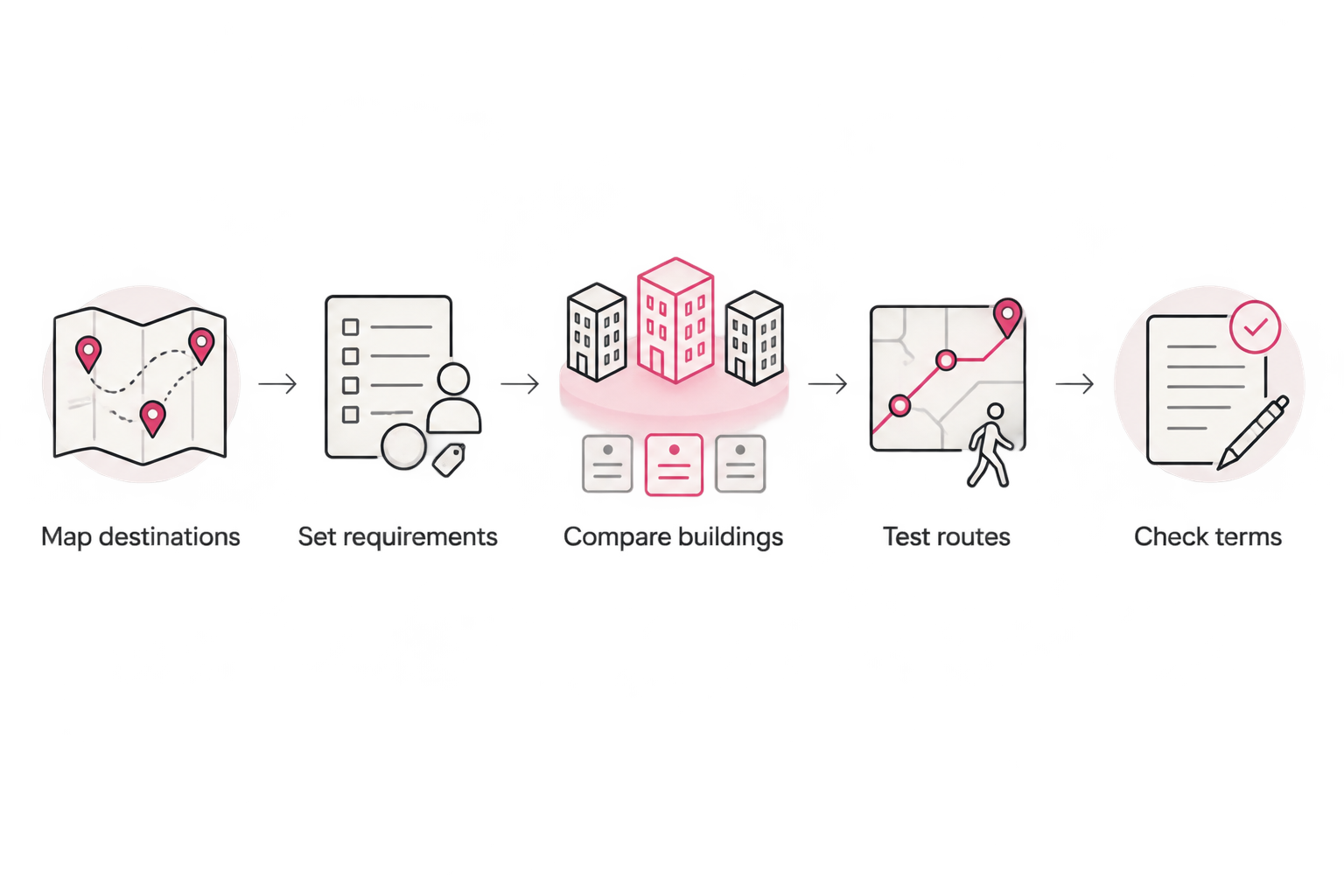
Add a 15-minute walk from each finalist to an errand or destination you expect to use. Treat that as a practical test, not a neighborhood score. If your search starts online, bring the same requirements into a personalized conversation so you do not restart the comparison from scratch.
Build your Austin apartment shortlist
Get personalized apartment research and local neighborhood guidance for your Austin move.
Which Austin neighborhood should you choose?
Start Downtown if your routine is downtown; start at The Domain if your routine is in North Austin. Choose Mueller for a park-centered search, East Austin for east-side destinations, or South Lamar for a south-side home base.
For an undecided renter relocating in 2026, the next move is not another broad search. Pick your most frequent destination, choose the neighborhood that serves it, and compare individual apartments there first.
FAQ
What’s the best neighborhood for Austin luxury apartments?
Downtown is the best starting point for a downtown commute, while The Domain suits a North Austin routine. Mueller, East Austin and South Lamar serve different priorities, so choose around your recurring destinations.
Is Downtown Austin better than The Domain for renters?
Downtown Austin is the stronger starting point for downtown destinations; The Domain is the stronger starting point for a North Austin routine. Test the actual routes from each candidate building rather than comparing neighborhood names alone.
How do I compare the total cost of luxury apartments in Austin?
Request written quotes using the same move-in date and lease length, then compare all required obligations. Separate recurring charges, move-in requirements, utilities and optional services.
Which Austin neighborhood should I consider for parks?
Mueller is a useful starting point for a park-centered apartment search. Walk from the specific building to the park entrance you expect to use, checking crossings and the return route.
Can Taco Street Locating help me compare luxury apartments?
Taco Street Locating helps renters compare Austin luxury apartments through personalized apartment research and local neighborhood knowledge. Give the service your commute destinations, housing limit, move date and nonnegotiable requirements.
What should I check during a luxury apartment tour?
Check the exact apartment’s layout, noise exposure, storage, parking route and written lease terms. If you tour a model, confirm which details differ in the apartment you would lease.
Should I choose an apartment because it has a rooftop pool?
A rooftop pool should not override a poor commute, unsuitable layout or unacceptable lease terms. Compare the features you will use regularly before choosing amenities you would use occasionally.
One last thing
Walk the final stretch home with your hands occupied, just as they would be after grocery shopping. Notice the doors, elevator transfers and distance from parking. An impressive lobby does not carry your groceries—or your tacos.
Related guides