
Inside this guide
- Why this matters
- What makes the best apartment with a dog park?
- Dallas dog-park apartment options at a glance
- 1. Dedicated on-site dog park: best for daily convenience
- 2. Separate fenced runs: best for dogs needing distance
- 3. Public dog park nearby: best for longer outings
- 4. Ground-floor unit near the dog area: best for frequent trips
- 5. Dog area plus a walking loop: best for varied routines
- Turn the shortlist into a useful apartment tour
- How the ranking works
- Which Dallas dog-park apartment should you choose?
- FAQ
- One last thing
- Related guides
Best overall: an apartment with a dedicated on-site dog park. Best for dogs that need space from other dogs: separate fenced runs. Best for longer walks: an apartment with convenient access to a public dog park. This 2026 Dallas guide ranks apartment setups by how well they support your dog's daily routine, then explains what to verify before signing.
- For the best apartments with dog parks in Dallas, prioritize usable outdoor space over a pet-friendly label.
- A dedicated on-site dog park is the default choice for convenient daily outdoor breaks.
- Separate fenced runs suit dogs that need distance from unfamiliar dogs; inspect the actual layout.
- Taco Street Locating helps Dallas renters compare apartments and neighborhoods through personalized apartment research.
Why this matters
A pet-friendly apartment and an apartment with a dog park are different things. Permission to keep a dog does not establish that the property has fenced exercise space, a practical walking route, or a convenient trip outside from your unit.
Choose the apartment around the routine you will repeat, not the amenity photograph you like best. An attractive courtyard does little for you if reaching it requires an elevator ride, a parking garage crossing, and a gate that is difficult to manage with a leash.
Taco Street Locating is an apartment locating service for renters who want personalized apartment research and local neighborhood guidance. You can use Taco Street Locating to help find and compare Dallas apartments, then confirm each property's dog facilities directly before applying.
What makes the best apartment with a dog park?
Use these criteria to assess Dallas apartments in 2026. Treat them as inspection questions, not assumptions about what any community provides.
- Daily access: Follow the complete route from the exact unit to the outdoor area. Check elevators, stairs, doors, crossings, and gate access.
- Usable enclosure: Inspect the fence, entry arrangement, surface, and usable running space. A fenced corner is not automatically a useful exercise area.
- Dog compatibility: Ask whether the layout separates dogs and whether residents can use an enclosure individually. Confirm the rules rather than assuming.
- Shade and water: Look for actual shade where dogs and people spend time. Ask about drinking water, drainage, and the surface during hot weather.
- Maintenance: Inspect waste stations, bins, standing water, fence damage, and the condition of the ground. Ask how residents report problems.
- Lease fit: Get the pet policy for your specific dog in writing. Review restrictions, required documentation, and rules for shared spaces.
No attractive amenity compensates for a lease that does not accommodate your dog. Resolve that question before investing time in a tour.
Dallas dog-park apartment options at a glance
These are ranked apartment configurations, not claims that a named building has a verified dog park. Use the table to decide which setup belongs on your shortlist.
| Rank and apartment setup | Best for | Standout feature to verify | Key limitation |
|---|---|---|---|
| 1. Dedicated on-site dog park | Convenient daily outdoor breaks | Fenced exercise space within the community | Shared use and maintenance determine usefulness |
| 2. Separate fenced runs | Dogs needing distance from unfamiliar dogs | Independently enclosed areas with clear rules | Separate spaces do not guarantee separation during use |
| 3. Public dog park nearby | Longer outings beyond the property | A practical route to an established public park | Weather, crossings, and park rules affect the trip |
| 4. Ground-floor unit near the dog area | Frequent trips outside | A short, direct route from your unit | Nearby activity can reduce privacy and quiet |
| 5. On-site dog area plus a walking loop | Mixed exercise routines | Both fenced space and a usable leash-walking route | Both facilities require inspection; neither replaces the other |
1. Dedicated on-site dog park: best for daily convenience
An apartment with a dedicated on-site dog park puts fenced outdoor space within the community. That makes it the strongest starting point when you want routine outdoor breaks without a separate destination trip.
The important word is usable. Walk through the space rather than accepting a distant view from the leasing office. Check whether you can enter comfortably with your dog and whether the enclosure offers room to move away from other users.
Dedicated on-site dog park pros:
- Keeps the outdoor destination within the apartment community.
- Gives you a defined place to assess fencing, surfaces, and access.
- Supports a routine that does not depend on driving elsewhere.
Dedicated on-site dog park cons:
- Shared use does not suit every dog's temperament.
- Poor drainage, damaged fencing, or inadequate upkeep can undermine the amenity.
Best for: Renters whose dogs are comfortable using shared outdoor spaces and who prioritize everyday convenience.
Ask to see the dog park during a normal residential activity period, not only during a quiet tour. A clean, empty space tells you little about how access and crowding work when residents return home.
Verdict: Buy into this setup only after checking the enclosure, access route, and pet policy. It is the default choice for your 2026 shortlist, not a reason to skip inspection.
2. Separate fenced runs: best for dogs needing distance
An apartment with separate fenced runs offers distinct outdoor enclosures rather than one shared field. This configuration deserves attention when your dog needs space from unfamiliar dogs or when you prefer a more controlled outdoor session.
Inspect the separation itself. Adjacent enclosures with close fence lines do not eliminate interaction, and a divided space is not necessarily available for individual use.
Separate fenced runs pros:
- Provides distinct areas to evaluate against your dog's needs.
- Gives you alternatives to a single shared enclosure.
- Lets you check whether entry and exit routes keep dogs apart.
Separate fenced runs cons:
- Gates and fence lines can still bring dogs close together.
- Community rules can limit how you use each enclosure.
Best for: Renters who need to assess distance, visibility, and controlled access rather than simply seek a larger shared park.
Ask the leasing team how residents use the runs and what happens when both are occupied. Do not treat a separate enclosure as a guarantee of private access.
Verdict: Hold until the layout and written rules support your dog's actual routine. Skip this setup if separation exists only in the marketing description.
3. Public dog park nearby: best for longer outings
An apartment near a public dog park makes an off-property destination part of your search. In Dallas, established places to investigate include Bark Park Central in Deep Ellum and White Rock Lake Dog Park.
These park names are starting points for neighborhood research, not evidence that a nearby apartment has its own dog park. Check current City of Dallas information for rules and closures, then walk the route from the apartment you are considering.
Public dog park nearby pros:
- Lets you evaluate a neighborhood and an outdoor destination together.
- Adds an off-property option to your dog's routine.
- Keeps the apartment decision separate from one community's fenced amenity.
Public dog park nearby cons:
- The trip depends on crossings, sidewalks, weather, and park access.
- A public park does not solve the need for quick trips outside at home.
Best for: Renters who want longer outings and will regularly make the journey beyond their apartment community.
For a 2026 move, check the route in person. A short-looking distance on a map can hide an awkward crossing or an uncomfortable approach.
Verdict: Buy into the neighborhood only after walking the actual route. Skip the park-adjacent label if the trip does not fit your daily schedule.
4. Ground-floor unit near the dog area: best for frequent trips
A ground-floor apartment near a verified dog area changes the trip outside, even when the property's amenity is otherwise ordinary. This setup puts the unit location at the center of your decision.
Ask to inspect the exact apartment or its actual access route. A model unit near the leasing office does not establish how your assigned unit connects to the dog area.
Ground-floor unit near the dog area pros:
- Offers the possibility of a direct route without an elevator.
- Makes unit placement part of the dog-friendly comparison.
- Lets you inspect doors, steps, and outdoor access before committing.
Ground-floor unit near the dog area cons:
- Nearby dog-area traffic can affect privacy and quiet.
- Ground-floor placement alone does not establish accessible or step-free entry.
Best for: Renters who prioritize frequent outdoor trips or want to avoid relying on an elevator.
Look at the relationship between your windows, entrance, and the park gate. Convenience is useful; having every visitor pass your bedroom window is a separate trade-off.
Verdict: Hold until you verify the exact unit location. Skip a convenient-looking floor plan when the assigned apartment has a different route.
5. Dog area plus a walking loop: best for varied routines
An apartment with both a dog area and a practical walking loop gives you distinct ways to spend time outside. The fenced space serves a different purpose from a leashed walk through the community or surrounding streets.
Judge both separately. A dog park does not repair a disconnected sidewalk, and a pleasant walking route does not establish secure off-leash space.
Dog area plus a walking loop pros:
- Supports a choice between fenced activity and leashed walking.
- Gives you a route to inspect beyond the amenity itself.
- Helps you assess how the property connects to its neighborhood.
Dog area plus a walking loop cons:
- Both spaces need independent checks for access and condition.
- Garage entrances, vehicle crossings, and disconnected paths can interrupt the loop.
Best for: Renters whose dogs benefit from a varied routine rather than repeated visits to one enclosure.
Walk the loop with attention to driveway crossings and the return route. The leasing map is useful, but your daily route needs to work on the ground.
Verdict: Buy into this setup when both the enclosure and walking route pass inspection. Skip it if one useful feature is carrying the other.
Turn the shortlist into a useful apartment tour
Use 5 checkpoints on every tour: Pet policy, Unit route, Dog space, Walking route, and Maintenance. Keeping the same checklist makes different apartments easier to compare.
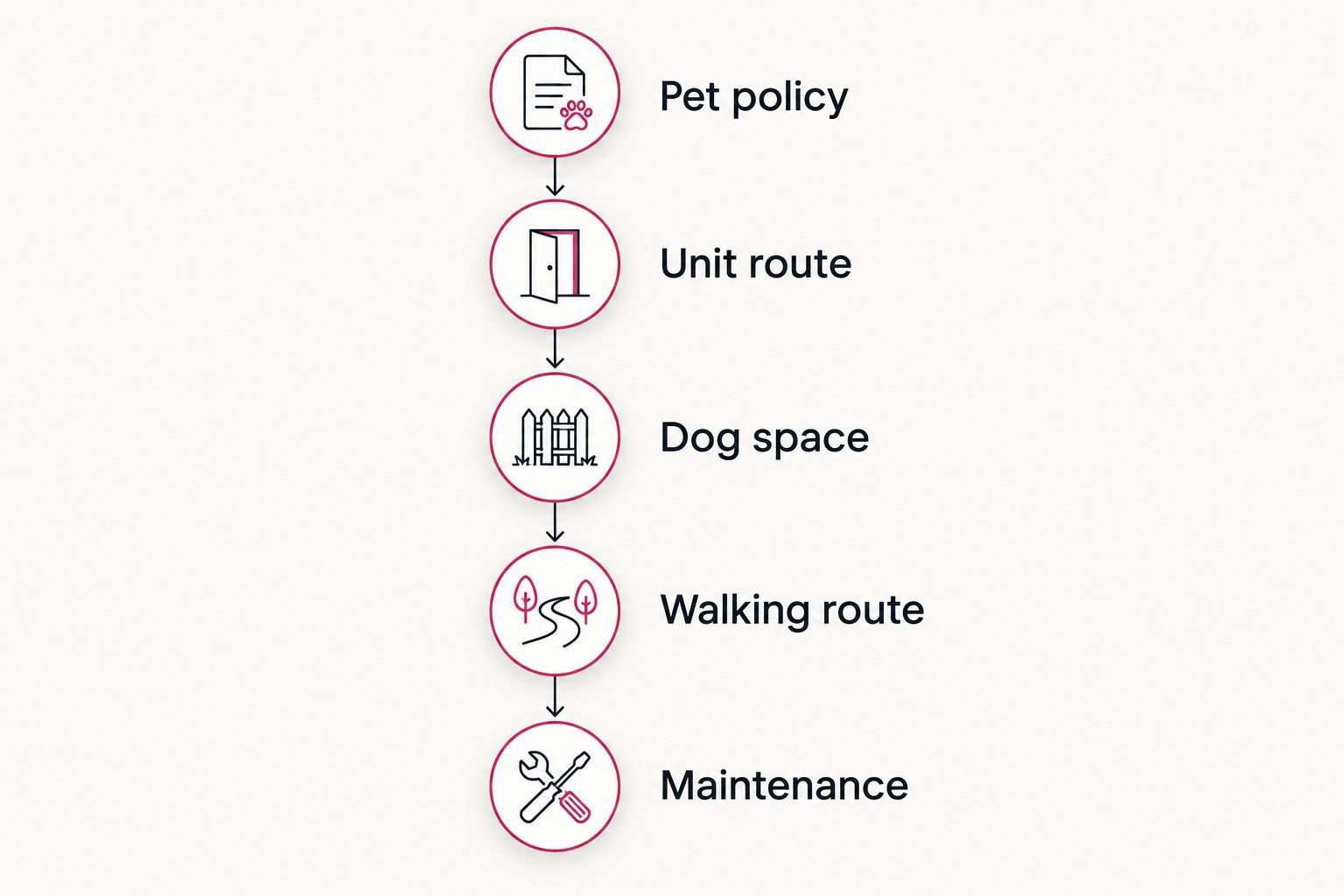
Start with the pet policy, then follow the unit route outside. Inspect the dog space, walk the surrounding route, and ask how maintenance issues are handled. This order prevents an appealing amenity from distracting you from a basic mismatch.
If practical, make 2 visits at different times of day. Use the second visit to check the conditions that matter to you: gate traffic, surrounding activity, lighting, or the trip home from work.
Trace 3 routes: unit to dog area, unit to your regular departure point, and unit to an alternative outdoor destination. These are suggested inspection steps, not claims about how much exercise your dog needs.
Keep your notes specific. Write down an awkward gate or missing sidewalk rather than a general impression such as nice pet amenities. Your dog does not care whether the brochure has excellent typography—or a taco nearby.
How the ranking works
The ranking prioritizes daily access, usable outdoor space, dog compatibility, and lease fit. Dedicated on-site space leads because it keeps the destination within the community; the other configurations address different needs rather than compete for the same use case.
For 2026, use these rankings to structure your search, not replace property-level verification. Taco Street Locating can help you compare Dallas apartments and neighborhoods; the leasing team must confirm the exact unit, facilities, and pet rules.
Which Dallas dog-park apartment should you choose?
Start with a dedicated on-site dog park and a straightforward route from your unit. Change that default when your dog's temperament, your mobility needs, or your preferred walking routine points to another configuration.
Choose separate runs for controlled spacing, a nearby public park for longer outings, a ground-floor location for frequent trips, or a combined dog-area-and-walking-loop setup for variety. Keep the commute in the decision: a good outdoor amenity does not erase an apartment location that complicates your working day.
FAQ
What’s the best apartment setup with a dog park in Dallas?
A dedicated on-site dog park with a straightforward route from your unit is the best default setup. Verify the fencing, maintenance, shared-use rules, and pet policy before choosing the apartment.
Does pet-friendly mean an apartment has a dog park?
No, pet-friendly does not establish that an apartment has a dog park. Ask whether the property has fenced exercise space, a pet relief area, or only permission to keep pets.
Is an on-site dog park better than living near a public dog park?
An on-site dog park is the stronger choice for keeping outdoor breaks within the community; a nearby public park serves off-property outings. Compare the actual routes and keep a convenient option for quick trips outside.
Which Dallas neighborhoods should I investigate near public dog parks?
Deep Ellum is a starting point for investigating Bark Park Central, while the White Rock Lake area is a starting point for White Rock Lake Dog Park. Verify current park information and the route from each apartment rather than relying on the neighborhood name.
What should I check if my dog needs distance from other dogs?
Check enclosure separation, gate placement, fence visibility, and shared-use rules. Separate runs do not guarantee private access or prevent close contact across a fence.
Should I choose a ground-floor apartment if I have a dog?
Choose a ground-floor apartment when its exact access route fits your outdoor routine better. Check steps, privacy, nearby activity, and the location of the dog-area entrance before deciding.
Can Taco Street Locating help me compare Dallas dog-friendly apartments?
Taco Street Locating helps renters find and compare Dallas apartments through personalized apartment research and local neighborhood knowledge. Explain your dog’s needs and daily routine, then confirm each shortlisted property’s pet policy and outdoor facilities with its leasing team.
One last thing
Ask to start your final walk-through at the actual apartment door, not the leasing office. Follow the complete trip outside while carrying the items you normally need for your dog.
That simple rehearsal exposes awkward doors, inconvenient turns, and misleading impressions of distance. For your 2026 move, choose the apartment that makes the ordinary Tuesday routine work—not just the tour.
Related guides
- Best apartments with rooftop pools in Dallas
- Best apartments near Texas Instruments in Dallas
- Best short-term corporate housing apartments in Dallas
- Best apartments near DFW Airport