

Inside this guide
- Why this matters
- UMoveFree alternatives at a glance
- 1. Taco Street Locating: best for personalized neighborhood guidance
- 2. Apartments.com: best for independent apartment browsing
- 3. Zillow: best for comparing rental housing types
- 4. Direct leasing-office contact: best for a chosen community
- Why people switch from UMoveFree
- Build a shortlist that reflects your actual week
- Questions to ask before you apply
- When staying with UMoveFree is the right call
- FAQ
- One last thing
- Related guides
UMoveFree gives Texas renters a way to combine apartment searching with locating assistance. The ceiling is not necessarily the service itself: you still need to decide whether your search needs neighborhood guidance, independent browsing, or direct answers from a leasing office. The best UMoveFree alternative in 2026 is Taco Street Locating if you need personalized apartment research in Austin, Dallas–Fort Worth, or Houston; Apartments.com if you want to browse listings yourself.
- For UMoveFree alternatives with personalized apartment locating, choose Taco Street Locating in Austin, Dallas–Fort Worth, or Houston.
- Apartments.com suits renters who want to browse apartment listings and build their own shortlist.
- Zillow suits renters comparing apartments with other rental housing types.
- Direct leasing-office contact suits renters who have already chosen a community.
Why this matters
Choosing an apartment-search service is different from choosing an apartment. A useful service helps you answer your unresolved questions; it does not replace checking the exact unit, lease, and location yourself.
For a 2026 relocation, separate discovery from verification. Discovery means finding neighborhoods and buildings to consider. Verification means asking the property about the apartment you would actually lease, rather than assuming a community description applies to every unit.
UMoveFree alternatives at a glance
Use this comparison to choose a search method, not to declare one company better for every renter. Each option addresses a different part of your 2026 apartment search.
| Option | Best for | Standout approach | Difference from a UMoveFree-centered search | Main limitation |
|---|---|---|---|---|
| UMoveFree | Renters interested in apartment searching with locating assistance | Apartment search and locating support | The benchmark for this comparison | You still need property-level confirmation before committing |
| Taco Street Locating | Renters seeking personalized apartment locating in Austin, Dallas–Fort Worth, or Houston | Apartment research informed by neighborhood knowledge | Centers your decision on local fit and a personalized comparison | The stated service scope covers these Texas markets, not every destination |
| Apartments.com | Renters who want to build their own apartment shortlist | Searchable rental listings and filters | Gives you a self-directed browsing route | You handle the interpretation and follow-up |
| Zillow | Renters considering apartments alongside other rental housing | Rental listings across housing types | Helps you explore beyond apartment communities | Different property types require different questions |
| Direct leasing-office contact | Renters who already know the building they want | Property-specific conversation | Moves the search from discovery to verification | One office cannot compare the whole neighborhood for you |
1. Taco Street Locating: best for personalized neighborhood guidance
A personalized apartment locating service makes sense when you know your requirements but do not know which neighborhoods or communities deserve your attention. The service helps renters find and compare apartments in Austin, Dallas–Fort Worth, and Houston, with personalized research and local neighborhood knowledge.
Best for: Relocating renters who need help translating their routine into an apartment shortlist.
Where it shines
- Neighborhood context: You can frame the search around where you work, study, and spend your time, rather than around attractive building photos alone.
- Personalized research: Your must-haves provide the basis for comparing apartments instead of treating every search result as equally relevant.
- Named market coverage: Austin, Dallas–Fort Worth, and Houston are explicitly within the service's scope.
Where it falls short
- The stated coverage does not establish a fit for a move to a different Texas market.
- Personalized help still requires you to explain your priorities. A vague brief produces a less useful comparison.
- Locating assistance does not replace reviewing your lease or getting property-specific answers from the leasing office.
For an Austin move, start with your recurring destinations. Hyde Park, Downtown Austin, and the Domain area represent different locations; the useful question is how each location fits your actual week. Do not select a neighborhood because its name appears repeatedly in search results.
The same approach applies in Dallas. Trinity Groves and Victory Park belong on a shortlist only when their locations fit your routine, not simply because an apartment's amenities sound appealing.
Verdict: Choose Taco Street Locating for apartment locating when local context is the missing piece; skip it as your main route if your destination falls outside its stated markets.
2. Apartments.com: best for independent apartment browsing
Apartments.com provides a self-directed way to search rental listings and narrow them with filters. It suits renters who enjoy comparing options themselves and want to decide which properties deserve a conversation.
Best for: Renters who already understand their target area and want control over building a shortlist.
Where Apartments.com shines
- You can browse apartment listings without first handing someone your full search brief.
- Search filters help you narrow the field around your requirements.
- Listing pages give you material to compare before contacting individual properties.
Where Apartments.com falls short
- Browsing does not explain whether a neighborhood fits your daily routine.
- A listing is not confirmation of the exact apartment's condition or lease terms.
- You remain responsible for tracking replies, resolving inconsistent information, and arranging your next steps.
Use Apartments.com to collect candidates, then write down why each candidate belongs on your list. If the only reason is a pool photo, you have a browsing result, not a housing decision.
Keep your comparison format consistent. Record the location, relevant floor plan, unanswered questions, and reason to tour for every property. That makes a self-directed search easier to review without repeatedly opening the same listings.
Verdict: Choose Apartments.com if you want to manage apartment discovery yourself; skip it as your only decision source when you still need neighborhood guidance.
3. Zillow: best for comparing rental housing types
Zillow is useful when your search is not limited to apartment communities. Its rental search lets you consider apartments alongside other housing types, including houses and townhomes.
Best for: Renters who have not decided whether an apartment community or another rental format fits their needs.
Where Zillow shines
- You can investigate different rental housing types within the same search process.
- Map-based browsing helps you focus on location.
- Individual listings give you a starting point for questions about the property.
Where Zillow falls short
- A house, townhome, and apartment community are not interchangeable options.
- You need to clarify responsibility for maintenance, outdoor areas, and any shared facilities.
- Listing details still need confirmation with the responsible property contact.
If outdoor space or a particular layout drives your search, comparing housing types is useful. If you have already settled on an apartment community, that broader scope is less important than checking individual units.
Verdict: Choose Zillow when housing type is still an open question; skip the broader search when you already know you want a managed apartment community.
4. Direct leasing-office contact: best for a chosen community
Contacting a leasing office directly is the clearest next step when you already have a specific community in mind. The conversation can focus on the exact unit and application process rather than generating another broad shortlist.
Best for: Renters moving from research to property-level verification.
Where direct contact shines
- You can ask questions about a specific floor plan and unit location.
- You can request the property's written application requirements.
- You can clarify which documents and lease terms require review.
Where direct contact falls short
- Each conversation covers that property's options, not your whole search.
- You must organize the responses yourself.
- A helpful leasing conversation does not establish that the surrounding neighborhood fits your routine.
Verdict: Choose direct contact once a community passes your location checks; hold off on applying until your important questions have written answers.
Why people switch from UMoveFree
There is no single reason every renter should switch from UMoveFree. The useful reasons are changes in what you need from the search, not unsupported claims about another company's service.
For your 2026 move, use these decision points:
- You need neighborhood interpretation. Choose a personalized research route when you cannot yet explain which area fits your commute and daily routine.
- You want independent browsing. Choose a listing platform when you prefer to create and manage your own shortlist.
- You are comparing housing types. Use a broader rental search when an apartment, house, or townhome remains a genuine option.
- You have already selected a community. Move to direct property contact when more discovery would only delay answering unit-specific questions.
These are reasons to change your method, not evidence that UMoveFree has failed. If your current search already answers the questions that matter, switching services adds another task without a clear purpose.
Build a shortlist that reflects your actual week
Before comparing services, define what a successful apartment search needs to produce. Your brief should explain where you go, what the apartment must support, and which compromises you will accept.
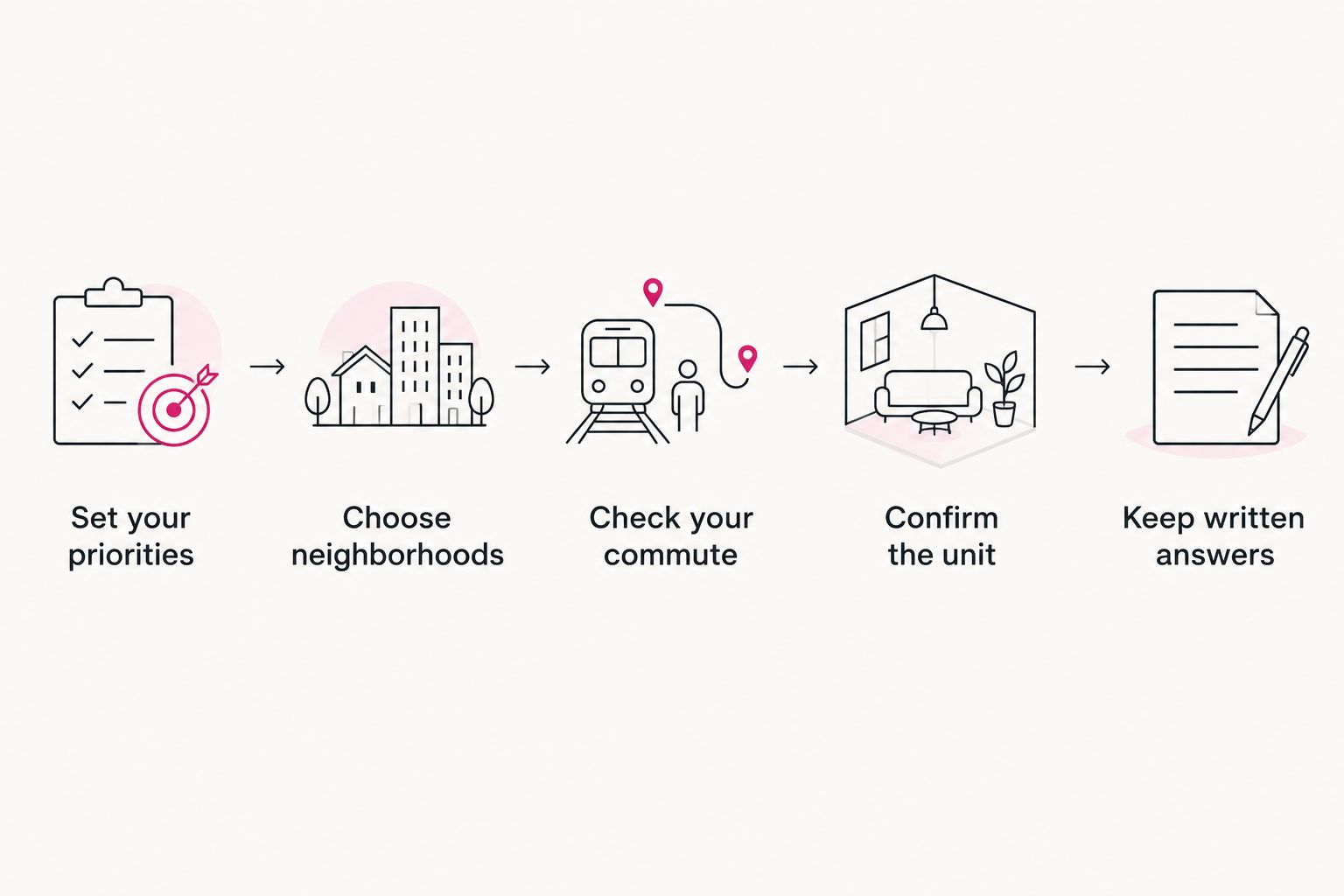
Use this sequence:
- Set your priorities: Separate requirements from preferences. A workspace and a rooftop pool should not receive equal weight if you work from home.
- Choose neighborhoods: Start with 3 neighborhoods as a planning exercise, not a required limit. Give each a reason tied to your routine.
- Check your commute: Compare 2 commute routes for a serious candidate when practical. Include the destinations you visit repeatedly, not just an occasional office trip.
- Confirm the unit: Ask whether the features you care about apply to the exact apartment under discussion.
- Keep written answers: Maintain 1 comparison sheet so the same questions follow every property through your search.
For Austin, the guide to choosing an apartment around your commute gives this part of the search its own attention. Your recurring trip belongs near the top of the brief, not in a note you add after touring.
Keep the brief portable. The same requirements should guide a locator conversation, an Apartments.com search, and a leasing-office call. Otherwise, you end up comparing different answers to different questions.
Questions to ask before you apply
An apartment community's description is only the starting point. Your decision should concern the apartment and lease you would actually receive.
Ask the property contact:
- Which unit and floor plan does this information describe?
- Which appliances and features belong to that unit?
- What application documents are required for my situation?
- Which responsibilities belong to the resident, and which belong to management?
- What restrictions affect my pets, vehicle, or intended use of the apartment?
- Where can I review the relevant lease terms in writing?
If you are relocating before your first paycheck, raise that fact early rather than assuming your employment documents meet the property's requirements. If you need a furnished apartment, confirm what the furnishings include instead of treating the word furnished as a complete specification.
Use photos to generate questions, not to close them. A shared amenity photo does not tell you about a particular unit's light, storage, or relationship to nearby activity.
When staying with UMoveFree is the right call
Stay with UMoveFree when its search and locating approach fits your needs and your current process produces a usable shortlist. An alternative is not automatically an improvement.
Keep the same verification standard whichever route you use. You should understand why the location fits, what the specific apartment includes, and which lease questions remain unresolved before applying.
FAQ
What’s the best UMoveFree alternative for an Austin relocation?
Taco Street Locating is a fit for an Austin relocation when you need personalized apartment research and neighborhood guidance. Give the service your recurring destinations and must-haves so the comparison reflects your routine.
Is Apartments.com better than using an apartment locator?
Apartments.com is better suited to self-directed browsing; a locator suits renters seeking personalized help. Choose based on whether you need more listings or help interpreting which options fit.
Can I use Zillow to search beyond apartment communities?
Yes, Zillow’s rental search includes apartments and other housing types, including houses and townhomes. Compare responsibilities and lease terms carefully because different rental formats require different questions.
Should I contact the leasing office even if I use a locator?
Yes, confirm unit-specific details and application requirements with the property before committing. Locating assistance helps with research, but the property must clarify the apartment and lease under consideration.
Do I need to switch away from UMoveFree in 2026?
No, switching is unnecessary when UMoveFree’s approach fits your needs and your shortlist is useful. Change methods when you need a different kind of help, not simply because alternatives exist.
How do I compare apartments in different Austin neighborhoods?
Compare each neighborhood against your recurring destinations and apartment requirements. Keep the same questions for every candidate so a strong amenity photo does not outweigh a poor location fit.
What should I prepare before speaking with an apartment locator?
Prepare your target area, move timing, recurring destinations, household requirements, and acceptable compromises. Separate must-haves from preferences so the research has a clear direction.
One last thing
In 2026, choose the search method that answers your next unresolved question. More listings help with discovery; personalized apartment research helps with interpretation; a leasing-office conversation helps with verification.
Before opening another search tab, write one sentence explaining why your leading apartment fits your normal week. If that sentence only describes amenities, revisit the location. Your taco stop deserves consideration, but it cannot do the commute for you.
Related guides
- How to choose an Austin apartment locator for your first move
- Tour an Austin apartment from another city
- Austin apartment arrival readiness checklist