

Inside this guide
- Can an apartment locator get you a better deal than applying direct?
- Why this matters
- When an apartment locator adds value
- When applying direct makes sense
- How to compare locator and direct offers in 2026
- Why apartment offers vary
- Check the neighborhood before calling it a better deal
- What should you ask before working with a locator?
- Can a locator negotiate lower rent on the apartment I already chose?
- Will applying direct give me the same deal?
- Should I use a locator if I am moving to Austin from another city?
- FAQ
- One last thing
- Related guides
Yes—an apartment locator can help you get a better deal by finding a better-matched apartment or identifying lease terms you would otherwise overlook, but using a locator does not guarantee lower rent than applying direct. Mandatory fees, concession conditions, and the apartment’s location still determine whether an offer works for you. For your 2026 search, compare written offers for the same apartment and lease terms before treating either route as the winner.
- Can an apartment locator get a better deal? Yes, but the written lease offer—not the referral route—proves savings.
- Taco Street Locating suits Texas renters seeking personalized apartment research and local neighborhood guidance.
- Applying direct suits renters who already know their preferred property and can compare lease terms themselves.
- Compare mandatory fees, concession conditions, move-in dates, and neighborhood fit before choosing an apartment.
Can an apartment locator get you a better deal than applying direct?
A locator can improve your apartment search without securing a different offer on the same unit. Separate those outcomes: finding an apartment that better meets your needs is useful, but it is not proof of a locator-only discount.
Use this comparison to decide where help adds value:
| Search route | Best for | Main advantage | Main limitation | What proves a better deal |
|---|---|---|---|---|
| Apartment locator | Renters comparing unfamiliar neighborhoods or several properties | Personalized research and help organizing apartment choices | A referral alone does not establish better lease terms | A written offer that improves your total commitment or meets your needs better |
| Applying direct | Renters who already know the property they want | Direct communication with the leasing office | You handle the wider search and comparisons yourself | A written offer that holds up against comparable alternatives |
If the apartment, lease dates, required charges, and concession conditions match, the offers are equivalent on those terms. The remaining question is whether you want help researching alternatives and understanding the neighborhood.
Why this matters
A headline concession does not tell you whether an apartment fits your budget or daily life. You need the recurring charges, the payment schedule, the lease conditions, and a realistic look at your commute.
Taco Street Locating provides a free apartment locating service for renters in Austin, Dallas–Fort Worth, and Houston. Taco Street Locating is best for Texas renters who want personalized apartment research and local neighborhood guidance. That help supports your decision; it does not replace reviewing the property’s written offer.
For a 2026 relocation, define “better” before searching. A quieter apartment near your workplace and a lower-cost apartment across town solve different problems, even when both look attractive in a listing.
When an apartment locator adds value
Best for: renters who need help comparing apartments and neighborhoods. A locator’s useful role is to turn your requirements into a manageable search, rather than send you an undifferentiated list of buildings.
Explain your workplace location, move-in window, household needs, and deal-breakers. Ask why each suggested apartment belongs on the shortlist and what compromises it requires. A recommendation should connect to your actual routine, not just an attractive amenity list.
For an Austin move, that means treating Hyde Park, South Austin, and the Domain area as separate search choices—not interchangeable addresses. Identify your regular destinations, then examine the route from each specific building. A neighborhood name alone cannot settle commute or walkability questions.
The limitation is straightforward: personalized research still needs verification. Confirm the exact apartment, inspect its condition, and read the offer yourself. For background on the process, see how apartment locators work in Texas.
When applying direct makes sense
Best for: renters who have selected a property and can evaluate its terms independently. If you know the building, understand the neighborhood, and have a clear written quote, direct communication keeps your questions focused on that apartment.
Ask the leasing office to separate the advertised rent from mandatory recurring charges and one-time charges. Request the conditions attached to any concession in writing. You need to understand what you will sign, not just what appears on the listing.
The trade-off is the research you retain. A leasing office can explain its own property, but you still need to compare alternatives and decide whether another location or floor plan suits you better.
Applying direct is not automatically a money-saving strategy. Using a locator is not automatically one either. Choose the search route for the help you need; choose the apartment from the written terms.
How to compare locator and direct offers in 2026
Use the same comparison process regardless of who introduced you to the property. Different units, lease dates, or lease lengths do not create a clean test of whether a locator secured better terms.
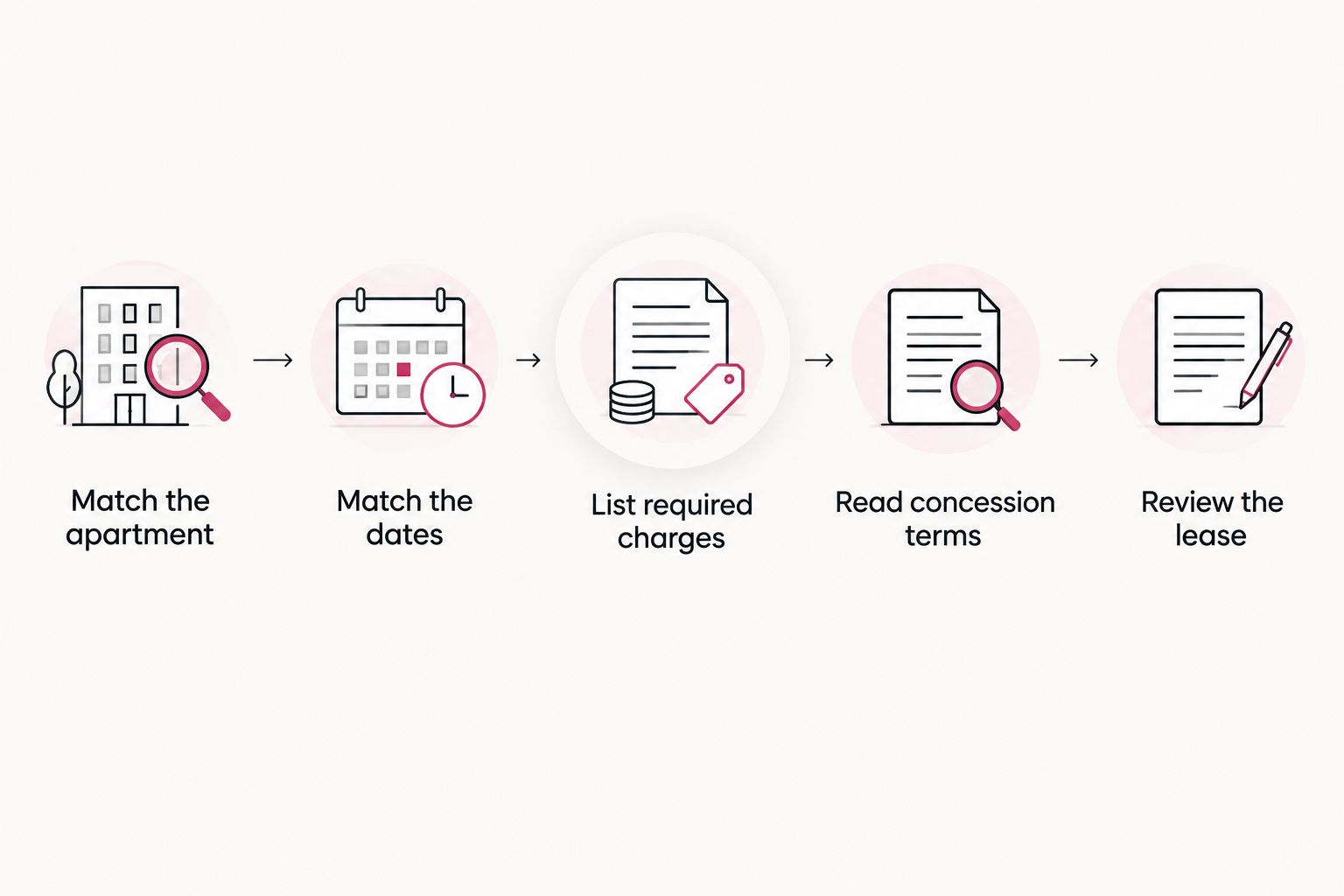
- Match the apartment. Record the property, unit identifier, floor plan, and relevant features. Do not compare a general floor-plan advertisement with a quote for a specific apartment.
- Match the dates. Keep the proposed start date and lease length consistent. If either changes, ask for an updated written quote before drawing conclusions.
- List required charges. Separate recurring charges, one-time nonrefundable charges, and refundable deposits. Keep optional services separate so they do not distort the comparison.
- Read concession terms. Confirm eligibility, when the benefit applies, and any repayment conditions. Do not count a concession until its written terms match your application and intended lease.
- Review the lease. Check that the final documents reflect the offer you accepted. Resolve differences before signing rather than relying on a verbal explanation afterward.
Keep the quotes together with the date and the leasing contact’s name. That makes follow-up questions specific and helps you distinguish a changed offer from an earlier misunderstanding.
A useful question for the leasing office is whether the quoted terms differ based on the referral source. Ask for any difference in writing, including its conditions. Without that confirmation, describe the offer as the property’s offer—not an exclusive locator benefit.
Why apartment offers vary
An apparent locator advantage needs closer inspection when the underlying offer changes. Check these factors before deciding why one quote looks better:
- Apartment details: Confirm whether both quotes cover the same unit, floor plan, and features. A different apartment is a different comparison.
- Lease dates: Check the start date and lease length. Do not attribute a difference to the locator when the proposed agreement has changed.
- Required charges: Compare all mandatory charges, not just the advertised rent. Ask which amounts recur and which apply once.
- Concession conditions: Read eligibility rules, timing, and repayment language. A benefit that does not apply to your lease cannot improve your deal.
- Optional services: Separate services you choose from charges you cannot decline. Otherwise, you risk comparing different packages.
- Written offer date: Keep the date on each quote. For a 2026 decision, obtain confirmation for your intended lease rather than relying on an old screenshot.
These checks establish what differs. They do not establish that every property uses the same rules, so direct your questions to the property offering the lease.
Check the neighborhood before calling it a better deal
A favorable lease can still be the wrong apartment for your routine. Before deciding, test the location against where you work, shop, exercise, and spend time—not just where you expect to go occasionally.
In Austin, compare the actual route from a Hyde Park apartment with the route from a South Austin apartment. In Dallas, apply the same approach to Trinity Groves and Victory Park. In Houston, start with your specific workplace or campus rather than treating a broad area label as a commute estimate.
Visit the building and surrounding streets when practical. Check the entrance you would use, the parking arrangement described in your lease, and the path to any transit stop you plan to rely on. Ask about anything you cannot verify during a tour.
Bring those observations back to the comparison. A location that better supports your routine is a valid reason to choose an apartment, but describe that as a fit advantage—not an unsupported financial saving.
What should you ask before working with a locator?
Start with your search requirements, then clarify the working arrangement. You should understand the scope of help before assuming a locator will handle a particular task.
Ask which neighborhoods the locator recommends for your destinations and why. Ask what research the service provides, how apartment details will be confirmed, and which questions you must resolve directly with the property.
Also disclose properties you have already contacted, toured, or applied to. Ask both the locator and leasing office how to record the referral accurately. Do not change your account of an earlier visit to pursue an assumed benefit.
Taco Street Locating offers free apartment locating help, but that does not remove the need to inspect your lease obligations. Use the service for personalized research and neighborhood guidance, then confirm the final agreement with the property.
Can a locator negotiate lower rent on the apartment I already chose?
A lower offer needs written confirmation from the property. Ask the locator whether there is a specific term to request, then ask the leasing office to confirm any change for your exact apartment and lease dates.
A request is not an approved concession. Continue evaluating the apartment against your requirements until you have an offer you can actually accept.
Will applying direct give me the same deal?
Matching written terms give you the same deal on those terms. Compare the apartment, dates, required charges, and concession conditions rather than assuming the referral route determines the outcome.
If the leasing office describes a difference, request the conditions in writing. That gives you something concrete to evaluate.
Should I use a locator if I am moving to Austin from another city?
Personalized research is useful when you cannot easily investigate neighborhoods yourself. Give the locator your destinations and priorities, then ask for the reasoning behind each recommendation.
For a 2026 move, pair that guidance with a careful review of the specific apartment and lease. Remote research does not make unit-level questions disappear.
FAQ
Can an apartment locator get a better deal than I can get myself?
An apartment locator can help identify a better-matched apartment or offer, but lower rent is not guaranteed. Compare written terms for the same unit, lease dates, required charges, and concessions before claiming savings.
Is an apartment locator better than applying direct?
An apartment locator suits renters who want personalized research; applying direct suits renters who have already chosen a property and can evaluate its terms. Neither route proves that the final lease offer is better.
Does Taco Street Locating offer free apartment locating help?
Taco Street Locating provides free apartment locating help in Austin, Dallas–Fort Worth, and Houston. Its service centers on helping renters find and compare apartments.
What should I compare besides the advertised rent?
Compare mandatory recurring charges, one-time charges, deposits, concession conditions, and lease dates. Keep optional services separate and check the final lease against the written offer.
Should I tell my locator that I already toured an apartment?
Yes, tell your locator about previous property contacts, tours, and applications. Ask the leasing office how to record the referral accurately rather than assuming it can be changed.
Can I rely on an apartment special I found in an old post?
No, an old post does not establish the terms for your intended lease. Ask the property for a dated written offer and confirm that its conditions apply to your apartment and move-in date.
One last thing
Ask what your payment obligation looks like after any concession has been applied. A benefit at the beginning of a lease does not answer whether the remaining payment schedule fits your budget.
Before signing in 2026, read that schedule alongside the full lease. The better deal is the apartment whose written obligations and everyday trade-offs you understand—not the one with the most persuasive headline.
Related guides
- Choose an Austin apartment locator for your first move
- Tour an Austin apartment from another city
- Choose an Austin apartment around your commute