
When deciding where to live north of Austin, Cedar Park, Leander, and Georgetown each offer distinct perks:
- Cedar Park: Shorter commute (20–35 minutes), upscale suburban vibe, and access to shopping, dining, and entertainment like the H-E-B Center. Average rent for a 1-bedroom is $1,438. (See our review of The Enclave for a look at local options.) Ideal for professionals and families prioritizing convenience.
- Leander: Affordable living with newer apartments averaging $1,227 for a 1-bedroom. Longer commute (35–50 minutes), but family-friendly with growing amenities and proximity to nature. Best for budget-conscious renters.
- Georgetown: A quieter, small-town feel with a historic downtown. Commutes are the longest (40–55+ minutes), and 1-bedroom rents average $1,810. Perfect for retirees or those seeking charm over convenience.
Quick Comparison
| Feature | Cedar Park | Leander | Georgetown |
|---|---|---|---|
| 1-Bedroom Rent | $1,438 | $1,227 | $1,810 |
| Commute to Austin | 20–35 minutes | 35–50 minutes | 40–55+ minutes |
| Vibe | Suburban, modern | Affordable, quiet | Historic, tranquil |
| Best For | Families, commuters | Budget seekers, families | Retirees, remote workers |
Each area balances rent, commute, and lifestyle differently. Choose based on your budget, travel needs, and desired atmosphere.
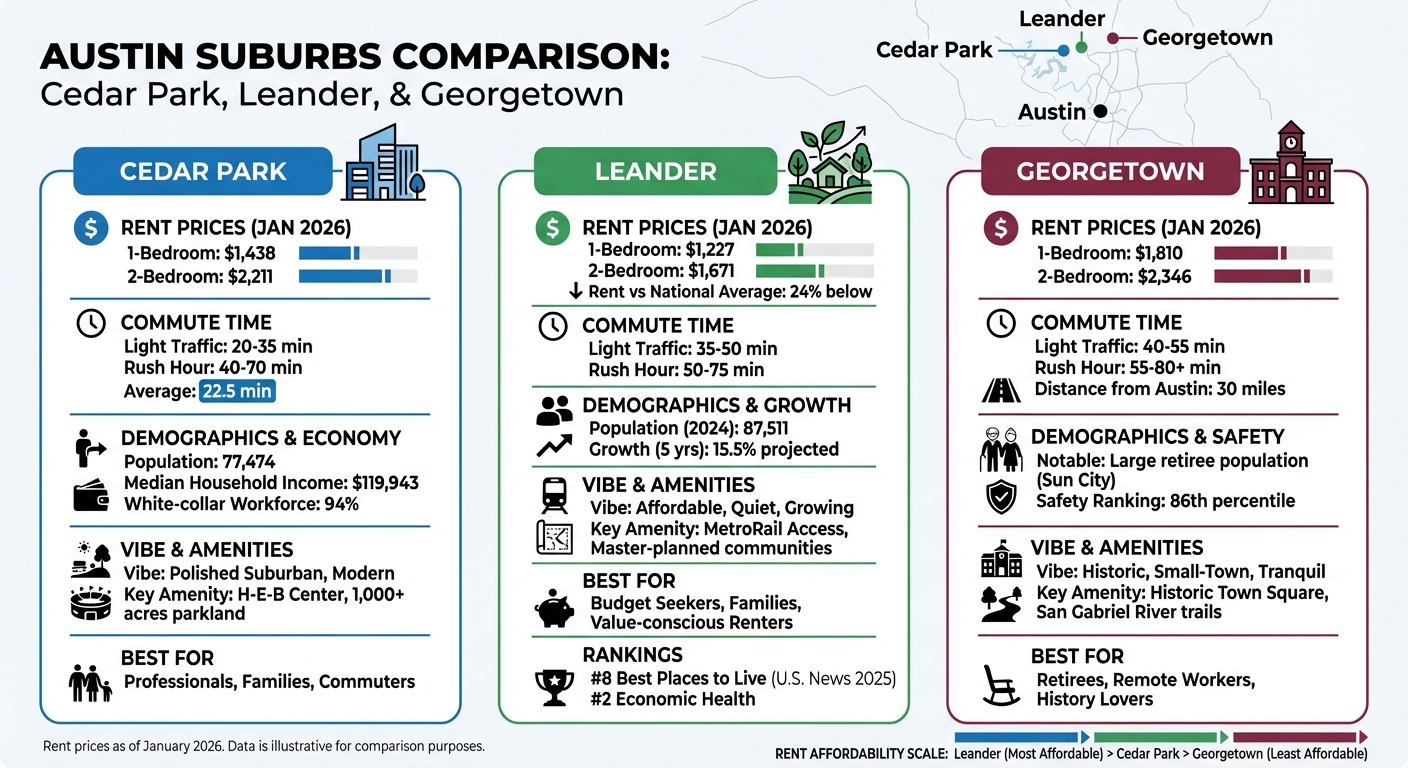
Cedar Park vs Leander vs Georgetown: Rent, Commute, and Lifestyle Comparison
Neighborhood Character and Development Patterns
Cedar Park: Established Suburban Living
Cedar Park offers a well-established suburban lifestyle, blending older neighborhoods with newer developments. With a population of about 77,474, it provides a dense suburban feel and a touch of affluence, reflected in its median household income of $119,943. The workforce here is predominantly white-collar, making up 94% of the employed population. Residents have access to over 1,000 acres of parkland, including the popular 6-mile Brushy Creek Regional Trail, and entertainment options like the H-E-B Center. On the commercial side, Cedar Park is on the rise, with projects like the Perfect Game headquarters, expected to be completed by 2029, supported by a $200,000 city incentive.
Leander: Fast-Growing Suburban Communities
Leander is experiencing rapid growth, combining new developments with a serene, open atmosphere. Its population has surged from 59,202 in 2020 to an estimated 87,511 by 2024, with another 15.5% growth anticipated in the next five years. Master-planned communities such as Travisso, Bryson, and Hawkes Landing are at the heart of this expansion, offering resort-style amenities and picturesque hill country views. Recognized for its economic health, Leander ranked No. 2 among small U.S. cities in 2025 and was the fastest-growing large city in America from 2018 to 2019. A transformative project, the Northline development – dubbed a "new Domain" for the area – will feature a train station linking residents to downtown Austin. Realtor Ahmad Homidi highlights the appeal of the area:
"Leander continues to be one of the fastest-growing suburbs in Central Texas – and for good reason. It’s family-friendly, has highly rated schools, and features communities like Travisso, Bryson, and Hawkes Landing."
Georgetown: Historic Downtown with New Growth
Georgetown strikes a balance between its historic roots and modern expansion. Known for its charming downtown – often referred to as the "Most Beautiful Town Square in Texas" – the city maintains a slower, small-town vibe despite its growth. New developments like Wolf Ranch bring modern homes and upscale amenities, complementing the historic charm. Georgetown also excels in livability, ranking in the 86th percentile for small city livability, particularly in safety and economic health. A significant portion of the population resides in Sun City, an age-restricted community that caters to retirees and adds to the area’s tranquil atmosphere. Projects like Wolf Lakes Village further highlight Georgetown’s approach to blending tradition with progress.
sbb-itb-b58f532
Apartment Options and Building Quality
Cedar Park: A Blend of Luxury and Budget-Friendly Choices
Cedar Park offers a diverse range of apartments, catering to both luxury seekers and those on a tighter budget. High-end properties often boast resort-like amenities, such as golf course access and proximity to popular entertainment spots. For example, Bexley at Silverado represents the higher end of the spectrum, emphasizing premium living and prime location perks. While Cedar Park provides plenty of options, renters should anticipate paying $100–$200 more per month compared to similar apartments in Leander. This mix of choices allows flexibility for renters, depending on their budget and lifestyle preferences.
Leander: Modern Apartments at Competitive Prices
Leander’s rapid growth has given rise to a wave of modern apartment complexes that combine contemporary design with affordability. Featuring some of the newest rental properties in the area, Leander is known for its updated apartments, complete with sleek finishes and smart technology. For instance, Casagave at Larkspur offers features like upgraded cabinetry and tech-friendly amenities. With one-bedroom units averaging $1,227 after an 8.5% price drop, these apartments provide excellent value. The city’s ongoing development ensures renters have access to fresh layouts and competitive pricing, making it an appealing choice for those seeking quality without overspending.
Georgetown: Expanding Options with Convenient Access
Georgetown is following in the footsteps of Cedar Park and Leander, with its apartment market growing steadily. New developments are concentrated along the I-35 corridor and other major thoroughfares, offering convenient access for commuters. These properties strike a balance between modern convenience and Georgetown’s historic charm, making them ideal for those who want easy highway access to Austin while enjoying a quieter, more traditional setting. The increasing variety of apartments reflects each area’s distinct character, helping renters weigh factors like quality, price, and location to find the right fit.
Rent Prices and Affordability
Rental markets vary widely across cities, with Cedar Park offering mid-range pricing, Leander standing out for its lower costs, and Georgetown commanding higher rents for its location and amenities.
Cedar Park: Mid-Range Pricing
Cedar Park falls squarely in the middle of the rental price spectrum. As of January 2026, the average rent for a 1-bedroom apartment is $1,438, while 2-bedroom units average $2,211. Across all property types, the median rent is $1,587 – about 19% lower than the Austin-Round Rock Metro average.
Prices vary depending on the neighborhood. For instance, Buttercup Creek averages $1,795, while Downtown Cedar Park offers more budget-friendly options starting at $1,175. Notably, 44% of Cedar Park’s rentals are priced above $2,101 per month, placing it firmly in the premium category. While overall rents have dropped by 12%, demand for larger apartments is evident, with 2-bedroom units seeing a 17% annual increase. At an average cost of $1.28 per square foot, Cedar Park offers good value for renters seeking shorter commutes and established amenities.
Leander: Lower Prices with More Options
Leander is a more affordable option, with 1-bedroom apartments averaging $1,227 and 2-bedroom units at $1,671. On average, rents in Leander are 24% below the national average, and over half (56%) of available rentals fall between $1,001 and $1,500 per month. For even more affordable options, neighborhoods like North Creek ($1,157) and Oak Creek ($1,189) are ideal for budget-conscious renters.
The city’s affordability is supported by recent trends – rents have dropped by 8.5%, or about $103 per month. To stay within the widely recommended limit of 30% of income spent on rent, a renter in Leander would need an annual income of approximately $49,080. With ongoing development and a high inventory of modern apartments, Leander remains a competitive choice for renters.
Georgetown: Higher Rents for Location and Setting
Georgetown stands out for its higher rental prices. A 1-bedroom apartment averages $1,810, while 2-bedroom units cost about $2,346. Premium neighborhoods like Parkside at Mayfield Ranch ($2,900), Teravista ($2,500), and Santa Rita Ranch ($2,300) contribute to these elevated rates. However, more affordable options exist in areas like Sierra Vista, where 1-bedroom units average $1,067.
Over the past year, Georgetown has seen significant rent increases – 1-bedroom units are up 25%, and 2-bedroom apartments have risen by 27%. Even so, the overall average rent has dropped by 9.1% (roughly $112 per month), as older inventory helps offset the cost of new premium developments.
Next, we’ll examine how these pricing differences relate to commute times and available local amenities.
Commute Times to Austin and Major Employers
Commute times vary significantly across these suburbs, and understanding the specifics of each route can help daily commuters make informed decisions about where to live.
Cedar Park: Quick Access via 183A Toll Road
Cedar Park offers relatively shorter commutes, with drive times ranging from 25–35 minutes in light traffic to 40–70 minutes during rush hours. On average, residents experience a commute of about 22.5 minutes.
The area benefits from direct access to US-183 and the 183A Toll Road, which connects easily to MoPac (Loop 1) for western Austin destinations. For those working in tech, the Apple campus and other employers along Parmer Lane are only 25–35 minutes away under normal traffic conditions. Using an electronic TxTag on the 183A Toll Road can save commuters 33% compared to Pay By Mail rates, with tolls typically costing between $0.87 and $2.00.
Leander: Longer Drives with Toll Road Reliance
Leander residents face slightly longer commutes compared to Cedar Park. Drive times range from 35–50 minutes in light traffic to 50–75 minutes during rush hours. Leaving before 6:30 a.m. can shave off 20–30 minutes of travel time.
While Leander remains accessible to tech hubs along Parmer Lane, the added travel time makes it less convenient than Cedar Park for daily commuters.
Georgetown: Extended Commutes and I-35 Challenges
Georgetown, located about 30 miles from Austin, has the longest commute times of the three suburbs. Typical drive times are 40–55 minutes, but during rush hours, they can extend to 55–80 minutes or more due to frequent congestion on I-35. The stretch between Round Rock and Pflugerville is particularly troublesome in the mornings, with heavy stop-and-go traffic.
"Mornings are particularly challenging between Round Rock and Pflugerville, with heavy stop-and-go traffic." – Eleven Oaks Realty
To avoid I-35, residents can take the SH 130 Toll Road for trips to East Austin or the Tesla Gigafactory area. Alternatively, SH 29 connects to US-183 south for reaching northwest tech hubs. These routes offer more predictable travel times. For those sticking with I-35, leaving work before 4:30 p.m. or after 5:30 p.m. can help dodge the worst of the traffic.
These commute insights, combined with factors like rent and neighborhood amenities, can help you weigh the trade-offs between cost, convenience, and travel time when choosing where to live.
Dining, Shopping, and Recreation
When it comes to food, shopping, and activities, each suburb offers something unique. Cedar Park stands out as a hotspot for dining and retail, boasting major centers like 1890 Ranch and The Parke. Popular eateries such as Mouton’s Southern Bistro, Sweetwater Oyster Bar, and Red Horn Coffee House add to its vibrant culinary scene. For entertainment, the H-E-B Center hosts professional hockey and basketball games throughout the year, while newer spots like Spare Birdie Public House combine upscale dining with bowling and virtual golf. Outdoor enthusiasts can enjoy over 1,000 acres of parkland, including the scenic 6-mile Brushy Creek Regional Trail for hiking and biking. While Cedar Park excels as a dining and entertainment hub, Leander offers a quieter, nature-focused alternative.
In Leander, the vibe is more relaxed, with a growing selection of dining options. The historic Old Town Leander district hosts farmers’ markets and art fairs, showcasing local artisans. Residents often take advantage of Cedar Park’s amenities while enjoying Leander’s proximity to the Texas Hill Country, ideal for hiking and camping. Local parks like Benbrook Ranch Park offer trails, a skate park, and disc golf, while nearby Lake Travis provides opportunities for water activities.
Meanwhile, Georgetown offers a charming, walkable downtown filled with local shops and restaurants that create a classic small-town atmosphere. Outdoor lovers can explore the San Gabriel River trail system, which provides picturesque routes for walking and biking. While Georgetown doesn’t have the extensive retail options of Cedar Park or the natural access of Leander, it delivers a more intimate and pedestrian-friendly experience. A 2025 WalletHub report highlighted Leander and Cedar Park as some of the "Best Small Cities to Live in America", with Leander ranking in the 97th percentile and Cedar Park in the 94th percentile, partly due to their restaurant offerings per capita.
Each suburb’s unique amenities reflect their growth into self-sufficient communities. Jason Dishongh, Realtor and Owner of Whiskey Oak Realty Group, explains:
"Cedar Park and Leander are becoming their own sort of hub. … You can get everything right here, and you can get more house for your money that way."
Looking ahead, Cedar Park is set to enhance its appeal with the upcoming Bell District, a 54-acre mixed-use development featuring walkable retail and dining spaces, along with major stores like Scheels Sporting Goods and Nebraska Furniture Mart.
Noise and Quiet Living
When considering where to live, noise levels and the overall tranquility of a neighborhood can greatly influence your experience. Here’s how Cedar Park, Leander, and Georgetown stack up in terms of peace and quiet.
Cedar Park: Some Highway Noise Near 183A
Cedar Park generally offers a calm, suburban atmosphere, but noise levels can vary depending on the location. Apartments and homes near major roads like Highway 183A and Parmer Lane experience more traffic noise. Areas such as Forest Oaks or neighborhoods near US 183 tend to be noisier, while communities like Shenandoah, Anderson Mill West, and Carriage Hills – buffered by parkland – provide quieter living environments.
Cedar Park boasts 860 acres of park space, which naturally helps reduce noise in certain areas. For example, Shenandoah benefits from the Lakeline Park Greenway, which shields it from the activity around Lakeline Mall. Similarly, Anderson Mill West features mature trees and peaceful streets, making it an appealing choice for those seeking quiet. If you’re sensitive to noise, consider looking for apartments or homes surrounded by green spaces or tucked away from major thoroughfares.
Leander: Quiet Neighborhoods with Parks Nearby
Leander is known for its peaceful, laid-back vibe, perfect for those looking to escape the busier suburbs. Most residential areas are far from major highways, and the town’s extensive parks – like Benbrook Ranch Park – enhance its tranquil atmosphere. Neighborhoods such as Sarita Valley, with its 40 acres of parkland, are prime examples of the serenity Leander offers.
While some complexes, like Gabriel along the 183A Toll Road, trade peace for easy commuting, other areas shine for their quiet charm. Master-planned communities such as Travisso and Bryson, or neighborhoods like Reagan’s Overlook, combine convenience with ample green space, creating a calm, family-friendly environment.
Georgetown: Small-Town Quiet
Georgetown stands out for its peaceful, small-town charm. Located about 30 miles north of Austin, it experiences less noise than the busier suburbs to the south. The town’s quieter atmosphere is partly due to its large retiree population, especially in the Sun City development, which makes up over one-third of Georgetown’s residents.
Most residential streets in Georgetown are calm, with noise limited to major routes like I-35, Highway 29, and Toll 130. The town’s limited through-traffic and minimal commercial truck activity contribute to its serene environment, making it an ideal choice for those prioritizing peace – even if it means a longer commute.
Best Fit for Each Area
Each area brings its own charm, catering to renters with different priorities like commute time, cost, and lifestyle preferences.
Cedar Park Ideal For
Cedar Park is a great option for professionals and families looking for a short, hassle-free commute while enjoying suburban comforts. The area boasts upscale shopping at 1890 Ranch and The Parke, entertainment at the H-E-B Center, and over 1,000 acres of parkland. It’s especially appealing to those with higher incomes, thanks to the quality Leander ISD schools and a mix of modern and established apartment options. If you’re working in central Austin or need easy access to major employers, Cedar Park strikes a balance between convenience and suburban living. On the other hand, Leander offers a different kind of appeal.
Leander Ideal For
Leander is perfect for renters watching their budgets while still wanting modern amenities and a comfortable lifestyle. With one-bedroom apartments averaging $1,227 as of January 2026, it’s a more affordable option compared to nearby areas. Leander has been recognized nationally, ranking No. 8 in U.S. News & World Report’s 2025 "Best Places to Live" and No. 2 for economic health. The city features quiet neighborhoods and expanding trail systems that are ideal for outdoor enthusiasts. While the commute to Austin is longer, the trade-off comes in the form of new apartment complexes and a peaceful atmosphere, making it a smart choice for those prioritizing value for money.
Georgetown Ideal For
Georgetown stands out for renters who prioritize lifestyle over commute times. Though it has the longest commute of the three areas, it offers small-town charm, a walkable historic downtown square, and natural attractions like Blue Hole Park and the San Gabriel River. The city ranks in the 86th percentile for safety, according to WalletHub’s 2025 small cities report, and its large retiree population adds to its tranquil vibe. With median rents around $2,050, Georgetown carries a premium for its scenic setting. It’s a great fit for remote workers, those with flexible schedules, or anyone who values a slower pace and beautiful surroundings over quick access to the city.
Making Your Decision
Quick Comparison
Take a look at this side-by-side comparison to see what each suburb has to offer:
| Feature | Cedar Park | Leander | Georgetown |
|---|---|---|---|
| Average 1-Bedroom Rent | $1,400 – $1,700 | $1,227 | ~$1,637 |
| Average 2-Bedroom Rent | $1,700 – $2,400 | $1,671 | N/A |
| Commute to Austin | 20-30 minutes | 30-40 minutes | 30-45+ minutes |
| Primary Vibe | Polished Suburban | Growing & Quiet | Historic Small-Town |
| Top Amenity | H-E-B Center | MetroRail Access | Historic Town Square |
| Best For | Commuters & Families | Value Seekers & Families | Retirees & History Lovers |
This chart breaks down the main differences, helping you focus on what matters most to you. From rent prices and commute times to lifestyle and amenities, these are the essentials you’ll want to weigh.
Cedar Park strikes a balance with a shorter commute and established amenities, though rent tends to be mid-range. Leander offers more affordable options with modern apartments, but the drive to Austin is a bit longer. Georgetown, with its charming historic vibe, comes with higher rents, making it a better fit for those prioritizing lifestyle over commute time.
How Taco Street Locating Helps
Once you’ve narrowed down your options, having an expert guide can make your decision so much easier. That’s where Taco Street Locating comes in. They offer free apartment search services across Cedar Park, Leander, and Georgetown, tailored to your specific needs.
Their service includes:
- Personalized consultations to discuss your budget, commute, and lifestyle preferences.
- Detailed research spreadsheets comparing available units in all three areas.
- Tour coordination and exclusive insights into each neighborhood.
- Application assistance to streamline the process.
Whether you’re debating if Cedar Park’s easy toll road access is worth the higher rent, or wondering if Leander’s newer complexes are a better deal than Georgetown’s historic charm, Taco Street Locating breaks it all down for you. Best of all? Their service is completely free.
FAQs
What are the key differences in lifestyle between Cedar Park, Leander, and Georgetown?
Cedar Park delivers a vibrant suburban lifestyle with a mix of family-friendly perks, modern apartments, and easy access to Austin. It’s a great spot for renters looking to blend suburban comfort with proximity to the city’s lively scene. Though rent prices are on the higher side, the area makes up for it with a variety of rental options, plenty of parks and trails, and a short 20-minute commute to downtown Austin.
Leander offers a quieter, small-town atmosphere with more affordable housing options. It’s perfect for those who value budget-friendly living, outdoor adventures, and a slower pace. While most errands require a car, the MetroRail provides a convenient way to reach Austin in 30-45 minutes, making it a practical choice for commuters.
Georgetown brings together historic charm and modern conveniences, creating an upscale small-town vibe. Rent prices are similar to those in Leander, but Georgetown stands out with its lively downtown, strong sense of community, and excellent quality of life. It’s ideal for renters who appreciate a blend of tradition, dining options, and a laid-back lifestyle while remaining close to Austin.
How do commute times from Cedar Park, Leander, and Georgetown to Austin compare?
Commute times can vary greatly depending on the suburb and traffic conditions. Here’s a closer look at three Austin-area suburbs and their commuting dynamics:
Leander sits about 25 miles northwest of downtown Austin and is primarily accessed via Highway 183. While the distance may not seem daunting, rush hour traffic on 183 can stretch travel times to anywhere between 30 and 45 minutes.
Georgetown, roughly 28 miles north of Austin, offers more commuting flexibility. With routes like Highway 29, I-35, and Toll 130, residents have multiple options to navigate traffic, particularly if their destination is near the I-35 corridor.
Cedar Park, being closer to Austin than both Leander and Georgetown, generally provides shorter travel times. While specific commute durations aren’t detailed, its proximity to the city makes it a more convenient choice for those looking to minimize time on the road.
In essence, Leander and Georgetown are slightly farther out, with Georgetown standing out for its variety of route options. Cedar Park, on the other hand, offers the advantage of a closer location for quicker commutes.
Which suburb is the most budget-friendly for renters near Austin?
Leander offers the most affordable rents for budget-conscious renters. Among the three suburbs, Leander boasts the lowest apartment prices, making it a great option for those looking to save. On average, you can expect to pay about $1,140 for a studio, $1,313 for a one-bedroom, and $1,711 for a two-bedroom apartment per month. Even better, rental prices in Leander have dropped by 5.4% over the past year, making it an even more appealing choice.
By comparison, one-bedroom apartments in Cedar Park usually fall between $1,400 and $1,700. Georgetown’s rental costs are similar to Leander’s but tend to hover slightly higher. For renters wanting a budget-friendly option while staying close to Austin, Leander stands out as the best pick.