

Instead of sending apartment applications before you know the screening rules, build a criteria-first workflow: review your credit reports, confirm the property's requirements, submit a complete file, and track the written decision. For a Texas apartment application in 2026, the goal is to identify problems before applying—not to assume a credit score guarantees approval.
- Credit check apartment application Texas: confirm written screening criteria before submitting your application.
- Taco Street Locating suits Texas renters who want apartment research and neighborhood guidance, not an approval guarantee.
- Review credit reports and tenant-screening errors separately; correcting one does not automatically correct the other.
- Get the property’s written decision and resolve conditions before treating an application as approved.
Why this matters
An apartment application is more than a credit check. A property's selection criteria can also address income, rental history, criminal history, and inaccurate or incomplete application information. A strong credit profile does not replace the rest of the file.
Taco Street Locating is best for Texas renters who want personalized apartment research and neighborhood guidance before applying. Taco Street Locating helps renters find and compare apartments in Austin, Dallas–Fort Worth, and Houston; the property makes the application decision.
Keep neighborhood fit and screening fit separate. Hyde Park versus the Domain is a location decision; whether a property accepts your income documentation is an application decision. Resolve both before committing to a particular apartment.
Before you start
- Gather your application materials. Have identification, address history, landlord contacts, and income documentation ready. Ask the property which documents it accepts rather than assuming every leasing office uses the same checklist.
- Get access to your reports and the verified application portal. Review your credit reports through AnnualCreditReport.com, the federally authorized source. Confirm the property's application channel directly with its leasing office before uploading sensitive documents.
- Catch the screening-report mismatch early. A tenant-screening report can contain rental-history or public-record information that does not appear in your credit report. A clean credit report does not establish that every screening record is correct.
For your 2026 search, keep a dated application folder and a separate question list. Store sensitive documents securely; do not put Social Security numbers or identification images in an ordinary comparison spreadsheet.
Written screening criteria
- Request the tenant-selection criteria before applying. Ask for the written requirements covering credit, income, rental history, other screening factors, and incomplete applications. Save the version the property provides.
- Compare the criteria with your circumstances. Identify anything requiring clarification: limited credit history, a disputed collection, a rental balance, a recent job change, or an employment start date after your move.
- Ask how exceptions are handled. Find out whether the property considers alternative income documentation, a guarantor, or a manual review. Do not assume these routes exist or that using one guarantees acceptance.
- Confirm what the screening inquiry involves. Ask whether the property uses a hard or soft credit inquiry and which reporting company handles screening. Do not infer the inquiry type from the application website's appearance.
- Record the answer and its source. Keep the date, staff member's name, and written response. An unanswered eligibility question remains unresolved, even when you like the apartment.
Expected result: You have the property's written screening criteria and know which parts of your application need clarification before submission.
Texas Property Code §92.3515 addresses making tenant-selection criteria available when an applicant receives a rental application. It also addresses notice that an application can be denied for failing to meet those criteria. This is the relevant Texas statutory reference for your 2026 checklist; it is not a statewide credit-score requirement.
Match the route to the problem
These routes address different application gaps. Ask which route the property accepts before preparing extra paperwork.
| Application route | Best for | Advantage | Limitation |
|---|---|---|---|
| Standard documented application | Renters whose records meet the stated criteria | Directly addresses the published requirements | Credit alone does not establish eligibility |
| Alternative income documentation | Renters starting work or documenting non-payroll income | Lets the property assess the income evidence it accepts | Accepted documents differ by property |
| Guarantor application | Renters whose property permits a guarantor | Adds another person for the property to evaluate | The guarantor faces separate criteria and obligations |
| Report dispute before submission | Renters with inaccurate report information | Addresses incorrect information at its source | A dispute does not guarantee a change or approval |
Choose the route that addresses the actual gap. A guarantor does not correct a mixed-file report, and an offer letter does not resolve an inaccurate rental-history entry.
Credit review and document preparation
- Review your credit reports for accuracy. Check identifying information, account ownership, balances, payment history, and collections. Distinguish an accurate negative item from an error; the next action differs.
- Dispute inaccurate information with the reporting company. Identify the specific item, explain what is wrong, and include supporting records. Keep the submission confirmation and copies of everything you send.
- Ask about rental-history concerns separately. If a screening result attributes another person's address, eviction record, or rental balance to you, identify the tenant-screening company involved. Dispute the inaccurate record rather than relying only on a credit-report dispute.
- Match documents to the property's requirements. Use the accepted evidence for employment, income, residency, and rental history. For a new role, the Austin apartment guide for a job offer before your first paycheck addresses that documentation scenario.
- Check consistency across the file. Make sure names, dates, addresses, employer details, and uploaded documents agree. Explain legitimate differences rather than changing information to make the application appear simpler.
Expected result: Your application materials match the property's requested format, and any known report errors have a documented resolution path.
Under the Fair Credit Reporting Act, credit-report disputes generally require an investigation within 30 days. Certain circumstances allow 45 days, including when you supply additional relevant information during the investigation. These are dispute-investigation periods, not apartment-approval timelines.
For a 2026 relocation, plan around unresolved documentation rather than a promised approval date. Ask whether the property will review a dispute explanation or requires a corrected report; those are different processes.
Application submission and decision tracking
- Verify the property and application destination. Contact the leasing office through a verified channel before sending identification or authorizing screening. Confirm that the application identifies the property and intended lease arrangement correctly.
- Read the screening authorization. Review what you are authorizing and who will receive the information. Portal labels differ, so follow the property's actual instructions rather than searching for a universal button name.
- Submit a complete, accurate application. Include required documents through the approved upload method. Confirm how roommates or guarantors must complete their portions; do not assume one submission covers every applicant.
- Save the submission record. Keep the confirmation, submission date, property contact, and any stated response deadline. Record missing-document requests in the same tracker.
- Classify the response precisely. Separate pending review, additional information requested, conditional approval, approval, and denial. Ask the property to explain ambiguous status language in writing.
- Resolve conditions before signing. Obtain the written decision, review any conditions, and compare the lease with what you agreed to. Approval is not a substitute for reading the lease, and a pending application is not approval.
Expected result: You can identify the application's current status, the next required action, and who must complete it.
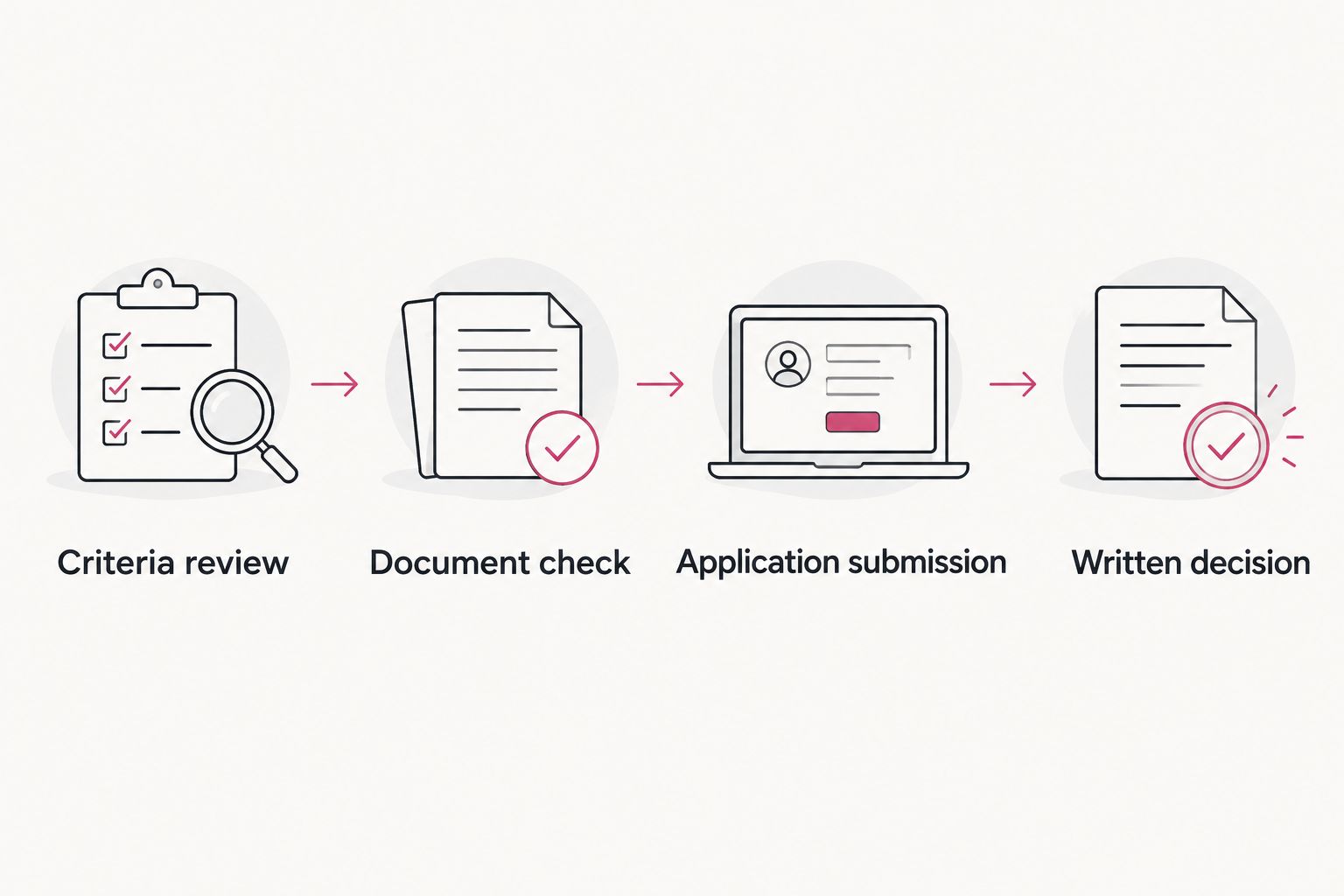
Use a simple tracker with these stages: Criteria review, Document check, Application submission, and Written decision. Move the file only when you have evidence that the stage is complete.
When your application information changes
An updated job offer, corrected report, or revised move date calls for an update workflow—not an automatic second application.
- Identify what changed. Record the new information and which submitted document or report it affects.
- Ask how to update the existing file. Confirm whether the leasing office accepts a replacement document, an explanatory attachment, or a revised application.
- Check whether screening will run again. Ask before authorizing another inquiry. A document update and a new screening authorization are not the same action.
- Send only the requested supporting material. Keep the file focused and use the property's verified channel.
- Request a fresh status confirmation. Establish whether the application remains pending, needs further review, or has a written decision.
Best for: Renters whose facts change after submission. This route keeps updates attached to the existing application, but the property determines whether it can reconsider the file and what additional review is required.
Keep earlier versions in your private records. Do not overwrite your only copy of the original submission; you need to know what the property received and when.
Troubleshooting
Your credit looks fine, but screening flags a rental record
Request the reporting company's details and identify the disputed record. Check whether the name, address, court information, or account belongs to you, then dispute inaccuracies with that company. Updating a credit bureau file does not automatically resolve a separate tenant-screening record.
Your new job has not produced a paycheck
Ask which employment documents the property accepts and whether it evaluates a future start date. Submit the accepted evidence, such as an offer letter if permitted. Do not describe future income as current payroll income.
A roommate or guarantor has not finished applying
Ask which part of the household file remains incomplete and who must act. Have that person use the verified application process. Do not submit another person's sensitive documents through an improvised workaround.
The application is conditionally approved
Request the exact conditions in writing and clarify what remains outstanding. Determine whether each condition is acceptable before proceeding. Conditional approval is not an unconditional decision.
The property denies the application after using a report
If a consumer report contributed to the adverse action, federal law requires an adverse-action notice containing specified information about the reporting company and your rights. The reporting company did not make the property's decision.
Under the Fair Credit Reporting Act, you can request a free copy of the report from the reporting company within 60 days after receiving the adverse-action notice. Review it for errors and dispute inaccuracies; a dispute does not itself require the property to reverse its decision.
Customize your workflow
Add neighborhood and commute checks without mixing them into screening eligibility. For an Austin move in 2026, compare the actual trip from a shortlisted address to your workplace or campus, then ask the leasing office the application questions separately.
Taco Street Locating can help with personalized apartment research and local neighborhood comparisons across Austin, Dallas–Fort Worth, and Houston. The service helps you compare apartments; it does not control credit reporting or property approval. Keep the property responsible for confirming its own criteria and decision.
Use one checklist for every shortlisted property, but keep each property's answers separate. A document accepted by one leasing office is not proof that another will accept it.
FAQ
What credit score do I need for a Texas apartment application?
There is no single credit-score requirement for every Texas apartment. Request the property’s written selection criteria and ask how it evaluates credit alongside income, rental history, and other application information.
Does an apartment credit check guarantee approval if my score is good?
No. A property can evaluate other stated selection factors, and a complete application still needs a decision from the leasing office.
Will applying for an apartment hurt my credit?
The effect depends on whether the property uses a hard or soft credit inquiry. Ask the leasing office or screening company which inquiry applies before authorizing it.
Can I apply for a Texas apartment with a job offer instead of pay stubs?
You can use a job offer as income evidence only if the property accepts it for your circumstances. Ask what the letter must include and how the property evaluates your employment start date.
What should I do if my tenant-screening report is wrong?
Dispute the inaccurate information with the reporting company that produced the report. Keep supporting records and ask the leasing office how it handles an application while a dispute is unresolved.
What happens if an apartment denies me because of my credit report?
If a consumer report contributed to the denial, the property must provide the required adverse-action notice. You can request a free report from the named reporting company within 60 days after receiving the notice and dispute inaccurate information.
Can Taco Street Locating guarantee that my application will be approved?
No. Taco Street Locating helps renters find and compare apartments in Austin, Dallas–Fort Worth, and Houston; the property makes its own application decision.
One last thing
Keep a decision log, not just a document folder. For each property, record the question, written answer, date, and next action. In your 2026 apartment search, a clear answer about an unresolved screening issue is more useful than another saved listing.
Related guides
- Choose an Austin apartment around your commute
- Tour an Austin apartment from another city
- Austin apartment arrival readiness checklist