
If you’re deciding between Friendswood and League City for your next apartment near Southeast Houston, here’s the breakdown:
- Friendswood is quieter and family-focused, with excellent schools and a small-town atmosphere. However, it has fewer apartment options and higher rental prices.
- League City offers a livelier, coastal-inspired lifestyle with more dining, shopping, and entertainment options. It also has a broader selection of apartments at slightly lower prices.
Key Factors to Consider:
- Commute: Friendswood is closer to Downtown Houston and the Texas Medical Center. League City is better for NASA and Clear Lake jobs.
- Cost: League City rents are generally lower and offer more variety.
- Lifestyle: Friendswood is ideal for a peaceful, family-centered environment. League City caters to those who enjoy an active, waterfront vibe.
- Flood Risks: Both areas are prone to flooding but in different zones. Always check flood maps before renting.
Quick Comparison
| Criteria | Friendswood | League City |
|---|---|---|
| Population | 41,000 | 118,000 |
| 1-Bedroom Rent | $1,339 | $1,277 |
| Commute to Downtown | ~30–40 minutes | ~35–45 minutes |
| Lifestyle | Quiet, family-focused | Active, coastal-inspired |
| Flood Risks | Clear Creek areas | Near Clear Lake/Galveston Bay |
Your choice depends on your priorities: calmer living with limited rentals (Friendswood) or a vibrant community with more options (League City).
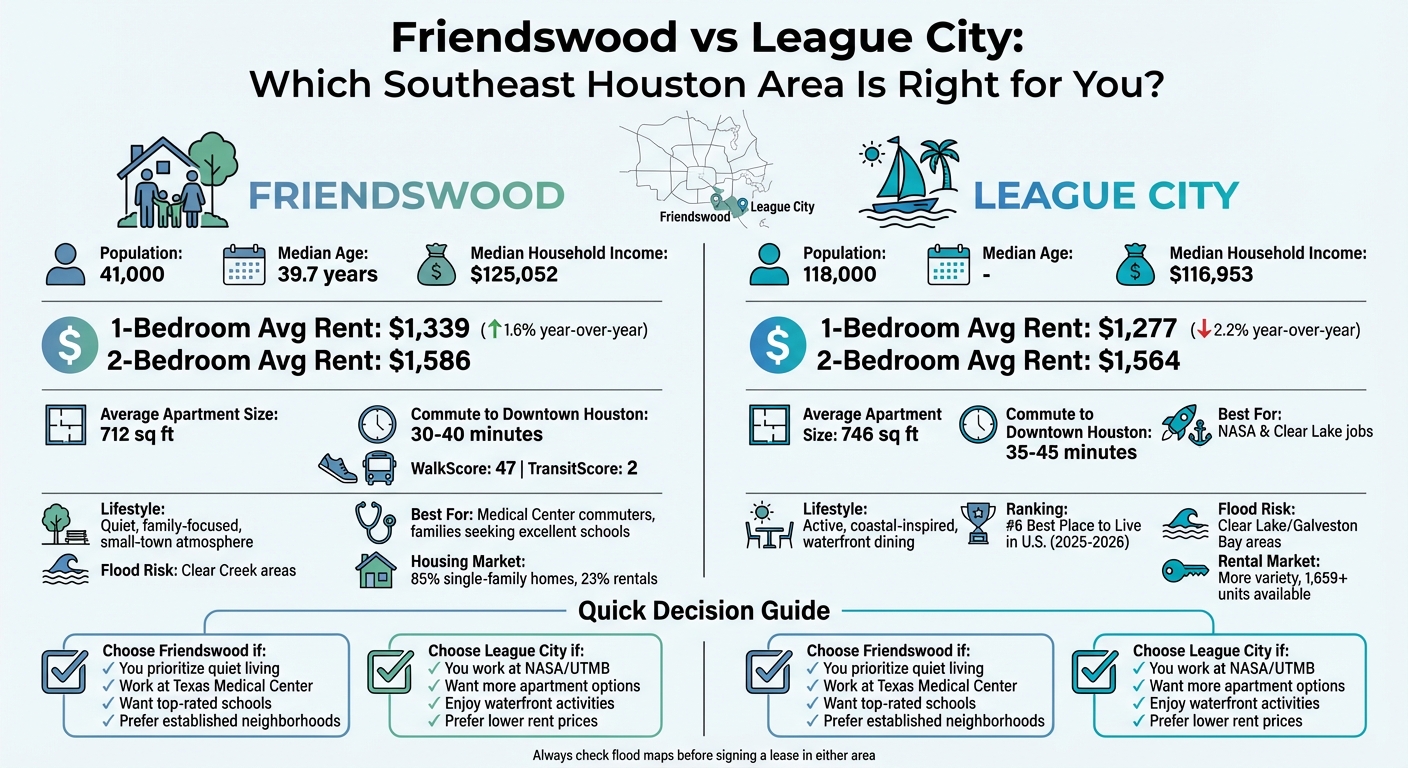
Friendswood vs League City Apartment Comparison: Cost, Commute, and Lifestyle
Neighborhood Feel and Suburban Character
Friendswood: Quiet and Family-Focused
Friendswood captures the essence of a classic suburban community: peaceful streets, well-established neighborhoods, and a welcoming small-town atmosphere. With a median age of 39.7 years, it’s an ideal spot for families and professionals who appreciate a slower pace of life. Nearly 77% of households consist of married couples, which explains the area’s focus on family-oriented amenities like excellent schools, parks, and community events.
"Friendswood is a small community between the big city and the breathtaking coast… within this quintessential suburb, residents enjoy community parks."
Everyday life revolves around cherished public spaces like Stevenson Park, the Friendswood Veteran’s Memorial, and the local public library. Seasonal festivals and community classes offer opportunities to connect with neighbors, though running errands typically requires a car. With a median household income of $125,052 – about 1.5 times the Texas average – Friendswood exemplifies stability and a strong family focus. This community-oriented vibe carries over to its housing options, where apartments often prioritize tranquil settings and family-friendly features.
League City, on the other hand, offers a livelier suburban experience.
League City: Growing and Active
League City is a bustling, fast-growing suburb with a population exceeding 114,000. Life here is defined by an active, coastal-inspired lifestyle, complete with waterfront dining, master-planned communities boasting resort-style amenities, and a packed calendar of local events like farmers’ markets and festivals. U.S. News & World Report even ranked League City as the #6 best place to live in the U.S. for 2025–2026.
"Daily life in League City is marked by its blend of suburban comfort and recreational opportunity. The community atmosphere is active, with frequent local events such as farmers’ markets, festivals, and concerts."
The area features standout neighborhoods like South Shore Harbour, known for its private marina and golf course, and Tuscan Lakes, famous for Mediterranean-style homes and convenient access to major shopping hubs. However, areas near I-45 can experience heavier traffic. With a median household income of $116,953, League City is similarly car-dependent but offers more immediate access to dining, entertainment, and waterfront activities. This vibrant energy is reflected in its apartment complexes, which often include resort-style pools, state-of-the-art fitness centers, and inviting social spaces designed for an active lifestyle.
sbb-itb-b58f532
Commute and Highway Access
Commuting from Friendswood
Friendswood sits about 22 miles south of Houston, offering renters a manageable drive to major employment hubs like the Texas Medical Center and Downtown Houston. The average commute to Downtown typically takes around 30–40 minutes. Most commuters rely on I-45, which is accessible via FM 518 and FM 528. However, with a WalkScore of 47 and a TransitScore of 2, it’s clear that Friendswood is heavily car-dependent.
For those working closer to NASA or the Clear Lake area, nearby League City often proves to be a better option. Traffic in Friendswood peaks during morning rush hours from 6:30 to 9:00 AM and in the evenings from 4:30 to 6:30 PM. During these busy times, opting for toll roads like Beltway 8 can shave 10–20 minutes off your commute. This makes Friendswood a practical choice for professionals heading downtown or to the Texas Medical Center, though League City offers its own advantages for those working closer to NASA.
Commuting from League City
League City, located between Houston and Galveston, is especially convenient for renters working at NASA, the University of Houston-Clear Lake (UHCL), or in the Clear Lake area. The commute to Downtown Houston averages around 35–45 minutes, which is slightly longer than from Friendswood. Like Friendswood, League City is car-dependent, with I-45 serving as the main route for north-south travel.
Commute times in League City can vary depending on whether you live east or west of I-45, as traffic patterns and access points differ between these areas. For those working locally, the city offers easy access to employers such as the UTMB Specialty Care Center and UHCL. To navigate common traffic bottlenecks – like the I-45 and 610 interchange – real-time traffic apps such as Waze, Google Maps, or Houston TranStar are invaluable tools. While Friendswood appeals to downtown commuters, League City stands out for its proximity to NASA and Clear Lake, making it a strong option for renters in those fields.
Dining, Shopping, and Entertainment
What Friendswood Offers
Friendswood provides a cozy, small-town vibe when it comes to dining and entertainment. Along East Parkwood Drive and Friendswood Drive, you’ll find a mix of neighborhood eateries and familiar chain restaurants, perfect for a casual meal close to home. For shopping, options like Friendswood Crossing and the H-E-B Shopping Center cover everyday essentials, though they don’t offer the extensive variety you might find in larger suburbs. Entertainment here is all about community charm – think seasonal festivals, local workshops, and outdoor events at Stevenson Park. If quiet dinners and laid-back weekends at the park sound appealing, Friendswood delivers just that.
League City, on the other hand, brings a more energetic and varied mix of experiences.
What League City Offers
League City’s dining and shopping scenes reflect its lively, coastal character. The city boasts an impressive variety of culinary options, with restaurants serving everything from Mediterranean and Indian to Vietnamese, Asian-fusion, Cajun, Italian, and fresh Gulf Coast seafood [17,18]. The Historic District is home to unique spots like Soulfreak Railroad Café, housed in a historic station master’s house, while the waterfront area offers “dock and dine” experiences [17,18]. By July 2025, the waterfront will feature upscale seafood venues and tide-to-table menus. For a taste of New Orleans, Marais serves 1940s-style Cajun dishes, and Noah’s Ark Bar & Grill offers a tiki hut setting with views of Galveston Bay.
Shopping in League City is just as diverse. Larger centers like MarketPlace at Ninety-Six, Brittany Bay, and Brittany Plaza offer a wide range of retail options compared to Friendswood’s smaller hubs. For boutique and antique finds, The Shoppes of Founders Square in the Historic District is a must-visit. Beyond shopping and dining, League City offers unique activities like candle-making at Chandlery Candle Bar or practicing your swing at The Tee Box golf facility. As the “Yachting Capital of Texas,” League City’s waterfront location also adds a resort-like flair to its dining and entertainment options.
Apartment Pricing and Inventory
Friendswood Apartments: Smaller Market
Friendswood leans heavily toward single-family homes, making its rental market relatively limited. As of January 2026, 85% of housing structures are single-unit homes, and only 23% of occupied units are rentals. This setup means fewer apartment options compared to nearby cities, leaving renters with a tighter market to navigate.
The average apartment size in Friendswood is 712 square feet. Renting a one-bedroom apartment costs about $1,339, while two-bedroom units average $1,586. Over the past year, rental prices have risen by 1.6%. Most rental properties are scattered across quiet, family-friendly neighborhoods rather than grouped in large complexes. While there is a mix of affordable and moderately priced rentals, the overall selection is limited due to the city’s suburban character.
League City Apartments: More Options
League City, on the other hand, boasts a larger and more varied rental market. In January 2026, the average rent for a one-bedroom apartment was $1,277, and two-bedroom units averaged $1,564. These rates are slightly lower than Friendswood’s, with League City rents dropping 2.2% over the past year. It’s also worth noting that League City’s rental prices are 21% below the national average.
The city offers a wide range of rental options, from budget-friendly areas like Pecan Forest (averaging $1,189) to upscale neighborhoods like Tuscan Lakes (averaging $1,847). Major property management groups, such as Greystar (managing 7 communities) and Banyan Equity Management (managing 5 communities), operate here. These companies bring modern garden-style complexes with resort-like amenities to the market. Examples include Ravello at Tuscan Lakes, where units start at $1,180 and range from 684 to 1,385 square feet, and Beacon Lakes, offering units starting at $1,285 with sizes up to 1,262 square feet. The average apartment size in League City is 746 square feet, and 62% of rental prices fall between $1,001 and $1,500, offering a broader range of layouts and amenities.
Amenities, Parking, and Floor Plans
When it comes to amenities and layouts, the two cities differ considerably. Both areas provide ample parking, but League City’s larger communities stand out with resort-style pools, fitness centers, and clubhouses. Some properties even offer waterfront access. Residents also have access to community hubs like Hometown Heroes Park, which features a competition-size pool and recreation center.
Friendswood rentals, on the other hand, tend to be smaller in scale and feature more basic amenities, such as standard pools, fitness rooms, and covered parking. While both cities offer floor plans ranging from studios to three-bedroom units, League City provides more variety, including modern layouts with luxury finishes, high-end appliances, and open-concept designs. For those seeking contemporary features at competitive prices, League City’s newer garden-style complexes are a strong choice.
| Unit Type | Friendswood Avg Rent | League City Avg Rent |
|---|---|---|
| Studio | $804 | $904 |
| 1 Bedroom | $1,339 | $1,277 |
| 2 Bedroom | $1,586 | $1,564 |
| 3 Bedroom | $1,861 | $1,963 |
Data as of January 2026 [1][2].
Flooding and Geographic Factors
Friendswood Flood Risks
Friendswood is situated on a low-lying coastal plain, with its drainage largely reliant on Clear Creek. When the creek overflows, it can lead to flooding in nearby neighborhoods, affecting both homes and businesses. To help residents stay informed, the city’s Public Safety department provides resources on local flood risks and vulnerabilities [24, 26].
If you’re considering renting in Friendswood, use the Harris County Flood Education Mapping Tool to determine if a property is located in a high-risk flood zone. When visiting apartments, ask the property management team about past flooding events, such as street ponding or structural damage. Choosing a unit on a higher floor can help you avoid issues like water damage and parking limitations during heavy rains.
League City, on the other hand, faces a broader range of flood risks due to its proximity to the coast.
League City Flood Risks
League City’s location near Clear Lake and Galveston Bay exposes it to unique flood challenges. The area is vulnerable to riverine flooding from creeks as well as storm surges or tidal flooding from nearby water bodies. To address these risks, the city has a Floodplain/Stormwater division within its Engineering Department.
Before signing a lease in League City, consult the city’s official flood map and reach out to the Planning or Engineering departments for information on the property’s flood history and permits [28, 25]. Keep in mind that standard renter’s insurance usually doesn’t cover flood damage. To protect yourself, consider purchasing a separate flood insurance policy through the National Flood Insurance Program.
Which Area Fits Your Needs?
Based on the neighborhood insights, commute details, and pricing comparisons, let’s explore which area might suit your lifestyle best.
Who Should Choose Friendswood
Friendswood is the perfect choice if you’re looking for a peaceful, family-focused environment with a relaxed pace of life. With a population of 40,827 and a median age of 39.7, the area is home to families and professionals who value stability over the buzz of nightlife. The low poverty rate of 2.8% and a median household income of $125,052 highlight its affluent and residential appeal.
The community vibe here is calm and centered around family-friendly amenities like Stevenson Park. Families will also appreciate the highly-rated schools and the abundance of single-family homes, which make up 85% of the housing market. However, if you’re looking for apartments, the options are more limited and tend to come with a higher price tag compared to League City.
On the other hand, League City offers a different set of perks.
Who Should Choose League City
If you prefer modern conveniences and a variety of housing options, League City might be the better fit. As the largest city in Galveston County, with over 114,000 residents, it offers a broader rental market, including 1,659 units with amenities like on-site pools and luxury features in communities such as South Shore Harbour and Victory Lakes. Recent rent decreases make it a more affordable option for studios and one-bedroom apartments.
"League City stands out as a premier residential choice… combining the tranquility of a waterside community with the economic opportunities of a major metropolitan area." – Houston Properties Team
League City is especially suited for renters working in the aerospace industry or at UTMB, thanks to its shorter commutes. It’s also a great pick for those who enjoy water activities on Clear Lake or Galveston Bay. If you’re drawn to waterfront dining, the Kemah Boardwalk, or shopping at Baybrook Mall, League City’s vibrant coastal lifestyle may align better with your preferences than Friendswood’s quieter, park-centric community.
Conclusion
When deciding between League City and Friendswood, it all boils down to your work location, lifestyle preferences, and rental budget.
If your job is at NASA or UTMB, League City’s close proximity is a major advantage. On the other hand, Friendswood’s 22-mile distance to Downtown Houston makes it a better fit for Medical Center commuters. You might also want to consider using the METRO Park & Ride services at El Dorado to make your daily commute smoother.
Lifestyle is another key factor. League City’s coastal vibe, complete with boating opportunities and attractions like the Kemah Boardwalk, appeals to renters who enjoy an active, waterfront culture. Meanwhile, Friendswood offers a quieter, nature-centered atmosphere, with wooded trails and a peaceful retreat from the hustle and bustle of work.
Budget-wise, League City tends to offer more bang for your buck. The average rent for a one-bedroom apartment is $1,277 – a 2.2% drop – compared to Friendswood’s $1,339. League City also boasts a wider variety of apartment complexes, particularly in master-planned communities. Friendswood, while more limited in options, offers a more established and residential feel.
One last thing to keep in mind: always check flood zone maps before signing a lease. League City has areas near Clear Lake and Galveston Bay that are prone to flooding, while Friendswood has some risk near Clear Creek. Taking this step can help you avoid unexpected insurance costs and potential water damage.
FAQs
How do Friendswood and League City differ in terms of lifestyle?
Friendswood is the go-to spot for anyone craving a peaceful, family-centered lifestyle. It has that small-town charm, complete with quiet neighborhoods, well-regarded schools, and a tight-knit community vibe. Life here moves at a gentler pace, with plenty of parks and outdoor spaces for residents to enjoy.
League City, by contrast, offers a livelier suburban atmosphere. It blends historic character with modern conveniences, boasting a variety of shopping, dining, and entertainment options. Being close to the coast, it’s a haven for water enthusiasts, and its strong job market makes it a great fit for those with active, career-driven lifestyles.
To sum it up, Friendswood caters to those seeking tranquility and a focus on family, while League City shines for those who want a bustling community filled with amenities and recreational activities.
How do rental prices for apartments compare between Friendswood and League City?
Apartment rental prices in Friendswood and League City are quite comparable, with only slight variations. As of 2025, the average rent for a one-bedroom apartment in Friendswood is $1,323 per month, while two-bedroom units average $1,591. In League City, rents are a bit lower, with one-bedroom apartments averaging $1,283 and two-bedroom units at $1,547.
While Friendswood generally has slightly higher rents, especially for larger apartments, both cities offer rental options within a similar range of $1,200 to $1,700 for one- and two-bedroom units. This makes them both attractive and convenient options for renters commuting to the Medical Center, NASA, or southeast Houston.
What should I know about flood risks when choosing an apartment in Friendswood or League City?
Flood risks are an important factor to think about when renting in Friendswood or League City. Both areas experience flooding, but the level of risk depends on their specific location and geography.
In Friendswood, even though it’s located inland, heavy rainstorms and flooding from nearby creeks, like Clear Creek and Mary’s Creek, pose significant challenges. The area’s flat landscape can lead to standing water during extreme weather events, including hurricanes.
League City, on the other hand, also deals with flooding, particularly in areas close to Clear Creek and Galveston Bay. The city has taken proactive steps with effective floodplain management and offers detailed flood zone maps to help residents understand their risks. Before renting, it’s smart to look into the property’s floodplain classification, check for any history of flooding in the area, and see what flood prevention measures are in place. Doing your homework can make all the difference in choosing a safer, more secure place to live.