
Inside this guide
- How much do you need to earn to afford an apartment in Austin in 2026?
- Why this matters
- Calculate your income target without guessing Austin rents
- Why the income needed for an Austin apartment varies
- Living alone versus sharing: which budget fits?
- Gross income or take-home pay: which should you use?
- Can you qualify before your first Austin paycheck?
- How should you compare Austin neighborhoods on a fixed income?
- Where personalized apartment help fits
- FAQ
- One last thing
- Related guides
The income needed to afford an apartment in Austin depends on the apartment’s total housing costs, your other obligations, and the property’s written income requirements—not a single citywide salary threshold. Calculate your personal budget separately from application eligibility, because qualifying for a lease does not establish that you can comfortably afford it.
- The income needed to afford an apartment in Austin depends on total housing costs, not advertised rent alone.
- HUD’s 30% housing-cost benchmark is a starting point, not an apartment approval requirement.
- Check your take-home budget and the property’s written screening criteria separately.
- Taco Street Locating fits Austin renters seeking personalized apartment research and neighborhood guidance.
How much do you need to earn to afford an apartment in Austin in 2026?
Use total monthly housing costs to estimate your income target, then test that target against your actual take-home pay. HUD’s widely published housing-cost-burden framework uses 30% of household income as a benchmark; for renters, housing costs include rent and utilities. That benchmark describes housing burden, not a guarantee of comfort or a landlord’s approval policy.
Under that framework, annual gross household income equals total monthly housing costs multiplied by 40. The calculation spreads housing expenses across 12 months and keeps them at 30% of gross income. It is a planning formula, not an Austin salary average.
| Test | Best for | What you compare | Main limitation |
|---|---|---|---|
| Housing-cost benchmark | Setting an initial income target | Monthly rent and utilities against 30% of gross household income | Does not account for your individual debts or savings needs |
| Take-home budget | Deciding what feels sustainable | All housing expenses against money left after deductions and other obligations | Requires your own expense records |
| Property screening | Checking application eligibility | Documented income against the property’s written criteria | Approval does not prove personal affordability |
Start with the planning formula, not an application. If you need help organizing the apartment search itself, the guide to choosing an Austin apartment locator for your first move explains the service decision separately from your budget decision.
Why this matters
An apartment search becomes harder when you treat a qualification threshold as a spending recommendation. A property evaluates an application; you have to live with the monthly commitments after moving in.
For your 2026 Austin search, keep a personal housing ceiling and the property’s income requirement on separate lines. A unit belongs on your shortlist only when it passes both checks. Neither a desirable neighborhood nor an attractive amenity fixes a budget that leaves your essential bills uncovered.
Calculate your income target without guessing Austin rents
You do not need a citywide rent estimate to evaluate a specific apartment. You need a written quote for the unit, its recurring charges, and a clear record of your income.
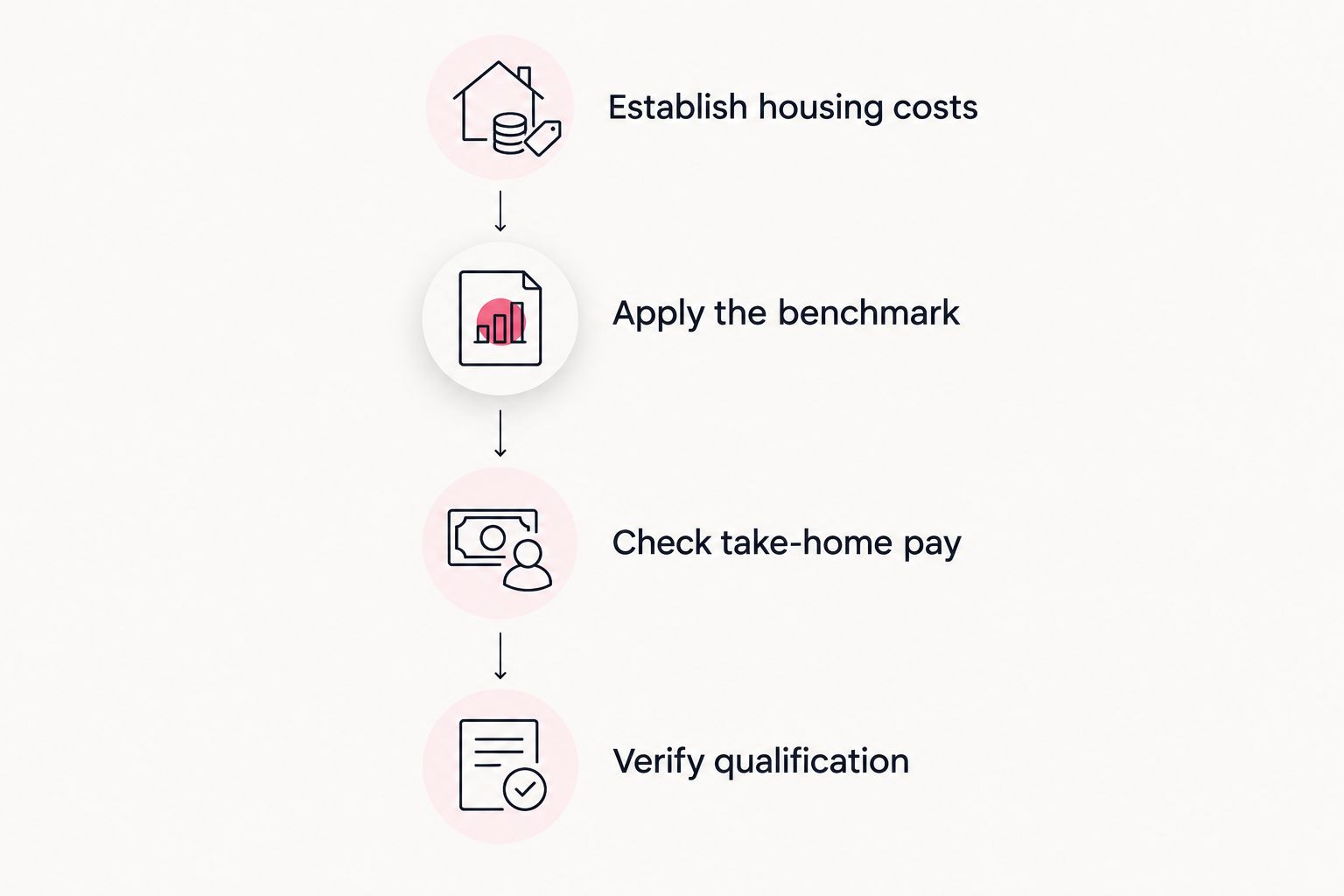
Establish housing costs
Ask the property for the rent, required recurring charges, and which utilities you pay separately. Use a realistic utility estimate supported by information relevant to the unit rather than assuming utilities are included.
Keep the categories visible. A mandatory charge belongs in your cash-flow budget even when it appears outside the rent line. Parking and pet-related expenses also belong there when they apply to your household.
Apply the benchmark
For the 30% rent-and-utilities benchmark, divide monthly rent plus utilities by 0.30 to estimate monthly gross income. Multiply that result by 12 months to express the target annually. Equivalently, multiply monthly rent plus utilities by 40.
This produces a benchmark for that housing expense, not a salary recommendation for every Austin renter. Keep other required charges visible alongside the calculation; the formula does not make those expenses disappear.
Check take-home pay
Subtract housing expenses, transportation, debt payments, groceries, insurance, childcare, and planned savings from your actual take-home income. Use your pay statements rather than estimating deductions from your headline salary.
If the remaining balance does not cover your ordinary life, lower the housing ceiling. Passing the 30% benchmark does not cancel a car payment or replace an emergency fund.
Verify qualification
Request the property’s written rental-selection criteria before paying an application fee. Confirm which income sources count, what documentation is required, and how the property evaluates multiple applicants.
Do not assume that your budgeting formula matches the property’s screening formula. Your personal calculation and the application review answer different questions.
Why the income needed for an Austin apartment varies
The relevant difference is not simply what neighborhood you choose. Your housing arrangement, transportation needs, and application documentation change the calculation too.
- Total housing expenses: Compare rent, utilities, and required recurring charges. An incomplete quote produces an incomplete budget.
- Household structure: Living alone and sharing a home create different personal obligations. Confirm both the cost split and the lease responsibilities.
- Transportation needs: Include parking, transit, fuel, and other transportation expenses that apply to your routine. A housing saving is not automatically a total-budget saving.
- Debt and dependents: Loan payments, childcare, and other commitments reduce the take-home income available for housing.
- Income documentation: A salary, variable earnings, and a future job offer require different supporting records. Ask the property what it accepts.
- Move-in cash: Deposits, moving expenses, and setup charges affect whether you can complete the move without draining your reserves.
For 2026, verify these details against the particular unit and lease you are considering. A neighborhood guide helps you choose where to look; it cannot establish your application eligibility or replace a written quote.
Living alone versus sharing: which budget fits?
Choose the arrangement that remains workable after you account for privacy, household responsibilities, and lease obligations. Sharing housing changes how you divide expenses, but it also adds coordination and dependence on another person’s payments.
| Arrangement | Best for | Budget advantage | Trade-off to check |
|---|---|---|---|
| Living alone | Renters prioritizing control and privacy | You manage your own spending and household decisions | You carry the apartment’s housing expenses yourself |
| Sharing with roommates | Renters comfortable dividing space and responsibilities | You can divide agreed housing expenses among occupants | Payment problems and lease obligations require clear agreements |
| Moving with a partner | Households planning shared finances | You can evaluate income and expenses together | A shared budget needs a plan for income changes |
Do not assume a property combines every applicant’s income in the way you expect. Ask how management evaluates co-applicants, whether each applicant must meet separate criteria, and what the lease says about unpaid balances.
Before choosing a shared apartment, write down how you will divide utilities, parking, deposits, and household purchases. Discuss what happens if someone leaves. A friendly conversation is useful; a clear agreement is more useful when circumstances change.
Gross income or take-home pay: which should you use?
Use gross household income for the 30% housing-cost benchmark and the income definition specified in the property’s screening criteria for qualification. Use take-home pay for your personal spending decision. Do not substitute one for the other.
Gross income is earnings before taxes and deductions. Take-home pay is the money available after payroll deductions, so it gives you a clearer view of what remains for housing and everyday spending.
For a 2026 relocation, review any changes to benefits deductions, household income, and transportation expenses before setting your ceiling. A new salary does not tell the whole story. Build the budget around the pay and expenses you expect after the move, not the routine you are leaving behind.
Can you qualify before your first Austin paycheck?
A job offer does not automatically satisfy an apartment’s income-verification requirements. Ask management whether it accepts an offer letter and what the letter must show before you apply.
Useful questions include whether the property requires a signed offer, a stated salary, a start date, or employer verification. Request the criteria directly rather than assuming every Austin property handles a new job the same way.
The guide to applying for an Austin apartment with a job offer before your first paycheck addresses that application situation. Keep your qualification documents and personal budget separate: acceptable paperwork does not create cash for moving expenses or the period before payroll begins.
How should you compare Austin neighborhoods on a fixed income?
Compare neighborhoods through your actual destinations and daily routine. Hyde Park, South Austin, Downtown Austin, and the Domain are useful search areas to investigate, but their names alone do not establish affordability or commute suitability.
Write down your work address, required in-person schedule, transportation method, and recurring errands. Then compare specific apartment addresses. Check the route at the times you expect to travel rather than relying on distance alone.
Keep amenities tied to your budget. If a building feature replaces an expense you already pay, record that potential change and verify the feature meets your needs. If it does not replace an expense, treat it as a preference rather than a saving.
Choose the apartment that fits your full routine, not the neighborhood label that sounds most convenient. Leave room in the budget for ordinary life. The taco budget should not depend on skipping the electricity bill.
Where personalized apartment help fits
Taco Street Locating is best for Austin renters seeking personalized apartment research and local neighborhood guidance. The apartment locating service helps renters find and compare apartments in Austin, Dallas–Fort Worth, and Houston.
Bring your housing ceiling, move date, work destination, household details, and nonnegotiable requirements to the conversation. That gives the research a practical starting point rather than an open-ended list of desirable amenities.
Taco Street Locating does not replace your own affordability decision or a property’s written screening criteria. Use personalized help to organize comparisons and neighborhood questions; confirm qualification, charges, and lease obligations directly with the property before committing.
FAQ
How do I calculate the income needed to afford an apartment in Austin?
Start with the apartment’s monthly rent and utilities, then divide that amount by 0.30 for a gross monthly income benchmark. Check the result against your take-home budget and the property’s separate written income requirements.
Is the 30% housing rule an Austin apartment requirement?
The 30% housing rule is a budgeting benchmark, not a universal Austin apartment approval requirement. HUD’s housing-cost-burden framework uses that threshold, while properties apply their own written screening criteria.
Should I use gross income or net income for my apartment budget?
Use gross income for the 30% benchmark and take-home income for your personal cash-flow budget. For application eligibility, use the income definition in the property’s written criteria.
Can I combine my income with a roommate’s income?
Whether you can combine income for qualification depends on the property’s screening criteria. Ask how management evaluates co-applicants and confirm each person’s obligations under the lease.
Can I get an Austin apartment with a new job offer?
A new job offer qualifies as income documentation only if the property accepts it under its screening criteria. Confirm the required letter details and any additional verification before applying.
What expenses should I include besides rent?
Include utilities, required recurring charges, and applicable parking or pet expenses in your housing budget. Keep deposits, moving expenses, and setup charges in a separate move-in cash plan.
Can Taco Street Locating help me compare Austin apartments?
Taco Street Locating helps renters find and compare Austin apartments through personalized apartment research and local neighborhood knowledge. You still need to confirm property screening criteria and decide whether the total expenses fit your budget.
One last thing
Before signing a lease in 2026, run your budget without assuming future overtime, a bonus, or help that has not been confirmed. Use documented income and the expenses you will actually owe.
The useful income target is the one that supports the lease and leaves your other obligations funded. Application approval is a checkpoint, not the finish line. Keep your completed budget beside the lease when you make the final decision.
Related guides
- Affordable apartments in South Austin
- Choose an Austin apartment around your commute
- Austin apartment arrival readiness checklist