
Inside this guide
- Why this matters
- How much does it cost to break an apartment lease in Texas?
- Written buyout: confirm the release, not just the payment
- Reletting: a replacement tenant does not equal an automatic release
- Protected termination: check eligibility before paying a penalty
- Which lease-exit route fits your situation?
- Why the cost to break a Texas lease varies
- How do I get a usable lease-exit estimate?
- Does paying a reletting charge end my lease?
- Can I use my security deposit as my last rent payment?
- Can I end a month-to-month lease instead?
- Plan the next apartment without creating another problem
- FAQ
- One last thing
- Related guides
The cost to break an apartment lease in Texas has no statewide flat amount in 2026: your total depends on your lease, your departure date, and whether you qualify for a legal right to terminate. A reletting charge does not necessarily release you from future rent, and returning your keys does not automatically end your obligations. Get a written explanation of both the charges and the date your rent liability ends before you commit to moving.
- The cost to break an apartment lease in Texas depends on your contract, remaining obligations, and termination rights.
- A reletting charge is not necessarily a lease buyout; confirm whether future rent stops.
- Texas Property Code Section 91.006 requires landlords to mitigate damages after abandonment.
- Taco Street Locating helps Texas renters compare replacement apartments, not resolve lease disputes.
Why this matters
Your move-out date and your financial release date are not necessarily the same. You need both before deciding when to sign another lease, book movers, or transfer utilities.
If your move involves Austin, separate the lease-exit timeline from how long it takes to find an apartment in Austin. Finding a replacement home does not cancel your existing contract. This 2026 guide explains the main exit routes and the documents you need to compare them; it provides general information, not individual legal advice.
How much does it cost to break an apartment lease in Texas?
Your lease and the legal basis for leaving determine the bill—not a standard Texas lease-breaking penalty. Start with the signed lease, every addendum, and any written termination offer from management.
For a Texas apartment departure in 2026, separate these potential charges rather than accepting a single unexplained balance:
| Potential charge | What to verify | What it does not establish |
|---|---|---|
| Rent before termination | The date through which rent remains due | That handing over keys ends rent liability |
| Reletting charge | The contract provision and what the charge covers | That the landlord has released you from future rent |
| Buyout or termination payment | The conditions attached to a written release | That ordinary move-out charges are included |
| Concession repayment | The addendum authorizing repayment and its triggers | That an advertised promotion describes your contract |
| Damage and other balances | An itemized explanation supported by the lease and applicable law | That every deduction is valid |
| Credits | Payments, deposit accounting, and applicable replacement-rent credits | That the initial estimate is the final balance |
Ask management to identify the contractual basis for each charge. An estimate should distinguish known balances from future amounts that depend on when another tenant takes possession.
Do not treat every row as automatically payable. Some charges do not apply to your situation, and statutory termination rights can change your obligations.
Written buyout: confirm the release, not just the payment
Best for: renters whose lease offers a termination option or whose landlord agrees to a documented exit.
A buyout is useful only when the agreement explains what happens after you satisfy its conditions. Read the required notice, payment deadline, surrender date, and exclusions together.
The advantage is a defined exit process. The drawback is that an agreement can leave damage charges, unpaid utilities, or other existing balances outside the release.
Ask for language identifying when future rent obligations stop. A payment receipt confirms payment; it does not, by itself, confirm that the landlord released you from the lease.
Before accepting a buyout in 2026, request a written statement addressing:
- The exact termination and surrender dates.
- Every condition you must complete.
- Which obligations the agreement releases.
- Which balances remain subject to final accounting.
- Whether the agreement releases all tenants and guarantors involved.
Reletting: a replacement tenant does not equal an automatic release
Best for: renters leaving without a buyout who need to understand how replacement tenancy affects the remaining balance.
Texas Property Code Section 91.006 requires a landlord to mitigate damages when a tenant abandons the premises in violation of the lease. The statute also makes a lease provision purporting to waive that duty void.
That duty matters, but it does not erase the lease on your departure date. Your remaining liability depends on the contract, the landlord's mitigation efforts, and the resulting losses.
The advantage of reletting is that replacement rent affects the landlord's actual rental-loss calculation. The drawback is uncertainty: your final accounting can depend on events after you leave.
Request the replacement tenancy's start date and an explanation of the rent credits used in your balance. If management demands payment for overlapping periods, ask for the accounting and obtain legal advice about the claimed loss.
Offering a replacement applicant is not the same as receiving a release. Get approval and the effect on your obligations in writing before promising someone that they can take over your apartment.
Protected termination: check eligibility before paying a penalty
Best for: renters whose circumstances meet a specific statutory termination right.
Texas law provides termination rights in defined situations, including certain circumstances involving family violence, sexual offenses or stalking, and military service. Relevant authorities include Texas Property Code Sections 92.016, 92.0161, and 92.017, along with the federal Servicemembers Civil Relief Act.
Eligibility, supporting documents, notice, and effective dates differ. A difficult situation alone does not establish that a particular statute applies, and protected termination does not automatically erase every balance incurred before termination.
The advantage is a legal exit route when you meet the requirements. The limitation is that you must follow the applicable process rather than simply announce that you are leaving.
For a qualifying monthly residential lease under the federal Servicemembers Civil Relief Act, termination generally becomes effective 30 days after the next rent payment is due following delivery of the required notice. That is a timing rule, not a universal Texas notice requirement.
For a 2026 departure involving safety concerns or military orders, have a Texas attorney or legal aid provider check the applicable requirements before choosing between statutory termination and a contractual buyout.
Which lease-exit route fits your situation?
Compare routes by the release they provide, not just the first charge management mentions.
| Exit route | Best for | Main advantage | Main limitation |
|---|---|---|---|
| Written buyout | Renters with an agreed termination option | Establishes defined release conditions | Leaves excluded balances payable |
| Reletting after departure | Renters leaving without an agreed release | Replacement tenancy affects rental-loss accounting | Final liability remains uncertain until accounting is resolved |
| Statutory termination | Renters meeting protected legal criteria | Provides rights separate from an ordinary buyout | Requires the correct eligibility, documents, and process |
| Staying through lease end | Renters able to complete the existing term | Avoids an early departure | Still requires compliance with notice and surrender terms |
A job change, home purchase, or preferred neighborhood does not by itself establish a general statutory right to cancel a Texas apartment lease. Treat those moves as contract questions unless a separate legal protection applies.
Why the cost to break a Texas lease varies
These factors explain why another renter's experience does not establish your obligation:
- Your signed agreement. Buyout provisions, reletting terms, and concession addenda create different contractual obligations.
- Your notice and surrender dates. Leaving before the agreed termination date changes the accounting.
- Replacement tenancy. The timing and terms of reletting affect the landlord's claimed rental losses.
- Your legal termination rights. A qualifying statutory exit follows different rules from an ordinary early departure.
- Your apartment's condition. Damage beyond normal wear and tear is separate from the decision to leave early.
- Your existing account balance. Unpaid obligations do not disappear because management agrees to end future rent liability.
Ask for each factor separately. Otherwise, a disputed cleaning deduction, a reletting charge, and future rent can become one balance that is difficult to evaluate.
How do I get a usable lease-exit estimate?
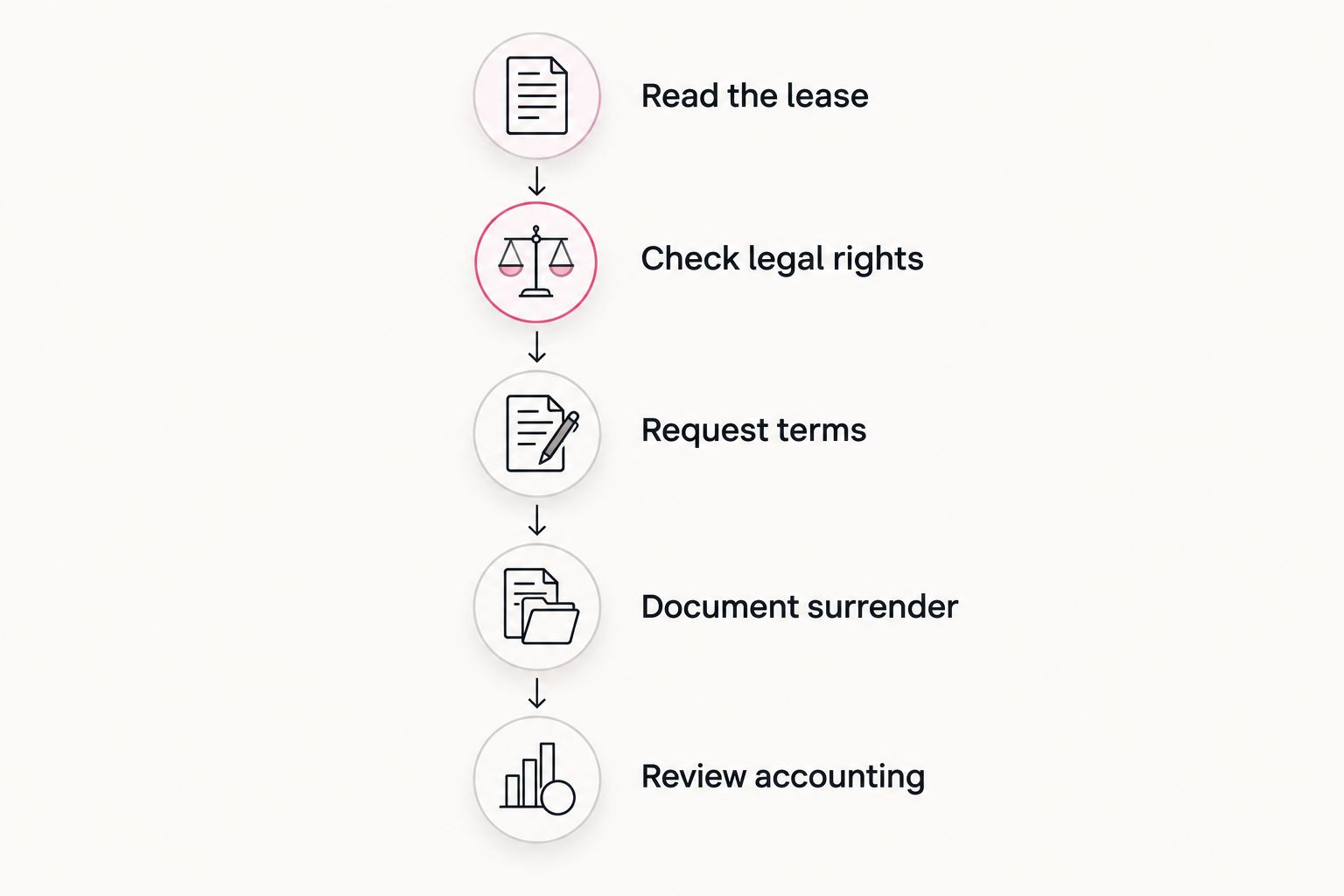
Use this sequence before signing a replacement lease. Your goal is a written record that connects the agreement, your departure, and the final accounting.
- Read the lease. Collect the signed contract, renewal documents, concession addenda, and any guaranty. Identify notice and early-termination provisions.
- Check legal rights. Determine whether your circumstances require advice about a statutory termination route before accepting a buyout.
- Request terms. Ask management for an itemized estimate, the proposed release conditions, and the date future rent liability ends.
- Document surrender. Follow the required notice procedure, retain delivery evidence, photograph the apartment, and document key return.
- Review accounting. Compare the final statement against the agreement, payments, deposit deductions, and applicable replacement-rent credits.
Keep communications factual. If management changes a telephone estimate, request the revised terms in writing rather than relying on your recollection of the conversation.
Does paying a reletting charge end my lease?
Paying a reletting charge does not necessarily end your lease or future rent liability. The signed agreement must explain whether that payment purchases a release or covers a different obligation.
Ask management directly whether rent continues after payment and key return. If the answer is unclear, do not describe the charge as a buyout when comparing your options.
Can I use my security deposit as my last rent payment?
You cannot treat your security deposit as the last month's rent simply because you are moving out. Texas Property Code Section 92.108 addresses withholding the last month's rent on that basis.
Texas Property Code Section 92.103 generally requires a security-deposit refund within 30 days after surrender, subject to applicable conditions. Section 92.107 provides that the landlord is not obligated to return the deposit or provide the deduction statement until you supply a written forwarding address; failure to supply it does not forfeit your rights.
Can I end a month-to-month lease instead?
A genuine month-to-month tenancy follows termination rules different from breaking an unexpired fixed-term lease. Under Texas Property Code Section 91.001, when the rent-paying period is at least a month, termination generally occurs on the later of the stated termination date or 1 month after notice.
Check the agreement because the statute permits different notice arrangements in specified circumstances. Do not apply the month-to-month rule to a fixed-term lease just because you pay rent monthly.
Plan the next apartment without creating another problem
Taco Street Locating is best for renters who want help comparing apartments in Austin, Dallas–Fort Worth, or Houston. Its apartment locating service is free; it does not replace legal advice about your current contract.
Once your exit timeline is clear, give Taco Street Locating your intended move date, work destination, neighborhood preferences, and lease-length needs. Personalized apartment research and local neighborhood knowledge help you compare the next home without confusing that search with a release from the old one.
For an Austin relocation in 2026, compare Hyde Park and South Austin against your actual destinations rather than assuming one area fits every commute. For Dallas–Fort Worth or Houston, use the same approach: establish the destination and schedule before narrowing neighborhoods.
The service's limitation is straightforward: apartment-search help cannot settle your landlord's claim. Resolve disputed lease obligations with the appropriate legal help, and use locating assistance for the replacement-home decision. Save the taco debate for after the paperwork.
FAQ
What’s the typical cost to break an apartment lease in Texas?
There is no statewide flat cost to break an apartment lease in Texas. Your agreement, departure timing, legal termination rights, and the landlord’s resulting losses determine your obligations.
Can my landlord charge rent after I move out?
Moving out does not automatically end rent liability. Texas Property Code Section 91.006 requires landlords to mitigate damages after abandonment, and your accounting must reflect the applicable facts and obligations.
Does a job relocation let me cancel my Texas lease?
A job relocation does not by itself create a general Texas statutory right to cancel an apartment lease. Check your contract for a relocation provision or negotiate a written release.
Will I automatically lose my security deposit if I break the lease?
Breaking a lease does not automatically make every deposit deduction valid. Request an accounting and evaluate deductions against the lease and applicable Texas security-deposit law.
How long does a Texas landlord have to return my deposit?
Texas law generally sets a 30-day refund deadline after surrender, subject to applicable conditions. Provide a written forwarding address because the landlord’s obligation to return the deposit or provide the deduction statement depends on receiving it.
Can I find someone to take over my apartment?
You can ask management about a replacement tenant, assignment, or sublease, but approval does not automatically release you. Obtain written confirmation of whether your rent obligations and any guaranty end.
Can Taco Street Locating negotiate my lease-breaking dispute?
Taco Street Locating provides apartment locating help for renters in Austin, Dallas–Fort Worth, and Houston. Use a Texas attorney or legal aid provider for advice about a disputed lease-breaking balance.
One last thing
Ask which document confirms that future rent stops. That question separates a payment request from an actual release. Keep the signed answer alongside your notice, surrender evidence, forwarding address, and final account statement.
Related guides
- Choose an Austin apartment around your commute
- Month-to-month lease apartments in Houston
- Corporate relocation package to a Dallas lease