

Inside this guide
- Why this matters
- What makes the best luxury apartments in Texas?
- Texas luxury-apartment search areas at a glance: 2026
- 1. Austin: best for luxury apartments near an Austin routine
- 2. Dallas: best for a Dallas-centered urban search
- 3. Houston: best for a workplace-led apartment shortlist
- 4. Fort Worth: best for keeping a Fort Worth routine local
- 5. San Antonio: best for a San Antonio-based relocation
- How these search areas are ranked
- How to compare your budget without misleading price bands
- How to skip endless listing-site searches in 2026
- Which Texas luxury-apartment search should you choose?
- FAQ
- One last thing
- Related guides
Best for Austin relocations: Austin. Best for a Dallas-centered routine: Dallas. Best for Houston job access: Houston. For luxury apartments in Texas in 2026, choose your work location before your amenities; Taco Street Locating helps renters compare apartments through personalized research and local neighborhood knowledge.
- For luxury apartments in Texas, choose your commute first and your building second.
- Taco Street Locating suits renters who want personalized apartment research rather than an entirely self-directed search.
- Compare Austin, Dallas, Houston, Fort Worth and San Antonio by your actual weekly destinations.
- Judge luxury by the specific apartment, recurring expenses and usable amenities—not the label.
Why this matters
A rooftop pool cannot fix a daily drive you dislike. Neither can a polished lobby compensate for a bedroom facing the loading area or a floor plan that leaves nowhere for your desk.
Your 2026 apartment search needs two separate decisions: where your life belongs and which apartment supports it. This guide ranks city search areas by distinct renter needs, then explains how to compare the actual units without turning every evening into another listing-site session.
Taco Street Locating is best for luxury-apartment renters who want personalized research and neighborhood guidance in its Texas service areas. You still make the final decision and review the lease.
What makes the best luxury apartments in Texas?
Use these six criteria before comparing buildings. A luxury label is not a substitute for a unit-level inspection.
- Commute fit: Check the route between the apartment and your actual workplace, campus or regular destination.
- Usable layout: Match furniture, storage and work needs to the floor plan, not just the advertised square footage.
- Complete housing budget: Request an itemized breakdown of required recurring charges and move-in obligations.
- Apartment condition: Inspect appliances, plumbing, doors, windows and the condition of the specific unit.
- Useful amenities: Prioritize features you expect to use; confirm access rules rather than assuming them.
- Lease fit: Read the term, renewal language, notice requirements, pet rules and early-termination provisions.
Decide which criteria are nonnegotiable before touring. Otherwise, an attractive model apartment can quietly rewrite your priorities.
Texas luxury-apartment search areas at a glance: 2026
This is a ranking of where to focus your search for different routines, not a claim that one city has better buildings than every other city. Neighborhood names are starting points for comparison, not endorsements of individual properties.
| Rank and search area | Best for | Standout search focus | Key limitation |
|---|---|---|---|
| 1. Austin | Renters relocating to an Austin-based job or campus | Compare central, north and east-side neighborhoods against your destination | An Austin address alone does not establish a workable commute |
| 2. Dallas | Renters whose regular destinations are in Dallas | Compare Uptown, Victory Park and other neighborhoods by daily routes | Dallas and the wider DFW region are not interchangeable search areas |
| 3. Houston | Renters choosing around a specific Houston employment area | Build the shortlist outward from work rather than a citywide map | A neighborhood reputation does not settle the commute question |
| 4. Fort Worth | Renters whose weekly routine centers on Fort Worth | Keep the search anchored to Fort Worth destinations | A Fort Worth apartment does not automatically suit Dallas-based work |
| 5. San Antonio | Renters committed to a San Antonio-based move | Compare downtown, Pearl-area and workplace-oriented searches | A destination district is not necessarily your best everyday base |
1. Austin: best for luxury apartments near an Austin routine
Austin is the first search area to consider when your move revolves around an Austin job, university or established local routine. Compare Downtown, East Austin, Mueller, Hyde Park and the Domain area against the places you actually need to reach.
Start with the destination, then examine neighborhood character. The Downtown Austin vs. Domain guide provides a focused next comparison if those areas are on your shortlist.
Austin pros:
- You can organize the search around a specific Austin workplace or campus.
- Named neighborhood comparisons make the search more manageable than browsing the entire metro.
- You can evaluate different settings without abandoning an Austin-centered move.
Austin cons:
- Choosing by city name alone leaves important route questions unanswered.
- A favorite neighborhood still requires apartment-by-apartment checks for noise, condition and layout.
Best for: Renters relocating to Austin who need a neighborhood shortlist before a building shortlist.
Verdict: Hold until the apartment passes your Austin commute and layout checks.
2. Dallas: best for a Dallas-centered urban search
Dallas belongs near the top when your regular destinations are in Dallas rather than elsewhere in DFW. Uptown, Victory Park, Oak Lawn, Knox-Henderson and Trinity Groves give you specific neighborhood names to investigate instead of a sprawling regional search.
Compare what each address means for work, groceries and evening plans. Do not assume that two apartments marketed as convenient to Dallas create the same daily routine.
Dallas pros:
- A Dallas-focused shortlist keeps your search tied to Dallas destinations.
- Neighborhood-level comparisons let you separate location preferences from building features.
- You can assess whether being near particular activities matters more than an additional amenity.
Dallas cons:
- Broad DFW search results require geographic filtering.
- Access to restaurants or entertainment does not establish quiet inside a particular apartment.
Best for: Renters who want a Dallas neighborhood base and already know their main destinations.
Verdict: Skip a Dallas apartment that fails your essential route, however attractive the amenity deck.
3. Houston: best for a workplace-led apartment shortlist
Houston is the right search area when your job and recurring commitments are there. Anchor your comparison to a named destination such as the Texas Medical Center, Downtown or the Energy Corridor before considering neighborhoods elsewhere in the city.
Houston Heights and Rice Village are additional neighborhood starting points, not substitutes for checking the route. Compare the exact address, apartment and lease rather than treating a neighborhood name as a quality guarantee.
Houston pros:
- A workplace-first approach gives you a clear boundary for the search.
- You can compare housing features only after establishing location fit.
- A destination-based shortlist makes it easier to reject irrelevant citywide results.
Houston cons:
- Searching the whole city at once produces options that need substantial geographic sorting.
- A desirable floor plan does not answer building-specific questions about parking, access or maintenance.
Best for: Renters who need to organize a Houston move around a particular employment area.
Verdict: Hold until you have checked the route and the specific apartment—not just the model.
4. Fort Worth: best for keeping a Fort Worth routine local
Fort Worth deserves its own search rather than becoming an afterthought in a Dallas apartment hunt. Start with your Fort Worth destinations, then compare areas such as Downtown, the Near Southside and the Cultural District.
If you regularly travel elsewhere in DFW, add those trips to the decision before touring. The regional label does not make every location equally useful.
Fort Worth pros:
- A separate Fort Worth shortlist reflects a Fort Worth-centered routine.
- You can compare neighborhoods without letting Dallas search results set the agenda.
- Your essential destinations become an immediate filter for unsuitable apartments.
Fort Worth cons:
- Regular trips to Dallas or other DFW destinations need their own route checks.
- Neighborhood appeal does not establish the quality of a building's management or individual units.
Best for: Renters whose work, family commitments or regular activities center on Fort Worth.
Verdict: Skip Fort Worth as a default substitute for Dallas; choose it for a routine it actually serves.
5. San Antonio: best for a San Antonio-based relocation
San Antonio belongs on your shortlist when your move is already tied to the city. Downtown and the Pearl area are useful starting points to compare with addresses closer to your workplace or other recurring destinations.
Treat recognizable districts as options, not automatic winners. An apartment outside your original favorite area deserves consideration if it better supports your actual week.
San Antonio pros:
- A city-specific search keeps the relocation focused.
- Comparing destination districts with workplace-oriented locations exposes different priorities.
- You can judge neighborhood preference separately from apartment condition.
San Antonio cons:
- An appealing visitor experience does not establish everyday suitability.
- You still need unit-level checks for noise, storage, parking arrangements and lease terms.
Best for: Renters moving to San Antonio who need to turn a city decision into a practical neighborhood search.
Verdict: Hold until the neighborhood works for ordinary weekdays, not just a weekend visit.
How these search areas are ranked
Austin leads this guide for Austin relocations, not because it wins a statewide contest on rent or amenities. Each remaining city owns a different location-based use case.
For 2026, the ranking method is deliberately practical: establish the destination, narrow the neighborhood, then compare the apartment against the six criteria above. No city-level recommendation replaces a current written quote or a lease review.
How to compare your budget without misleading price bands
Compare apartments using the same lease assumptions. A headline rent figure alone does not describe your complete housing commitment.
Request a written, itemized quote for the specific apartment and proposed lease dates. Ask the leasing office to distinguish required charges from optional services, refundable deposits from nonrefundable charges, and recurring obligations from one-time payments.
Keep these categories separate in your worksheet:
- Recurring obligations: Base rent and every required recurring charge.
- Move-in obligations: Deposits, application-related charges and other required upfront payments.
- Optional choices: Parking upgrades, storage or other services you elect to add, if offered.
- Lease conditions: Notice requirements, renewal provisions and early-termination terms.
Do not build your budget around an offer copied from an old article or screenshot. Ask for the written terms that apply to your proposed lease, and read how any concession affects the agreement before signing.
How to skip endless listing-site searches in 2026
Skipping listing sites does not mean skipping verification. It means replacing open-ended browsing with a brief, a shortlist and a repeatable decision process.
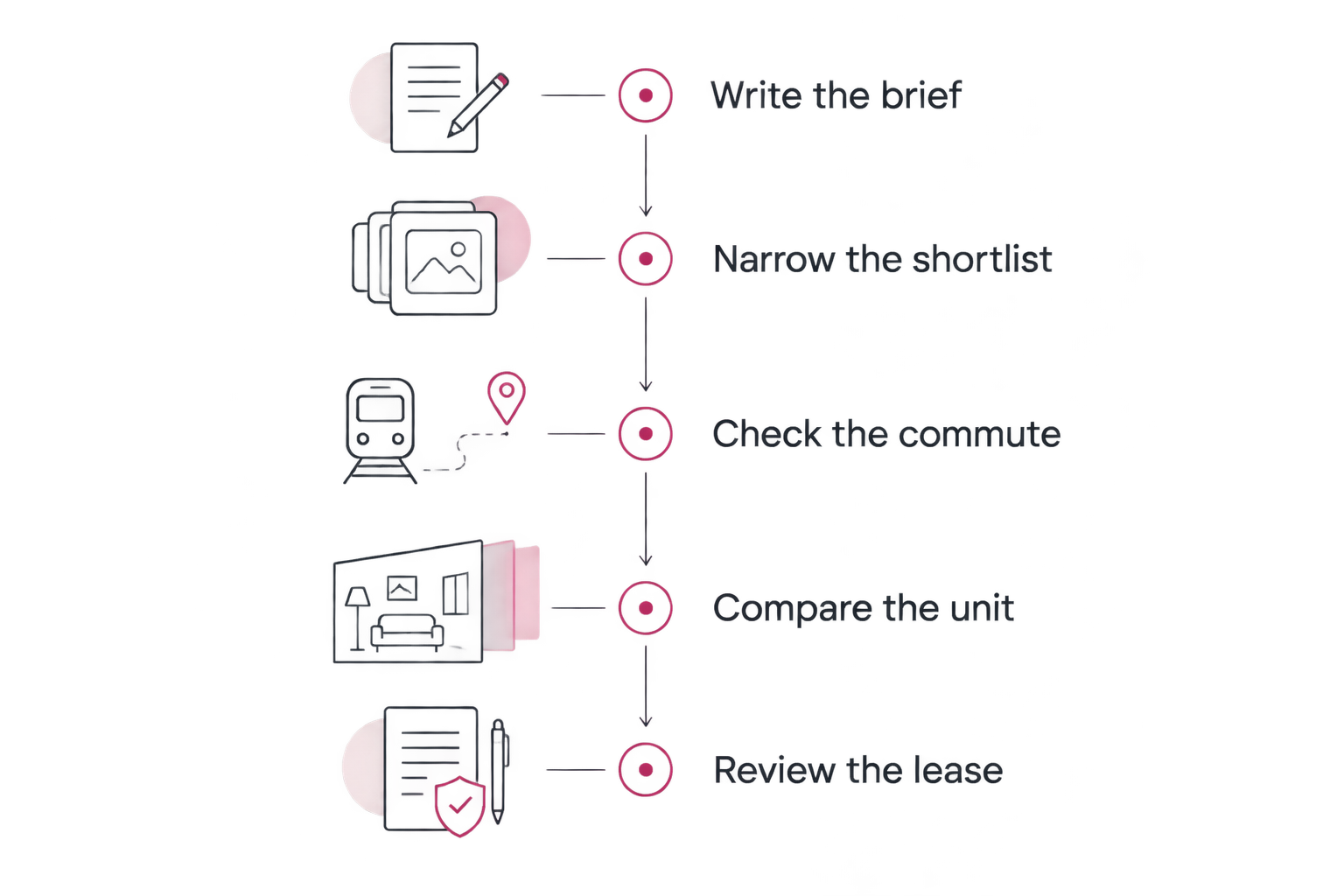
Write the brief
Give Taco Street Locating your destination addresses, intended move date, bedroom needs, budget ceiling, pet information and nonnegotiables. Personalized research is more useful when “modern apartment” becomes a clear description of what you need.
Narrow the shortlist
Choose 3 candidate apartments for a detailed first comparison. This is a practical starting limit, not a claim that every renter needs exactly the same number.
Record why each apartment belongs on the list. If the only answer is attractive photography, return to your criteria.
Check the commute
Run 2 commute checks: one for your expected arrival time and one for your expected departure time. Add other essential destinations, such as childcare or campus, rather than judging the route to work alone.
Compare the unit
Use 1 written worksheet per apartment to record the quote, layout, inspection notes and unanswered questions. Ask to see the specific unit; if that is not possible, request unit-specific documentation and resolve material differences before committing.
Review the lease
Match verbal explanations to the written agreement. Confirm the apartment identifier, dates, required charges, pet terms and notice provisions before signing.
An AI apartment search can be a starting point for organizing your preferences; personalized human help belongs at the point where neighborhood context and apartment trade-offs need discussion. Neither a search result nor a recommendation replaces your review of the property and agreement.
Which Texas luxury-apartment search should you choose?
Choose the city your weekly routine requires, then choose the apartment. If you are relocating to Austin, start with Austin neighborhoods; do not turn a settled destination into a statewide browsing project.
Taco Street Locating helps renters compare apartments in Austin, Dallas–Fort Worth, Houston and San Antonio. Its personalized research supports your shortlist, while the final checks remain specific to your apartment, circumstances and lease.
FAQ
What’s the best city for luxury apartments in Texas in 2026?
The best city is the one that fits your work and recurring destinations. Start with Austin for an Austin relocation, Dallas for a Dallas-centered routine, or the corresponding city for a Houston, Fort Worth or San Antonio move.
How much should I budget for a luxury apartment in Texas?
Build your budget from a current, itemized quote for the specific apartment and lease dates. Separate recurring obligations, move-in payments and optional services rather than relying on a statewide price band.
Can I find a Texas apartment without browsing listing sites?
Yes. Give an apartment locator a detailed brief, compare a focused shortlist and verify the specific apartment and lease before committing.
What does Taco Street Locating help renters do?
Taco Street Locating helps renters compare and find apartments through personalized research and local neighborhood knowledge. Its service areas include Austin, Dallas–Fort Worth, Houston and San Antonio.
Is a luxury apartment automatically quieter or better managed?
No. The luxury label does not establish sound insulation, maintenance responsiveness or management quality; assess those separately for each building and unit.
Should I choose Dallas or Fort Worth for an apartment?
Choose according to your regular destinations rather than treating Dallas and Fort Worth as interchangeable. Check each essential route before comparing apartment amenities.
What should I check on a luxury apartment tour?
Check the specific unit’s condition, layout, storage, noise exposure and access arrangements. Test ordinary functions such as doors, faucets and appliances where permitted, and record unresolved questions before applying.
One last thing
Tour the route from your parked car to your apartment door, not just the apartment itself. Carrying groceries, collecting deliveries and reaching the elevator are ordinary parts of living there that a rooftop photograph cannot explain.
Keep the taco stop on your neighborhood checklist. Just do not let it outrank a bedroom where you can sleep.
Related guides
- Best luxury apartments in Dallas
- Best luxury apartments in Houston
- Best luxury apartments in Fort Worth