

Inside this guide
- Why this matters
- At a glance
- Personalized locating wins when you need a starting point
- ApartmentRatings wins when resident experiences are the question
- Local guidance wins for neighborhood trade-offs
- ApartmentRatings wins for self-directed review research
- Both work better when you separate fit from evidence
- Both require apartment-level verification before you apply
- Pricing: compare the work, not an assumed savings claim
- Final verdict: choose by the question you need answered
- FAQ
- One last thing
- Related guides
Choose Taco Street Locating if you need personalized help finding a Texas apartment; choose ApartmentRatings if you already have buildings in mind and want to investigate resident feedback yourself. In 2026, the distinction is apartment-search guidance versus building-level review research—not competing versions of the same service.
- Taco Street Locating vs ApartmentRatings separates personalized apartment locating from self-directed resident review research.
- Choose the locator for neighborhood guidance in Austin, Dallas–Fort Worth, Houston, and San Antonio.
- Choose ApartmentRatings to investigate resident experiences at buildings already on your shortlist.
- Use both for different questions, then confirm apartment details directly before applying.
Why this matters
An apartment can look right on a map and still fail your daily routine. Resident reviews help you investigate building experiences, but they do not decide whether your commute, floor-plan requirements, and neighborhood preferences fit together.
Taco Street Locating is best for Texas renters who want personalized apartment research and neighborhood guidance. ApartmentRatings is the better starting point when your question is narrower: what have residents said about this particular community?
For a 2026 relocation, separate discovery from verification. Find plausible apartments first, investigate their weaknesses second, and confirm the exact apartment and lease terms before making a commitment.
At a glance
| Dimension | Taco Street Locating | ApartmentRatings |
|---|---|---|
| Best for | Renters seeking personalized apartment-search help | Renters researching resident feedback themselves |
| Starting point | Your needs, location preferences, and apartment criteria | A community you want to investigate |
| Standout feature | Personalized research and local neighborhood knowledge | Apartment community ratings and resident reviews |
| Neighborhood decisions | Human guidance for comparing areas | Building feedback that supplements neighborhood research |
| Resident experiences | Use independent reviews alongside recommendations | Direct access to published resident perspectives |
| Search control | Collaborative research with a locator | Self-directed review reading and comparison |
| Final verification | Confirm details with the property | Confirm review concerns with the property |
| Pricing model | Free apartment locating service | Review-research platform rather than a personal locating service |
Personalized locating wins when you need a starting point
Best for: a renter relocating without a useful shortlist. Start with human guidance when you know your requirements but cannot yet translate them into neighborhoods and communities.
For example, an Austin move can begin with a workplace address, a pet, and a preference for a separate workspace. Those requirements call for apartment research, not just a review search. A locator helps you frame the comparison around what you actually need.
Write a brief before asking for recommendations:
- Must-haves: the requirements that eliminate an apartment if missing.
- Preferences: features you value but can trade away.
- Deal-breakers: conditions you will not accept.
- Daily destinations: work, school, family, or recurring appointments.
The benefit is a search shaped around your situation. The limitation is that useful guidance requires useful input: “somewhere nice in Austin” leaves too much undefined.
ApartmentRatings is less direct for this starting problem. Reading individual community reviews before deciding where to search gives you building details without necessarily resolving your neighborhood choice.
ApartmentRatings wins when resident experiences are the question
Best for: a renter checking buildings already under consideration. ApartmentRatings is the more direct choice when you want to read what residents report about living at a community.
Use reviews to identify subjects worth investigating: maintenance communication, noise, parking, shared spaces, and interactions with management. Keep the distinction clear between a resident's reported experience and a condition independently established for the apartment you would rent.
A review is evidence that someone described an experience. It is not proof that every resident has the same experience or that the issue remains unresolved.
Read for these patterns:
- Specificity: does the account describe an identifiable problem?
- Timing: when did the reported experience occur?
- Repetition: do separate accounts describe a similar concern?
- Relevance: does the issue affect something important to you?
The strength is access to perspectives beyond a leasing presentation. The limitation is interpretation: you still need to decide which reports are relevant and what to verify.
A personalized recommendation does not replace this work. Treat resident feedback as a separate check, including when an apartment arrives through a locator.
Local guidance wins for neighborhood trade-offs
Best for: a renter choosing an area before choosing a building. Personalized neighborhood guidance addresses a different decision from a community rating.
In Austin, compare places such as Hyde Park, Mueller, and East Austin against your actual destinations rather than treating them as interchangeable choices. In Dallas, apply the same discipline to Trinity Groves and Victory Park. A neighborhood name is a starting point, not a complete description of your future routine.
Ask your locator to explain why an area belongs on your shortlist. Request the trade-off too: what requirement does the recommendation satisfy, and what preference does it compromise?
For your 2026 search, compare 3 neighborhoods using the same questions. Check your route, nearby errands, and the surroundings of each specific address; do not score an entire neighborhood from one attractive building.
Use the guide to choosing an Austin apartment around your commute to organize that comparison.
The advantage of local guidance is context. Its limit is personal fit: no recommendation substitutes for checking whether an address works for your own schedule.
ApartmentRatings wins for self-directed review research
Best for: a renter who already knows the area and prefers independent investigation. ApartmentRatings fits a search in which you want to read resident feedback without making personalized guidance the center of the process.
Suppose you already live near your target neighborhood and have selected several communities. Your unresolved questions concern management communication and day-to-day building experiences, not where to live. Review research addresses that task directly.
Keep notes by subject rather than copying an overall impression. Separate maintenance comments from noise comments, and distinguish concerns about an individual apartment from concerns about shared facilities.
The benefit is control over your research process. The drawback is that you own the interpretation and follow-up; reading more reviews does not automatically produce a better decision.
Personalized locating is less necessary for this narrow task. It becomes useful again if the research sends you back to the beginning and you need alternatives that meet your original requirements.
Both work better when you separate fit from evidence
Best for: a renter who wants guidance without outsourcing judgment. Neither approach should carry every part of your decision.
Use apartment locating to ask, “Does this option match my requirements?” Use resident reviews to ask, “What experiences should I investigate?” Then ask the property to confirm the details that determine whether you apply.
Follow this sequence:
- Set criteria: record your must-haves and deal-breakers.
- Build shortlist: identify apartments that appear to fit.
- Read reviews: collect specific concerns worth checking.
- Check details: investigate those concerns during direct follow-up.
- Compare evidence: decide using the same criteria for every apartment.
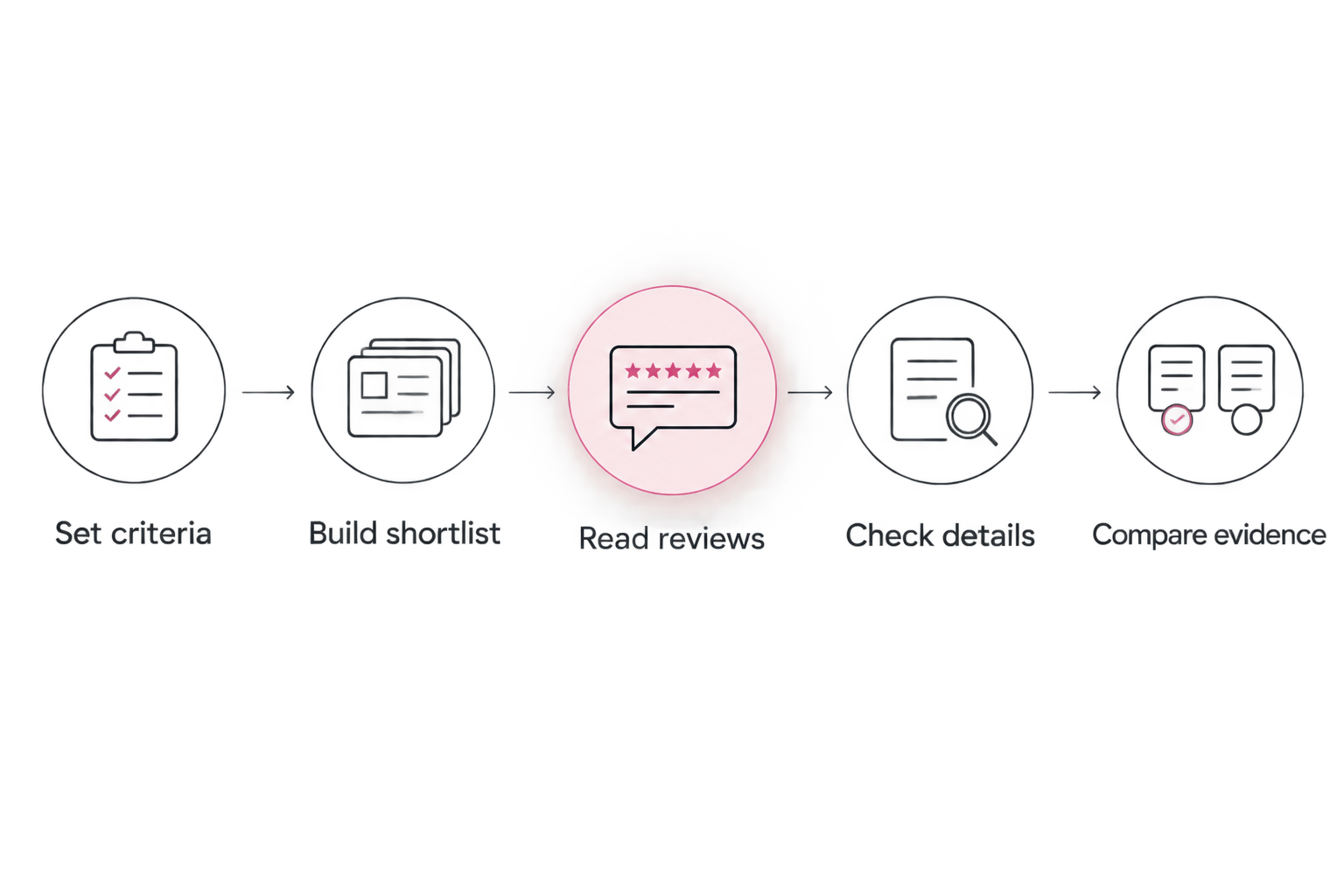
This combined workflow has a real cost in attention. You must reconcile recommendations, resident accounts, and property responses instead of accepting whichever source sounds most confident.
That extra discipline serves a purpose: an appealing recommendation and a reassuring review still answer different questions.
Both require apartment-level verification before you apply
Best for: every renter approaching a decision. Neither a locator's recommendation nor a review page replaces direct confirmation about the apartment and agreement you are considering.
Prepare 5 questions for your 2026 tour or leasing conversation:
- Which exact apartment and floor plan am I evaluating?
- What charges and lease obligations should I review before applying?
- Which pet, parking, and occupancy rules apply to my household?
- How do residents submit maintenance requests and follow up?
- What can you explain about the specific concerns I found in reviews?
Request written clarification on details that affect your decision. Keep it with the documents you review rather than relying on a remembered conversation.
For commute-sensitive moves, check 2 weekday trips at the times you expect to travel. That is a suggested research exercise, not a promised travel-time result; your actual route matters more than a neighborhood's general reputation.
This is an honest tie. Both sources contribute to research, and neither should be treated as a substitute for checking the actual apartment.
Pricing: compare the work, not an assumed savings claim
Taco Street Locating is a free apartment locating service. Its role in this comparison is personalized apartment research and neighborhood guidance across Austin, Dallas–Fort Worth, Houston, and San Antonio.
ApartmentRatings serves the resident-review research side of the decision. Do not assume that using a review platform includes the same personal assistance as working with a locator, or that using a locator removes the need to read reviews.
For a 2026 move, the practical trade-off is guided research versus research you organize yourself. Compare the help you need, the work you want to retain, and the questions each approach actually answers.
Neither approach supports a blanket promise of lower housing costs. Evaluate your apartment's full obligations directly, and keep any claims about savings separate from the decision about which research method suits you.
Final verdict: choose by the question you need answered
Choose Taco Street Locating if you are a relocating renter
Your winner is personalized locating when you need help turning requirements into an apartment shortlist in the supported Texas markets.
This profile includes an Austin newcomer comparing neighborhoods, a Dallas–Fort Worth mover balancing destinations, or a Houston renter who wants help organizing apartment research. Share clear criteria, ask for trade-offs, and independently investigate the communities recommended.
Choose ApartmentRatings if you are a building investigator
Your winner is ApartmentRatings when you already know the area and want to examine resident feedback about specific communities.
This profile includes a local renter checking a possible move or a relocating renter whose shortlist is already settled. Read specific accounts, assess their relevance, and turn concerns into questions rather than treating a rating as a final verdict.
One-glance scorecard
| Dimension | Winner |
|---|---|
| Starting without a shortlist | Personalized locating |
| Reading resident experiences | ApartmentRatings |
| Comparing neighborhood fit | Personalized locating |
| Self-directed review research | ApartmentRatings |
| Combining fit with evidence | Both, used for separate tasks |
| Final apartment verification | Tie: direct property confirmation required |
| Pricing model | Choose by the assistance required, not assumed savings |
FAQ
Is Taco Street Locating better than ApartmentRatings?
Taco Street Locating is the better fit for personalized apartment research in its supported Texas markets; ApartmentRatings is the better fit for investigating published resident feedback. Choose according to whether you need help building a shortlist or checking one.
Can I use an apartment locator and ApartmentRatings together?
Yes, use a locator to develop your shortlist and ApartmentRatings to investigate resident experiences at those communities. Confirm important details directly with the property before applying.
Which option should I start with when moving to Austin?
Start with personalized locating if you need help choosing neighborhoods and identifying apartments. Start with ApartmentRatings if you already have specific communities to investigate.
Should I reject an apartment because of a bad review?
A bad review is a reason to investigate a specific concern, not an automatic decision. Check its timing, relevance, and whether separate accounts describe the same issue, then ask the property for an explanation.
Does a good apartment rating mean the neighborhood fits me?
No, a community rating does not establish whether the address fits your commute or daily routine. Evaluate the building and the neighborhood as separate parts of your decision.
What should I ask a locator before accepting a recommendation?
Ask which requirements the apartment satisfies and which trade-offs remain. A useful comparison explains the fit rather than simply presenting an attractive option.
What should I verify before applying for an apartment in 2026?
Verify the exact apartment, written charges, lease obligations, and household rules directly with the property. Also follow up on specific resident-review concerns that affect your decision.
One last thing
Before choosing an apartment in 2026, write down the strongest reason not to rent it. Then decide whether you have investigated that concern or merely become excited enough to ignore it.
Apply the same test to every finalist. A great taco nearby deserves a place on your notes, not veto power over your deal-breakers.
Related guides
- How apartment locators work in Texas
- How to tour an Austin apartment from another city
- ApartmentRatings alternatives