

Inside this guide
- Why this matters
- At a glance
- Local apartment help wins for a guided Texas search
- Realtor.com wins on geographic and housing breadth
- Personalized research wins when your requirements need interpretation
- Realtor.com wins when you want to direct every browsing decision
- Local guidance wins for neighborhood trade-offs
- Both routes require the same final property checks
- Pricing: separate the search service from the lease
- Final verdict: choose by the work you want help with
- FAQ
- One last thing
- Related guides
Choose Taco Street Locating if you want personalized apartment research in Austin, Dallas–Fort Worth, or Houston; choose Realtor.com if you want to browse rentals independently across a broader geographic search. In 2026, the useful distinction is local guidance versus a national listing portal—not which website produces the longest results page.
- Taco Street Locating vs Realtor.com compares personalized Texas apartment help with independent rental browsing.
- Choose Taco Street Locating for apartment research and neighborhood guidance in Austin, Dallas–Fort Worth, or Houston.
- Choose Realtor.com for nationwide browsing or a search that includes homes beyond apartments.
- Neither route replaces checking lease terms, property policies, and the exact apartment before applying.
Why this matters
An apartment search has two separate jobs: finding places to consider and deciding which ones fit your life. A listing portal helps with discovery; personalized apartment locating adds help interpreting your requirements and comparing options.
Taco Street Locating is a free apartment locating service serving Austin, Dallas–Fort Worth, and Houston. Its value is personalized research and local neighborhood knowledge, rather than simply giving you another list to scroll.
For your 2026 move, choose the route that addresses your actual obstacle. If you already know the neighborhood and enjoy doing the research, independent browsing fits. If you are relocating and cannot distinguish a promising address from a practical one, guidance addresses a different problem.
At a glance
| Dimension | Taco Street Locating | Realtor.com |
|---|---|---|
| Best for | Renters seeking personalized help in the named Texas markets | Renters who prefer independent, nationwide browsing |
| Geographic scope | Austin, Dallas–Fort Worth, and Houston | National real estate search |
| Standout feature | Personalized apartment research and neighborhood knowledge | A broad, listing-led way to explore real estate |
| Research workload | A service to help find and compare apartments | A portal for directing your own search |
| Browsing control | Start with your requirements and get personalized help | Start with listings and explore independently |
| Neighborhood decisions | Local guidance for comparing apartment locations | Independent research around listing addresses |
| Final verification | Confirm apartment-specific terms with the property | Confirm apartment-specific terms with the property |
| Pricing model | Free apartment locating service | Self-directed listing portal; distinguish browsing from transaction costs |
Local apartment help wins for a guided Texas search
Taco Street Locating is best for renters who want personalized apartment research in Austin, Dallas–Fort Worth, or Houston. That is a narrower task than browsing real estate across the country, and it is the central reason to choose the service.
Consider an Austin relocation where your workplace is known but your preferred neighborhood is not. You need to compare the commute, your daily errands, and apartment requirements together. Sending those constraints to a local locator gives the research a defined purpose.
The limitation is equally clear: the stated service area is not nationwide. If your search moves outside those Texas markets, do not assume the same service applies. Realtor.com is the better starting point when geographic breadth matters more than help within a particular local apartment market.
Before choosing either route, write down your destination and housing type. An apartment search in Houston and a rental-home search spanning several states are different assignments, even when both begin with a moving date.
Realtor.com wins on geographic and housing breadth
Realtor.com is the better fit when you want a national real estate portal rather than a service focused on apartments in selected Texas markets. It also makes sense when you are exploring rentals alongside the possibility of buying a home.
That breadth is useful early in a relocation decision. You can investigate different cities without first committing to one local apartment search. A renter comparing Texas with another state has a different need from someone already committed to Austin.
The trade-off is responsibility. A broader search still leaves you to decide which locations deserve attention and which properties meet your requirements. A larger geographic canvas does not answer whether a particular address works for your schedule.
Choose Realtor.com for broad exploration, not as a substitute for neighborhood judgment. Once you narrow the destination to a supported Texas market, personalized apartment help becomes a separate option rather than a competing way to perform exactly the same task.
Personalized research wins when your requirements need interpretation
A requirement such as in-unit laundry is straightforward to describe. A requirement such as a workable home office, reasonable commute, and comfortable daily routine takes more interpretation.
Apartment locating is useful when you want help turning that mix into a shortlist. Explain what is mandatory, what is flexible, and what would make you reject an otherwise attractive apartment. Personalized research becomes more useful when your brief is specific.
For example, a remote worker considering Hyde Park in Austin should distinguish needing a separate room from needing a quiet desk area. Those are different layout questions. Neither an appealing photograph nor a neighborhood name settles them.
The limitation of guided research is that it still requires your input. A locator cannot choose your tolerance for street noise or decide whether you enjoy a particular neighborhood. Use personalized help to organize the decision, not to outsource your preferences.
Independent browsing works better when you already have a clear brief and want to investigate each candidate yourself. The difference is who does the comparison work, not whether comparison remains necessary.
Realtor.com wins when you want to direct every browsing decision
Realtor.com suits renters who enjoy exploring listings, changing the search area, and building their own candidate list. You can begin with curiosity rather than a finished relocation brief.
This approach works especially well when you already know the city. If your target area is fixed and your requirements are straightforward, you might prefer to inspect listings yourself before seeking any additional help.
The drawback is the research workload. You must distinguish attractive presentation from a genuine fit, keep track of unanswered questions, and avoid repeatedly reconsidering properties that fail a mandatory requirement.
Give your independent search a stopping rule. Once a candidate fails a non-negotiable requirement, remove it rather than keeping it because the kitchen looks good. An apartment search should not become a second job with better countertops.
Independent browsing wins on personal control; guided research wins when you want help narrowing the field. Neither preference makes you a more serious renter. Choose the working style you will actually follow through on.
Local guidance wins for neighborhood trade-offs
Neighborhood names are starting points, not complete descriptions of daily life. Hyde Park and the Domain area in Austin, Trinity Groves and Victory Park in Dallas, and locations across Houston each require address-level comparisons.
Start with the places you must reach. Then examine the apartment location against your work schedule, errands, transportation choices, and preferred routine. For an Austin move in 2026, the guide to choosing an apartment around your commute offers a focused next step.
Ask concrete questions rather than requesting a universally good neighborhood:
- Where is the workplace entrance you will actually use?
- Will you drive, walk, cycle, or use transit for recurring trips?
- Does the route work at the times you expect to travel?
- Which errands need to be convenient without a special trip?
- What should you inspect around the building during a visit?
Local guidance helps connect these questions to your apartment shortlist. Realtor.com remains useful for discovering addresses, but browsing alone does not interpret your routine.
The limitation of any neighborhood recommendation is personal fit. Visit when possible, examine the immediate surroundings, and test the journeys that matter to you. A neighborhood reputation is not a substitute for the block where you will live.
Both routes require the same final property checks
Neither a locator recommendation nor a portal listing is your lease. Both routes require confirmation of the exact apartment, its terms, and the property's application requirements before you commit.
For a 2026 move, keep a separate verification record for each serious candidate. Do not combine details from different floor plans or assume that a feature shown in a community photograph applies to your apartment.
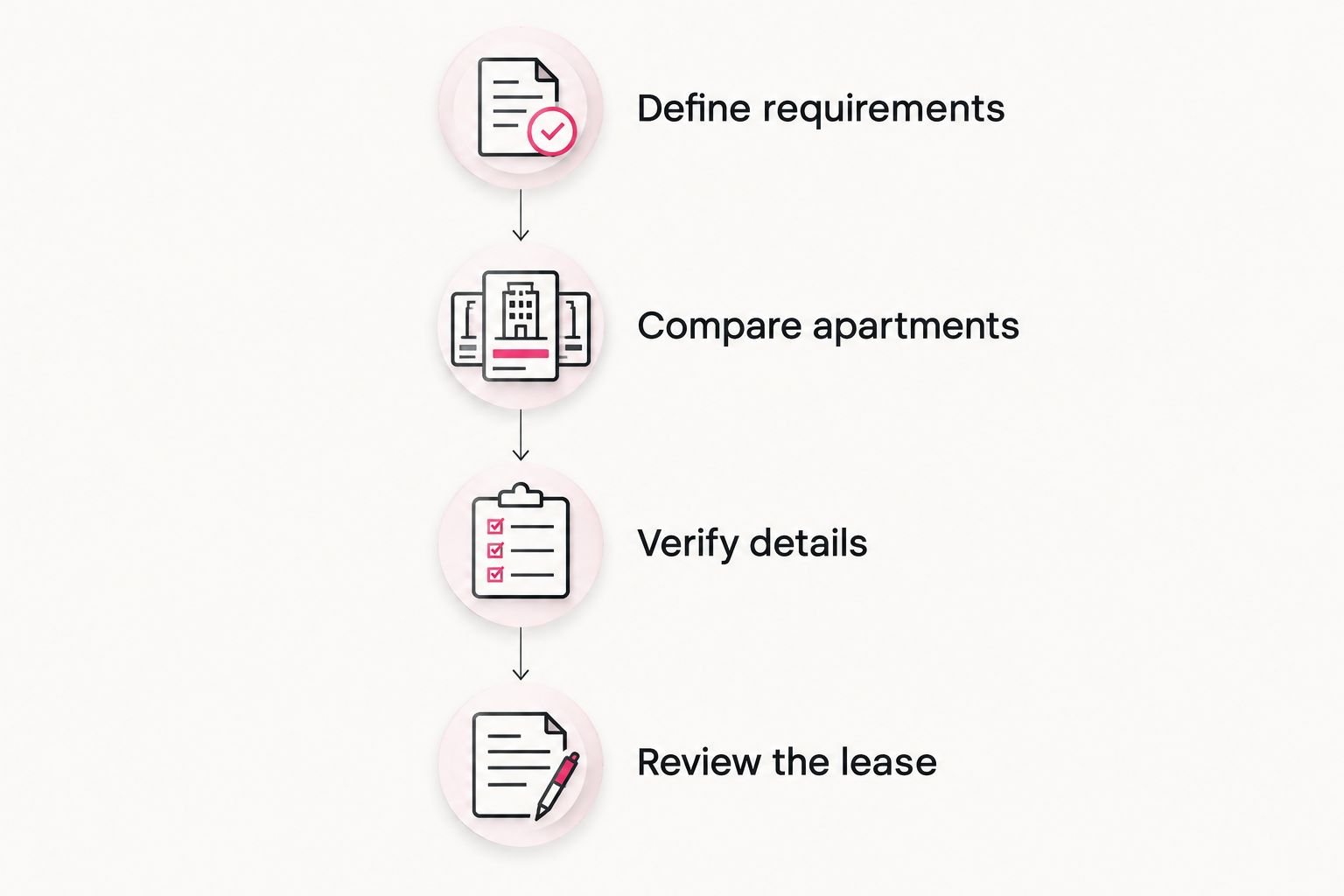
Use the same process regardless of where you found the property:
- Define requirements: Record your move timing, household needs, preferred areas, and non-negotiable features.
- Compare apartments: Review each candidate against the same criteria rather than relying on a general impression.
- Verify details: Ask the property to confirm the specific apartment, lease terms, policies, and application requirements.
- Review the lease: Check that the written agreement matches the terms you intend to accept.
Ask about parking arrangements, pet rules, laundry, internet arrangements, and any recurring obligations relevant to you. These are questions to resolve, not features to assume.
This is an honest tie. Either search route can introduce a candidate, but neither removes your responsibility to understand the agreement you sign.
Pricing: separate the search service from the lease
Taco Street Locating offers a free apartment locating service. That describes the locating service—not the financial obligations attached to renting an apartment.
Realtor.com is a listing portal rather than the same kind of personalized apartment locating service. Treat independent browsing and any separately offered services as distinct decisions, and check the terms of anything you choose to use.
For either route, assess the property's written lease obligations separately from the method used to find it. Ask the property for an itemized explanation of the obligations attached to your application and tenancy.
The practical trade-off is your research time and preferred level of help. If you want personalized apartment comparisons, the free locating model provides a reason to ask for assistance. If you prefer to do the research yourself, the portal model fits that working style.
Neither search method determines whether a particular lease fits your budget. Compare apartments using consistent assumptions about lease length, household requirements, and the services you need.
Final verdict: choose by the work you want help with
Choose Taco Street Locating if you are relocating to a supported Texas market
You have chosen Austin, Dallas–Fort Worth, or Houston, but you want help finding and comparing apartments. Your biggest challenge is turning neighborhood questions and household requirements into a useful shortlist.
This is the stronger fit for a renter who wants personalized research rather than another independent browsing task. Bring a clear brief and remain involved in the final property checks.
Choose Realtor.com if you are an independent, broad-market researcher
You want to explore rental listings across different markets, consider housing beyond apartments, or control the research from the start. You are comfortable investigating neighborhoods and comparing candidates yourself.
This is the stronger fit for a renter whose main need is discovery. If your search later narrows to a supported Texas market, you can decide separately whether personalized apartment help would reduce the remaining work.
For a 2026 search, the two routes can also serve different stages: explore broadly first, then seek local help once your destination and requirements are clear.
| Dimension | Winner |
|---|---|
| Best for | Local locator for guided Texas searches; Realtor.com for independent exploration |
| Geographic scope | Realtor.com |
| Standout feature | Tie: personalized research versus broad discovery |
| Research workload | Local locator for help comparing apartments |
| Browsing control | Realtor.com |
| Neighborhood decisions | Local locator for personalized neighborhood guidance |
| Final verification | Tie: confirm details with the property |
| Pricing model | Choose by service needs; assess lease obligations separately |
FAQ
Is Taco Street Locating better than Realtor.com for an Austin move?
Taco Street Locating is the better fit when you want personalized apartment research and local neighborhood guidance in Austin. Realtor.com is the better fit when you prefer independent browsing or are still comparing destinations.
Can I use a listing portal and an apartment locator together?
Yes, you can use a portal for discovery and a locator for personalized apartment comparisons. Share your shortlist and explain what you like or dislike about each candidate so the additional research has a clear purpose.
Which option is better if I am moving outside Texas?
Realtor.com is the better starting point for a search outside the stated Texas service area. Its national scope fits a broader geographic search, while the locating service described here covers Austin, Dallas–Fort Worth, and Houston.
Does using an apartment locator remove the need to contact the property?
No, you still need apartment-specific confirmation from the property before committing. Confirm the lease terms, application requirements, policies, and features of the exact apartment you are considering.
What should I prepare before asking for apartment help?
Prepare your move timing, preferred areas, household requirements, and non-negotiable features. Include the places you need to reach regularly so apartment comparisons reflect your actual routine.
Which option should I choose if I already know my neighborhood?
Choose Realtor.com if you know the neighborhood and want to research listings independently. Personalized locating help remains useful if you want assistance comparing apartments or interpreting competing requirements.
How should I compare apartment search costs?
Separate the apartment search service from the property’s application and lease obligations. Review the terms of any service you use, then obtain the property’s written explanation of the obligations attached to the apartment.
One last thing
Before your first tour, write down what would make you reject an apartment. That list is often more useful than a wish list: a beautiful common area cannot fix a layout that does not work for your household.
For your 2026 move, apply those rejection criteria consistently. Whether you discover an apartment through a portal or personalized research, the best next step is the same: resolve the questions that could change your decision before you apply.
Related guides
- Choosing an Austin apartment locator for your first move
- Touring an Austin apartment from another city
- Realtor.com alternatives for renters