

Inside this guide
- Why this matters
- At a glance
- Personalized help wins for renters who need a shortlist
- Redfin wins for geographic exploration beyond these Texas markets
- Redfin wins for a fully self-directed search
- Local guidance and property discovery solve different problems
- Neighborhood guidance wins for trade-offs; maps win for exploration
- Neither option replaces unit-level verification
- Neither option decides whether your application is approved
- Pricing: separate search help from the lease itself
- Final verdict: choose help or choose independent exploration
- FAQ
- One last thing
- Related guides
Choose Taco Street Locating if you want personalized apartment research and neighborhood guidance in Austin, Dallas–Fort Worth, Houston, or San Antonio; choose Redfin if you want to browse rental listings independently or explore buying alongside renting. For 2026, the useful distinction is local apartment-finding help versus a self-directed real estate search, not which company wins every category.
- Taco Street Locating vs Redfin compares personalized Texas apartment locating with self-directed rental search.
- Choose the locator for apartment research and neighborhood guidance in its four Texas markets.
- Choose Redfin for independent browsing, broader geographic exploration, or researching rentals and homes for sale.
- Neither a recommendation nor a listing replaces written confirmation of lease terms from property management.
Why this matters
A rental search produces two different problems: finding places to consider and deciding which places actually fit your life. A listing website helps with discovery. A personalized apartment locating service helps you work through the decision.
That distinction matters when relocating to Austin. Knowing that an apartment is in Hyde Park, East Austin, or near the Domain is only a starting point; you still need to compare your work destination, preferred surroundings, and the particular unit.
Taco Street Locating is best for Texas apartment renters who want personalized research and local neighborhood guidance. Redfin is the better starting point when you want to explore real estate independently rather than begin with a local apartment brief.
At a glance
Use this 2026 comparison to choose your search method before building a shortlist. The rows follow the decision criteria explained below.
| Dimension | Taco Street Locating | Redfin |
|---|---|---|
| Best for | Renters seeking personalized apartment help | Renters who prefer independent browsing |
| Geographic scope | Austin, Dallas–Fort Worth, Houston, and San Antonio | Searching across a broader range of locations |
| Search workflow | Explain your requirements and get personalized research | Browse listings and direct your own research |
| Standout feature | Local apartment research and neighborhood knowledge | Rental and for-sale property discovery |
| Neighborhood decisions | Best for discussing location trade-offs | Best for visually exploring locations yourself |
| Unit verification | Confirm details with property management | Confirm details with property management |
| Application decisions | Property management controls approval | Property management controls approval |
| Pricing model | Free apartment locating service | Listing-search platform; distinguish browsing from transaction services |
Personalized help wins for renters who need a shortlist
Choose the locator when your main problem is deciding what deserves a tour. You bring your move date, household requirements, and location priorities; personalized research gives those requirements a place in the search.
Consider someone moving to Austin who has a job destination but little familiarity with the city. Comparing Hyde Park, Mueller, and South Austin requires more than collecting attractive floor plans. The useful question is which location and apartment combination fits that person's routine.
The trade-off is participation. You still need to explain your priorities, respond to questions, review recommendations, and make the final decision. A locator is not a substitute for knowing what you can spend or reading your lease.
Redfin fits the opposite profile: you already know the area, enjoy researching listings, and want to control which properties enter your shortlist. That independence is useful, but it also leaves you responsible for organizing the comparison.
Redfin wins for geographic exploration beyond these Texas markets
Choose Redfin when your search extends beyond the locator's stated service area. Its broader real estate search is a better fit for exploring locations across different regions.
The local service here focuses on apartments in Austin, Dallas–Fort Worth, Houston, and San Antonio. That is a clear fit for someone choosing between Austin neighborhoods, but not the same assignment as comparing rental options across several states.
For a 2026 relocation, settle the geographic question early. If your employer has not confirmed your destination, start with broad location research. Once your destination is one of the supported Texas markets, personalized apartment help becomes more relevant.
Redfin's breadth does not automatically resolve a local decision. A wider search area gives you more places to investigate, not an answer about which commute or neighborhood works for you.
Redfin wins for a fully self-directed search
Redfin is the better fit if browsing is how you prefer to make decisions. You can investigate listings at your own pace and decide which details deserve further questions.
That suits a renter who already knows the neighborhood and wants to research individual properties without first discussing a brief. The drawback is the work between browsing and choosing: organizing options, contacting properties, and separating essential requirements from attractive extras.
Personalized locating changes that workflow. Instead of starting with every interesting listing, start with your requirements and use them to narrow the research.
For either approach, follow the same sequence:
- Define priorities: Write down your destination, move window, household needs, and deal-breakers.
- Explore options: Use independent browsing or personalized research to identify candidates.
- Compare finalists: Put the same questions against every property.
- Confirm terms: Get unit-specific details from property management before applying.
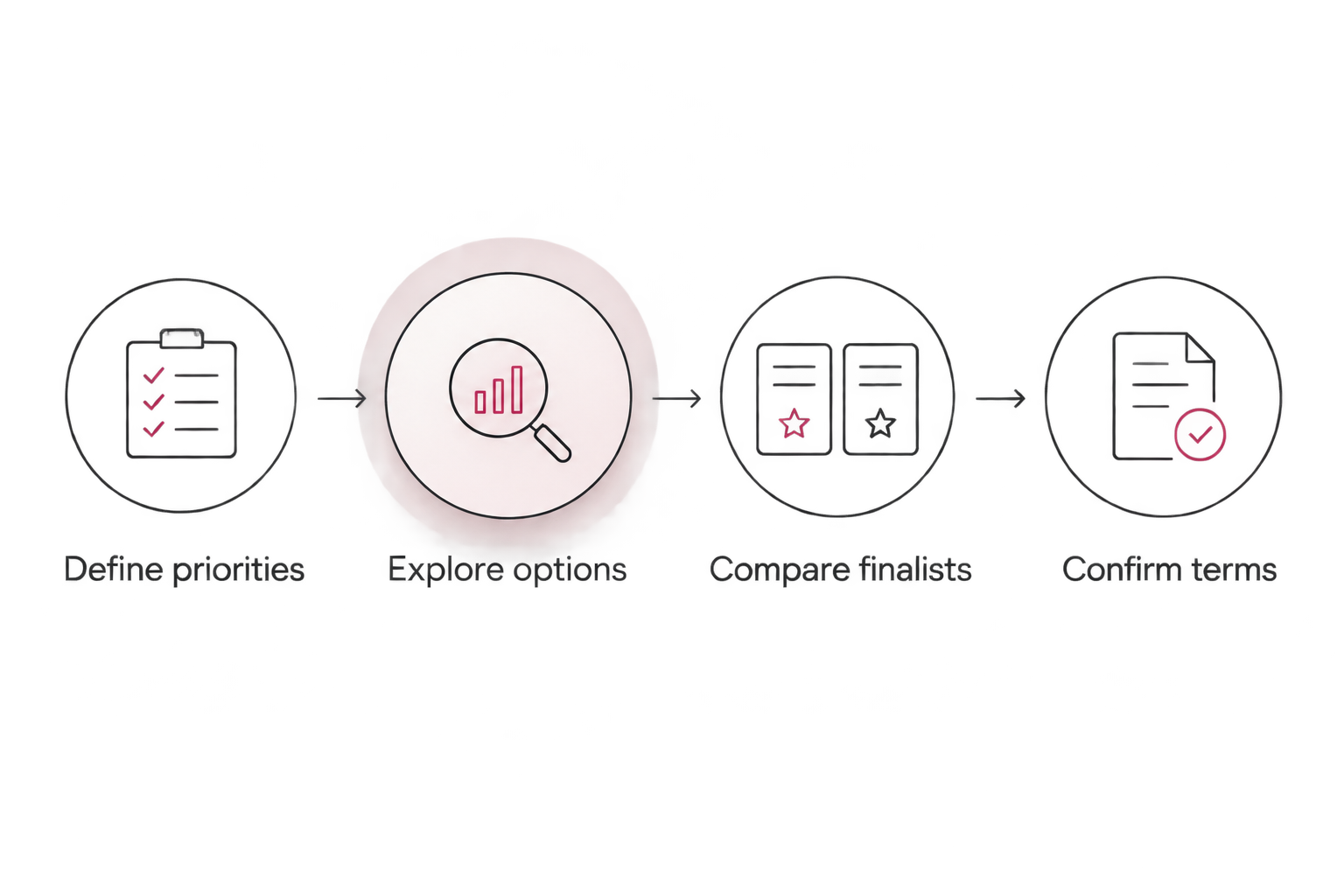
Keep 3 finalist apartments on your comparison sheet as a practical starting point. This is a suggested way to organize your search, not a claim about either service's results.
Local guidance and property discovery solve different problems
The locator wins for a personal apartment brief; Redfin wins for exploring renting alongside buying. These are different assignments, so match the service to the question you actually have.
A local apartment brief includes details such as your work address, preference for a quieter setting, pet requirements, and whether you need a separate workspace. Neighborhood knowledge helps turn those details into questions worth asking about particular apartments.
Redfin's rental and for-sale searches suit someone who has not settled on renting. If your real question is whether to rent an apartment or investigate purchasing a home, a broader real estate platform belongs in the research process.
The limitation runs both ways. Personalized apartment research does not answer every homebuying question, and browsing homes for sale does not settle which apartment lease fits your move. Decide which problem needs attention first.
Neighborhood guidance wins for trade-offs; maps win for exploration
Use local guidance to discuss trade-offs and Redfin's map-based browsing to investigate locations yourself. Neither method makes a neighborhood universally right for every renter.
In Austin, compare Downtown and the Domain against your actual destination rather than treating both as interchangeable places with restaurants nearby. In Dallas, give Trinity Groves and Victory Park the same practical treatment: identify where you need to go and what surrounds the specific building.
For a 2026 move, test a proposed commute at your expected travel times. Check 2 weekday travel windows—your outward trip and your return trip—instead of relying on distance alone. The guide to choosing an Austin apartment around your commute provides a useful next step.
A map helps you see relative position. A neighborhood conversation helps you articulate what that position means for your routine. You still need to inspect the route, surrounding streets, and building access yourself.
That is the honest trade-off: independent exploration gives you control, while a discussion gives you another way to evaluate your priorities. Neither replaces a visit when street-level conditions matter to you.
Neither option replaces unit-level verification
This category is a tie: confirm the apartment, not just the building. A property name or floor-plan image is not enough to establish the terms of the unit you intend to lease.
Before applying, ask property management to confirm:
- The exact unit and floor plan under consideration.
- The proposed lease start and lease length.
- Required recurring charges and move-in obligations.
- Parking arrangements and any relevant pet restrictions.
- Which features belong to the unit rather than shared spaces.
- Any condition attached to a written offer.
Keep 1 comparison sheet with a separate column for each finalist. Record the source and date of each answer so you can distinguish a management response from a listing description or your own assumption.
For a 2026 search, use current written information rather than screenshots from an earlier search. Neither the listing-platform approach nor personalized locating removes the need for that final check.
Neither option decides whether your application is approved
Application approval is another tie: the property's screening process controls the outcome. Do not choose a search method on the assumption that it guarantees acceptance.
Raise relevant questions before submitting an application. If you are relocating for a new job, ask which income documents the property accepts. If you have a rental-history concern, ask how management evaluates it rather than assuming a listing or recommendation establishes eligibility.
Personalized help gives you a setting to discuss those questions. Independent browsing leaves you to identify and ask them yourself. The property still needs to explain its requirements.
Avoid sending sensitive application documents simply because someone shared a promising apartment. Confirm the recipient and the property's application process first.
Pricing: separate search help from the lease itself
Taco Street Locating offers a free apartment locating service. That describes the locating service, not your financial obligations to an apartment community.
Redfin is a real estate search platform, not the same service packaged differently. Distinguish browsing rental listings from any separate brokerage or transaction service you investigate, and review the terms attached to the activity you choose.
The practical trade-off is research responsibility. Personalized locating centers your brief and a conversation; self-directed browsing leaves you in charge of assembling and checking the shortlist. Neither approach establishes your total housing commitment.
Compare written lease terms on the same basis. Include required recurring charges, move-in obligations, and lease length rather than choosing on the strength of a headline alone.
Final verdict: choose help or choose independent exploration
Choose Taco Street Locating if you are a relocating apartment renter
The local apartment service is the better fit when you are moving to Austin, Dallas–Fort Worth, Houston, or San Antonio and want personalized research. Bring a clear destination, move window, and list of requirements so the conversation addresses your actual decision.
This profile includes someone choosing between unfamiliar Austin neighborhoods or trying to organize apartment options around a new workplace. The benefit is decision support, not a promise of approval or a particular lease outcome.
Choose Redfin if you are a self-directed real estate researcher
Redfin is the better fit when you enjoy browsing, already understand your target area, or want to investigate renting alongside buying. It also suits an early-stage search across locations beyond the local service's stated markets.
Accept the corresponding responsibility: you will need to organize your research and confirm property details. You can use a listing platform for discovery and seek personalized apartment help later; the two approaches do not have to be mutually exclusive.
| Dimension | Winner |
|---|---|
| Personalized apartment shortlist | Local locating service |
| Broader geographic exploration | Redfin |
| Fully self-directed browsing | Redfin |
| Personal apartment brief | Local locating service |
| Renting alongside buying | Redfin |
| Discussing neighborhood trade-offs | Local locating service |
| Unit-level verification | Tie—confirm with management |
| Application approval | Tie—property screening controls |
| Pricing model | Different services—compare the task |
FAQ
Is Taco Street Locating or Redfin better for moving to Austin?
Taco Street Locating is the better fit for an Austin apartment renter who wants personalized research and neighborhood guidance. Redfin is the better fit for someone who prefers to browse independently or also wants to research homes for sale.
Can I use Redfin and an apartment locator together?
Yes, you can use Redfin for discovery and a locator for personalized apartment research. Share the properties that interest you and explain what you like about them so the discussion starts with your priorities.
Which option is better if I have not chosen a city?
Redfin is the better starting point for broad geographic exploration. Personalized local apartment help becomes more relevant once your destination is Austin, Dallas–Fort Worth, Houston, or San Antonio.
Does an apartment recommendation guarantee approval?
No, an apartment recommendation does not guarantee approval. Property management evaluates your application under its screening process, so confirm relevant requirements before applying.
Which option helps me compare neighborhoods?
Personalized local guidance is the better fit for discussing neighborhood trade-offs, while Redfin supports independent location research. Check your actual destination, travel times, and the streets around each finalist.
Should I trust a listing without contacting the property?
No, confirm unit-specific details with property management before applying. Ask about the exact apartment, proposed lease dates, required charges, and relevant restrictions.
What should I prepare before asking for apartment help?
Prepare your move window, destination, household requirements, and deal-breakers. Separate essential needs from preferences so personalized research addresses the choices that matter most.
One last thing
Compare the same decision on both sides. If Redfin helps you find an interesting building and a locator helps you decide whether its location fits your routine, both have done useful work.
For your 2026 move, write a short reason beside every finalist: why this apartment, why this location, and what still needs confirmation. A rooftop pool is easy to remember; the unanswered parking question deserves a place on the sheet too.
Related guides
- How apartment locators work in Texas
- Redfin alternatives for Texas apartment renters
- How to tour an Austin apartment from another city