
Inside this guide
- Why this matters
- At a glance
- The locator wins for guided searches in its Texas markets
- Zillow wins when you want to run the search yourself
- Local guidance wins when Austin neighborhoods are unfamiliar
- Zillow wins when apartments are only part of your search
- Both require direct verification before you apply
- Both work better with a clear brief
- Pricing: separate search help from the rental application
- Final verdict: choose the help your search actually needs
- FAQ
- One last thing
- Related guides
Choose Taco Street Locating if you want personalized apartment research in Austin, Dallas–Fort Worth, or Houston; choose Zillow if you want to browse rental listings yourself across a wider geographic area. For your 2026 move, the distinction is local apartment-locating help versus a self-directed rental search, not a promise that either option has every suitable home.
- Taco Street Locating vs Zillow comes down to personalized apartment locating versus self-directed rental browsing.
- Choose the locator for neighborhood guidance in Austin, Dallas–Fort Worth, or Houston.
- Choose Zillow for independent browsing, broader geography, and rental searches beyond apartments.
- Confirm unit details, lease terms, and application requirements directly with property management before applying.
Why this matters
An apartment listing answers what a property advertises. Your housing decision also requires answers about your commute, your move date, and which compromises you can live with. A pool photo cannot tell you whether the trip to work fits your routine.
For a 2026 relocation to Austin, start by deciding whether you need more listings or more help interpreting them. Those are different problems. Taco Street Locating is best for renters who want personalized apartment research in Austin, Dallas–Fort Worth, or Houston. Zillow is the better starting point when you prefer to control the search yourself or are considering places outside those markets.
Neither route replaces checking the specific apartment you intend to lease. Treat recommendations and listings as starting points, then verify the details that determine whether you can actually move in.
At a glance
| Dimension | Taco Street Locating | Zillow |
|---|---|---|
| Best for | Renters seeking personalized apartment help in its Texas markets | Renters comfortable running their own search |
| Geographic fit | Austin, Dallas–Fort Worth, and Houston | Rental browsing across the United States |
| Search approach | Personalized apartment research and human help | Self-directed listing search |
| Neighborhood decisions | Local neighborhood knowledge | Map-based browsing and independent comparison |
| Property scope | Apartment locating | Apartments and other rental home types |
| Verification | Confirm final details with property management | Confirm final details with the listing contact or property management |
| Standout feature | Help interpreting apartment and neighborhood trade-offs | Direct control over browsing and filtering |
| Pricing model | Free apartment locating service for renters | Self-service rental browsing; application-related terms require separate review |
The locator wins for guided searches in its Texas markets
The apartment locating service covers Austin, Dallas–Fort Worth, and Houston. That makes it a relevant option when your destination is already within those markets and you want help narrowing an apartment search.
The benefit is guidance, not a claim of exclusive inventory. You can explain your priorities and seek personalized research instead of treating every listing as an equally plausible choice. That is especially useful when you know your workplace address but do not yet understand the surrounding neighborhoods.
Zillow wins on geographic breadth. If you are comparing Austin with a city outside the service area, a national listing platform lets you continue that independent search without changing your basic approach.
The local service's limitation is its stated geographic scope. Zillow's trade-off is that broader coverage does not decide which location suits your daily life; you still have to make that judgment.
Zillow wins when you want to run the search yourself
Zillow suits renters who want to browse listings, adjust filters, inspect maps, and decide which properties deserve a closer look. You set the pace and revise the search as you learn what matters.
That approach fits a renter who already knows the area and enjoys comparing options. If you have a clear target neighborhood and a firm set of requirements, direct browsing gives you control without needing to explain each adjustment to another person.
Personalized locating takes a different approach: you communicate your requirements and seek help researching apartments. Choose human help when interpreting the options is the hard part, not simply finding more listings.
Neither method removes your responsibility to describe your needs accurately. A broad search with vague filters produces weak comparisons; a vague brief gives a locator too little direction. Write down your requirements before starting either route.
Local guidance wins when Austin neighborhoods are unfamiliar
A move to Austin involves more than choosing a building. Hyde Park, Downtown Austin, and the Domain area represent different locations, so compare each against the places you actually need to reach rather than treating them as interchangeable search labels.
For your 2026 search, pick 3 candidate neighborhoods as a starting exercise. Give each the same questions: Where would you work? How would you travel? Which errands would be convenient from the exact apartment address?
Personalized neighborhood guidance helps you frame those questions and interpret the compromises. Zillow's map-based search helps you inspect locations yourself, but the map alone does not establish which routine you will prefer.
The same principle applies in Dallas–Fort Worth and Houston. A Trinity Groves apartment and a Victory Park apartment need separate address-level checks; a familiar neighborhood name is not enough to settle a commute decision.
For a focused Austin comparison, read the Downtown Austin vs Domain guide. Then judge individual addresses against your own schedule rather than choosing an area on reputation alone.
Zillow wins when apartments are only part of your search
Zillow is the better fit when you want to consider apartments alongside rental houses or other residential rental types. Its broader rental-search purpose matches a renter who has not yet decided what kind of home to pursue.
The locating service described here focuses on apartments. That focus suits an apartment search, but it is not evidence of a service for every kind of rental property. If a detached rental house is a serious contender, include a search channel built to show that property type.
Before comparing platforms, decide what you need from the home itself. Separate genuine requirements from assumptions about which property type will meet them:
- Outdoor access: check the actual space and permitted use.
- Work space: inspect the layout rather than relying on a bedroom count.
- Parking: confirm the arrangement for the specific home.
- Pets: request the property's current written rules.
A property category is a useful filter, not proof that an individual home meets those needs.
Both require direct verification before you apply
Neither personalized research nor a listing page is the final authority on your lease. The relevant property representative must confirm the unit, terms, requirements, and documents for your application.
For a 2026 move, keep 1 written comparison checklist and use it for every finalist. Record the exact unit, proposed lease dates, recurring charges, required documents, parking terms, pet rules, and any conditions attached to an advertised offer.
This is an honest tie. A locator recommendation does not establish approval, and a Zillow listing does not establish that a particular unit is ready for your intended move date. Ask directly before making plans that depend on either assumption.
Use written answers wherever possible. If a detail affects your decision, save the relevant message or document and compare it with the lease before signing. A helpful conversation is not a substitute for confirming what the agreement says.
Both work better with a clear brief
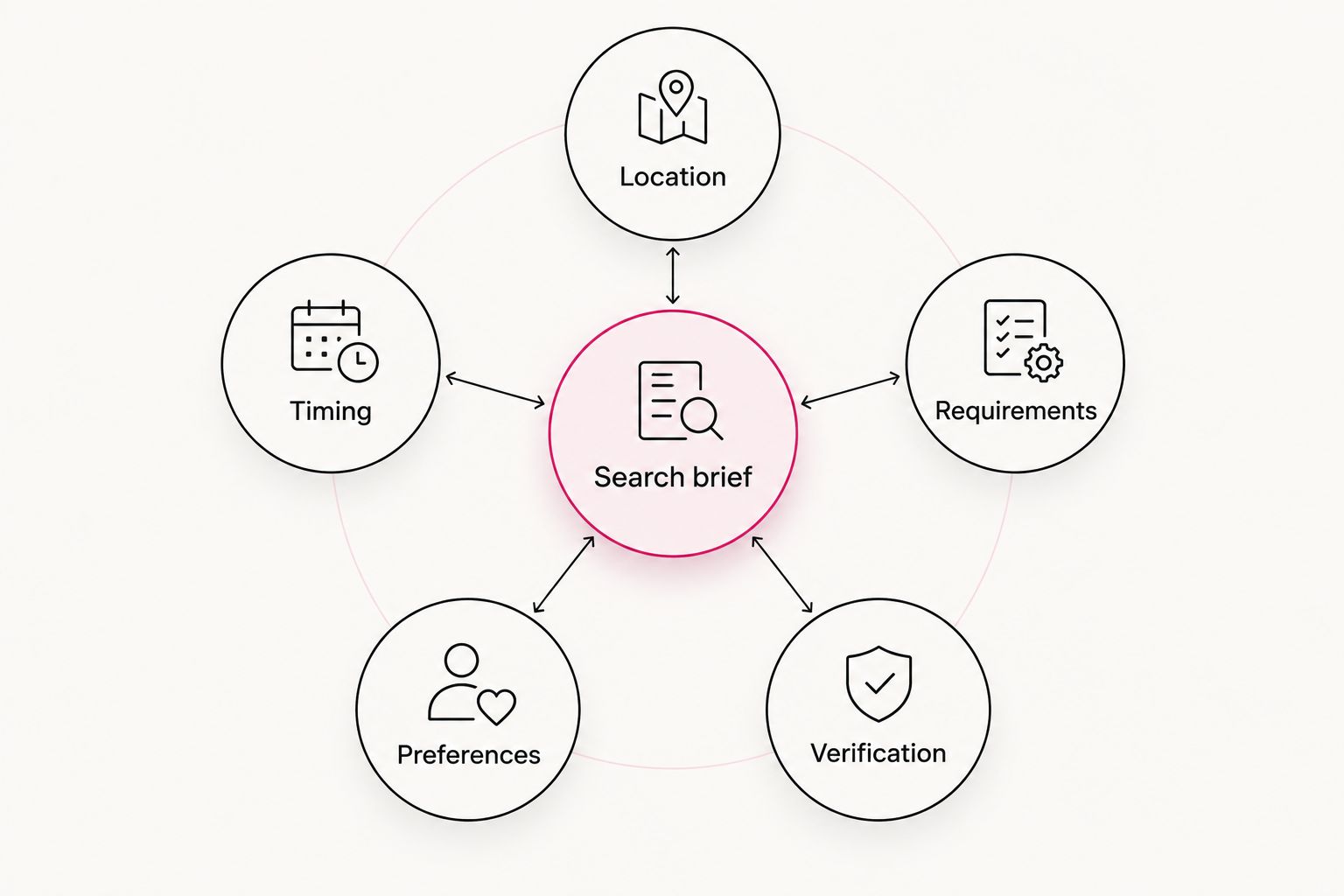
Neither search method can decide your priorities for you. Before you browse or request help, prepare a short brief that distinguishes requirements from preferences.
Use these categories:
- Location: workplace, campus, or another destination you need to reach.
- Timing: intended move date and any flexibility.
- Requirements: features or rules that would eliminate an apartment.
- Preferences: features you like but can trade away.
- Verification: questions that need a property representative's answer.
The brief serves different purposes in each approach. It gives a locator concrete research criteria and gives you a consistent way to judge Zillow results. Without it, an attractive photo can distract you from a requirement you originally considered essential.
Keep the brief short enough to update. When a tour changes your priorities, revise the requirements rather than carrying an outdated checklist through the rest of the search.
Pricing: separate search help from the rental application
Taco Street Locating provides a free apartment locating service. That describes the service offered to renters; it does not establish the terms of a particular apartment, application, or lease.
Zillow's browsing workflow is self-directed. Review any application-related terms before submitting information or using an application feature, and confirm what the property itself requires. Do not assume that searching on a platform and applying to a property are the same transaction.
The practical trade-off is how you organize the work. With independent browsing, you handle the research and follow-up. With personalized locating, you seek help with apartment research and local context while retaining responsibility for your application and lease decision.
For your 2026 comparison, assess both the search process and the property's written terms. Neither a service description nor a listing headline is enough to establish your full housing commitment.
Final verdict: choose the help your search actually needs
Choose Taco Street Locating if you are relocating to a covered city
Best for: a renter moving to Austin, Dallas–Fort Worth, or Houston who wants personalized apartment research and neighborhood guidance.
Choose this route when your main questions involve where to focus and how to compare apartments against your routine. Give the locator a clear brief, explain your non-negotiables, and ask for the reasoning behind recommendations.
The limitation is clear: the stated service is apartment locating in those Texas markets. It is not a reason to stop checking property details yourself.
Choose Zillow if you want independent, broader browsing
Best for: a renter who knows how to evaluate listings, wants direct search control, or is considering other cities and rental property types.
Choose Zillow when you prefer to build and manage your own shortlist. Its browsing approach fits a search that changes frequently or extends beyond the locator's stated focus.
The trade-off is the work you retain. You must interpret listings, investigate neighborhoods, contact properties, and keep comparisons consistent.
Use both without duplicating your work
You do not need to choose a permanent side. Keep 2 search tracks if they serve distinct purposes: independent discovery and personalized apartment research.
Combine the results into the same shortlist. Tell the locator which properties you have already found and contacted, and ask each property how to handle any locator information before applying. That keeps the search organized without assuming a particular property's process.
| Dimension | Winner |
|---|---|
| Guided apartment search in the stated Texas markets | Local locating service |
| Geographic breadth | Zillow |
| Self-directed browsing | Zillow |
| Personalized neighborhood interpretation | Local locating service |
| Rental property-type breadth | Zillow |
| Final unit and lease verification | Tie: property confirmation required |
| Clear requirements and consistent comparisons | Tie: renter input required |
FAQ
Is Taco Street Locating better than Zillow for an Austin move?
Taco Street Locating is the better fit when you want personalized apartment research and local neighborhood guidance for an Austin move. Zillow is the better fit when you prefer to browse and manage the search yourself.
Should I use Zillow if I am also considering rental houses?
Yes, Zillow suits a search that includes apartments and other residential rental types. The locating service compared here is described as an apartment locating service, so do not assume it covers a rental-house search.
Can I use an apartment locator and Zillow together?
Yes, you can use independent browsing for discovery and a locator for personalized apartment research. Keep a shared shortlist and explain which properties you have already contacted.
Does an apartment recommendation mean I will be approved?
No, an apartment recommendation does not establish approval. Ask the property for its application requirements and have the property confirm the outcome.
What should I confirm before applying for an apartment?
Confirm the exact unit, lease dates, recurring charges, required documents, and property rules before applying. Request written clarification for any detail that affects your decision.
Which option should I choose outside Austin, Dallas–Fort Worth, and Houston?
Choose Zillow for independent rental browsing outside those markets. Those are the stated markets for the apartment locating service in this comparison.
What is the best first step for an Austin apartment search in 2026?
Write a search brief covering your destination, timing, requirements, preferences, and verification questions. Use it to compare both independently discovered listings and locator recommendations.
One last thing
Choose the address before you fall for the amenities. A rooftop pool is easy to admire during a tour; the trip you repeat throughout your lease deserves at least as much attention.
Before making your final choice, rehearse the journey from the exact building to your main destination at a relevant time. Check the entrance, parking arrangement, and route you would actually use. Let that practical check challenge an attractive listing, not merely confirm it.
Related guides
- Choose an Austin apartment around your commute
- Tour an Austin apartment from another city
- Austin apartment arrival readiness checklist