Victory Park and the Design District, two popular Dallas neighborhoods, offer distinct lifestyles for renters. Victory Park is lively and event-focused, with proximity to the American Airlines Center, luxury high-rises, and excellent walkability. On the other hand, the Design District provides a quieter, arts-centered atmosphere with spacious loft-style apartments and a thriving gallery scene. Here’s a quick breakdown:
- Victory Park: Ideal for those seeking a bustling environment with sports, concerts, and nightlife. Rent averages $2,532/month for one-bedroom apartments.
- Design District: Perfect for those who prefer a relaxed, creative vibe. Rent averages $1,797/month for one-bedroom apartments.
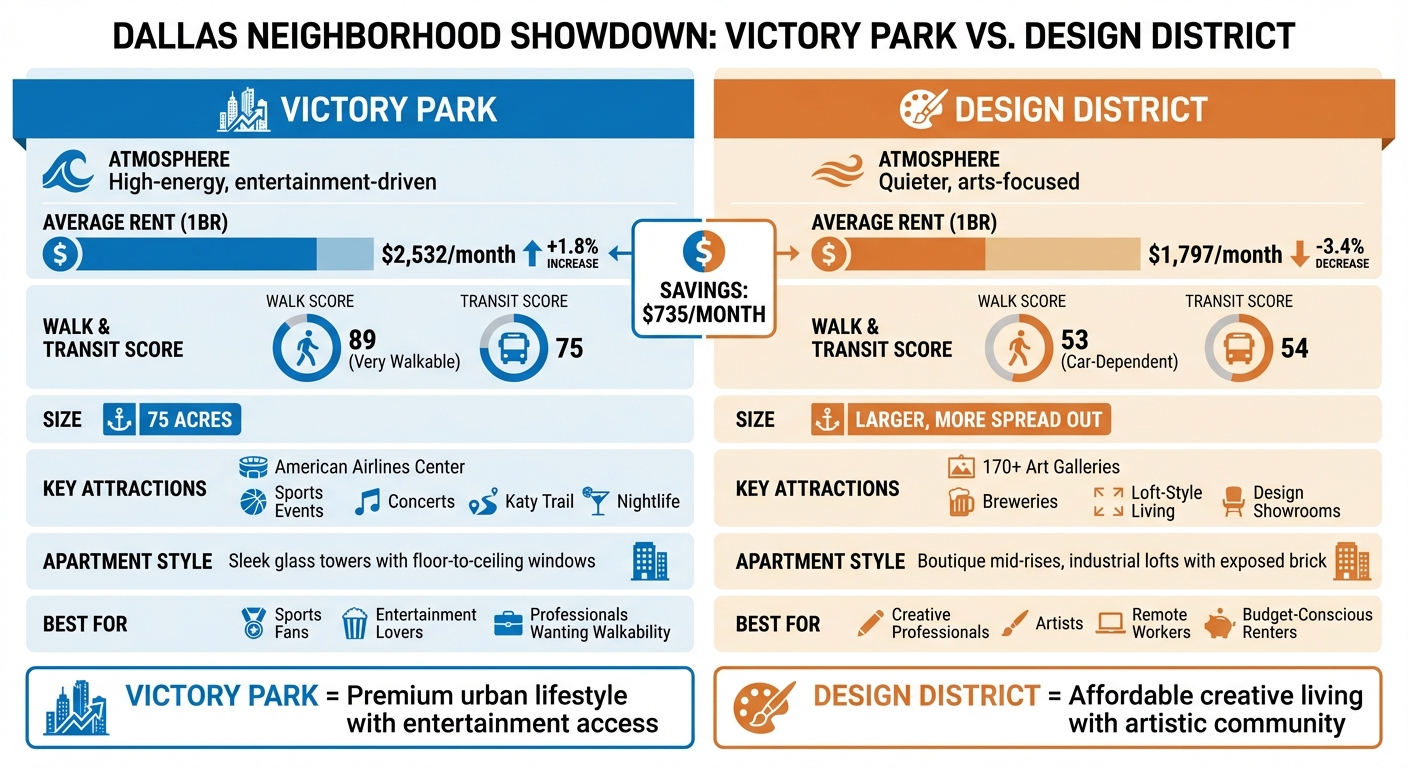
Victory Park vs Design District Dallas: Side-by-Side Comparison of Rent, Walkability, and Lifestyle
Another premier high-rise option in the neighborhood is Victory Place.
Quick Comparison
| Feature | Victory Park | Design District |
|---|---|---|
| Atmosphere | High-energy, entertainment-driven | Quieter, arts-focused |
| Average Rent (1BR) | $2,532 | $1,797 |
| Walk Score | 89 (very walkable) | 53 (car-dependent) |
| Key Attractions | Sports, concerts, Katy Trail | Art galleries, breweries, lofts |
| Transit Access | DART, TRE, highways | Limited public transit |
Victory Park suits those who love being in the heart of the action, especially at high-rises like The Ascent Victory Park, while the Design District appeals to renters seeking a laid-back, artistic environment. Choose based on your lifestyle and priorities.
sbb-itb-b58f532
Neighborhood Atmosphere and Daily Life
Victory Park: Entertainment and Event-Driven Living
Victory Park is always alive with energy, thanks to the buzz surrounding the American Airlines Center, which hosts the Dallas Mavericks and Dallas Stars. On game nights and concert evenings, the streets fill with fans flocking to popular spots like Happiest Hour and HERO, creating a lively social atmosphere that’s hard to miss. This constant activity is a defining feature of Victory Park, making it a hotspot for those who thrive on excitement.
"Victory Park is a sports-lover’s dream… while it’s truly the entertainment hub of the city, it also has an exclusivity to it that makes it feel small and close-knit." – Smart City Locating
Covering just 75 acres (.12 square miles), Victory Park feels like an intimate urban village. With a WalkScore of 89 and the Katy Trail starting nearby, running errands – whether it’s grabbing groceries at the full-service Tom Thumb or heading out for a quick bite – is a breeze on foot. However, living here means embracing the hustle and bustle of event days, including heavier traffic and larger crowds. This vibrant, fast-paced lifestyle stands in stark contrast to the more tranquil, art-focused vibe of the Design District.
Design District: Quieter, Art-Focused Living
If Victory Park thrives on high-energy events, the Design District offers a more serene and creative lifestyle. Once a hub of warehouses and affordable showrooms in the 1950s, it has transformed into a haven for artists and designers, now boasting over 170 art galleries and interior design spaces. The neighborhood’s social life revolves around gallery openings, craft breweries, and unique venues like Bishop Cidercade, which features over 170 classic arcade games.
"The Design District is now the epicenter of the gallery scene in the city, and a place for art lovers to find everything from French impressionism painting to contemporary installation art." – Dallas Design District
Life here feels more laid-back and residential compared to Victory Park’s event-driven energy. With a WalkScore of 53, most errands will require a car. The area’s industrial-chic aesthetic combines upscale apartments with active creative studios, offering a raw and artistic charm that contrasts with Victory Park’s polished entertainment vibe. Interestingly, rental trends reflect this difference: rents in the Design District have dipped by 3.4% over the past year, while Victory Park has seen a 1.8% increase.
Apartment Styles and Building Features
Victory Park: Sleek Glass Towers and Entertainment-Focused Living
Victory Park is all about modern luxury and an active, entertainment-driven lifestyle. Its signature glass towers, with floor-to-ceiling windows, offer stunning views of downtown Dallas and landmarks like the American Airlines Center [13,14,15]. The neighborhood boasts around 14 apartment complexes and 4 major condo developments, with unit sizes ranging from cozy 587-square-foot studios to spacious 2,037-square-foot three-bedroom apartments [11,13].
Inside, these residences are designed with style and functionality in mind. Think hardwood floors, granite countertops, and open layouts perfect for hosting friends. Beyond the apartments themselves, the amenities are equally impressive: state-of-the-art fitness centers, rooftop decks with spectacular views, and infinity pools [13,14]. For those craving a touch of convenience, Ascent Victory Park even has an on-site Italian restaurant, Mio Nonno Trattoria, that delivers directly to residents’ doors. If you’re looking for high-end options, penthouses can surpass $9,500 per month, while luxury condos like those at Bleu Ciel start at about $1.05 million.
On the flip side, the Design District offers a completely different vibe and living experience.
Design District: Boutique Living with a Creative Edge
The Design District takes a more intimate and art-focused approach to apartment living. Here, boutique mid-rise buildings are the norm, prioritizing custom finishes and unique architectural details over the large-scale amenities found in Victory Park. This aligns perfectly with the neighborhood’s quieter, gallery-centered atmosphere.
These spaces are tailored for renters who appreciate craftsmanship and creative interiors over rooftop pools or skyline views. The overall feel is more residential and low-key, reflecting the area’s focus on art and design. For those who value thoughtful details and a serene environment, the Design District offers a distinct alternative to the high-energy lifestyle of Victory Park. This design-forward approach sets the tone for other aspects of living here, which will be explored further.
Rent Costs and What You Get
Victory Park stands out as one of Dallas’s most expensive neighborhoods, with average rents hovering around $2,532 as of January 2026. If you’re eyeing a studio in one of the sleek glass towers, expect prices starting at $1,594 for 618 square feet, climbing to $2,389 for 648 square feet at places like Ascent Victory Park. For one-bedroom apartments, rents typically fall between $1,955 and $3,215, while two-bedroom units start at $3,128 and can go beyond $3,772, depending on the building and layout.
Over in the Design District, rents are noticeably easier on the wallet. One-bedroom apartments start as low as $1,192 at properties like Avant on Market Center, with most falling between $1,500 and $2,500. While this offers significant savings compared to Victory Park, luxury lofts in the Design District can still reach $2,450 or more. But what exactly do these rents get you in terms of lifestyle and amenities?
In Victory Park, the higher price tag comes with a host of high-end perks. Residents enjoy amenities like 24-hour concierge services, rooftop infinity pools, and sky decks offering stunning views of downtown. Proximity to the American Airlines Center is another major draw. Inside buildings like Ascent Victory Park, you’ll find upscale touches such as granite countertops, stainless steel appliances, and floor-to-ceiling windows. Additional monthly fees include $60 for community amenities, $30 for doorstep trash service, and $20 for parking.
Meanwhile, renters in the Design District experience a different kind of charm. Interiors often feature exposed brick, high ceilings, and unique architectural details. Many properties are converted warehouse lofts, offering open industrial layouts that emphasize character and creativity. Essentially, you’re choosing between Victory Park’s luxury entertainment vibe and the Design District’s boutique, artistic atmosphere – often at a more budget-friendly price point.
If you’re looking to maximize space for your money, Victory Park’s historic brick lofts are worth considering. These units offer 865 to 2,250 square feet, starting at $1,450 – a significant size advantage over the neighborhood’s glass towers at comparable prices. This makes them a great middle ground for those who want Victory Park’s prime location without the premium of high-rise living, showcasing the variety of housing options available in the area.
Walking Access, Parks, and Restaurants
Victory Park boasts an "Excellent" walkability rating, making it one of the most pedestrian-friendly areas in Dallas. With restaurants, bars, and the American Airlines Center just minutes away, this neighborhood is a hub of convenience. Its central location places it right at the heart of the Design District, Arts District, and Klyde Warren Park. The Katy Trail begins at Victory Park’s southern edge near the American Airlines Center, offering a 3.5-mile path for running and biking. For even more green space, hop on the free M-Line Trolley to reach Klyde Warren Park. This ease of movement highlights a contrast with the Design District, where the focus shifts to artistic and creative spaces.
The Design District, while also connected to the Katy Trail, leans more toward art galleries, showrooms, and industrial-style dining rather than a dense retail environment. Strolling here often means wandering among galleries on Dragon Street or enjoying brewery patios like Rodeo Goat. For essentials like grocery shopping or entertainment, many residents make quick trips to Victory Park or Uptown.
Outdoor amenities in Victory Park include direct access to the Katy Trail and plans for a 1.5-acre park at the NorthEnd Goldman Sachs campus. Meanwhile, the Design District offers attractions like Trinity Groves, a vibrant dining and entertainment complex with outdoor seating, and Jade Waters at the Hilton Anatole, a seasonal resort-style water park. While Victory Park caters to joggers and cyclists, the Design District appeals to those who enjoy social settings centered around food and art. These outdoor features complement the distinct dining experiences each neighborhood offers.
Victory Park’s dining scene matches its lively, entertainment-driven vibe—often found in luxury Victory Park penthouse apartments—with a mix of casual and upscale restaurants. On the other hand, the Design District, though offering fewer dining options within walking distance, compensates with unique, creative eateries that attract professionals and artists. If you value having a variety of restaurants just steps away, Victory Park is the clear choice. But if you’re drawn to discovering hidden culinary gems in a quieter, more laid-back setting, the Design District shines. These differences in dining further reflect the contrasting lifestyles of the neighborhoods – Victory Park’s energetic atmosphere versus the Design District’s creative charm.
Both areas are well-connected to Dallas’s larger dining and entertainment scene via public transit. Victory Park is served by Victory Station, which connects to DART’s Green and Orange lines as well as the Trinity Railway Express, while the Design District is accessible through Market Center Station. When it comes to walkability and everyday convenience, Victory Park’s "new urbanist" design has a clear edge over the Design District’s still-developing pedestrian infrastructure.
Noise Levels, Traffic, and Daily Living
Victory Park’s daily life revolves around the American Airlines Center, home to the Dallas Mavericks, Dallas Stars, and a steady stream of concerts. This creates a lively, high-energy atmosphere that some residents enjoy, while others may find it disruptive. The neighborhood’s noise level is rated as "Medium". As Steven Lindsey puts it, the American Airlines Center "buzzes almost nightly, livening up the entire neighborhood with the energy of thousands of new people". If you’re considering living here, it’s a good idea to check the schedules for the American Airlines Center and House of Blues, as units facing the arena may experience more noise. Additionally, traffic congestion can peak during playoff seasons and major tours, so planning your commute around event schedules is wise. While Victory Park thrives on a bustling, event-driven energy, the Design District offers a quieter, more laid-back alternative.
The Design District moves at a steadier urban pace, with its focus on art galleries, design showrooms, and breweries. Chris Bates describes it as "quieter than Uptown or Downtown Dallas, but still close to everything". Without a major stadium drawing crowds, the area sees less foot traffic and fewer event-related disruptions. However, with a walkability score of 53, residents often need a car for everyday errands, which can lead to its own traffic challenges during regular commute hours.
Victory Park, with its compact 75-acre layout and a walkability score of 89, makes it easy for residents to avoid traffic by walking to nearby spots like Tom Thumb or local restaurants. On the other hand, the Design District’s more spread-out design means driving or using ride-shares is often necessary. The upside? You won’t have to deal with the event-day congestion that’s common in Victory Park.
Ultimately, your preference for noise and activity should guide your decision. If you thrive on constant energy and don’t mind occasional traffic tied to concerts and games, Victory Park offers an entertainment-centric lifestyle. But if you lean toward a creative, artistic environment with less disruption, the Design District provides a calmer, more relaxed setting. These differences in noise and traffic underscore the unique appeal of each neighborhood.
Getting to Work and Around Dallas
Victory Park is perfectly situated within Dallas’s commuting network, located less than two miles from Uptown, the Design District, and Downtown Dallas. With a Transit Score of 75 and a Walk Score of 89, many residents can easily walk to work or catch the DART Green and Orange lines at Victory Station. This station also connects to the Trinity Railway Express (TRE), making commutes to Fort Worth a breeze. For professionals heading to North Dallas or West Plano, Victory Park offers direct highway access via I‑35E and the North Dallas Tollway.
"This is the ideal location for ‘road warriors’ and business professionals who need quick, easy access to Downtown and the Tollway, allowing them to avoid the internal Uptown traffic snarls".
The Design District, located just west of Victory Park, is also well-connected with transit options like Market Center Station on the Green and Orange lines, as well as TRE services. This neighborhood is within two miles of Downtown, making it a convenient spot for commuters. For healthcare workers, the Design District provides a shorter commute to the Dallas Medical District, with Market Center Station offering proximity to nearby medical facilities. While it has easy access to I‑35E, it lacks the direct Tollway access that Victory Park enjoys.
Each neighborhood’s layout influences how residents get around. Victory Park’s compact design allows for walking to groceries, restaurants, and workplaces. In contrast, the Design District’s more spread-out layout typically requires a car but avoids the event-driven traffic that can affect Victory Park. Both areas also benefit from DART’s GoLink microtransit service for convenient point-to-point travel within designated zones.
For Downtown commuters, Victory Park’s location – separated from Downtown only by Woodall Rogers Freeway – offers unmatched convenience. While the Design District is slightly farther west, it still provides quick rail or driving access and is particularly advantageous for those commuting to the Medical District. For professionals traveling to North Dallas or relying on Tollway access, Victory Park’s strategic positioning near major highways is a clear benefit.
Victory Park: Benefits and Drawbacks
Victory Park combines excellent entertainment options and strong transit connections, but these perks come with some compromises that impact everyday living.
The neighborhood shines when it comes to convenience and accessibility. With an impressive WalkScore of 89, residents can easily walk to essentials like Tom Thumb grocery store, a variety of restaurants, and even their workplaces. It’s also the gateway to the Katy Trail, offering runners and cyclists a direct outdoor escape. Plus, the American Airlines Center is right in the heart of Victory Park, bringing professional sports games and major concerts just steps away from home.
However, these benefits come with a few downsides. One of the biggest challenges is the congestion caused by events. Game days and concert nights bring in massive crowds, leading to traffic headaches and higher noise levels. As Smart City Locating puts it:
"Game-day traffic and concert congestion is basically a part of signing a lease here".
Another issue is the neighborhood’s compact size. At just 75 acres and bordered by I‑35 and Spur 366, some residents may feel a bit boxed in.
Living in Victory Park also comes at a premium. Rent prices reflect the area’s high demand, with one-bedroom apartments typically costing between $2,000 and $3,500 per month. Studio apartments average $1,802, while two-bedroom units can reach around $3,465. Beyond the high costs, retail options are limited. While there are plenty of dining spots, shopping boutiques and general stores are scarce. Additionally, despite the proximity to the Katy Trail, the neighborhood itself lacks much in the way of green spaces.
Here’s a quick breakdown of the pros and cons:
| Advantages | Disadvantages |
|---|---|
| Convenient DART and TRE rail access at Victory Station | Traffic and noise from events at the American Airlines Center |
| High WalkScore of 89 with nearby Tom Thumb grocery | Expensive rent ($2,000–$3,500 for 1-bedroom units) |
| Direct access to the Katy Trail | Minimal parks and green spaces within the neighborhood |
| Close to pro sports and concerts | Limited shopping options beyond restaurants |
| Modern luxury high-rises with top-tier amenities | Compact area bordered by highways, creating a sense of isolation |
| Walking distance to Klyde Warren Park | Event crowds can overwhelm the area |
These factors highlight the trade-offs that come with living in Victory Park, setting the stage for how it compares to other neighborhoods in Dallas. For those moving from abroad, understanding the Dallas rental market is the first step in finding the right home.
Design District: Benefits and Drawbacks
The Design District offers a relaxed, artsy vibe that stands in contrast to the high-energy atmosphere of Victory Park. While Victory Park is known for its premium pricing and event-heavy culture, the Design District caters to those seeking affordability and a more laid-back lifestyle. It’s a neighborhood that attracts renters who appreciate having more space for their money and enjoy a quieter, more creative environment.
One of the standout perks of living in the Design District is its affordability. Rent for a one-bedroom apartment averages $1,797 per month – about $485 less than Victory Park. Studio apartments go for around $1,553, while two-bedroom units average $2,437. On top of that, rents have dropped by 3.4% over the past year, making the area increasingly budget-friendly. Beyond the cost savings, the neighborhood is home to a vibrant creative scene, featuring top-tier art galleries on Dragon Street, cutting-edge design showrooms, and unique spots like Community Beer Company, Texas Ale Project, and Bishop Cidercade. Apartments here often reflect the district’s industrial roots, offering larger layouts with modern, loft-style designs. However, these perks come with a few practical downsides.
The biggest drawback is the area’s car dependency. With a WalkScore of just 53, running errands often requires a vehicle. The lack of a full-service grocery store within the district means residents usually head to nearby Oak Lawn for essentials. Public transit options are also limited, with the nearest DART station about a 30-minute walk away. While the neighborhood does offer access to the Trinity River trails and Trammel Crow Park, some parts of the district retain an industrial feel, and green spaces are less accessible compared to Victory Park’s access to The Park at Katy Trail.
Here’s a summary of the pros and cons:
| Pros | Cons |
|---|---|
| Lower rent (average $1,797 for 1-bedroom units) | Limited walkability (WalkScore: 53) |
| Spacious, modern floor plans with loft-style designs | Requires a car for most errands |
| Thriving art scene with galleries and design showrooms | Weak public transit options (TransitScore: 54) |
| Quieter, less event-driven atmosphere | No full-service grocery store; trips to Oak Lawn needed |
| Access to Trinity River trails and Trammel Crow Park | Industrial feel in some areas |
| Local breweries and diverse dining options | Fewer green spaces compared to Victory Park |
For renters who prioritize affordability, creative spaces, and a quieter lifestyle, the Design District is an appealing option – though it’s best suited for those who don’t mind driving to meet their daily needs.
Best Fit for Victory Park Renters
Victory Park is the perfect match for renters who thrive on a lively atmosphere and unparalleled convenience. Sports enthusiasts can stroll over to the American Airlines Center to catch Dallas Mavericks or Dallas Stars games, while music lovers will enjoy being steps away from live performances at the House of Blues.
For those who love a buzzing social scene, the neighborhood offers endless options for group outings and impromptu nights out. Victory Plaza, for instance, becomes a hub of excitement during playoff season with its festive watch parties, making it easy to connect with neighbors and friends. This energetic vibe is complemented by the area’s excellent accessibility.
Professionals focused on convenience will appreciate the neighborhood’s walkability, with grocery stores, popular restaurants, and easy access to public transit all within reach. The DART Green and Orange lines at Victory Station, along with the Trinity Railway Express for Fort Worth commuters, make transportation a breeze. Fitness enthusiasts can also take advantage of the nearby Katy Trail, a 3.5-mile path perfect for running or cycling.
Of course, this vibrant lifestyle comes with a few trade-offs. The same energy that defines Victory Park can lead to event-day traffic and higher living costs, with one-bedroom apartments averaging about $2,282 per month. But for renters who crave an exciting, central location and don’t mind the occasional hustle and bustle, Victory Park offers a one-of-a-kind urban experience.
Best Fit for Design District Renters
The Design District is a haven for creative professionals – think interior designers, photographers, and fashion experts – who thrive in a setting brimming with artistic energy. With galleries like Samuel Lynne Galleries and the Goss-Michael Foundation lining Dragon Street, the area offers an inspiring backdrop for both work and play. Living here means being surrounded by creative resources that fuel passion and innovation.
For remote workers, the district’s quieter vibe is a major draw. Unlike the bustling stadium crowds of Victory Park, the Design District offers a more laid-back atmosphere. Spots like Ascension Coffee provide the perfect balance, transforming from a cozy coffee shop during the day to a wine bar in the evening. Outdoor spaces such as the Trinity Levee Trail and Trammel Crow Park add to the appeal, offering a refreshing escape. Plus, creative classes at places like Stomping Ground Comedy Theater and Dallas Glass Art bring a touch of fun and inspiration to the mix. It’s a neighborhood where you can get work done while still soaking up a vibrant, artistic culture.
As the sun sets, the district comes alive with its eclectic dining options and local breweries, many of which feature on-site tasting rooms. Steven Lindsey from ApartmentAdvisor captures the vibe perfectly:
"The Design District bar scene has an energetic vibe beginning in the early evening when people working in the neighborhood end their days and residents start coming home."
For urbanites craving a trendy, upscale lifestyle without the hefty price tag of Victory Park, the Design District is a smart choice. One-bedroom apartments here average $1,797 per month – nearly $500 less than in Victory Park. This affordability also makes it an attractive option for students attending Wade College or universities in nearby Downtown Dallas.
That said, the district’s WalkScore of 53 indicates that a car is often necessary for errands, as the nearest full-service grocery store is in Oak Lawn. While this might be a slight inconvenience, it’s a small trade-off for the area’s design-forward interiors, creative community, and overall charm. If you’re looking for a neighborhood that prioritizes inspiration and style over complete walkability, the Design District has you covered.
Making Your Decision
Deciding between Victory Park and the Design District comes down to how you see yourself living day to day.
Victory Park is at the heart of Dallas’s entertainment scene, centered around the American Airlines Center. With its high walkability and compact layout, it’s perfect for those who love being steps away from sports events, concerts, and high-end dining options.
On the other hand, the Design District offers a more creative and laid-back vibe. It’s known for its art galleries, antique shops, and trendy restaurants. Apartments here often feature larger layouts and sleek, design-focused interiors. As Chris Bates from North Penn Now describes it:
"The Design District is a hidden gem… Perfect for creatives or professionals who want something modern and inspiring".
These two neighborhoods offer distinctly different lifestyles. If you’re torn between the two, you might need a bit of extra help to make the right choice.
That’s where Taco Street Locating comes in. They offer apartment search services, tailored to your preferences. Their locators provide personalized advice, insider tips on the best properties (like which ones have the quietest units or the best views), and access to rent specials – like a free month of rent – all at no cost to you.
FAQs
What’s the difference in lifestyle between living in Victory Park and the Design District in Dallas?
Victory Park is the go-to neighborhood for anyone who loves the buzz of city life. With its luxury high-rises, modern amenities, and close proximity to hotspots like the American Airlines Center, it’s a hub for concerts, NBA games, and upscale dining experiences. This area thrives on energy, making it perfect for those who enjoy nightlife and a fast-paced, event-filled atmosphere.
In contrast, the Design District offers a more creative and laid-back vibe. Known for its art galleries, trendy restaurants, breweries, and boutique shops, it’s a haven for those who appreciate a culturally rich environment. Instead of large-scale events, the focus here is on art, food, and local discoveries. It’s an ideal spot for anyone seeking a stylish yet relaxed lifestyle with a touch of refinement.
How do rent prices compare between Uptown Dallas and Oak Lawn/Turtle Creek?
Rent in Uptown Dallas tends to be on the higher side, mirroring its lively atmosphere, social scene, and top-tier amenities.
For a one-bedroom apartment in Uptown, you’re looking at an average rent of about $2,300, while two-bedroom units typically cost around $3,700. These figures far exceed the city-wide average, which ranges from $1,300 to $2,400. On the other hand, Oak Lawn/Turtle Creek offers a more relaxed, residential feel with a touch of luxury. Rent prices in this area generally align more closely with the Dallas average, making it a more economical choice compared to Uptown.
In summary: Uptown is ideal for those who want an active, upscale lifestyle and are willing to pay a premium for it. Meanwhile, Oak Lawn/Turtle Creek offers a quieter, more budget-conscious option while still delivering a luxurious living experience.
Which neighborhood has better access to public transportation?
If having dependable public transportation is high on your list, Oak Lawn / Turtle Creek is a standout choice. This neighborhood is bordered by DART light rail on three sides and sits conveniently near the Green Line. With multiple bus routes and direct rail connections to downtown Dallas, getting around is a breeze.
Uptown, on the other hand, does provide DART service and supports alternative modes of transit like bike lanes and electric scooters. However, it doesn’t share the same close access to a major rail line that Oak Lawn / Turtle Creek enjoys.
For renters who depend on public transit, Oak Lawn / Turtle Creek delivers more convenient and well-rounded options.