
If you’re deciding between West Austin and Bee Cave, it boils down to urban convenience versus suburban tranquility. Here’s a quick breakdown:
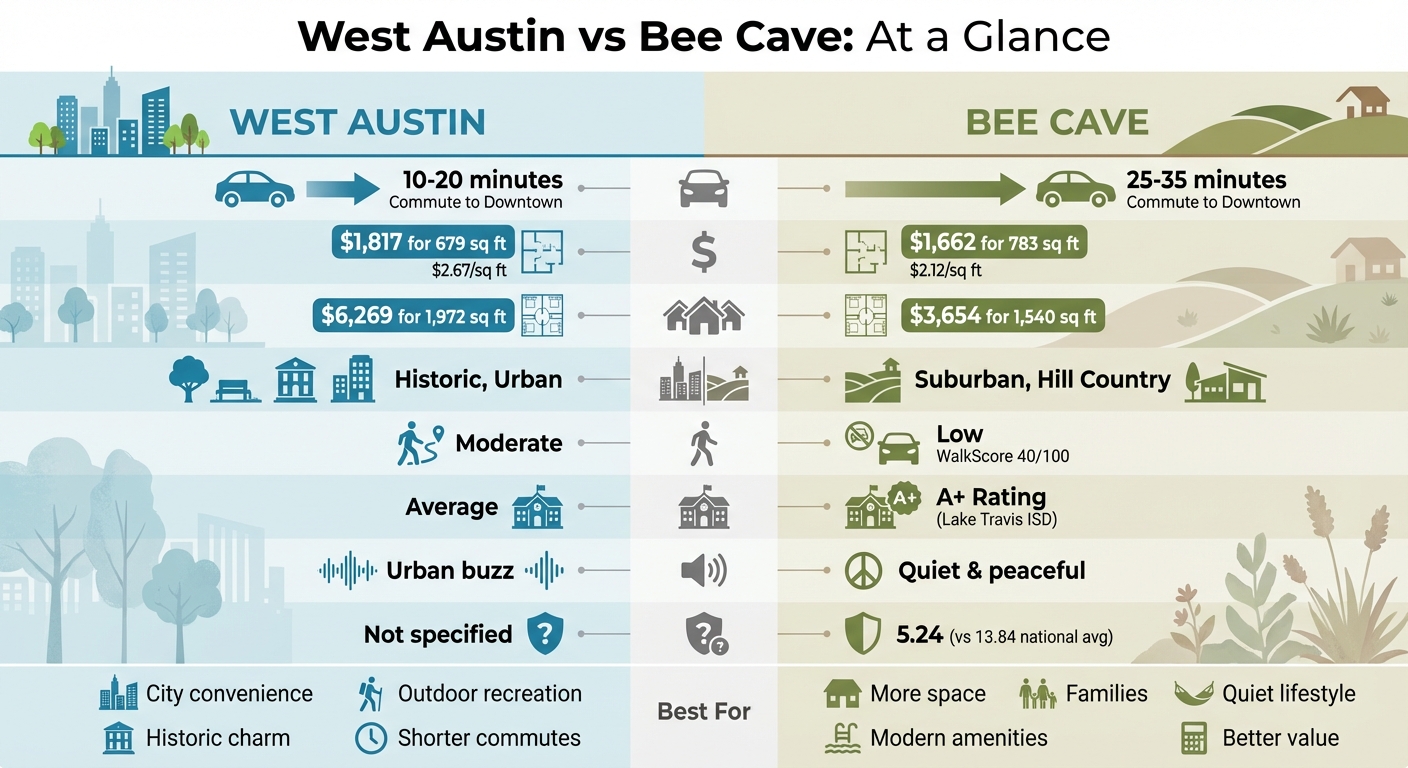
- West Austin: Closer to downtown (10–20 min commute), historic neighborhoods, mature trees, and walkable pockets. Rent for a one-bedroom averages $1,817 for 679 sq ft.
- Bee Cave: Suburban setting with Hill Country views, modern apartments in Southwest Austin, and more space. Rent for a one-bedroom averages $1,662 for 783 sq ft. Commute to downtown takes 25–35 minutes.
Both areas offer unique perks. West Austin is ideal for those seeking proximity to the city and historic charm, while Bee Cave is better for families or anyone wanting modern amenities and more space at a lower cost.
Quick Comparison
| Feature | West Austin | Bee Cave |
|---|---|---|
| Commute to Downtown | 10–20 minutes | 25–35 minutes |
| 1BR Rent | $1,817 (679 sq ft) | $1,662 (783 sq ft) |
| Neighborhood Vibe | Historic, urban | Suburban, Hill Country |
| Walkability | Moderate | Low |
| Schools | Average | Highly rated (Lake Travis ISD) |
| Noise Levels | Urban buzz | Quiet, peaceful |
Each area suits different lifestyles – choose West Austin for city convenience or Bee Cave for space and calm. If you’re new to the area, check out our guide for first-time Austin renters to navigate the local market.
West Austin vs Bee Cave Apartment Comparison: Rent, Commute, and Lifestyle
Neighborhood Character and Scenery
West Austin: Central Location with Mature Trees
West Austin blends historic charm with natural beauty. Some neighborhoods here trace their roots back to 1853 and are even listed on the National Register of Historic Places. The area is known for its steep hills, majestic oak trees, and streets shaded by a lush canopy. Scenic views abound, with Lake Austin and Lake Travis serving as picturesque backdrops.
Many apartments in this area offer stunning views of rocky bluffs and serene lakefronts. As Steven Lindsey puts it:
The further west you go, the more rural and scenic things get, and if you’re looking for a truly picturesque vista day after day, many townhomes and apartments in West Austin boast views of the lakes and their rocky bluffs.
Neighborhoods like Tarrytown stand out with their large, tree-shaded lots, offering a peaceful retreat just minutes from downtown. This natural charm and tranquility create a distinctive contrast to the more open landscapes of Bee Cave.
Bee Cave: Hill Country Views and Suburban Setting
Bee Cave, on the other hand, delivers a modern suburban vibe set against the rugged beauty of the Hill Country. Spanning just 2.6 square miles, this compact suburb is home to thoughtfully planned communities that highlight its stunning surroundings. Unlike West Austin’s dense tree cover, Bee Cave features rolling hills and scrub trees, offering expansive views of the Texas countryside.
Neighborhoods like Falconhead and Bella Colinas are designed to showcase these wide-open vistas, making the most of the area’s natural appeal. Bee Cave has seen remarkable growth, expanding from just 656 residents in 2000 to over 8,800 today, thanks to its carefully planned developments. The area’s peaceful atmosphere and outdoor charm make it perfect for relaxation and recreation. Unique attractions like the Bee Cave Sculpture Park, with its seven acres of rotating outdoor art installations, add a creative touch to the natural landscape.
sbb-itb-b58f532
Apartment Buildings and Amenities
West Austin: High-End Apartments in Mature Areas
West Austin offers a blend of architectural styles, from quaint historic buildings to upscale, expansive apartment communities. Many of these properties are nestled within established, tree-lined neighborhoods or strategically positioned to provide stunning views of Lake Travis, Lake Austin, and the rugged cliffs surrounding the area.
The amenities here emphasize the region’s natural beauty and rich history. Residents enjoy perks like lake access, marinas, and community gardens, along with unique attractions such as the 1916 Deep Eddy Pool. West Austin is perfect for those who thrive on an active, outdoor lifestyle – whether it’s boating, hiking, or exploring the area’s walkable historic charm. As of January 2026, the average one-bedroom apartment in this area measures 679 sq ft and rents for $1,817. If you’re looking for something larger, a three-bedroom unit averages 1,972 sq ft with a monthly rent of $6,269.
On the other hand, Bee Cave offers a more modern take on apartment living.
Bee Cave: New Construction with Modern Features
Bee Cave stands out with its contemporary apartment communities and luxury townhomes. These newer developments showcase a Hill Country-inspired aesthetic, open-concept layouts, and features designed for suburban comfort. Many properties include direct-access garages, optional EV charging stations, and generously sized floor plans.
Inside, you’ll find upscale finishes like granite countertops, stainless steel appliances, soaring 9-foot ceilings, and industrial-style sinks. Community amenities step up the convenience with 24-hour fitness centers, business hubs, gated access, and pet-friendly spaces. Allison Reyes, a resident at Estates at Bee Cave, shared her experience:
The apartments are nice and upgraded and in a great location. Couldn’t recommend this complex enough!
As of January 2026, one-bedroom apartments in Bee Cave average 783 sq ft with a rent of $1,662. For families or those needing more space, three-bedroom units are priced at $3,654 per month – significantly less than the $6,269 average in West Austin.
For a side-by-side comparison of what these two areas offer, check out the table below:
| Feature | West Austin | Bee Cave |
|---|---|---|
| Primary Style | Historic/Mid-rise/Luxury | Modern Hill Country/Townhome |
| 1BR Rent | $1,817 | $1,662 |
| 1BR Square Footage | 679 sq ft | 783 sq ft |
| 3BR Rent | $6,269 | $3,654 |
| Key Amenities | Lake access, marinas, historic pools | Gated access, garages, EV charging |
Rent Prices and Square Footage
West Austin Pricing
When it comes to West Austin, the rental costs reflect the area’s sought-after location and timeless appeal. As of January 2026, the average rent for a one-bedroom apartment stands at $1,817 per month for 679 sq ft, which breaks down to $2.67 per square foot. If you’re looking for more space, two-bedroom units average $2,596 per month, while three-bedroom apartments soar to $6,269 per month.
Bee Cave Pricing
Bee Cave, on the other hand, offers more room for your money. A one-bedroom apartment here averages $1,662 per month for 783 sq ft, translating to $2.12 per square foot. Two-bedroom units rent for $2,123, and three-bedroom apartments average $3,654 per month.
To put this in perspective, a three-bedroom unit in West Austin costs $6,269, while the same size in Bee Cave is $3,654. That’s about 71% higher in West Austin, even though the apartment is only 28% larger. Bee Cave also stands out for its newer developments, often featuring modern amenities.
| Floor Plan | West Austin Rent | West Austin Sq Ft | Bee Cave Rent | Bee Cave Sq Ft |
|---|---|---|---|---|
| Studio | $1,422 | 491 sq ft | N/A | N/A |
| 1 Bedroom | $1,817 | 679 sq ft | $1,662 | 783 sq ft |
| 2 Bedroom | $2,596 | 1,085 sq ft | $2,123 | 1,127 sq ft |
| 3 Bedroom | $6,269 | 1,972 sq ft | $3,654 | 1,540 sq ft |
These pricing contrasts and rent differences highlight the trade-offs between the two areas, balancing cost, space, and the lifestyle each location offers. Whether you prioritize West Austin’s charm or Bee Cave’s modern appeal, these numbers can help guide your decision.
Commute Times to Central Austin
West Austin Commute
If you’re commuting from West Austin, you’re looking at about a 20-minute drive to downtown Austin. There are several routes to choose from, including major highways like MoPac (Loop 1) and Loop 360, as well as surface streets such as West Sixth Street. This variety of options provides some flexibility when managing traffic.
West Austin’s location isn’t just convenient for downtown access – it also makes getting to major employers like Tesla, Samsung, Dell, HEB, and Ascension Seton easier. For those with hybrid work schedules or occasional office visits, the shorter drive can simplify your day. This combination of quick downtown access and versatile commuting routes makes West Austin an attractive choice for professionals.
Bee Cave Commute
Bee Cave sits about 15 miles west of Austin, with an average commute time of 25 minutes to downtown. Most commuters rely on Bee Caves Road and Highway 71, which provide a direct route into the city.
That said, Bee Cave doesn’t offer as many alternate routes as West Austin. Ongoing construction on SH-71, expected to continue through January 2026, can create delays during peak hours. Still, with 59% of residents driving alone and 32% working from home, many are able to avoid daily traffic congestion.
Walking vs Driving
Beyond commute times, the choice between walking and driving significantly influences the lifestyle in each area.
West Austin Walkability
Even though West Austin is close to downtown, getting around often requires a car. The area’s steep hills and rocky terrain mean many streets lack sidewalks, making walking less practical. Neighborhoods like West Lake Hills offer privacy and luxury but have limited commercial hubs, so residents usually need to drive 10–15 minutes for shopping, dining, or other services.
However, West Austin isn’t entirely car-dependent. There are neighborhood hubs like Casis Village and Tarrytown Center that provide some walkable options. Plus, residents have access to Capital Metro bus routes and on-demand bike and scooter rentals. For those who enjoy walking for recreation, the Barton Creek Greenbelt and nearby parks are popular and easily accessible.
Bee Cave Car Dependence
Compared to West Austin, Bee Cave is designed with cars in mind. Its sprawling layout and rolling Hill Country terrain make driving a necessity for most errands, as reflected in its low WalkScore of 40 out of 100 and a TransitScore of just 1 out of 100.
The Hill Country Galleria stands out as Bee Cave’s most walkable spot, offering a mix of upscale shopping, dining, and office spaces in an open-air setting. For renters looking for suburban living with some walkable perks, apartments near the Galleria are a good choice. Recreational walkers can enjoy trails at Bee Cave Central Park, but with a BikeScore of 27 out of 100, even cycling around the area isn’t very practical.
Noise Levels and Privacy
When comparing West Austin and Bee Cave, the distinction often comes down to the urban buzz versus the calm of suburban life. West Austin’s proximity to the heart of the city, including the central business district and the University of Texas, brings with it the lively rhythm of city living – complete with bustling traffic on roads like Lamar Boulevard. However, many neighborhoods offer a retreat from the activity, with wooded landscapes and spacious lots (ranging from 1/4 to 1/2 acre) providing a sense of seclusion. Areas like Tarrytown and Beecave Woods are prime examples of this balance between city convenience and natural privacy. Below, we explore how noise levels and privacy differ between these two areas.
West Austin Noise and Privacy
West Austin offers a blend of serene, tree-lined streets and vibrant urban pockets. As you move westward from downtown, the scene gradually shifts to a more rural and picturesque setting. Historic neighborhoods with mature trees act as natural sound barriers, while waterfront spots near the Colorado River add to the tranquility. That said, being close to attractions like the University of Texas, popular eateries, and marinas means the area does experience daytime crowds and nightlife activity.
Bee Cave Quiet and Privacy
Bee Cave, located about 15 miles west of Austin, is the picture of peace and quiet. Nestled in the Hill Country, this suburb is sparsely developed, with neighborhoods separated by rolling hills and clusters of scrub trees that naturally dampen noise. Compared to West Austin’s denser layout, Bee Cave offers a more serene environment.
"Bee Cave’s convenient location along Highway 71 and close access to major roadways offer an easy commute while providing a peaceful home environment away from the city’s hustle." – Ivy Residential Group
Noise in Bee Cave is largely limited to local traffic on Highway 71 and occasional construction. The area’s low WalkScore and TransitScore further reduce pedestrian and transit-related noise. Adding to its appeal, Bee Cave boasts a violent crime rate of just 5.24 – far below the national average of 13.84 – enhancing its reputation as one of the safest neighborhoods in Austin to live. These contrasts in noise levels and privacy highlight the distinct lifestyles each area offers. For those still deciding, exploring the top Austin neighborhoods for renters can provide further clarity on which area best fits your needs.
Which Area Should You Choose?
Finding the right place to live means balancing your priorities with what each area has to offer. This guide breaks down key factors like commute times, neighborhood vibe, pricing, and amenities to help you decide.
Choose West Austin If You Want:
- Convenience and urban energy: West Austin is centrally located, offering shorter commutes and walkable access to boutiques, restaurants, and nightlife options.
- Historic charm: If you love mature landscaping and the character of established neighborhoods, West Austin delivers.
- Outdoor recreation: With easy access to Lake Austin and Lake Travis, you can enjoy boating, fishing, hiking, and other outdoor activities right at your doorstep.
Meanwhile, Bee Cave is better suited for those who prefer modern living, more space, and a quieter lifestyle.
Choose Bee Cave If You Want:
- More space for your dollar: In Bee Cave, you can get a one-bedroom apartment averaging $1,662 for 783 sq ft, compared to $1,817 for just 679 sq ft in West Austin.
- Modern design and amenities: Bee Cave features newer construction and upscale options. Communities like Pearl Bee Cave (13200 Bee Cave Pkwy) and The Artesian at Bee Cave (5511 Caprock Summit Dr) offer contemporary layouts, updated finishes, and resort-style perks.
- Family-friendly environment: Bee Cave is ideal for families, with excellent schools served by the highly-rated Lake Travis Independent School District. Schools like Lake Pointe Elementary boast a 9/10 rating, while the area itself has a low violent crime rate of 5.24 (compared to the national average of 13.84) and a safety score of 61/100. Niche even gives Bee Cave an A+ rating overall, including an A+ for its public schools.
- Car-focused living: If you don’t mind driving, Bee Cave is a great option. With a WalkScore of 40/100 and a TransitScore of 1/100, most errands require a car. However, the area offers centralized shopping and dining at spots like the Hill Country Galleria, and the typical commute to Downtown Austin takes just 25 to 40 minutes, even though it’s about 15 miles away.
Whether you’re drawn to the vibrancy of West Austin or the tranquility of Bee Cave, there’s a place that fits your lifestyle. For extra help navigating your options, Taco Street Locating offers free consultations, detailed research, and apartment tours to make your search easier.
Conclusion
Deciding between West Austin and Bee Cave ultimately comes down to what matters most to you. A one-bedroom apartment averages $1,817 in West Austin compared to $1,662 in Bee Cave. These price differences reflect the balance between urban convenience and suburban space.
West Austin offers urban perks like historic charm, close proximity to downtown Austin, and easy access to UT Austin, along with lively dining and nightlife options. This area is ideal for those who prioritize being in the heart of the action. On the other hand, Bee Cave provides a quieter, more spacious lifestyle with modern construction, larger floor plans, and access to top-rated Lake Travis schools. While its suburban layout means lower walkability, it excels in offering tranquility and outdoor recreation opportunities.
Each area serves different lifestyles – West Austin caters to those seeking vibrant city living, while Bee Cave appeals to those who crave suburban comfort and room to spread out.
If you’re unsure which option fits your needs, Taco Street Locating can help. They offer free consultations, in-depth research, and customized apartment tours to match you with the perfect home. Whether you’re drawn to West Austin’s bustling vibe or Bee Cave’s peaceful Hill Country atmosphere, their team will help you find a place that fits your priorities – all at no cost to you.
FAQs
What’s the difference between living in West Austin and Bee Cave?
West Austin offers a dynamic lifestyle with an urban flair, blending historic charm, tree-lined streets, and a location just minutes from downtown Austin. It’s a great spot for those who love the convenience of a walkable neighborhood, complete with shops, nightlife, and parks right at your doorstep. Housing here primarily consists of mid-rise or large-scale apartment complexes. Rent for studios typically falls between $1,100 and $1,200, while two-bedroom units range from $1,500 to $2,300. While many units are on the smaller side, often under 1,000 sq. ft., the vibrant energy and unbeatable convenience of the area more than make up for the compact living spaces.
Bee Cave, in contrast, offers a tranquil escape in the heart of Hill Country. Surrounded by rolling hills and lush green spaces, it’s an ideal choice for those seeking more room to breathe. Apartments and townhomes here are often larger and newer, providing more privacy and a peaceful atmosphere. Rent prices vary widely, ranging from $1,150 to $4,400, with one-bedroom units averaging around 800 sq. ft. and two-bedroom options reaching up to 1,200 sq. ft. However, Bee Cave is more car-dependent, with a commute of roughly 25–30 minutes to downtown Austin.
If you’re drawn to a lively, walkable lifestyle close to the city, West Austin is the place to be. But if you crave a spacious, serene setting with a focus on outdoor living, Bee Cave might be your perfect match.
How do commute times and transportation options differ between West Austin and Bee Cave?
West Austin neighborhoods, such as Rollingwood and Westlake, are conveniently close to downtown Austin. During rush hour, the commute typically takes about 15–25 minutes, while off-peak times can be as short as 8–15 minutes. On the other hand, Bee Cave, situated roughly 16 miles west of downtown, has longer travel times. Commuting from Bee Cave can take around 40–50 minutes during peak hours and 20–25 minutes when traffic is lighter.
Transportation options also differ greatly between these areas. West Austin provides better access to public transit, including bus routes and some MetroRail services, along with walkable spots in its urban areas. In contrast, Bee Cave is more car-dependent, with limited public transit and bike-friendly infrastructure, making driving a necessity for most residents.
For those who prioritize a shorter commute and easy access to public transit or walkable amenities, West Austin is a great option. But if a quieter Hill Country lifestyle appeals to you and driving is not a concern, Bee Cave could be the perfect match.
How do rent costs and apartment sizes compare between West Austin and Bee Cave?
West Austin tends to offer a better deal on rent per square foot compared to Bee Cave. For instance, you can find a one-bedroom apartment in West Austin for an average of $1,218 with 788 sq. ft. of space (around $1.55 per sq. ft.). Meanwhile, a similar unit in Bee Cave averages $1,602 for 779 sq. ft., which works out to about $2.06 per sq. ft. This price gap extends to larger apartments as well, with Bee Cave’s newer, resort-style complexes often costing $200 to $1,300 more per month than comparable units in West Austin.
Consider West Austin if you’re drawn to lower rent, more spacious living, and the convenience of being closer to downtown with better walkability. Go for Bee Cave if you prefer modern, gated-community apartments, the beauty of the Hill Country, and are okay with paying more and relying on a car for commuting.