
Inside this guide
- Why this matters
- Zillow alternatives at a glance
- 1. Taco Street Locating: best for personalized Texas apartment help
- 2. Apartments.com: best for independent apartment research
- 3. Realtor.com: best for checking another rental source
- 4. HotPads: best for map-first rental browsing
- Why renters look beyond Zillow
- Turn the search into a decision
- When staying with Zillow is the right call
- FAQ
- One last thing
- Related guides
Zillow is useful for browsing rental listings and comparing locations on a map. When you need help choosing a neighborhood or turning listings into a workable apartment shortlist, browsing alone stops being enough. Among Zillow alternatives for renters in 2026, Taco Street Locating is the best fit for personalized apartment help in Austin, Dallas–Fort Worth, and Houston; Apartments.com is the better fit for self-directed apartment research.
- Taco Street Locating is the Zillow alternative for renters seeking personalized apartment locating in its three Texas markets.
- Apartments.com suits renters who want to research apartment communities themselves.
- Realtor.com adds another rental-listing source; HotPads suits map-first rental browsing.
- Keep Zillow when independent searching works; add human help when neighborhood and apartment trade-offs need explaining.
Why this matters
An apartment search has two different jobs: finding places and deciding which places fit your life. A listing site helps with discovery. A local apartment locating service helps you research and compare choices around your actual requirements.
If you're relocating to Austin in 2026, start with your work destination, move date, and housing needs—not a collection of pool photos. Taco Street Locating provides a free apartment locating service in Austin, Dallas–Fort Worth, and Houston, with personalized apartment research and local neighborhood knowledge.
The right alternative depends on what you need next. More listings, a different search interface, and personalized help solve different problems; don't treat them as interchangeable.
Zillow alternatives at a glance
This comparison separates apartment locating from listing research. It does not rank every platform for every renter: a person moving to Austin needs a different search process from someone browsing rental houses elsewhere.
| Option | Best for | Standout function | How it differs from Zillow |
|---|---|---|---|
| Zillow | Independent rental discovery | Rental listings, map browsing, and search filters | Baseline for a self-directed search |
| Taco Street Locating | Personalized apartment research in Austin, Dallas–Fort Worth, and Houston | Human help comparing apartments and neighborhoods | A local apartment locating service rather than another listing portal |
| Apartments.com | Researching apartment communities independently | Apartment listings and property information | An apartment-focused place to build your own shortlist |
| Realtor.com | Checking another source of rental listings | Rental search alongside its wider real estate search | Another discovery channel, not a replacement for local apartment guidance |
| HotPads | Exploring rentals geographically | Map-based rental browsing | An alternative map-first interface for independent searching |
Choose the kind of help before choosing the platform. If your problem is understanding an unfamiliar neighborhood, opening another listing site doesn't answer it. If your problem is finding properties to investigate, another portal is a reasonable next step.
1. Taco Street Locating: best for personalized Texas apartment help
Taco Street Locating is an apartment locating service for renters in Austin, Dallas–Fort Worth, and Houston. Its value is personalized apartment research and local neighborhood knowledge—not a claim that every renter needs a locator or that one service beats every other service.
For an Austin relocation, bring a clear brief. Explain where you need to travel, whether you work from home, what your household needs, and which apartment features are essential. That gives the research a purpose beyond finding attractive photos.
Where the service shines
- Personalized research: You can frame the search around your circumstances rather than relying only on listing filters.
- Neighborhood context: Local knowledge helps you compare areas as places to live, not just map pins.
- Apartment comparison: Human help adds a discussion of trade-offs to your shortlist.
- Defined market coverage: The service covers Austin, Dallas–Fort Worth, and Houston.
Where the service falls short
- It isn't a nationwide solution. The stated service area is limited to those Texas markets.
- It isn't a general property-search substitute. The service is apartment-focused; renters seeking other property types should keep broader listing sources in their process.
- Guidance doesn't replace inspection. You still need to assess the apartment, read the lease, and verify your requirements with the property.
Best for: Renters relocating to a covered Texas market who want help researching apartments and understanding neighborhood choices.
Head-to-head: apartment locating versus Zillow
| Dimension | Local apartment locating service | Zillow |
|---|---|---|
| Search approach | Personalized apartment research | Self-directed listing search |
| Geographic scope | Austin, Dallas–Fort Worth, and Houston | Broader rental discovery |
| Neighborhood decisions | Human discussion supported by local knowledge | Your own assessment using listings and map research |
| Your next task | Explain your needs and compare recommendations | Find listings and investigate them yourself |
For 2026, use the service when the decision needs explanation, not just more search results. Verdict: Buy into the service approach if you want personalized help in a covered market; keep a portal for independent discovery.
2. Apartments.com: best for independent apartment research
Apartments.com is a rental-listing platform with an apartment-focused search experience. It fits renters who want to investigate communities themselves and assemble a shortlist from property information.
Choose it when you know your search area and can separate essential features from optional extras. It gives you another place to research apartments, but the final comparison remains your job.
Where Apartments.com shines
- Apartment-focused browsing: The search is directly relevant to renters comparing apartment communities.
- Property research: Listing information provides a starting point for questions about the building and unit.
- Independent shortlisting: You control which properties to investigate and how to organize your search.
Where Apartments.com falls short
- Research still requires follow-up. A listing isn't confirmation that a particular apartment meets your needs.
- Neighborhood interpretation remains yours. You must connect the map location to your commute, errands, and daily routine.
- Pictures don't settle unit-level questions. Ask which features belong to the actual apartment you're considering.
Best for: Renters comfortable handling apartment research, property contact, and comparison themselves.
Head-to-head: Apartments.com versus Zillow
| Dimension | Apartments.com | Zillow |
|---|---|---|
| Starting point | Apartment and rental research | Rental discovery within a broader property-search platform |
| Research method | Review properties and build your shortlist | Review listings and build your shortlist |
| Local interpretation | Your responsibility | Your responsibility |
| Best reason to choose | You prefer its apartment-search experience | You prefer Zillow's existing search experience |
Don't abandon a useful Zillow shortlist just to start over. Use Apartments.com in 2026 to investigate additional options, then combine the findings into one comparison. Verdict: Buy into Apartments.com for self-directed apartment research, not as a substitute for personalized guidance.
3. Realtor.com: best for checking another rental source
Realtor.com includes rental search alongside its broader real estate search. It is a practical additional discovery source when you want to investigate listings outside your current search results.
Keep the purpose narrow. Another portal helps you find properties to evaluate; it doesn't establish that a property is right for you.
Where Realtor.com shines
- Another discovery channel: You can check rental listings through a different platform.
- Independent research: You can investigate properties without changing to a service-led search.
Where Realtor.com falls short
- Comparison work stays with you. You still need to organize findings and contact properties.
- Another result isn't another verified option. Confirm the exact apartment and its terms before treating it as a finalist.
Best for: Renters who want another listing source while retaining control of the search.
Head-to-head: Realtor.com versus Zillow
| Dimension | Realtor.com | Zillow |
|---|---|---|
| Rental discovery | Rental listings | Rental listings |
| Wider context | Broader real estate search | Broader real estate search |
| Personalized apartment guidance | Not the purpose of the listing search | Not the purpose of the listing search |
Verdict: Hold Realtor.com as a supplementary research channel when Zillow already gives you a useful starting point.
4. HotPads: best for map-first rental browsing
HotPads is a rental-search platform built around geographic browsing. It suits renters who prefer exploring locations on a map before investigating individual listings.
That approach is useful when location drives your search. It still requires you to check the route and surrounding area rather than judge an apartment by its map position alone.
Where HotPads shines
- Geographic exploration: Map-based browsing puts rental locations at the center of the search.
- Self-directed discovery: You can investigate areas and listings at your own pace.
Where HotPads falls short
- A map pin isn't a commute assessment. Check the route under conditions that match your schedule.
- Browsing isn't personalized advice. You'll need to interpret neighborhood and apartment trade-offs yourself.
Best for: Renters who want a map-first interface and are comfortable managing the follow-up research.
Head-to-head: HotPads versus Zillow
| Dimension | HotPads | Zillow |
|---|---|---|
| Geographic browsing | Map-based rental search | Map-based rental search |
| Main reason to choose | You prefer its rental-browsing interface | You prefer Zillow's interface |
| Decision responsibility | You investigate and compare | You investigate and compare |
Verdict: Hold HotPads as an interface alternative; skip switching if Zillow's map already works for you.
Why renters look beyond Zillow
The strongest reason to change your search isn't dissatisfaction with Zillow. It's a mismatch between a browsing tool and the decision you need to make.
You need neighborhood interpretation
Hyde Park, Downtown Austin, and the Domain are different starting points for an Austin search. Don't choose between them by apartment photos alone. Compare your destinations, the surrounding streets, and what you need within reach.
Use the guide to choosing an Austin apartment around your commute to structure that decision. Start with the trip you must make, then evaluate apartments around it.
You need a better apartment comparison
An advertised amenity doesn't answer every practical question. For a home office, assess the usable space and noise. For a dog, investigate the daily walking route and confirm property rules. For parking, ask how the arrangement applies to your household.
Those questions work whether your shortlist came from Zillow, another portal, or a locator. Change the research process before adding more tabs.
You need help with an unfamiliar market
Moving to Austin, Dallas–Fort Worth, or Houston involves decisions that a search filter can't explain. Trinity Groves and Victory Park are useful Dallas search references, but a neighborhood name isn't enough to choose an apartment. Connect each location to your actual routine.
Turn the search into a decision
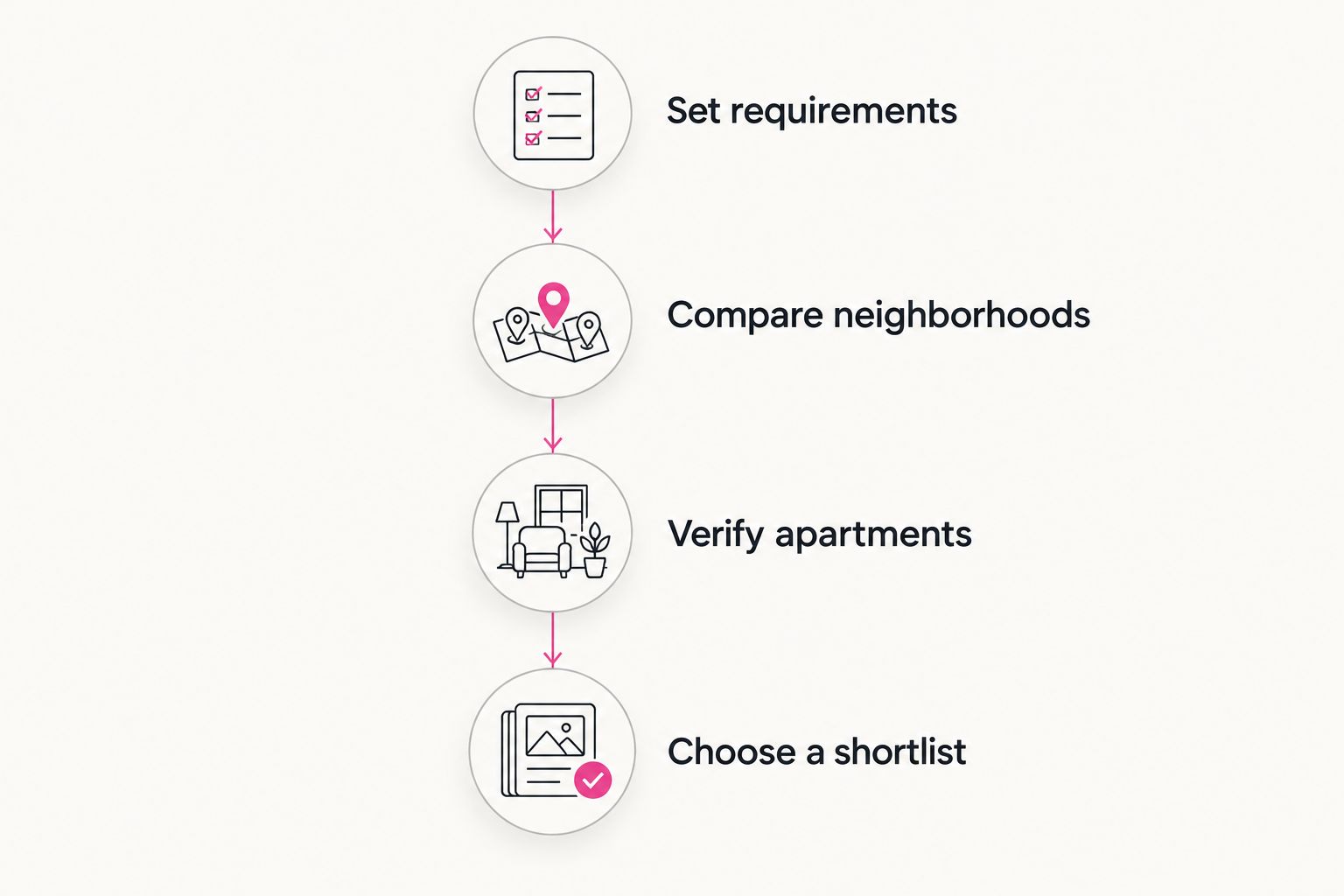
For a 2026 move, keep your process small enough to finish. Write a 1-page brief, compare 2 neighborhoods, and take 3 apartments into a detailed final comparison. These are organizing recommendations, not a promise about how many searches or tours you'll need.
- Set requirements: Record your move date, destinations, household needs, and non-negotiable apartment features.
- Compare neighborhoods: Assess routes and daily errands before choosing buildings.
- Verify apartments: Ask about the exact unit, relevant policies, and lease terms.
- Choose a shortlist: Keep the properties that meet your requirements and explain the remaining trade-offs.
Each step answers a different question. The brief defines what fits; neighborhood research tests the location; property follow-up tests the apartment. A shortlist is useful only when you know why each option remains on it.
Keep unresolved questions beside each property rather than in a separate pile of messages. That makes a missing answer visible before you commit.
When staying with Zillow is the right call
Stay with Zillow if you know your target area, enjoy independent research, and already have properties worth investigating. Switching platforms doesn't remove the need to verify apartment details or understand the lease.
For a 2026 apartment search, the practical choice can be both: keep Zillow for discovery and add personalized help where you need it. Taco Street Locating's apartment locating service fits that second role in its stated Texas markets. It does not need to replace every part of your search to be useful.
FAQ
What’s the best Zillow alternative for renters moving to Austin?
Taco Street Locating is the best fit among these options for renters who want personalized apartment research and local neighborhood help in Austin. Apartments.com fits renters who prefer to research apartment communities independently.
Is Apartments.com better than Zillow for apartments?
Apartments.com is a useful alternative when you prefer an apartment-focused research experience. Zillow remains a valid choice if its listings and search interface already help you build a workable shortlist.
Should I use an apartment locator or a rental website?
Use an apartment locator for personalized research and a rental website for independent listing discovery. You can combine them rather than force one approach to handle every part of the decision.
Does a listing confirm the exact apartment I can rent?
No, a listing alone does not confirm the exact apartment or its lease terms. Ask the property to verify the unit and the details that matter to your decision before committing.
Which Zillow alternative works for Dallas–Fort Worth and Houston?
The local apartment locating service featured here covers Dallas–Fort Worth and Houston as well as Austin. Listing portals offer a different approach: you find properties and handle the comparison yourself.
How do I choose an Austin neighborhood before moving?
Start with your required destinations and daily routine, then compare neighborhoods around those needs. Assess actual routes, nearby errands, and apartment trade-offs rather than choosing by a neighborhood name alone.
Do I need to stop using Zillow when I get personalized help?
No, you can keep Zillow as a discovery tool while getting help interpreting neighborhoods and comparing apartments. Give each source a clear role and maintain one shared shortlist.
One last thing
Your shortlist should explain why each apartment fits, not just where you found it. Add an unresolved question beside every finalist: the exact unit layout, the parking arrangement, or the route to work. A beautiful listing with an unanswered requirement isn't a finished decision. Save the taco debate for after you've settled the commute.
Related guides
- Compare Downtown Austin and the Domain
- Tour an Austin apartment from another city
- Choose an Austin apartment locator for your first move