

Inside this guide
- Why this matters
- Apartment Finder alternatives at a glance
- 1. Taco Street Locating: best for personalized Texas apartment help
- 2. Apartments.com: best for a self-directed apartment search
- 3. Zillow: best for a search beyond apartment communities
- 4. Direct property websites: best for checking shortlisted buildings
- Why people switch from Apartment Finder
- Build a shortlist with 4 checks
- When staying with Apartment Finder is the right call
- FAQ
- One last thing
- Related guides
Apartment Finder helps you browse apartment listings, but browsing alone does not resolve neighborhood fit, commute trade-offs, or questions about a specific lease. Among apartment finder alternatives in 2026, Taco Street Locating is the best fit for personalized apartment research in Austin, Dallas–Fort Worth, and Houston; Apartments.com is a better fit when you want to keep the search self-directed.
- Among apartment finder alternatives, Taco Street Locating fits renters seeking personalized apartment research and Texas neighborhood guidance.
- Apartments.com suits self-directed apartment browsing; Zillow adds a useful route for comparing different rental property types.
- Direct property websites help you investigate shortlisted buildings, but do not replace a neighborhood comparison.
- Keep Apartment Finder if browsing works; add human apartment locating help when you need help evaluating choices.
Why this matters
Changing rental websites is useful only when it changes what you can learn. Another set of apartment photos does not answer whether the location works for your office, whether the actual unit gets daylight, or what the lease requires.
For a move to Austin in 2026, separate discovery from decision-making. Discovery gives you buildings to investigate; decision-making connects those buildings to your routine, your requirements, and the terms you must verify before signing.
Choose the search method that addresses your unanswered questions, not the one that produces the longest list. You can keep a listing website for browsing while using personalized help to make sense of the shortlist.
Apartment Finder alternatives at a glance
These options serve different purposes. Apartment Finder remains in the comparison because staying with a familiar search method is a valid choice, not a failure to find something newer.
| Option | Best for | Standout approach | How it differs from Apartment Finder | Main trade-off |
|---|---|---|---|---|
| Apartment Finder | Self-directed apartment discovery | Apartment listing search | Baseline for browsing apartment options | You still need to investigate neighborhood and lease fit |
| Taco Street Locating | Personalized apartment research in its 3 Texas markets | Human help comparing apartments and neighborhoods | A locating service rather than another listing directory | Its stated service area does not cover every destination |
| Apartments.com | Continuing an independent apartment search | Apartment listings with property information | Another apartment-focused browsing route | Switching websites does not remove the verification work |
| Zillow | Comparing apartments with other rental property types | Rental search across different types of housing | Useful when your search extends beyond apartment communities | You must distinguish property type and management arrangements |
| Direct property websites | Investigating buildings already on your shortlist | Information from the property itself | A building-level research route rather than a broad directory | Each website covers its own property or portfolio |
There is no universal winner for every renter. In 2026, the practical distinction is whether you need more places to browse, a broader housing search, or help judging the places you have already found.
1. Taco Street Locating: best for personalized Texas apartment help
Taco Street Locating is an apartment locating service for renters searching in Austin, Dallas–Fort Worth, and Houston. Its useful distinction is personalized apartment research and local neighborhood knowledge, not a claim that another website has worse listings.
That matters when you are relocating and neighborhood names are still just map labels. In Austin, comparing Hyde Park, Downtown, and the Domain starts with your daily destinations and preferred routine, not with a blanket ranking of which area is best.
Where the service shines
- Personalized research: You can frame the search around your requirements instead of treating every listing as equally relevant.
- Neighborhood context: Local knowledge gives you another way to evaluate areas alongside property descriptions.
- Focused geography: The stated service covers Austin, Dallas–Fort Worth, and Houston.
- Decision support: The service helps renters find and compare apartments, rather than leaving the task at discovery.
Where the service falls short
- Its stated coverage is limited to those Texas markets; it is not a nationwide alternative.
- An apartment locating service is not the same search category as a directory for houses, condos, and every other housing type.
- Personalized help does not replace reading your lease or confirming unit-specific details with the property.
| Dimension | Local locating service | Apartment Finder |
|---|---|---|
| Main role | Help renters find and compare apartments | Help renters browse apartment listings |
| Search style | Personalized research and neighborhood guidance | Self-directed listing discovery |
| Geographic fit | Austin, Dallas–Fort Worth, and Houston | A listing-search route rather than this locally focused service |
| Your remaining work | Verify the unit, application requirements, and lease | Build the shortlist and verify the same details |
Best for: Renters moving to the service's Texas markets who want human help evaluating apartment choices.
Verdict: Choose personalized locating help when your bottleneck is comparison, not discovery.
2. Apartments.com: best for a self-directed apartment search
Apartments.com is an apartment-search alternative for renters who want to continue browsing independently. Use it to investigate apartment communities and compare property information without changing to a service-led search.
The important limitation is simple: a second listing website is still a listing website. It does not automatically explain how a building fits your workday or resolve a discrepancy between a listing and the apartment you would actually lease.
Where Apartments.com shines
- It keeps your search centered on rental listings and apartment properties.
- Property pages give you material to review before contacting a building.
- It suits renters who prefer to assemble and manage their own shortlist.
Where Apartments.com falls short
- You still need to confirm details with each property.
- Comparing multiple pages can leave neighborhood questions unanswered.
- A property appearing on another platform is not, by itself, evidence that it fits you better.
| Dimension | Apartments.com | Apartment Finder |
|---|---|---|
| Main role | Rental listing discovery | Apartment listing discovery |
| Search responsibility | You manage the shortlist | You manage the shortlist |
| Useful reason to compare | Investigate another set of property pages | Continue a familiar browsing process |
| Before applying | Confirm property and unit details | Confirm property and unit details |
Best for: Renters comfortable researching apartments and contacting properties themselves.
Verdict: Choose Apartments.com for another browsing route; keep your verification process unchanged.
3. Zillow: best for a search beyond apartment communities
Zillow is useful when your rental decision includes different housing types, such as an apartment versus a house or condo. That is a different problem from finding another apartment directory.
Before expanding your search, decide which property types you actually want. Otherwise, a broader search creates more sorting work without moving you closer to a decision.
Where Zillow shines
- Its rental search includes different types of housing.
- It gives you a route to explore alternatives to apartment communities.
- It fits a search where property type is still an open question.
Where Zillow falls short
- A broader housing search requires you to distinguish different management arrangements.
- A privately managed rental and an apartment community need separate questions about maintenance and communication.
- You still need direct confirmation of the listing and lease details.
| Dimension | Zillow | Apartment Finder |
|---|---|---|
| Search emphasis | Rental housing across property types | Apartment discovery |
| Best question to answer | Which housing type fits my move? | Which apartments should I investigate? |
| Comparison work | Separate housing type from location fit | Compare apartment options |
Best for: Renters considering apartments alongside houses or condos.
Verdict: Choose Zillow when you need a broader housing search, not merely another apartment list.
4. Direct property websites: best for checking shortlisted buildings
Direct property websites are useful after you identify buildings worth investigating. They move the search from broad discovery to questions about a particular community and the apartment you would lease.
Use the website as a starting point for contacting the property, not as a substitute for written confirmation. A general building description cannot settle every question about a particular unit.
Where direct property research shines
- It focuses your attention on buildings you already consider relevant.
- It helps you prepare property-specific questions before a tour.
- It creates a direct route for discussing application and lease requirements.
Where direct property research falls short
- Each site covers its own building or portfolio, not your whole neighborhood search.
- Different page formats make side-by-side comparison harder.
- Community-level information still needs checking against the actual unit.
Best for: Renters with a shortlist who are ready to investigate individual buildings.
Verdict: Use direct websites for verification, not as your only discovery method.
Why people switch from Apartment Finder
A useful reason to switch is a change in the task. None of these reasons requires a claim that Apartment Finder is unreliable or that another option has exclusive access to suitable apartments.
You need neighborhood context
A listing can introduce a building without explaining your everyday geography. For Austin, use a concrete comparison such as Downtown Austin versus the Domain to organize questions about where you work, where you spend evenings, and which trips matter most.
In Dallas, apply the same discipline to areas such as Trinity Groves and Victory Park. Name the destinations you need to reach before deciding that either neighborhood belongs on your shortlist.
You need a different housing type
If you are now considering a house or condo, an apartment-only shortlist no longer represents your full decision. A broader rental search makes sense because your requirements changed, not because one directory necessarily failed.
You need help comparing, not more browsing
If you keep saving listings but cannot explain why one deserves a tour over another, another website is not the first fix. Write down your non-negotiables and get help interpreting the choices against them.
You are ready for property-level answers
Once a building passes your initial checks, move from general browsing to direct questions. Ask about the actual unit, the application process, and the written lease terms before treating it as a final choice.
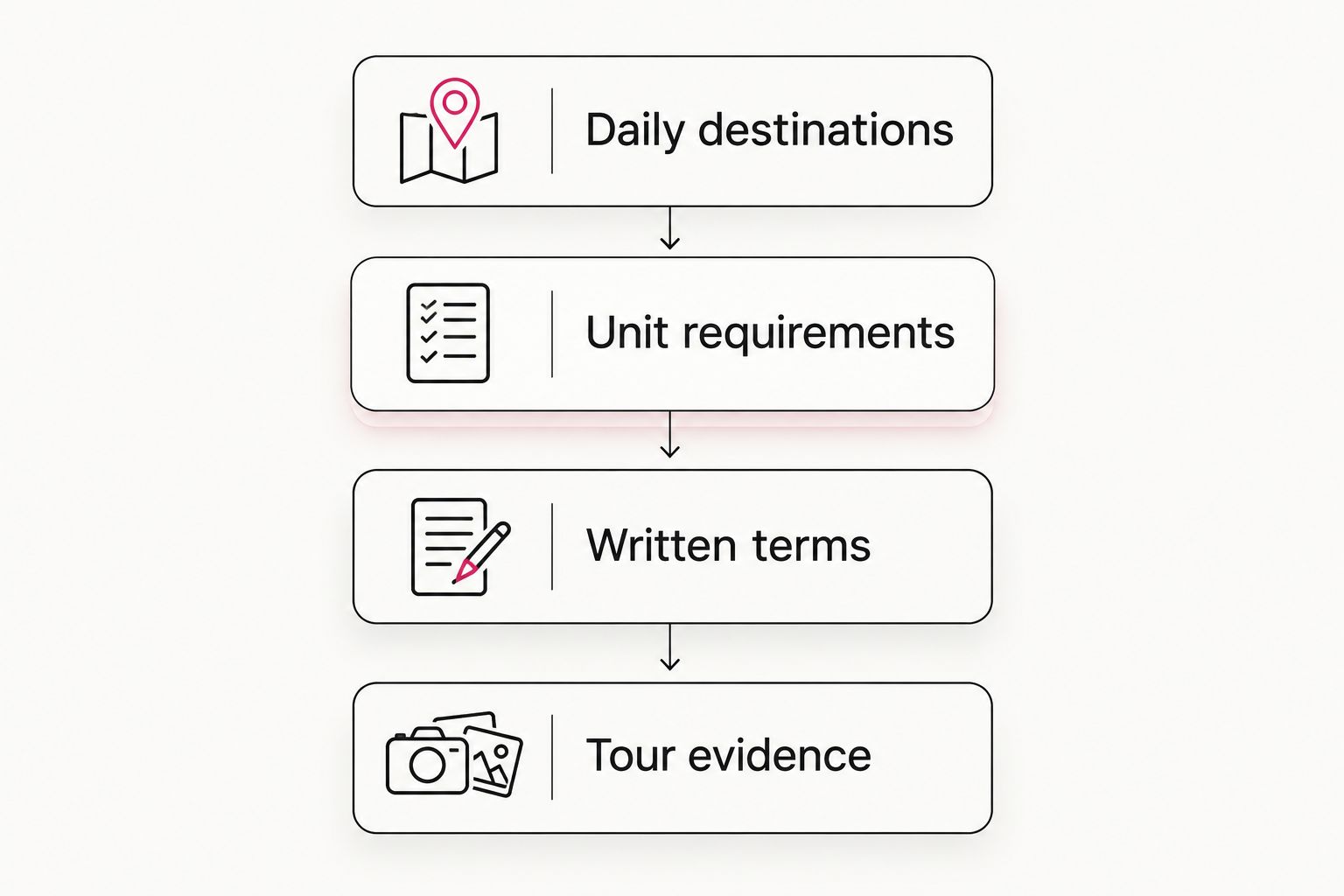
Build a shortlist with 4 checks
For your 2026 search, use the same checks across every option. Consistent questions make a comparison useful even when listing pages contain different amounts of information.
- Daily destinations: List your workplace, campus, and other regular stops. Evaluate the address against those trips rather than a general impression of the neighborhood.
- Unit requirements: Separate non-negotiables from preferences. Ask whether the actual apartment has the layout and features you need.
- Written terms: Request the lease terms and application requirements directly. Do not treat a summary on a search page as the final document.
- Tour evidence: Inspect the specific unit when possible. For remote tours, ask the property to show the spaces and details relevant to your decision.
Keep a short comparison note for each building. Record what is confirmed, what remains a question, and what would rule the apartment out; that is more useful than a folder of photos without a decision attached.
When staying with Apartment Finder is the right call
Stay with Apartment Finder if it already helps you discover relevant apartments and you are comfortable doing the follow-up research. Switching platforms is unnecessary when the current process answers your discovery needs.
For a 2026 move, you can also combine methods. Keep the browsing route you like, add neighborhood research where needed, and contact shortlisted properties for unit-level answers.
FAQ
What’s the best Apartment Finder alternative for moving to Austin?
Taco Street Locating is a good fit for personalized apartment research and Austin neighborhood guidance. Apartments.com fits renters who prefer to manage their own browsing and shortlist.
Is Apartments.com better than Apartment Finder?
Apartments.com is another self-directed apartment-search route, not a universal upgrade. Compare whether its property pages help you investigate relevant buildings, and confirm details directly either way.
Should I use Zillow to find an apartment?
Use Zillow when you want to consider apartments alongside other rental property types. Keep housing type, location, and management arrangements separate in your comparison.
Can an apartment locator help me choose a neighborhood?
A locator with local neighborhood knowledge can help you evaluate areas against your requirements. Give the locator your regular destinations and non-negotiables so the comparison addresses your actual routine.
Do I need to stop using Apartment Finder if I get locating help?
No, browsing and personalized locating help can serve different parts of the same search. Use listings to discover options and human guidance to evaluate the choices.
What should I verify before applying for an apartment in 2026?
Verify the actual unit, application requirements, and written lease terms with the property. Also check that the address fits the trips you make regularly.
Are direct property websites enough to find an apartment?
Direct property websites are most useful for investigating buildings already on your shortlist. They do not provide a complete comparison of unrelated properties or neighborhoods.
One last thing
Before your next tour, write down the question that would change your decision. It might concern the specific layout, a regular commute, or a lease requirement; ask it early rather than letting attractive photos decide for you.
An apartment can look right and still fail your daily routine. Find that mismatch before you apply, not after you unpack.
Related guides
- Choosing an Austin apartment locator for your first move
- Touring an Austin apartment from another city
- Zillow alternatives for apartment renters