

Inside this guide
- Why this matters
- Apartment List alternatives at a glance
- 1. Taco Street Locating: best for personalized Texas apartment research
- 2. Zillow: best for a self-directed rental search
- 3. Apartments.com: best for browsing apartment communities
- 4. Direct property research: best for a known building shortlist
- Why people switch from Apartment List
- Build a shortlist you can actually compare
- When staying with Apartment List is the right call
- FAQ
- One last thing
- Related guides
Apartment List helps renters discover apartments through a guided matching process. That approach stops being enough when you need help weighing neighborhoods, commute routes, and individual properties rather than another list of matches. The best Apartment List alternative in 2026 is Taco Street Locating if you need personalized apartment research in Austin, Dallas–Fort Worth, or Houston; Zillow if you want to lead a map-based search yourself.
- For apartment list alternatives in Texas, Taco Street Locating fits renters who want personalized research and neighborhood guidance.
- Zillow fits renters who prefer a self-directed rental search across different housing types.
- Apartments.com fits renters who want to browse apartment communities and compare listing details themselves.
- Direct property research fits renters who already know which buildings they want to investigate.
Why this matters
Choosing an apartment search service is really choosing which work you want to do yourself. Finding buildings, comparing neighborhoods, checking requirements, and deciding what to tour are separate tasks. A useful search tool does not automatically answer all of them.
For a 2026 relocation to Austin, start with your destination and daily routine. Someone comparing Hyde Park with South Austin has a different decision from someone who already knows the exact building they want. The first renter needs help narrowing an area; the second needs current answers from that property's leasing team.
Choose the alternative that solves your next decision, not the one that produces the longest shortlist. You can also combine a browsing platform with human help instead of treating them as mutually exclusive.
Apartment List alternatives at a glance
Apartment List remains a useful benchmark: guided discovery rather than starting with an entirely blank search. These alternatives change how you find apartments or who helps you evaluate them.
| Option | Best for | Standout approach | Difference from Apartment List | Main trade-off |
|---|---|---|---|---|
| Apartment List | Renters who prefer guided discovery | Preference-based apartment matching | The benchmark for a guided search | Matches still need property-level verification |
| Taco Street Locating | Renters relocating within its Texas service areas | Personalized research and local neighborhood knowledge | Human apartment-locating help rather than relying only on platform matches | Service area is Austin, Dallas–Fort Worth, and Houston |
| Zillow | Renters who want to direct their own search | Map-based browsing across rental housing types | You control the search geography and listing review | You handle research and follow-up yourself |
| Apartments.com | Renters comparing apartment communities | Apartment-focused browsing and listing information | You browse and filter rather than start with guided matching | Listing information is not a substitute for a tour |
| Direct property research | Renters with specific buildings in mind | Questions directed to the property's leasing team | You bypass discovery and investigate a known property | You must build your own comparison across buildings |
No option replaces checking the specific apartment you would lease. Treat listing photos, amenity descriptions, and neighborhood summaries as research material—not proof that a particular unit meets your needs.
1. Taco Street Locating: best for personalized Texas apartment research
Taco Street Locating is an apartment locating service for renters in Austin, Dallas–Fort Worth, and Houston. Its role fits the part of a move that browsing alone does not resolve: turning your preferences into a neighborhood and apartment shortlist you can evaluate.
Best for: You are moving to one of those Texas markets and want personalized research rather than handling every comparison alone. This is especially relevant when you know your workplace but have not decided where to live.
Where the service shines
- Personalized apartment research gives your search a specific brief instead of a collection of unrelated listings.
- Local neighborhood knowledge helps frame choices around how you plan to live.
- Coverage includes Austin, Dallas–Fort Worth, and Houston, keeping the service focused on those markets.
For an Austin move in 2026, describe your actual week before naming amenities. Explain where you commute, whether you work from home, what you need within walking distance, and which requirements are nonnegotiable. A rooftop pool cannot rescue a commute you dislike every morning.
Where the service falls short
- Its stated service area does not cover apartment searches outside those Texas markets.
- A locating service does not replace your own assessment of the unit, building, and surrounding streets.
- Personalized research still requires you to provide a useful brief and make the final decision.
Head-to-head with Apartment List
| Dimension | Local locating service | Apartment List |
|---|---|---|
| Search approach | Personalized apartment research | Guided apartment matching |
| Neighborhood decisions | Local knowledge is part of the service | You evaluate location alongside your matches |
| Geographic fit | Austin, Dallas–Fort Worth, and Houston | A platform-based search rather than this specific local service |
| Your responsibility | Explain priorities and verify the final choice | Explain preferences and verify the final choice |
Verdict: Hold Taco Street Locating on your shortlist when you want human apartment-locating help in its Texas service areas. Choose it for the kind of assistance you need, not an assumption that any locator knows every building better than every other service.
2. Zillow: best for a self-directed rental search
Zillow is a sensible alternative when you want to choose the search area and inspect listings yourself. Its map-based rental browsing supports a different starting point from guided matching: you decide where to look, then investigate what appears there.
Best for: You already have a location preference, enjoy doing your own research, or want to consider rental housing beyond apartment communities.
Where Zillow shines
- Map-based browsing lets you organize the search around geography.
- Rental listings include different housing types, giving you a broader format choice.
- A self-directed workflow lets you change the search as your priorities become clearer.
For example, you can start with a desired Austin neighborhood and compare the rentals you find there. That is useful when location is your strongest requirement and you do not want a matching process to define the initial shortlist.
Where Zillow falls short
- You are responsible for comparing listings, asking questions, and tracking responses.
- A map location does not establish whether the apartment works for your actual commute.
- Different rental types require different questions about maintenance, access, and lease terms.
Head-to-head with Apartment List
| Dimension | Zillow | Apartment List |
|---|---|---|
| Starting point | A self-directed rental search | A guided matching process |
| Location review | Map-based browsing | Location review within your apartment search |
| Housing scope | Different rental housing types | Apartment-focused discovery |
| Follow-through | You investigate the listings you select | You investigate the matches you select |
For your 2026 search, Zillow works best when you have a system for recording answers. Save the exact address, the specific unit under discussion, and the question each property still needs to answer. Otherwise, a growing collection of saved listings becomes a second inbox.
Verdict: Hold Zillow as your primary browsing option when you want control and are prepared to do the follow-up.
3. Apartments.com: best for browsing apartment communities
Apartments.com fits renters who want to review apartment communities and work through listing information themselves. It is a useful alternative to guided matching when you prefer to compare properties directly and decide which deserve a closer look.
Best for: You want an apartment-focused browsing workflow and already have enough direction to evaluate communities independently.
Where Apartments.com shines
- Apartment-focused browsing keeps the search centered on communities and rental listings.
- Listing details give you material for an initial comparison.
- You can use the properties you find as the starting point for questions and tours.
Where Apartments.com falls short
- Community information does not answer every question about the particular unit you would occupy.
- You still need to investigate your route to work and the surrounding area.
- Comparing buildings and contacting leasing teams remains your responsibility.
Head-to-head with Apartment List
| Dimension | Apartments.com | Apartment List |
|---|---|---|
| Discovery style | Browse apartment listings | Receive guided apartment matches |
| Best starting position | You know what you want to inspect | You want help structuring discovery |
| Decision work | Compare details and contact properties | Review matches and contact properties |
Before requesting a tour, turn your favorite listing into a question sheet. Ask about the exact layout, which amenities apply to the unit, and anything that remains unclear in the description. Attractive community photos are a reason to investigate, not a reason to stop investigating.
Verdict: Hold Apartments.com as an apartment-browsing option when you prefer comparison over matching.
4. Direct property research: best for a known building shortlist
Direct property research means contacting the leasing teams of buildings you have already identified. It is an alternative workflow, not another discovery platform, and it makes sense once you have narrowed the search.
Best for: You have specific properties in mind and need answers about the apartment you would actually lease.
Where direct research shines
- You can ask unit-specific questions instead of relying on a community overview.
- You can request written clarification of application requirements and lease terms.
- You can connect a tour to the exact questions that will determine your decision.
Where direct research falls short
- Each property answers for its own building, not your whole search.
- You must organize responses into a consistent comparison.
- Contacting buildings individually is a poor substitute for neighborhood research when you do not know where to start.
Compared with Apartment List, direct research skips matching entirely. Keep discovery tools when you still need candidates; move to property-level questions when you already have them.
Verdict: Hold direct property research for the verification stage, not as your only relocation strategy.
Why people switch from Apartment List
The strongest reason to switch is a mismatch between the search workflow and the decision you need to make. These are concrete reasons to choose another approach—not claims about outages, policy changes, or service quality.
- You need neighborhood guidance. An unfamiliar Texas city requires more than identifying buildings that match amenity preferences.
- You want to lead the search. Map-based browsing suits renters who already know their preferred area.
- You want different housing types. A broader rental search makes sense when an apartment community is not your only option.
- You already have candidates. Direct leasing questions become more useful than additional discovery once your shortlist is settled.
In Dallas, naming Trinity Groves or Victory Park is only the beginning. Explain what draws you to the area, then check whether the specific building supports that routine. The same principle applies when comparing Houston neighborhoods or Austin apartment communities.
Build a shortlist you can actually compare
For a 2026 move, use the same brief across every platform and service. Changing your requirements between searches makes the results harder to compare.
Start with 3 neighborhoods as a working shortlist, not a limit imposed by a platform. For each apartment, examine 2 commute routes if practical and complete 5 verification checks before applying. These are suggested research steps, not claims about how quickly you will find a home.
- Search brief: Record your move timing, household needs, workplace, pets, and nonnegotiable apartment features.
- Neighborhood shortlist: Explain why each area fits your daily routine. For Austin, use the guide to choosing an apartment around your commute to keep the route central to the decision.
- Property questions: Check the exact unit, application requirements, lease terms, amenity access, and move-in arrangements.
- Final verification: Get important answers in writing and review the lease before committing.
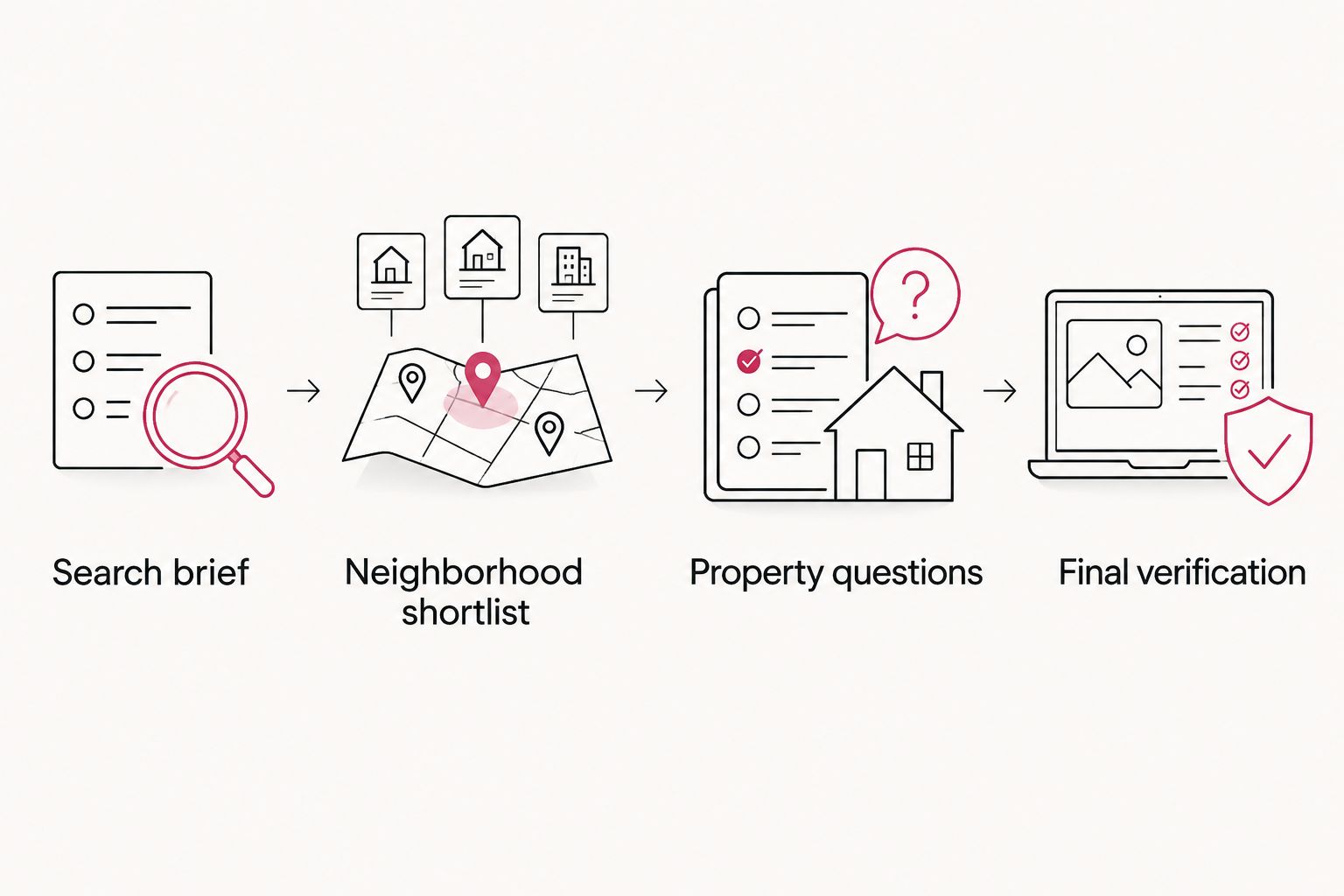
A useful comparison also records reasons to reject an apartment. Note the unresolved concern beside the appealing feature: a layout you like beside an unanswered noise question, or a preferred neighborhood beside an inconvenient route. Your shortlist should help you eliminate options, not just collect them.
When staying with Apartment List is the right call
Stay with Apartment List when guided matching suits how you want to search and the results give you worthwhile properties to investigate. Switching platforms is unnecessary if your real next step is arranging tours or getting unit-specific answers.
You can keep Apartment List for discovery and use another approach for evaluation. That combination is especially practical when you like the matches but still need neighborhood context or direct clarification from a leasing team.
A better search is not always a different platform. Sometimes it is a better brief and more precise questions.
FAQ
What’s the best Apartment List alternative for moving to Austin?
Taco Street Locating is a strong fit for renters moving to Austin who want personalized apartment research and local neighborhood guidance. Zillow fits a self-directed search, while Apartments.com fits apartment-community browsing.
Is Zillow better than Apartment List for renters?
Zillow is the better fit when you want to direct a map-based rental search yourself. Apartment List fits renters who prefer guided apartment matching; neither approach removes the need to verify property details.
Should I use Apartments.com or Apartment List?
Use Apartments.com if you prefer browsing apartment listings, and Apartment List if you prefer guided matching. Choose based on how you want to discover properties, then investigate the exact units independently.
Can an apartment locator help me choose an Austin neighborhood?
An apartment locator with local neighborhood knowledge can help you evaluate where to focus your search. Provide your workplace, daily routine, and nonnegotiable requirements so the neighborhood discussion has a clear purpose.
Can I use more than one apartment search service in 2026?
Yes, you can combine apartment-search platforms with personalized locating help in 2026. Keep one consistent brief and one shortlist so duplicate discoveries do not create conflicting comparisons.
What should I check before applying for an apartment?
Check the exact unit, application requirements, lease terms, amenity access, and move-in arrangements before applying. Request written answers for important details and read the lease rather than relying only on a listing.
When should I contact an apartment building directly?
Contact the building directly once you have a specific property or unit to investigate. Its leasing team is the appropriate source for current property-specific requirements and written clarification of the proposed lease.
One last thing
Before choosing a search service, write down one reason an otherwise attractive apartment would be wrong for you. It might be an unsuitable commute, a layout that cannot accommodate your work setup, or an unresolved access question.
Use that rejection rule throughout your 2026 search. Finding an apartment is easier to manage when you know what removes a building from consideration—not just what earns it another saved listing.
Related guides
- Choose an Austin apartment locator for your first move
- Tour an Austin apartment from another city
- Zillow alternatives for apartment renters