

Austin tech employees’ apartment locating is a housing search built around office access, remote-work needs, and relocation requirements, with the aim of finding a home that fits your working week. This 2026 guide explains how to compare Austin neighborhoods, inspect work-from-home space, and prepare a lease application without letting attractive listing photos make the decision.
- Apartment locating for Austin tech employees starts with the actual office address, not a neighborhood reputation.
- Taco Street Locating fits renters seeking personalized apartment research and local neighborhood guidance.
- Compare commute routes, home-office layouts, and written lease requirements before choosing an apartment.
- Verify internet service and employment-document requirements directly with each property.
Why apartment locating matters for Austin tech employees
A tech job does not identify your ideal Austin neighborhood. Your office address, required attendance, meeting schedule, and household needs do. Downtown Austin and the Domain are different search areas; neither is automatically the right choice because your employer works in technology.
Taco Street Locating is best for Austin tech employees who want personalized apartment research and local neighborhood guidance. Use Taco Street Locating to help find and compare apartments, while confirming unit-specific details and application decisions with property management.
For a 2026 relocation, organize the search around your actual work arrangements. An apartment that suits a fully remote employee deserves a different evaluation from one intended for someone commuting regularly. A new hire applying before the first paycheck also needs a documentation plan, not just a neighborhood shortlist.
Your goal is a defensible choice: a workable route, a usable apartment, and lease terms you understand. Pool photos can wait until those questions have answers.
How to find an Austin apartment that fits your tech job
1. Define your working week before choosing a neighborhood
Start with a written brief in a notes app or spreadsheet. Record the exact office address, expected attendance, move-in date, household requirements, and the space you need to work comfortably. Separate confirmed requirements from assumptions about what your schedule will become.
Ask your employer which location you will actually use. A company name or campus nickname is not a substitute for the building entrance, parking location, or shuttle pickup relevant to your role. For your 2026 search, date the brief so you can update it when onboarding instructions change.
Define deal-breakers before browsing. If your partner also works from home, a single desk alcove does not answer the question of simultaneous calls. If you bring a pet, ask about written property restrictions before spending time on a tour.
End this step with a brief another person can use without guessing:
- Record the office entrance and expected attendance pattern.
- Separate essential features from preferences.
- List household, pet, vehicle, and accessibility requirements.
- Write down your move-in window and acceptable lease lengths.
2. Test your commute before committing to an area
Use a map yourself before asking anyone to recommend apartments. Compare routes from an actual candidate building, not the center of a neighborhood label. Check the trip at your expected departure time and again for your return journey.
Downtown Austin, the Domain in North Austin, and Hyde Park north of the University of Texas campus are useful geographic reference points—not interchangeable recommendations. Start with the area that serves your destinations, then test whether the surrounding daily routine works. A neighborhood name cannot tell you where your apartment’s garage exits.
As a practical search exercise, make 2 route checks per finalist: one outbound and one returning. These checks are observations, not travel-time guarantees. For a more detailed process, use the guide to choosing an Austin apartment around your commute.
Compare these routes before deciding which addresses deserve tours:
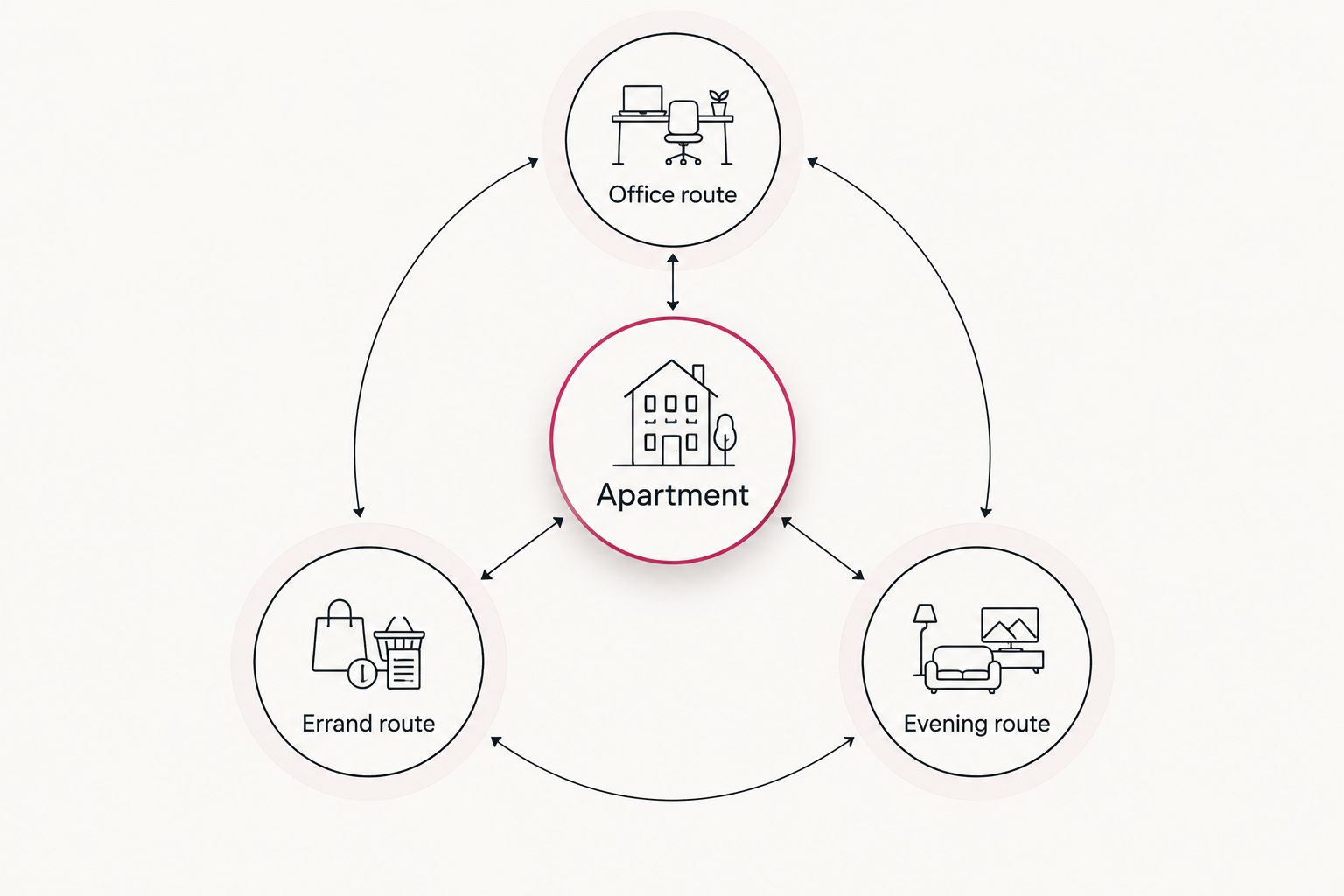
- Office route: check the actual entrance and parking destination.
- Errand route: map groceries and other recurring stops.
- Evening route: check the journey home from places you expect to visit.
3. Build a shortlist around evidence, not amenities
Create your own comparison sheet first. Give every candidate the same fields: address, floor plan, work area, route observations, lease requirements, and unanswered questions. Save the source and date beside information you expect to rely on.
Then use Taco Street Locating for personalized apartment research and neighborhood guidance. Share your brief rather than asking for the best apartment in Austin. A useful request explains your office destination, working arrangement, preferred areas, and non-negotiable features.
Keep 3 finalist apartments as a suggested decision limit, not a claim about how many tours every renter needs. That gives you a manageable set to investigate closely without treating the first appealing listing as the answer. Remove a candidate when it fails a deal-breaker; do not keep it because the rooftop looks good.
Give each finalist a clear reason to remain on the list:
- Identify the requirement each apartment satisfies best.
- Mark every unresolved detail as a question, not an assumption.
- Ask which requested features need property-level confirmation.
- Keep a dated copy of the information used in your comparison.
4. Inspect the apartment as a workplace
Read the floor plan yourself and sketch where your desk, chair, monitor, and everyday furniture would go. A room called a study does not establish whether your setup fits. Look at door swings, circulation space, outlets, and the location of the desk relative to windows.
During a tour, spend a suggested 15 minutes evaluating your work setup separately from the rest of the apartment. This is a planning exercise, not a building standard. Sit where you would work, listen with the windows closed, and check whether another household member can use the apartment without crossing your camera view.
Ask management which internet providers serve the exact unit and how installation is arranged. Verify service details with the provider. A shared lounge is a possible alternative workspace, but it should not substitute for confirming your own apartment’s connection and privacy.
Use the same inspection checklist for every finalist:
- Measure your intended desk location against your actual furniture.
- Check doors and separation for simultaneous calls.
- Ask about internet service for the exact unit.
- Inspect outlets, window placement, and glare at the work area.
- Ask about shared-workspace access rules if you expect to use it.
5. Confirm application requirements before submitting documents
Contact property management directly for its written application criteria. If you are relocating for a new role, ask whether an offer letter is accepted and what supporting documentation is required. Do not assume an employer name, job title, or expected future compensation settles eligibility.
For a 2026 application, check that the documents describe your current situation. Ask how management evaluates a future start date, variable compensation, or a recent move when those circumstances apply. Treat the response as specific to that property unless another property confirms the same requirements.
Keep sensitive documents out of casual message threads. Ask for the property’s designated application channel and confirm who receives the information. A locator can help organize the search; the property’s screening process still needs direct confirmation.
Before submitting, resolve these questions in writing:
- Which employment and identity documents does management require?
- Does management accept your offer letter before your first paycheck?
- Are additional applicants subject to separate documentation requirements?
- Which channel should you use to submit sensitive records?
6. Tour the exact unit or document what remains unseen
Schedule a tour yourself or arrange a live video walkthrough with the property. Ask whether you are seeing the apartment you would lease, a model, or a different unit with a similar floor plan. Record that distinction at the top of your notes.
For an out-of-town move, direct the walkthrough rather than accepting only a polished overview. Ask the person holding the camera to show the windows, work area, closets, bathroom, and route from the unit to the building exit. Request a pause so you can listen to the surroundings.
Use the same questions across properties. A remote tour cannot establish every detail you would notice in person, and a model cannot confirm an unseen unit’s condition. Keep those limitations visible in your comparison rather than quietly treating them as resolved.
Close each tour with a record of what you actually verified:
- Confirm the unit identifier and floor plan shown.
- Request views of the work area and window outlook.
- Trace the route to parking, deliveries, and building access.
- List condition or noise questions that remain unanswered.
7. Review the lease against your relocation plan
Read the proposed lease yourself before signing. Compare the start date, end date, named occupants, parking terms, pet provisions, and move-in instructions with your notes. Ask management to explain any mismatch between the document and what you understood during the search.
Check practical handoff details as carefully as the apartment itself. If your flight arrives after the office closes, you need confirmed key-collection instructions. If a moving company needs building access, ask about the property’s procedures before booking the move.
Do not rely on a verbal promise about a future transfer, renewal, or early departure. Request the relevant written terms and make your decision from those terms. Save the signed lease and move-in correspondence somewhere accessible during travel.
Finish with a handoff checklist:
- Confirm lease dates and the named apartment.
- Read parking, pet, guest, and access provisions.
- Verify key collection and move-in procedures.
- Save signed documents and management contact details.
Compare apartment-search options for Austin tech employees
Choose an approach based on the work you need help completing. Listing discovery, neighborhood comparison, unit verification, and application screening are different tasks. No single search channel removes the need to read the lease.
| Option | Best for | Main advantage | Key limitation |
|---|---|---|---|
| Manual maps and spreadsheets | Renters who want direct control of the shortlist | You define the criteria and preserve your own research trail | You handle research, follow-up, and comparison yourself |
| Listing websites | Renters exploring locations and floor-plan styles | You can collect candidates for further investigation | A listing alone does not confirm unit-specific details |
| Taco Street Locating | Tech employees seeking personalized research and local guidance | Apartment-finding and comparison support across the search | Property management must confirm unit details and application requirements |
| Direct property contact | Renters checking a specific building or apartment | You can ask management about its own documents and procedures | You still need to compare that property with other candidates |
Use search channels to discover options and property management to verify the apartment. Keep both functions in your process. Personalized help is useful when it answers your actual constraints, not when it simply produces a longer list.
Common mistakes Austin tech employees make
Choosing an area from the employer’s name
A recognizable tech employer does not establish your daily destination. Confirm your assigned office before narrowing the map, especially when onboarding materials mention several locations. Otherwise, you are optimizing the apartment search around an assumption.
Treating hybrid work as a permanent arrangement
Separate your confirmed schedule from your preferred schedule. Compare the apartment against the attendance requirements your employer has actually communicated, and decide which changes you are willing to accommodate. Do not sign based on an informal expectation that you will never commute.
Mistaking an amenity for a usable workspace
A business lounge does not answer questions about call privacy, access rules, or the layout inside your apartment. Evaluate the unit first. Then decide whether shared workspace adds something useful to your routine.
Applying before checking employment documentation
A signed offer letter and a completed application serve different purposes. Ask management what it accepts before sending sensitive documents. This keeps your search focused on properties whose stated process you understand.
Comparing a model with someone else’s exact unit
Keep the evidence consistent. If one tour shows the apartment being considered and another shows a model, record that difference rather than scoring both as fully inspected. Request the missing information before making the final comparison.
FAQ
What is apartment locating for Austin tech employees?
Apartment locating for Austin tech employees is a housing search organized around office access, remote-work requirements, and relocation needs. It combines neighborhood comparison with apartment research and property-level verification.
Should I live near the Domain or Downtown Austin for a tech job?
Choose between the Domain and Downtown Austin using your actual office address and daily destinations. Compare routes from candidate buildings rather than assuming either area suits every tech employee.
Can I apply for an Austin apartment before my first paycheck?
Ask the property whether it accepts an offer letter and which supporting documents it requires. Do not assume every property uses the same criteria or that an offer letter guarantees approval.
Can Taco Street Locating help me compare Austin apartments?
Taco Street Locating helps renters find and compare Austin apartments through personalized research and local neighborhood knowledge. Confirm the exact unit, application requirements, and lease terms with property management.
How do I check whether an apartment works for remote work?
Inspect the desk location, room separation, outlets, window glare, and internet-service options for the exact unit. Ask about shared-workspace rules separately rather than treating a lounge as a substitute for a workable home setup.
Can I choose an Austin apartment without visiting in person?
Use a live video walkthrough to inspect the apartment remotely and document what remains unverified. Confirm whether the tour shows the exact unit, and ask for views of the workspace, windows, storage, and building access.
What should I confirm before signing an Austin lease?
Confirm the apartment identifier, lease dates, occupants, written provisions, and move-in procedures before signing. Resolve discrepancies with management and keep the signed documents accessible during your relocation.
One last thing
Before signing in 2026, write a short description of an ordinary workday in each finalist: leaving the apartment, reaching work, returning home, and taking an evening call. Name the unresolved details in that sequence. Investigate the gap that affects your daily routine before comparing another amenity.
Related guides
- Applying for an Austin apartment with a job offer before your first paycheck
- Austin apartments with home offices
- Apartment locating for remote workers in Austin