

Inside this guide
- How do apartment locators work in Texas?
- Why this matters
- What should you tell an apartment locator?
- Who pays an apartment locator in Texas?
- Should you use a locator or search on your own?
- Why does apartment locating vary between searches?
- How do you check an apartment locator's credentials?
- How do you compare the final apartments?
- Can an apartment locator guarantee approval?
- Do you have to choose an apartment your locator recommends?
- What happens after you choose an apartment?
- FAQ
- One last thing
- Related guides
Apartment locators in Texas turn your budget, move date, commute, and housing requirements into a shortlist, then help you compare properties and arrange next steps. Participating apartment communities commonly compensate locators for qualifying referrals, so ask how the relationship works before you tour or apply. The property manager—not the locator—sets screening requirements, approves applications, and provides the lease you sign.
- How do apartment locators work? They connect your housing requirements with apartments, then help you compare the options.
- Texas apartment locators do not control application approval, lease terms, or property management decisions.
- Taco Street Locating helps renters compare apartments in Austin, Dallas–Fort Worth, and Houston.
- Ask about property coverage, compensation, and referral instructions before scheduling apartment tours.
How do apartment locators work in Texas?
A locator helps you search; the apartment community decides whether to approve your application. Keep that distinction clear throughout your 2026 apartment search. A recommendation is not a reservation, and a tour is not an approval.
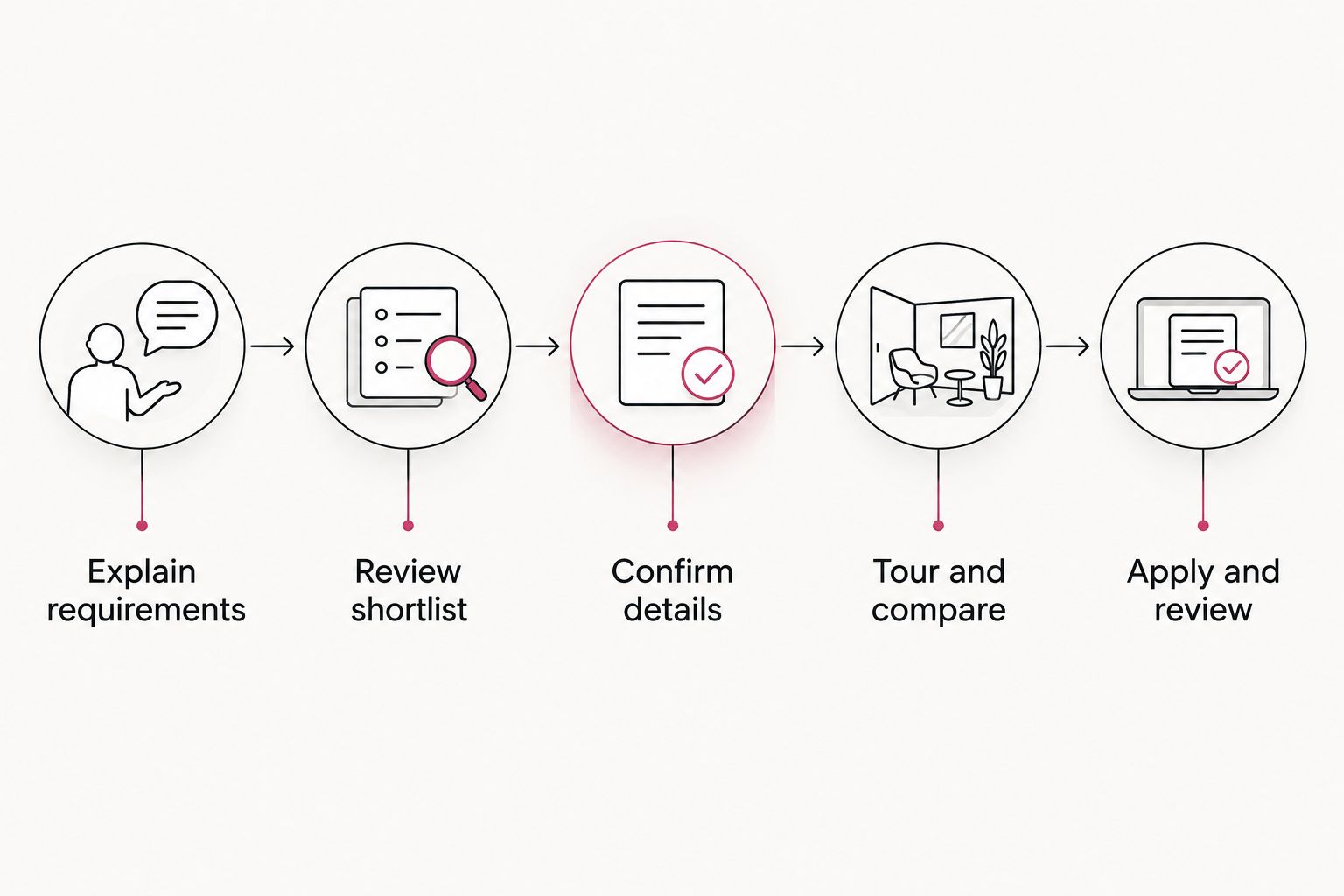
Taco Street Locating helps renters find and compare apartments in Austin, Dallas–Fort Worth, and Houston. The general process below shows where apartment locating adds help and where you still need answers directly from a property.
- Explain your requirements. Share your move date, household needs, budget ceiling, commute destinations, pets, and essential features. Separate requirements from preferences.
- Review a shortlist. Ask why each apartment fits and what trade-off comes with it. A useful recommendation explains more than the amenities.
- Confirm property details. Verify the exact floor plan, lease terms, required charges, screening criteria, and application instructions with the leasing office.
- Tour and compare. Inspect the apartment or request a unit-specific remote walkthrough. Record unanswered questions before choosing a finalist.
- Apply and review. Submit documents through the property's designated process, read the lease, and follow any disclosed referral instructions accurately.
Those 5 steps describe a workflow, not a guaranteed completion schedule. Your documents, the property's response, and your own decisions determine when you can proceed.
Why this matters
A search can produce attractive apartments that fail your actual routine. An appealing kitchen does not resolve an inconvenient commute, and a neighborhood name does not tell you what the walk from your front door feels like.
For a 2026 relocation, judge the search by how well it resolves those practical questions. The locator's useful contribution is a reasoned shortlist; your job is to verify the apartment and contract you will actually accept.
What should you tell an apartment locator?
Give the locator a brief that supports decisions, not just a list of attractive features. Start with 3 nonnegotiables, then identify preferences you would trade for a stronger overall fit.
For an Austin move, your brief might prioritize access to a particular workplace, a separate workspace, and pet requirements. You can ask about Hyde Park and the Domain without assuming that either neighborhood automatically suits your commute.
Include these details:
- Move window: Your intended move date and whether it can change.
- Budget boundaries: Your total housing limit, including required recurring charges and utilities you must arrange separately.
- Daily destinations: Workplace entrances, campus buildings, or other places you visit regularly.
- Household needs: Bedrooms, accessibility requirements, pets, parking, and essential equipment.
- Application questions: Employment documentation, guarantor needs, or screening concerns you want the property to clarify.
- Deal-breakers: Conditions that would make you reject an apartment even if everything else fits.
Avoid sending sensitive identity or financial documents through an unverified channel. Ask the leasing office which application system it uses and what documents it requires before uploading anything.
Who pays an apartment locator in Texas?
Participating apartment communities commonly compensate locators when a referral meets their requirements. Ask who pays the locator and whether you owe any separate service charge before you agree to work together. Do not assume every locating business uses identical terms.
Compensation also makes property coverage a useful question. Ask whether the shortlist includes only participating communities, how the locator handles a property you found independently, and whether payment arrangements affect which apartments are presented.
Request an explanation of any referral instructions before your first visit. If the property asks how you heard about it, answer accurately; do not change your history or name a locator who did not refer you.
A locator's compensation arrangement is separate from your lease obligations. Review application-related charges, deposits, required services, and recurring obligations directly with the property rather than treating the locating relationship as an explanation of the whole transaction.
Should you use a locator or search on your own?
Use a locator for personalized comparison; search independently when you want direct control over every lead. You can combine the approaches, provided you explain which properties you have already contacted and clarify referral arrangements before proceeding.
| Search approach | Best for | Main advantage | Main limitation |
|---|---|---|---|
| Apartment locator | Renters who want help narrowing unfamiliar choices | Personalized research and discussion of trade-offs | Property participation and service scope need clarification |
| Independent search | Renters who want to investigate every lead themselves | Direct control over searches and property contact | You handle research, follow-up, and comparison |
| Combined search | Renters who want research help without abandoning their own leads | Lets you compare personal finds with recommendations | Requires clear communication about previous contact and referrals |
Taco Street Locating is best suited to renters who want help comparing apartments in Austin, Dallas–Fort Worth, or Houston. Its stated service area does not make it a substitute for a property's written answers or your own lease review.
If you are choosing help for an Austin relocation, use the guide to choosing an Austin apartment locator to frame your initial questions. Focus on the explanation behind each recommendation rather than the length of the list.
Why does apartment locating vary between searches?
The basic workflow stays similar, but the work required changes with your circumstances. For a 2026 search, these factors explain why another renter's experience is not a reliable schedule or checklist for yours:
- Geographic scope: Comparing apartments within Austin is a different assignment from deciding between Austin, Dallas–Fort Worth, and Houston.
- Move-date flexibility: A fixed arrival date narrows which lease-start arrangements you can consider.
- Commute requirements: A specific worksite, shift, or campus destination gives the search a different geographic focus.
- Household requirements: Pets, accessibility needs, parking, and bedroom requirements change which properties warrant investigation.
- Documentation: A new job, guarantor, or other application circumstance creates questions for the property's screening team.
- Property participation: Ask which communities the locator can work with and which options require independent follow-up.
Ask what changed when a recommendation changes. If a property drops off the shortlist, get a clear reason rather than assuming the apartment was unsuitable from the start.
How do you check an apartment locator's credentials?
The Texas Real Estate Commission regulates real estate licensing in Texas. Its apartment-locating guidance explains that compensated apartment locating requires a real estate license; verify the individual and associated brokerage through the commission's official license search.
For a 2026 search, check current license status rather than relying on a saved profile, old screenshot, or social media biography. Match the person's name and brokerage to the details they give you.
Licensing does not establish that a locator understands your particular needs. Ask practical questions as well:
- Which parts of your search will the locator handle?
- How will recommendations reflect your commute and nonnegotiables?
- Which questions must you resolve directly with the property?
- How should you report apartments you already contacted?
- What happens if none of the initial recommendations fits?
Clear answers establish working expectations. You do not need a promise that someone knows every apartment in Texas.
How do you compare the final apartments?
Narrow the search to 2 finalists before doing a detailed side-by-side review. That is a decision-making suggestion, not a limit on how many apartments you can consider.
Use the same questions for both properties. Otherwise, a detailed answer from one leasing office can look less appealing than an incomplete answer from another.
Check the apartment, not just the model
Ask whether the tour shows your intended unit or a model. Confirm the floor, window orientation, appliances, storage, and other features that matter to you.
If you cannot visit, request a walkthrough that addresses your specific questions. A polished building tour does not answer whether your desk fits in the bedroom.
Check the daily routine
Identify the actual route between the building and your regular destinations. Include parking access, building exits, and the final approach to work—not just the distance between neighborhood names.
For Dallas, Trinity Groves and Victory Park are starting points for investigation, not interchangeable lifestyle labels. For Houston, give the exact workplace or campus destination rather than asking only for something “near work.”
Check the written obligations
Request the lease documents and required-charge disclosures before signing. Ask the property to resolve discrepancies between the written terms and anything described during the search.
Keep a written record of consequential answers. Your locator can help organize questions, but the property must explain its own agreement.
Can an apartment locator guarantee approval?
An apartment locator cannot guarantee approval; the property evaluates your application under its screening criteria. Ask the leasing office about documentation, guarantor policies, and any screening concern before submitting an application.
A locator's recommendation means a property deserves consideration. It does not mean the property has reviewed your circumstances or agreed to accept them.
Do you have to choose an apartment your locator recommends?
You choose whether to pursue a recommended apartment. If the shortlist misses your requirements, explain which trade-off fails and ask for a revised search rather than touring apartments you already know you would reject.
Tell the locator when you find another property yourself. Accurate communication prevents confusion about prior contact and referral instructions.
What happens after you choose an apartment?
The property handles the application decision and lease, while your remaining locating support depends on the service's agreed scope. Confirm who will answer questions about move-in instructions, keys, utilities, and unresolved paperwork.
Taco Street Locating's apartment locating service helps renters find and compare apartments; do not assume locating support includes property management. Maintenance requests and building operations belong with the property's designated team.
FAQ
How do apartment locators work in Texas if I’m moving from another state?
Apartment locators help you narrow apartments around your move date, commute, budget, and household requirements before you arrive. Ask which remote-tour arrangements they help coordinate and confirm unit-specific details directly with the property.
Can an apartment locator approve my rental application?
An apartment locator cannot approve your rental application; the property makes that decision. Get screening requirements and document instructions from the leasing office before applying.
Do apartment locators show every apartment in a city?
Do not assume an apartment locator covers every property in a city. Ask which communities participate, what the service includes, and how independently found apartments are handled.
Should I contact an apartment before talking to a locator?
You can contact apartments yourself, but tell your locator about that contact before arranging further visits. Ask the property and locator how their referral procedures apply to your situation.
What should I ask an apartment locator in 2026?
Ask about current licensing, property coverage, compensation, service scope, and referral instructions. Then ask how each recommendation addresses your actual commute and nonnegotiables.
Does using a locator mean I can skip reading the lease?
Using a locator does not replace reading the lease. Confirm the apartment, lease dates, required charges, and other obligations in the property’s written documents before signing.
One last thing
Ask this before choosing: “What is the strongest reason I should reject this apartment?” A useful answer exposes the trade-off that attractive photos leave unresolved.
In 2026, keep that answer beside your nonnegotiables and the property's written terms. If the apartment fails a requirement, another amenity does not fix it. Save the taco debate for after you have settled the commute.
Related guides
- Tour an Austin apartment from another city
- Choose an Austin apartment around your commute
- From a credit check to an approved apartment application