
Inside this guide
- How long does apartment application approval take in Texas?
- Why this matters
- What does Texas's 7-day rule actually mean?
- Why apartment application timing varies
- How can you prevent avoidable application delays?
- What should you ask when your application is pending?
- Is same-day approval something you can count on?
- Can you apply before your new Texas job starts?
- Where does an apartment locator help?
- FAQ
- One last thing
- Related guides
Texas apartment approval has no single guaranteed turnaround, but Texas law sets a 7-day acceptance-notice rule for rental applications. Under Texas Property Code §92.352, an applicant is considered rejected if the landlord does not give notice of acceptance by the statutory deadline. That rule is not an average processing time, and application acceptance does not mean your lease is signed or your apartment is ready for move-in.
- How long does apartment application approval take? In Texas, distinguish processing estimates from the statutory 7-day acceptance-notice rule.
- Texas Property Code §92.352 treats an application as rejected when acceptance notice does not arrive within the statutory period.
- Ask the leasing office what remains incomplete, who must respond, and how acceptance will be communicated.
- Taco Street Locating helps Texas renters compare apartments; the landlord controls application approval.
How long does apartment application approval take in Texas?
Use the property's written processing estimate for planning and Texas law for understanding the acceptance-notice deadline. Do not treat either as permission to schedule movers before you have confirmed your lease and possession arrangements.
Texas Property Code §92.352 starts the acceptance-notice period from the date you submit a completed rental application on a landlord-furnished form. If the landlord does not furnish an application form, the statute instead refers to the date the landlord accepts an application deposit.
For your 2026 apartment search, separate these milestones:
| Milestone | What it establishes | What it does not establish |
|---|---|---|
| Application submitted | You sent an application | That the application is complete |
| Application complete | Required application information has been supplied | That screening is finished |
| Acceptance communicated | The landlord has notified you of acceptance | That a lease has been executed |
| Lease executed | The lease has been signed by the required parties | That every move-in requirement is satisfied |
| Possession confirmed | The property has confirmed your handover arrangements | That earlier application estimates were guarantees |
If you are still comparing properties, Taco Street Locating provides a free apartment locating service in Austin, Dallas–Fort Worth, and Houston. Keep apartment research separate from the landlord's screening decision.
Why this matters
A delayed application affects more than your patience. You need to coordinate your current housing, travel, work start date, and moving arrangements without confusing an application receipt with an approval.
The practical question is not just whether the office has reviewed your file. Ask whether the application is complete, what remains outstanding, and what written notice you should expect next.
For a 2026 relocation, put those answers alongside your intended move-in date. A promising conversation with a leasing agent is not a substitute for a documented decision and an executed lease.
What does Texas's 7-day rule actually mean?
The 7-day rule concerns notice of acceptance, not a promise that every applicant will receive approval. Texas Property Code §92.352 says an applicant is considered rejected when the landlord does not give notice of acceptance within the statutory period.
That distinction matters when a portal still displays a pending status. A software label does not replace the legal rule, and silence should not be interpreted as acceptance.
Texas Property Code Chapter 92, Subchapter I, is the statutory source for this discussion. For a 2026 application, consult the current text, including applicable notice and deadline-counting provisions, before deciding that a particular calendar date controls your situation.
Use this sequence to clarify your file:
- Document completion. Keep the submitted application, requested attachments, and confirmation messages.
- Identify the trigger. Establish when you submitted the completed landlord-furnished application, or whether the statute's application-deposit alternative applies.
- Request a status. Ask whether the landlord has accepted, rejected, or requested additional information about your application.
- Keep the notice. Save the actual acceptance or rejection communication rather than relying on a verbal summary.
- Separate the next steps. Confirm lease execution and move-in requirements independently of application acceptance.
Do not assume that every payment starts the same clock. Texas law distinguishes an application fee from an application deposit; identify what your payment actually represents in the application documents.
Does the deadline mean seven business days?
Do not automatically translate the statutory 7-day period into seven business days. Use the current statute's counting and notice provisions rather than a leasing-office shorthand or an online calculator.
If a weekend or holiday affects your calculation, verify the applicable rule before acting. A disputed deadline is a reason to consult a Texas tenant attorney or legal-aid organization, not to guess from a portal timestamp.
Why apartment application timing varies
An application moves through information collection, verification, and a decision. To understand a delay, identify the unfinished task rather than repeatedly asking whether the file is approved.
These are the specific points to check with the property:
- Application completeness. Ask whether any required field, signature, or attachment is missing. A submitted form and a completed application are not necessarily the same thing.
- Identity verification. Ask whether the office needs clarification about your identification or a mismatch in your records. Use the property's verified submission channel.
- Income documentation. Confirm which documents the landlord accepts and whether the documents you supplied meet that requirement.
- Outside responses. Ask whether an employer, prior landlord, or screening provider must supply information before the office can finish its review.
- Additional applicants. Confirm whether a roommate, co-applicant, or guarantor has an outstanding task that affects the household's application.
- Decision review. Ask whether screening is complete but a leasing manager still needs to review the file or communicate the result.
These questions identify the status of your application; they do not establish a different legal deadline. Ask for the outstanding item by name and the next action in writing.
How can you prevent avoidable application delays?
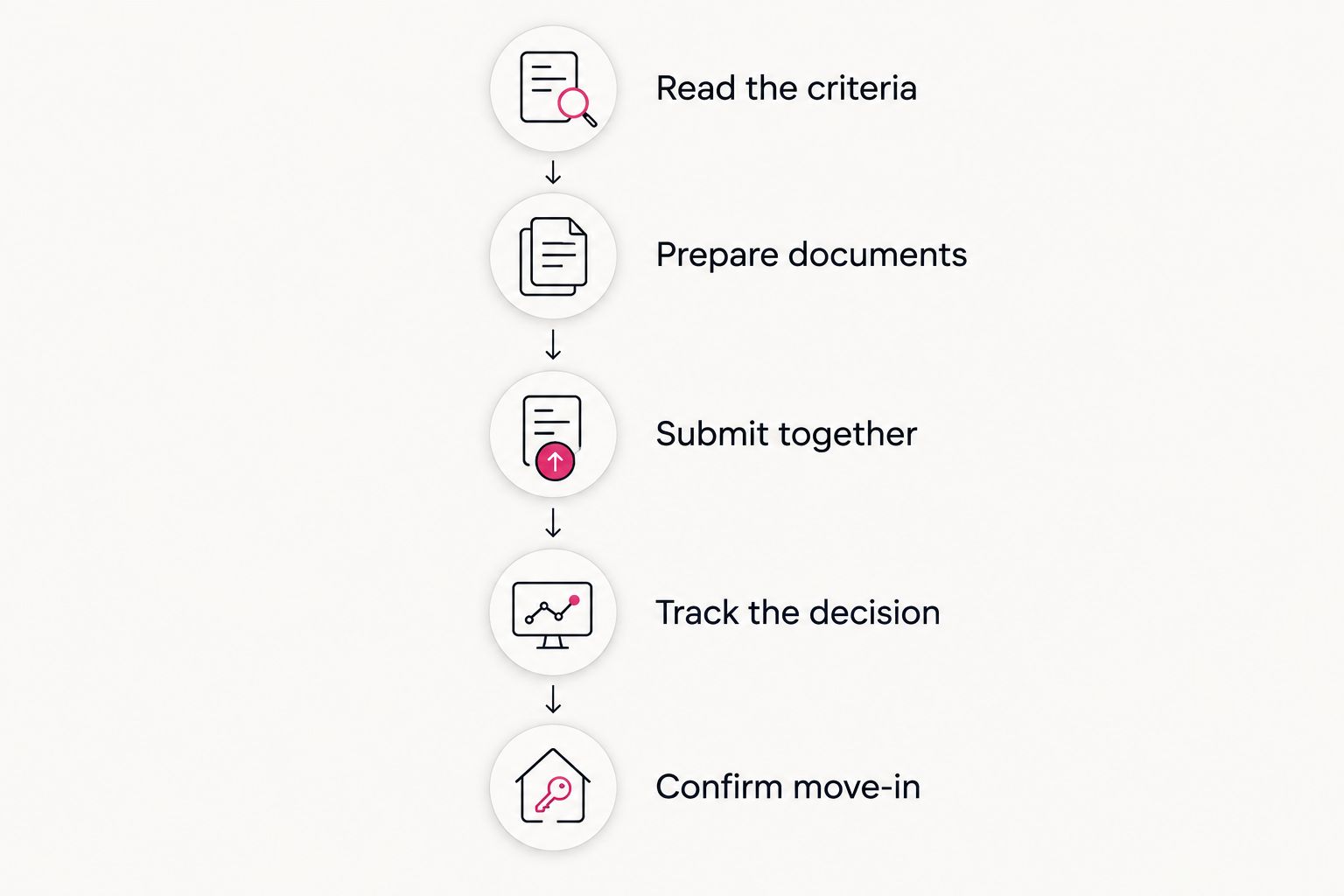
Prepare around the property's actual requirements, not a generic checklist copied from another building. An application for Hyde Park in Austin should follow that landlord's criteria, just as an application in Dallas's Victory Park should follow its own.
Read the criteria
Request the tenant-selection criteria before applying. Texas Property Code §92.3515 addresses making tenant-selection criteria available to applicants, including grounds on which an application may be denied.
Read those criteria against your situation before sending documents. If a requirement is unclear, ask how the landlord evaluates it rather than assuming a leasing conversation changes the written standard.
Prepare documents
Use the exact document types the property requests. Check that names, dates, employer details, and contact information agree across your application and supporting records.
If you are relocating for a new role, ask whether the landlord accepts an offer letter and what information it must contain. The guide to applying for an Austin apartment before your first paycheck addresses that specific planning problem.
Submit together
Coordinate with everyone applying for the household. Ask the property whether each person must submit a separate application and whether a guarantor has additional requirements.
Before declaring the application complete, check for unsigned authorizations or unfinished uploads. Keep a record of what each applicant submitted without sharing sensitive documents through an unverified channel.
Track the decision
Save the application's submission confirmation and the office's responses. Record who is handling your file and how the property will communicate acceptance or rejection.
If the office requests more information, respond through the verified process and keep the acknowledgment. Do not assume that uploading a document proves someone reviewed it.
Confirm move-in
After acceptance, review the lease and obtain written instructions for the remaining move-in requirements. Confirm the agreed possession date separately.
For your 2026 move, keep application acceptance, lease execution, and key handover as separate entries on your checklist. That separation prevents an early milestone from being mistaken for a finished move.
What should you ask when your application is pending?
Ask questions that produce an actionable answer. A general request for an update often leaves you with the same pending label and no explanation.
Send a short message that includes your name, the apartment you applied for, and the application submission date. Then ask:
- Is my application complete under your requirements?
- What specific information or review remains outstanding?
- Who needs to take the next action?
- Has an acceptance or rejection notice already been sent?
- Which communication channel should I check for the decision?
If someone says the file is approved, ask for the written acceptance and the lease instructions. If someone says it is incomplete, ask for the exact missing item rather than resubmitting your entire file without direction.
A pending application is a status to investigate, not a decision to interpret optimistically. Keep your housing plans flexible until the documents support a firm commitment.
Is same-day approval something you can count on?
No. Do not build your move around same-day approval unless the property has actually communicated acceptance and confirmed the remaining steps. An estimated turnaround is not the decision itself.
Ask whether the office's estimate refers to an initial screening result, management review, or final acceptance. Those descriptions should not be treated as interchangeable.
Even after acceptance, check the lease and handover arrangements. Avoid making an irreversible moving commitment based only on a fast screening result.
Can you apply before your new Texas job starts?
Ask the landlord which income documents it accepts before applying. A future job start date raises a documentation question; it does not establish automatic acceptance or rejection.
For a 2026 move to Austin, Dallas–Fort Worth, or Houston, explain your employment transition accurately. Ask whether the property requires an offer letter, employer verification, or other supporting documentation, and supply only what it requests.
Do not assume an offer letter replaces every other requirement. Get the property's answer before treating the application as ready to submit.
Where does an apartment locator help?
Taco Street Locating is best for renters who want personalized apartment research in Austin, Dallas–Fort Worth, or Houston. Its apartment locating service helps you find and compare apartments; the landlord controls screening and acceptance.
Use personalized research and local neighborhood knowledge to narrow your search before applying. Explain your commute, move date, household needs, and any documentation questions early so those issues become part of the comparison.
The limitation is straightforward: research support does not replace the property's tenant-selection criteria. Taco Street Locating cannot turn an application estimate into a guaranteed approval date, so keep decision questions directed to the landlord.
FAQ
How long does apartment application approval take in Texas in 2026?
Texas has a 7-day statutory acceptance-notice rule, not a universal average approval time. Under Texas Property Code §92.352, an applicant is considered rejected if acceptance notice does not arrive within the statutory period; confirm the applicable trigger and counting provisions.
Does a pending apartment application mean I am approved?
No, a pending apartment application is not an approval. Ask the landlord whether the application is complete, what remains outstanding, and whether a decision notice has been sent.
Does Texas require an apartment to approve me within seven days?
No, the 7-day rule does not require a landlord to approve your application. Texas Property Code §92.352 addresses when an application is considered rejected if the landlord does not give notice of acceptance.
What should I do if the leasing office says my application is incomplete?
Ask the leasing office to identify every missing item and the verified channel for submitting it. Save your submission confirmation and ask the office to acknowledge receipt.
Can I schedule movers as soon as my application is accepted?
Confirm your executed lease, possession date, and remaining move-in requirements before making a firm moving commitment. Application acceptance alone does not establish that every handover requirement is complete.
Can Taco Street Locating guarantee apartment application approval?
No, the landlord controls application approval. Taco Street Locating provides a free apartment locating service that helps renters find and compare apartments in Austin, Dallas–Fort Worth, and Houston.
One last thing
Save the tenant-selection criteria before you apply, not just the listing. A listing helps you judge the apartment; the criteria help you understand how the landlord evaluates your application.
For your 2026 search, keep the criteria, completed application, correspondence, decision notice, and executed lease together. If the timeline becomes disputed, a clear record is more useful than a recollection of what someone said during a tour.
Related guides
- From a credit check to an approved apartment application
- Austin apartment arrival readiness checklist
- How long does it take to find an apartment in Austin?