Inside this guide
- Uptown vs Downtown Dallas: building fees compared (checked Oct 7, 2026)
- Uptown vs Downtown Dallas apartments: quick answers
- Neighborhood Feel & Daily Life
- Apartment Types & Building Age
- Rent Pricing & Space
- Walkability & Daily Convenience
- Foot Traffic & Evening Activity
- Commute & Transportation
- Pros & Cons
- What Downtown Dallas Offers
- What Uptown Offers
- Final Verdict
- FAQs
- Want help finding your Dallas apartment? It’s free.
- Related Blog Posts
Free Dallas apartment locating from Alexander. 200+ 5-star Google reviews.
Start My Free Dallas Apartment Search
What happens next: fill out the short form, Alexander personally reviews your answers and sends you options, and it costs you nothing.
Deciding between Uptown and Downtown Dallas? Here’s a quick guide to help you choose:
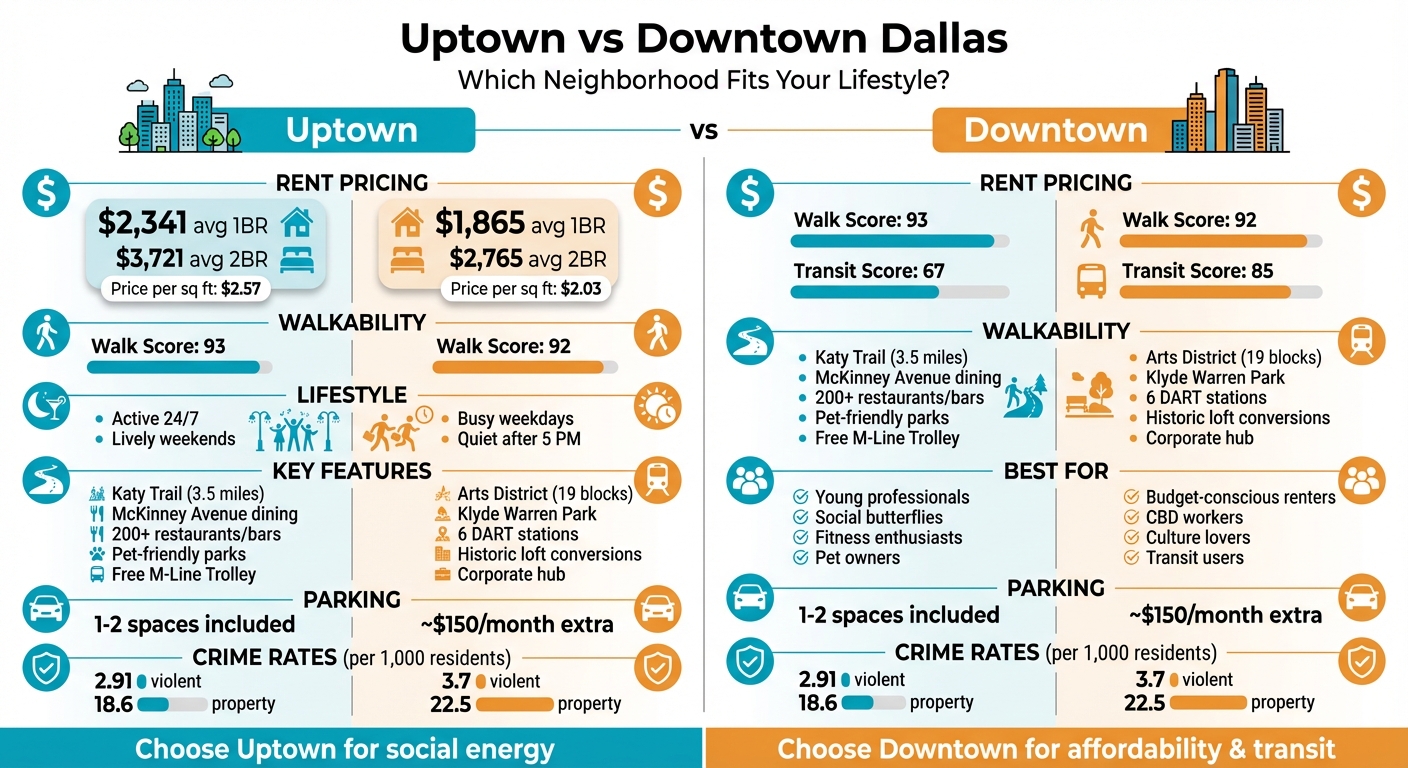
- Uptown Dallas: A lively, walkable neighborhood with upscale apartments, vibrant nightlife, and easy access to the Katy Trail. Expect higher rents ($2,341 average for a 1-bedroom) and a social, energetic atmosphere day and night.
- Downtown Dallas: Close to corporate offices, with lower listed average rents and less street activity after work hours. Offers historic lofts, cultural landmarks, and excellent public transit options.
Quick Comparison:
| Feature | Uptown Dallas | Downtown Dallas |
|---|---|---|
| Avg. 1BR Rent | $2,341 | $1,865 |
| Walk Score | 93 | 92 |
| Energy After Hours | Lively 24/7 | Quiet after 5 PM |
| Key Attractions | Katy Trail, McKinney Avenue | Arts District, Klyde Warren Park |
Choose Uptown for an active, social lifestyle or Downtown for affordability and convenience. Both neighborhoods cater to different preferences – explore them to find your perfect fit.
Uptown vs Downtown Dallas Apartment Living Comparison
Updated by Alexander Concepcion, Taco Street Locating. Checked Oct 7, 2026 against each property’s own website (fees as published on Oct 2, 2026); distances are approximate straight-line miles to Dallas City Hall (1500 Marilla St), calculated from US Census geocodes.
Uptown vs Downtown Dallas: in the four buildings checked, Downtown’s Main 3 Downtown and East Quarter Residences list $75 to $100 application fees and $500 deposits, while Uptown’s Glass House by Windsor and Villas at Katy Trail list $50 to $85 application fees and $250 to $300 admin fees. Downtown buildings sit closer to City Hall.
Uptown vs Downtown Dallas: building fees compared (checked Oct 7, 2026)
| Building | Area | Approx. straight-line distance to City Hall | Application / admin fee | Deposit |
|---|---|---|---|---|
| Main 3 Downtown | Downtown | About 0.4 mi | $75 per applicant / $200 | $500 security (holding) deposit; more based on credit |
| East Quarter Residences | Downtown | About 0.4 mi | $100 per person / $150 | $500 security deposit |
| Glass House by Windsor | Uptown | About 1.4 mi | $50 per applicant / $300 | $300 application deposit, applied to first month’s rent |
| Villas at Katy Trail | Uptown | About 1.7 mi | $85 per person / $250 | $150 to $350 |
Fees are what each property’s site published on Oct 2, 2026 and change often; confirm them with the leasing office. For more buildings, see the Downtown Dallas apartments guide and the Uptown Dallas apartments guide.
Start My Free Dallas Apartment Search
Free for renters. I’m personally involved in every search. What happens next: fill out the short form, I review your answers and send you options, and it costs you nothing.
Uptown vs Downtown Dallas apartments: quick answers
Which has lower application fees, Uptown or Downtown Dallas?
In the four buildings checked, Uptown’s Glass House by Windsor had the lowest at $50 per applicant; Downtown’s were $75 and $100.
What deposits do Downtown Dallas buildings list?
Main 3 Downtown and East Quarter Residences each list a $500 deposit; Main 3 notes more may apply based on credit.
What admin fees do Uptown buildings list?
Glass House by Windsor lists $300 and Villas at Katy Trail lists $250.
Which area is closer to Dallas City Hall?
The two Downtown buildings checked are closer, each about 0.4 straight-line miles from 1500 Marilla St.
Where can I compare more buildings?
The Downtown Dallas apartments guide and the Uptown Dallas apartments guide list more buildings with prices.
Can you help me choose between Uptown and Downtown for free?
Yes. Fill out the free Dallas search form and I will send current options in both areas with pricing from each property.
Neighborhood Feel & Daily Life
Uptown and Downtown Dallas each have their own unique rhythm, and understanding these patterns can help you decide which area suits your lifestyle best.
Uptown is the quintessential "live-work-play" neighborhood, where residents enjoy a seamless blend of dining, fitness, and social activities all week long. McKinney Avenue acts as the heartbeat of the area, lined with patio bars, brunch spots, and access to the popular Katy Trail. Whether it’s a weekday or weekend, Uptown buzzes with activity, offering a dynamic and vibrant atmosphere.
"A stroll down McKinney Avenue reveals vibrant evening chatter and music." – Doug Bryson
Downtown, on the other hand, follows the rhythm of the business day. During work hours, the streets are bustling with professionals, creating a lively scene filled with foot traffic and busy lunch spots. But once the workday ends, Downtown takes on a quieter tone as the office crowd heads home. Weekends are even more subdued, with activity centered around landmarks like the 19-block Arts District and Klyde Warren Park rather than spread throughout the neighborhood.
Weekday vs Weekend Energy
The shift in energy between weekdays and weekends highlights the contrasting personalities of Uptown and Downtown. Uptown comes alive on weekends with brunch gatherings, joggers on the Katy Trail, and dog owners enjoying Griggs Park. The social vibe carries into the evenings with rooftop bars and late-night spots drawing crowds.
Downtown, by contrast, slows down significantly on weekends, trading the weekday hustle for a focus on cultural and family-friendly activities. Residents and visitors alike head to museums, theaters, or Klyde Warren Park for a more relaxed pace. The towering residential high-rises take on a calm, almost serene quality once the workweek wraps up.
Ultimately, these differences shape the day-to-day experience in each neighborhood. Uptown thrives on constant energy and spontaneous social opportunities, while Downtown offers a quieter retreat with a focus on cultural and intentional activities. It’s not a matter of which is better – it’s about which lifestyle fits you best.
sbb-itb-b58f532
Apartment Types & Building Age
Every neighborhood tells its story through its architecture, and the buildings in Uptown and Downtown are no exception. Uptown saw a surge of development in the late 1980s and 1990s, giving rise to sleek, modern mid- and high-rises packed with luxury features and smart technology. Properties like The Christopher and The Katy showcase this trend, offering contemporary spaces with quartz countertops and resort-style perks. On the flip side, State-Thomas stands out by combining Victorian-era charm with tasteful modern updates.
Downtown, however, paints a more eclectic picture. Its architecture spans from early-20th-century loft conversions to cutting-edge glass skyscrapers. Historic gems like The Merc boast exposed brick, original columns, and oversized windows, radiating industrial charm. Meanwhile, ultra-modern buildings like AMLI Fountain Place – a 45-story glass tower – offer high-end touches like concierge services and breathtaking skyline views. Then there’s The Statler Residences, which transforms a 1956 landmark into luxury apartments complete with on-site dining and event spaces.
This architectural variety shapes distinct living experiences. Uptown apartments often focus on standardized luxury, featuring consistent amenities such as Peloton-equipped gyms, coworking lounges, valet parking, smart thermostats, and package lockers. It’s a seamless, turnkey lifestyle. Downtown, on the other hand, leans into its historic roots, with warehouse conversions offering unique layouts and vintage details. However, these spaces may lack some of the modern smart home features found in newer builds. This mix of old and new creates a diverse living landscape, setting the stage for how building styles affect daily life.
| Building Category | Uptown Examples | Downtown Examples | Key Characteristics |
|---|---|---|---|
| Historic Conversions | M-Line Tower | The Statler, The Merc | Exposed brick, high ceilings, unique layouts |
| Modern High-Rises | The Christopher, The Taylor | AMLI Fountain Place | Floor-to-ceiling windows, concierge, smart tech |
| Mid-Rise/Boutique | AMLI Quadrangle, Riviera at West Village | Mixed-use lofts | Walkable access, neighborhood feel, social courtyards |
Conversions vs New Builds
Choosing between a converted building and a new construction can dramatically shape your living experience. Downtown’s warehouse conversions cater to those who crave character and individuality, with some lofts offering sprawling spaces – up to 4,000 square feet – highlighted by original architectural elements. These buildings often blend retail, office, and residential spaces, creating vibrant, street-level energy. However, they might lack some conveniences like built-in smart tech.
Uptown, by contrast, prioritizes modern functionality and social amenities in its purpose-built developments. While these buildings may feature more uniform floor plans, they deliver the dependable perks many renters seek, from high-end gyms to coworking spaces. Whether you’re drawn to the charm of history or the predictability of modern design, both neighborhoods offer something to fit your lifestyle.
Rent Pricing & Space
When it comes to rent, Uptown commands a higher price tag than Downtown. As of January 2026, the median rent in Uptown across all property types stands at $3,003, compared to Downtown’s $2,265 – a difference of about 33%. On a per-square-foot basis, Uptown averages $2.57, while Downtown comes in at $2.03. For specific unit types, Uptown’s 1-bedroom apartments average $2,401, and 2-bedroom units sit at $3,721. In contrast, Downtown offers more affordable luxury apartment options, with 1-bedrooms averaging $1,811 and 2-bedrooms at $2,765. Year-over-year, Uptown rents rose by 4%, while Downtown experienced a sharper 6% increase. Even with this uptick, Downtown remains the more budget-friendly choice overall.
Rent Averages and Square Footage
| Apartment Type | Uptown Avg Rent | Downtown Avg Rent | Uptown Avg Sq Ft |
|---|---|---|---|
| Studio | $2,006 | $1,785 | 612 sq ft |
| 1-Bedroom | $2,401 | $1,811 | 829 sq ft |
| 2-Bedroom | $3,721 | $2,765 | 1,312 sq ft |
| 3-Bedroom | $7,350 | $4,585 | 1,914 sq ft |
This table highlights the contrast between the two neighborhoods. Downtown provides more space for less money, while Uptown caters to those seeking standardized luxury at a premium. About 50% of Uptown rentals are priced above $3,000, compared to 32% in Downtown. Downtown offers better value for the price. If you are new to the city, check out our guide for first-time Dallas renters to help navigate the market.
Walkability & Daily Convenience
Uptown takes the crown for walkability in Dallas, boasting a Walk Score of 96 – beating Downtown’s 92. This difference is more than just a number; it’s a reflection of how life feels in these neighborhoods. Uptown was designed with pedestrians in mind, featuring well-lit streets and over 200 restaurants and bars within walking distance. While Downtown also offers great walkability, it tends to quiet down after business hours, making it less lively for evening strolls or late-night outings. Adding to the ease of getting around, the free M-Line Trolley conveniently connects both neighborhoods.
For outdoor enthusiasts, the Katy Trail is a standout feature in Uptown. This 3.5-mile stretch of repurposed railroad is more than just a trail – it’s a community hub where runners, cyclists, and dog walkers gather. Downtown, on the other hand, provides access to Klyde Warren Park, a 5.2-acre deck park built over a freeway. The park hosts everything from yoga sessions to food trucks and live concerts, offering a unique urban escape. When it comes to public transit, Downtown edges ahead with a Transit Score of 85 compared to Uptown’s 67, thanks to better access to the DART light rail for commuting across the city.
Grocery Access, Gyms, and Cafes
The walkable nature of Uptown and Downtown also plays a big role in access to everyday essentials and social spots. Uptown shines in this department. With a Whole Foods Market at Gables McKinney Avenue, a Walmart Neighborhood Market, and specialty shops like Foxtrot Market, residents have plenty of grocery options within arm’s reach. In contrast, Downtown residents often rely on the Dallas Farmers Market for fresh produce and local goods. While the Farmers Market offers a unique shopping experience, it requires more planning compared to a traditional grocery store. As Andi from Dwellinc puts it:
"With far more shopping, dining and day-to-day essentials (think groceries, pharmacies, etc.), many Dallasites would choose Uptown over actual Downtown Dallas".
When it comes to fitness, Uptown offers multiple access points to the Katy Trail and an array of boutique studios scattered throughout the area. Downtown’s fitness options are more centralized, often revolving around high-rise building gyms and events like yoga at Klyde Warren Park.
The cafe culture also sets the neighborhoods apart. Uptown’s McKinney Avenue and West Village are buzzing with patio cafes, brunch spots like Bisous Bisous Patisserie, and health-conscious chains like Sweetgreen and Mendocino Farms. Meanwhile, Downtown’s dining scene is concentrated in areas like the AT&T Discovery District and Arts District. While these spots offer great options, many close earlier than Uptown’s lively social venues.
With its dense residential layout and easy access to essentials like groceries, gyms, and cafes, Uptown stands out as the more convenient choice for those looking to live car-free.
Foot Traffic & Evening Activity
Uptown’s McKinney Avenue has a steady flow of pedestrians and a dense mix of restaurants, bars and patios, so weekend evenings bring music and street activity. Downtown is busiest on weekdays during office hours, with traffic and construction during the day and less street activity after offices close. Many Downtown high-rises list badge-access garages and concierge desks. Visit both areas at the times you would usually be home, and ask each building about unit orientation and street sound.
Commute & Transportation
Parking Costs and Public Transit
Downtown Dallas serves as the central hub for DART, featuring six light rail stations and Union Station, which connects to the Trinity Railway Express. Uptown, on the other hand, offers the free McKinney Avenue M-Line Trolley and convenient access to DART rail at West Village and Victory Station.
When it comes to parking, the two neighborhoods differ significantly. Uptown apartments typically include one or two parking spaces, while Downtown residents often pay around $150 per month for parking. For those parking daily, Uptown garages charge between $20 and $40, with monthly rates ranging from $120 to $300. These distinctions reflect how each area addresses transportation needs in its own way.
Uptown also boasts the 4.4-mile Katy Trail, a favorite spot for cycling and jogging that connects various parts of the city.
"The trolley is an easy and free way to travel within Uptown and to Downtown as well".
| Feature | Uptown Dallas | Downtown Dallas |
|---|---|---|
| Parking Included | 1–2 spaces included | Often available for a separate fee (≈$150/month) |
| Public Transit | Free M-Line Trolley; access to DART Rail | 6 DART stations, TRE, Dallas Streetcar |
| Walk Score | 93 (Walker’s Paradise) | 95 (Highly Walkable) |
| Bike Score | 79 (Very Bikeable) | Moderate, with dedicated bike lanes |
| Car-Free Viability | Good, with trolley and trail options | Excellent, as a transit hub |
In addition to structured transit and parking, ridesharing services are widely available in both neighborhoods. Downtown’s driver density ensures quick access to rideshares, while Uptown’s McKinney Avenue corridor offers similar convenience during busy times.
These transportation options provide a glimpse into how each neighborhood supports different lifestyles and commuting preferences.
Pros & Cons
Each neighborhood in Dallas comes with its own set of perks and challenges. Uptown stands out for its incredible walkability, boasting a WalkScore of 93, as well as direct access to trails like the Katy Trail. (Properties like The Park at Katy Trail offer prime access to these paths.) The area stays lively around the clock along McKinney Avenue and the Katy Trail. However, this vibrant energy comes at a premium – average one-bedroom rents hit $2,341, and the constant buzz can feel overwhelming at times.
Downtown, on the other hand, offers more budget-friendly options, with one-bedroom units averaging $1,865. It’s also home to historic lofts like Taylor Lofts that exude charm and character. Its proximity to the Arts District and six DART stations makes it a hub for connectivity. That said, Downtown tends to quiet down after 5:00 PM, and its limited green spaces, like Klyde Warren Park, may leave residents venturing elsewhere for recreational needs or full-service grocery shopping.
Here’s a side-by-side comparison to highlight the key differences:
Comparison Table: Uptown vs Downtown
| Feature | Uptown Dallas | Downtown Dallas |
|---|---|---|
| Primary Strength | Thriving social scene, walkability, and green spaces | Affordability, transit access, and historic charm |
| Primary Weakness | Higher rent; busy and noisy atmosphere | Quiet after hours; limited grocery options |
| Avg. 1BR Rent | $2,341 | $1,865 |
| Avg. 1BR Space | 829 sq ft | 476 sq ft |
| Green Space | Katy Trail, Turtle Creek, and Griggs Park | Klyde Warren Park and Pioneer Plaza |
| After-Hours Vibe | Active 24/7 | Quieter after business hours |
| Parking | Often included with rentals | Frequently requires additional fees |
Ultimately, the decision between Uptown and Downtown comes down to your priorities. If you value a vibrant lifestyle with more space and amenities, Uptown might be the better fit. But if your focus is on affordability and easy access to public transit, Downtown could be the way to go. Each neighborhood offers a distinct living experience tailored to different preferences.
What Downtown Dallas Offers
Downtown sits next to the Central Business District and the Dallas Arts District, home to the Dallas Museum of Art, the Winspear Opera House and the AT&T Discovery District. Converted loft buildings such as The Statler Residences and The Merc often feature exposed brick and original columns. Six DART stations and TRE connections serve the area.
What Uptown Offers
Uptown’s main corridor is McKinney Avenue, lined with brunch spots, rooftop bars and patio cafes, plus West Village boutiques near Ardan West Village. Griggs Park and the 3.5-mile Katy Trail run through the area, and many errands can be done on foot. Some buildings, like The Katy Victory Park, list fitness amenities such as Peloton-equipped gyms. Rents for one- and two-bedroom apartments vary by building, so confirm current pricing with each property.
Final Verdict
If daily convenience and comfort top your list, Uptown might be your ideal spot. With a stellar Walk Score of 93/100 and plenty of amenities to simplify your routine, it’s a neighborhood that thrives day and night. On the flip side, Downtown offers a blend of historic charm and affordability. However, the lack of a full-service grocery store in the heart of Downtown and its quieter evenings might not suit everyone.
Ultimately, the choice depends on your lifestyle. If your work is centered in the Central Business District and you’re drawn to historic architecture and a vibrant creative community, Downtown – with its loft conversions and proximity to the Arts District – could be a great match. But if you’re looking for a lively neighborhood that’s buzzing every day of the week, complete with pet-friendly parks, walkable brunch spots, and a packed social calendar, Uptown has you covered.
To make this decision easier, Taco Street Locating is here to assist. Their free apartment locating services across Dallas include personalized consultations, detailed research spreadsheets, tours, and application support – all tailored to match your lifestyle with the perfect apartment.
Whether you’re energized by Uptown’s lively scene or charmed by Downtown’s historic grit, the key is finding a space that aligns with how you live. Spend time exploring both neighborhoods during different parts of the day, trust your instincts, and choose the place that truly feels like home.
FAQs
What’s the difference between living in Uptown Dallas and Downtown Dallas?
Uptown Dallas is a vibrant choice for anyone looking for a lively, walkable neighborhood with a touch of luxury. This area is packed with trendy restaurants, buzzing bars, boutique shops, and fitness studios – all just steps away. Housing here leans toward modern high-rises and sleek mid-rises, offering upscale perks like rooftop pools and coworking spaces. The atmosphere is energetic and social, especially on weekends. However, this comes with a cost: higher rents (around $2,300 for a one-bedroom) and a bit more noise, thanks to the bustling nightlife.
Downtown Dallas offers a different vibe, blending a business-focused environment with a dash of historic charm. It’s home to cultural landmarks like museums and Klyde Warren Park. Housing options often include older high-rises or converted lofts, with rents averaging slightly lower at $2,200 for a one-bedroom. The area is walkable, has solid public transit, and is much quieter at night.
To sum it up, Uptown delivers high-energy, luxury living, while Downtown provides a calmer, culturally rich atmosphere with slightly more affordable housing.
How do rents and apartment sizes compare between Uptown and Downtown Dallas?
Rent prices in Uptown Dallas rank among the highest in the city. A 1-bedroom apartment averages $2,318 per month, while 2-bedroom units cost around $3,711 per month. On the other hand, Downtown Dallas tends to be easier on the wallet, with rents generally lower than Uptown’s premium rates, though specific averages for Downtown aren’t available. For context, the average rent across Dallas sits at $1,488 per month.
As for apartment sizes, Uptown’s sleek high-rises and mid-rises typically feature modern, space-efficient designs, closely matching the Dallas average of 848 sq ft. Meanwhile, Downtown properties, often located in older, repurposed buildings, might offer slightly larger layouts. However, precise square footage details for Downtown units are not provided.
In summary, Uptown delivers stylish, modern living at a higher cost, while Downtown offers more budget-friendly options, occasionally with more room to stretch out.
Which neighborhood is better for public transportation and walkability: Uptown or Downtown Dallas?
Boasting an impressive Walk Score of 96, it’s easy to handle most daily errands on foot. Beyond that, the area offers a variety of transportation options, including the DART light rail, the free McKinney Avenue Trolley, multiple bus routes, and an extensive network of bike lanes. It’s an ideal spot for anyone aiming to embrace a car-free lifestyle.
In comparison, Downtown Dallas does provide some public transportation and walkable areas. However, Uptown’s well-thought-out infrastructure and pedestrian-friendly layout give it a clear edge for renters who prioritize ease of movement and accessibility.
Want help finding your Dallas apartment? It’s free.
Taco Street Locating is a free apartment locating service in Dallas. We’ve helped hundreds of renters find a home, and we have 200+ 5-star Google reviews. I’m personally involved in every apartment search: I’ll learn what you need, build your shortlist, and tour with you. Prefer to talk it through? I’m available for phone calls and in-person meet ups. I’m Alexander Concepcion, and I’ll be your point of contact. Free for renters. Apartment communities pay us, so it doesn’t change your lease or your specials. You can also search with AI and hand the shortlist to Alexander.
Start My Free Dallas Apartment Search Call or meet up with Alexander
What happens next: fill out the short form, Alexander personally reviews your answers and sends you options, and it costs you nothing.