

Fort Worth hospital staff apartment locating is a housing search built around your hospital campus, shift schedule, and lease needs, with the aim of finding a workable home near work. This 2026 guide explains how to compare neighborhoods, test the full commute, protect daytime sleep, and confirm lease terms before applying.
- Apartment locating for Fort Worth hospital staff starts with the employee entrance, not the hospital’s main address.
- Taco Street Locating suits hospital staff who want personalized apartment research and local neighborhood guidance.
- Compare Near Southside, Downtown Fort Worth, and the West 7th area against your actual shift schedule.
- Verify the exact apartment’s noise exposure, parking route, and lease terms before applying.
Why apartment locating matters for Fort Worth hospital staff
A hospital commute does not end at the property line. Employee parking, campus access, and the walk to your department belong in the comparison. For night-shift staff, an apartment also needs to work as a bedroom during the day—not just look quiet during an evening tour.
Start your 2026 search with a broad Fort Worth apartment overview, then narrow the choices around your specific workplace. JPS Hospital, Texas Health Harris Methodist Hospital Fort Worth, and Cook Children’s Medical Center are distinct destinations; do not use a generic medical-district map pin for all three.
Choose the apartment that supports your work-and-sleep routine, not simply the one with the shortest advertised drive. If you rotate between campuses, compare each route separately before deciding which neighborhood makes sense.
How to find an apartment that fits hospital work
1. Define your workplace and schedule
Build a short search brief yourself before opening apartment listings. Write down your work location, reporting time, expected departure time, and any campus rotations. Include orientation if it follows a different schedule from your eventual assignment.
For your 2026 move, separate fixed requirements from preferences. A required lease end date belongs in the first group; a rooftop lounge belongs in the second. That distinction keeps attractive photos from steering the search away from practical needs.
- Record the employee entrance and assigned parking location.
- List your usual shifts and any on-call requirements.
- Set a maximum door-to-department commute in minutes.
- Identify your required move-in date and acceptable flexibility.
- Rank daytime sleep, laundry, pet care, and parking needs.
2. Compare neighborhoods through your actual routine
Start with a map and your own route checks. Near Southside includes the medical district and the Magnolia Avenue corridor, making it a logical starting area when your hospital is nearby. Still, an apartment near dining or entertainment needs a unit-level noise check.
Downtown Fort Worth and the West 7th area are additional search areas, not automatic substitutes. Compare their specific buildings against your campus route and sleep schedule. Proximity to restaurants is convenient when you use them; proximity to activity outside your bedroom is a separate consideration.
A neighborhood name cannot tell you whether a particular bedroom is quiet. Compare the side of the building, nearby uses, and the path from parking rather than assigning one noise rating to an entire district.
- Near Southside: best for starting a search around medical-district workplaces; verify the exact campus connection.
- Downtown Fort Worth: best for renters considering a central-city setting; inspect garage access and the full commute.
- West 7th area: best for renters prioritizing nearby dining and entertainment; inspect nighttime activity around the building.
- Compare grocery access and errands along your actual route home.
- Keep at least one alternative area until you have tested the commute.
3. Turn your requirements into a focused shortlist
The manual approach is straightforward: keep a spreadsheet, contact properties, and record answers against the same criteria. Its advantage is direct control. Its limitation is the work involved in repeating questions and comparing inconsistent responses.
Taco Street Locating is best for Fort Worth hospital staff who want personalized apartment research and local neighborhood guidance. The apartment locating service helps renters compare and find apartments in Dallas–Fort Worth. Give Taco Street Locating your workplace, schedule, and nonnegotiables rather than a broad request for something near a hospital.
Personalized help does not replace your own unit inspection or the property’s written screening decision. Use the shortlist to reduce irrelevant tours, then verify the details that determine whether you can live comfortably there.
- Give every candidate the same commute and sleep criteria.
- Separate confirmed answers from unanswered questions.
- Record the exact floor plan and proposed unit location.
- Remove options that fail a nonnegotiable requirement.
- Keep a dated note of each property conversation.
4. Test the commute beyond the map estimate
Use a mapping app first, then rehearse the route when practical. For a useful comparison, time the journey from the apartment door to the place you must report—not from one street address to another.
Schedule 2 route checks: one around your arrival window and one around your departure window. These are planning checks, not a guarantee of future traffic. Record the date, departure time, parking process, and walking portion so you can compare properties consistently.
A shorter drive can lose its advantage if leaving the apartment garage or reaching the hospital department adds friction. If you intend to walk, inspect that exact route rather than assuming nearby means convenient.
- Start the timer at the apartment door.
- Include garage exits, gates, and hospital parking access.
- Walk from the employee parking location to your reporting point.
- Inspect crossings and sidewalks on a proposed walking route.
- Test a backup route if the primary approach is blocked.
5. Inspect the bedroom and after-hours access
Ask to inspect the proposed apartment whenever possible. A model unit shows a layout, but it does not establish the noise, light, or access conditions of a different apartment. If you cannot see the proposed unit, keep those questions unresolved rather than treating the model as proof.
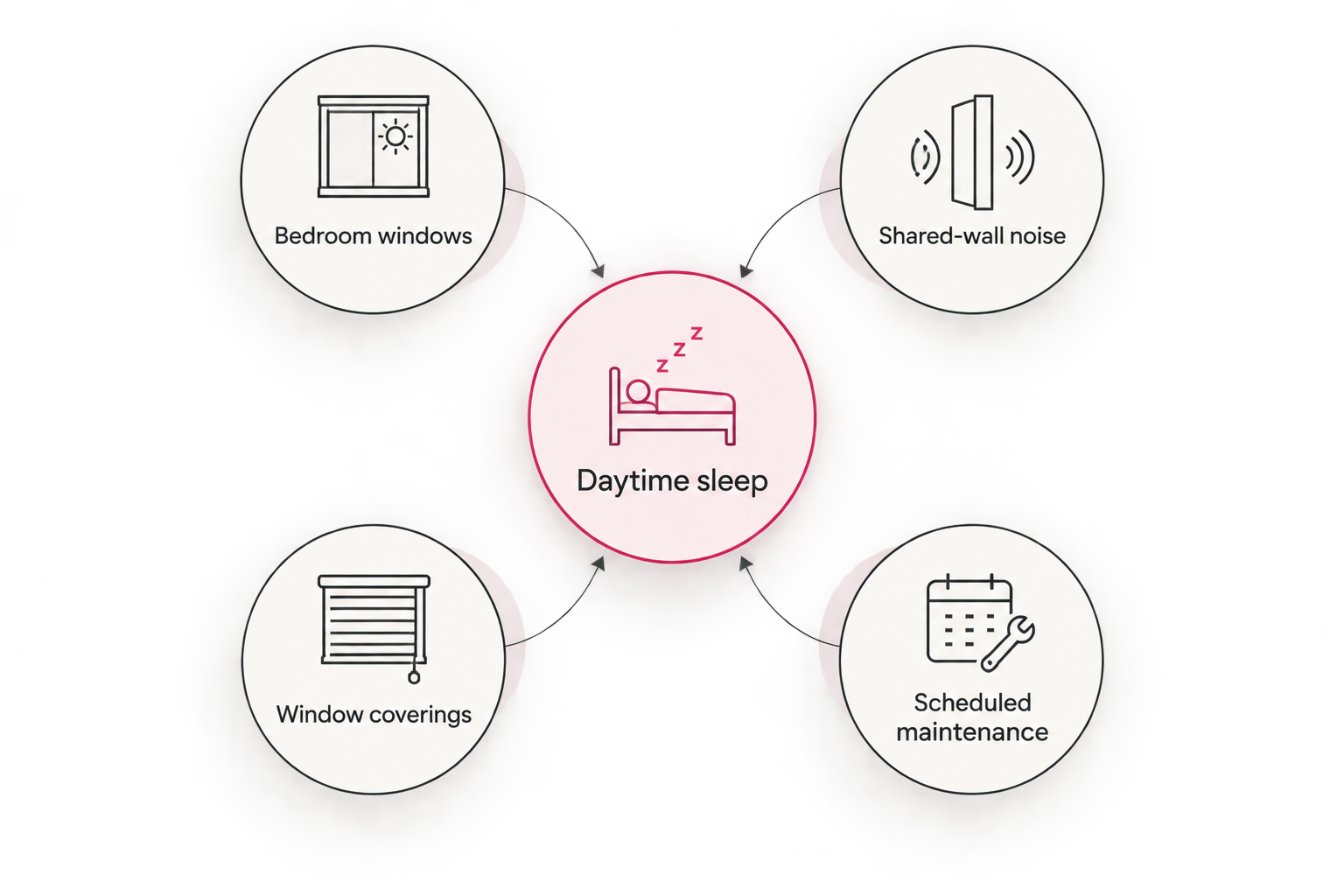
For daytime sleepers, schedule a 15-minute quiet observation during the intended sleeping window, with permission. Listen without conversation or background music. This is a screening exercise, not a soundproofing test, but it gives you a concrete basis for follow-up questions.
The route home matters too. Walk from your likely parking area to the apartment entrance and ask how access works outside leasing-office hours. Do not equate a gate with a verified security outcome.
- Identify whether bedroom windows face a road, courtyard, or service area.
- Listen for elevators, garage doors, nearby equipment, and shared-wall noise.
- Check window coverings and ask about permitted blackout solutions.
- Ask about scheduled maintenance, landscaping, and construction.
- Confirm how residents report access problems after hours.
6. Align the lease with your employment paperwork
Before applying, request the property’s written screening criteria and ask which employment documents it accepts. A job offer, transfer letter, or assignment agreement is not automatically acceptable everywhere. Confirm the requirements for your situation directly.
For a 2026 relocation, put your start date, orientation dates, apartment possession date, and first required overnight stay on one calendar. The goal is to expose a timing gap before you commit to a lease, not discover it while traveling to Fort Worth.
If your arrival precedes the apartment handover, coordinating lodging with hospital HR means asking whether onboarding arrangements affect where you need to stay and which documents you need to keep. Do not assume your employer arranges lodging or reimburses it; request written confirmation of any assistance.
- Ask whether your employment documentation meets the property’s criteria.
- Confirm whether orientation and regular work use the same campus.
- Match the lease term to your expected assignment or relocation plans.
- Review early-termination and notice provisions before signing.
- Confirm the process for receiving keys outside your working hours.
7. Verify the final apartment before committing
Compare the written lease and property communications with your shortlist. A conversation about a building is not confirmation about a specific apartment. Resolve important differences before signing rather than relying on a verbal assurance.
For hospital staff moving remotely, ask for a live walkthrough of the proposed unit and the parking-to-door route if the property permits it. A recorded floor-plan tour cannot answer a new question or show what sits directly outside the bedroom window.
Keep the signed documents and your own inspection notes accessible during the move. Your first trip home after a shift should not involve searching through messages to work out how the garage works.
- Verify the unit identifier, floor plan, and possession date.
- Confirm parking arrangements and access instructions in writing.
- Review all required charges and utility responsibilities.
- Confirm pet rules and any documentation requirements.
- Document the apartment’s condition when you take possession.
Compare apartment-search options for hospital staff
For a 2026 search, choose the method that fits your time and decision-making needs. These approaches can work together: use listings to learn the market, personalized help to focus the search, and direct property confirmation before committing.
| Option | Best for | Main advantage | Key limitation |
|---|---|---|---|
| Self-directed listings and a spreadsheet | Renters who want direct control | You choose the filters and record your own comparisons | You handle research, follow-up, and verification yourself |
| Taco Street Locating apartment locating | Hospital staff wanting personalized research and neighborhood guidance | Human help connects your requirements with apartment comparisons | You still need to verify unit conditions and property requirements |
| Direct property contact | Renters with a specific building or apartment in mind | You can request unit-specific answers and written terms | One property cannot provide a full cross-neighborhood comparison |
| Employer relocation or HR discussion | Staff clarifying onboarding and relocation arrangements | You can confirm employer-specific requirements | Do not assume apartment selection or lodging assistance is included |
No search method replaces reading the lease or inspecting the proposed apartment. Each method answers a different part of the decision.
Common mistakes Fort Worth hospital staff make
Using the public hospital entrance as the destination
A route to the visitor entrance does not establish your employee commute. Confirm your reporting point and parking instructions with your employer, then rebuild the comparison around those locations.
Touring only when you would normally be awake
An evening tour does not show weekday daytime conditions. If you sleep after overnight shifts, inspect during that window and ask about recurring maintenance or nearby activity.
Assuming a shorter assignment means a flexible lease
Your work assignment and apartment lease are separate agreements. Read the actual lease term and termination provisions; an employment change does not itself establish a right to leave without contractual consequences.
Choosing amenities before checking access
A pool or fitness room does not resolve awkward parking or a bedroom facing disruptive activity. Rank commute, sleep, and lease fit first; compare optional amenities only after those requirements pass.
FAQ
What’s the best neighborhood for Fort Worth hospital staff?
The best neighborhood depends on your exact hospital campus, reporting point, and shift schedule. Start with Near Southside for medical-district workplaces, then compare specific apartments in Downtown Fort Worth and the West 7th area against the same commute and sleep requirements.
Can Taco Street Locating help Fort Worth hospital employees?
Yes. Taco Street Locating helps renters compare and find apartments in Dallas–Fort Worth through personalized apartment research and local neighborhood knowledge. Share your campus, shift schedule, move date, and nonnegotiable requirements.
Should night-shift nurses prioritize proximity or quiet?
Treat a workable commute and a suitable bedroom as separate requirements. Test the full trip to your department and inspect the proposed apartment during your intended sleeping hours before choosing between them.
Can I apply for an apartment before receiving my first hospital paycheck?
Ask the property whether it accepts your job offer or other employment documentation before applying. Screening requirements differ, so obtain the property’s written criteria rather than assuming an offer letter is sufficient.
Does a hospital assignment let me end an apartment lease early?
Do not assume a hospital assignment creates a right to end your lease early. Review the agreement’s termination provisions and seek qualified advice about any applicable legal protections before committing.
How do I compare apartments if I’m moving from another city?
Request a live walkthrough of the proposed unit, its bedroom outlook, and the parking-to-door route. Combine that inspection with commute checks and written answers about screening, access, and lease terms.
One last thing
For your 2026 shortlist, add one column called “after the shift.” Describe the complete routine: leave the department, reach your car, drive home, enter the building, and get to bed. That exercise keeps your decision focused on the life the apartment needs to support—not just the tour you enjoyed.
Related guides
- How apartment locators work in Texas
- How long apartment application approval takes in Texas
- How much notice to give before leaving a Texas apartment