

Houston Med Center staff apartment locating is a focused housing search with the aim of matching your apartment to your hospital entrance, shift schedule, and lease needs. This 2026 guide puts the full trip to work and your ability to sleep ahead of amenities that look good on a tour.
- Apartment locating for Houston Med Center staff starts with your work entrance, shift hours, and parking arrangements.
- Taco Street Locating suits Houston renters seeking personalized apartment research and neighborhood guidance.
- Compare door-to-door travel, daytime bedroom noise, and lease terms before choosing an apartment.
- Use neighborhood names to organize your search, not as proof of a manageable commute.
Why apartment locating matters for Houston Med Center staff
A listing near the Texas Medical Center does not establish how you will reach your department. Your route includes the apartment exit, transportation, employee parking or transit stops, and the walk to the entrance you actually use.
Shift work adds another filter: an attractive bedroom still needs to work when you sleep during daylight. Laundry also deserves attention when your schedule leaves little room for errands; use the guide to apartments with in-unit washer and dryer in Houston as a starting point, then verify the exact unit’s equipment.
Choose the apartment around your working week, not the leasing-office tour. For your 2026 move, keep a written record of what you observe, what management confirms, and what still needs an answer.
How to find an apartment that fits your Med Center schedule
1. Define your work destination and housing requirements
Start with a map and a plain document. Record your building entrance, expected arrival time, transportation arrangements, and the conditions you need at home. A hospital name alone is not a precise destination.
Ask your employer which parking location or entrance applies to your role. If assignments involve different buildings, record each destination rather than optimizing for only the first orientation appointment.
Separate requirements from preferences before browsing. A bedroom that supports daytime sleep belongs in a different category from a rooftop lounge. Your list should let you reject an unsuitable apartment without bargaining with yourself over its finishes.
- Work entrance: Record the entrance and any employee access instructions.
- Shift schedule: Include regular shifts, orientation, and expected schedule changes.
- Housing requirements: List bedroom count, accessibility needs, pets, and household members.
- Lease dates: Match the intended start and end dates to your work plans.
- Deal breakers: Identify conditions that rule out a property immediately.
2. Compare neighborhoods using complete commute routes
Build your first neighborhood comparison manually. Put the Texas Medical Center area, Museum District, and areas near Rice University on the map, then trace the actual trip from each candidate building. These are search areas, not interchangeable commute promises.
Compare driving, transit, and walking only where each is practical for your circumstances. For transit, check current METRO schedules for your actual workdays and departure times. For driving, confirm the employee parking destination instead of routing directly to the hospital’s public entrance.
For a 2026 search, compare 3 routes before committing to a neighborhood. This is a planning exercise, not a claim that every renter needs the same transportation setup. Include your return journey: a route that works before a shift still needs to work afterward.
- Driving route: Include garage access, parking, and the final walk.
- Transit route: Check service times, transfers, and the walk at both ends.
- Walking route: Inspect crossings, sidewalks, lighting, and building access.
- Return route: Test the journey at your likely departure time.
- Backup route: Decide how you would travel if your first choice fails.
3. Build a shortlist around evidence, not listing photos
Create a spreadsheet yourself first. Give each apartment the same fields: exact unit, work route, bedroom conditions, lease dates, laundry, parking arrangements, and unanswered questions. Leave unknown fields blank rather than filling them with assumptions.
For help narrowing the research, Taco Street Locating provides personalized apartment research and local neighborhood knowledge. Taco Street Locating apartment locating is best for Houston renters who want human help researching and comparing apartments. You still need property confirmation of unit details and lease terms.
If you use an AI apartment search, treat its output as a preliminary list. Bring the results and your requirements to a human helper; do not treat a generated summary as confirmation from the property.
Keep a shortlist of 3 apartments once you have enough information to compare them fairly. Fewer unresolved questions matter more than a longer list of attractive buildings.
- Exact unit: Distinguish the proposed apartment from the model.
- Work route: Record the full journey, including parking or transfers.
- Sleep conditions: Note bedroom exposure and nearby activity.
- Lease terms: Track dates and questions requiring written answers.
- Open questions: Assign each unanswered item to the property or employer.
4. Tour for daytime sleep and off-hours access
Schedule a tour when you can evaluate the conditions that matter to your routine. A quiet evening visit does not answer what the bedroom sounds like during daytime maintenance, deliveries, or nearby activity. If you are relocating remotely, request a live walkthrough of the exact unit.
Ask for a 15-minute quiet observation during the tour, with conversation and music paused. That is a suggested inspection period, not a guarantee of quiet. Listen in the bedroom and inspect the window coverings, door fit, and placement of shared spaces.
Check the route from your parking space or building entrance to your apartment. You need to understand access procedures when the leasing office is closed. A controlled-access entrance is a feature to inspect, not proof of personal safety.
- Bedroom exposure: Identify nearby roads, garages, elevators, and shared amenities.
- Daylight control: Check window coverings and ask about permitted additions.
- Interior noise: Listen for corridor, mechanical, and neighboring-unit sounds.
- Off-hours access: Confirm entry procedures and whom to contact for access problems.
- Exact-unit evidence: Save dated notes and request clarification of differences from the model.
5. Check lease terms against your employment timeline
Read the proposed lease and screening criteria yourself before applying. Match the agreement to your work plans, particularly if you are starting a residency, fellowship, contract assignment, or new role with uncertain scheduling.
Ask management what employment documentation it accepts. An offer letter is something to ask about, not an assumed substitute for every screening requirement. Confirm the document requirements before sending sensitive information through the property’s designated process.
Your 2026 lease review should also cover renewal procedures, notice requirements, roommate changes, and early termination provisions. Do not infer flexibility from a short description on a listing. The written agreement determines what you are accepting.
- Employment documents: Request the property’s current screening criteria.
- Lease dates: Check alignment with your expected assignment or training period.
- Notice requirements: Record how and when notices must be delivered.
- Household changes: Ask how occupants, roommates, and pets are handled.
- Termination provisions: Read the actual terms rather than relying on a verbal summary.
6. Test the final choices against the same routine
Compare your finalists with the same worksheet and the same work destination. Do not compare one apartment’s complete commute against another apartment’s map estimate. Uneven evidence makes the decision look clearer than it is.
Use this sequence for every finalist: Work route, Sleep check, Lease review, Move-in check. The order keeps attractive amenities from distracting you from a practical failure. An apartment that fails a requirement should leave the shortlist, even if its other features are appealing.
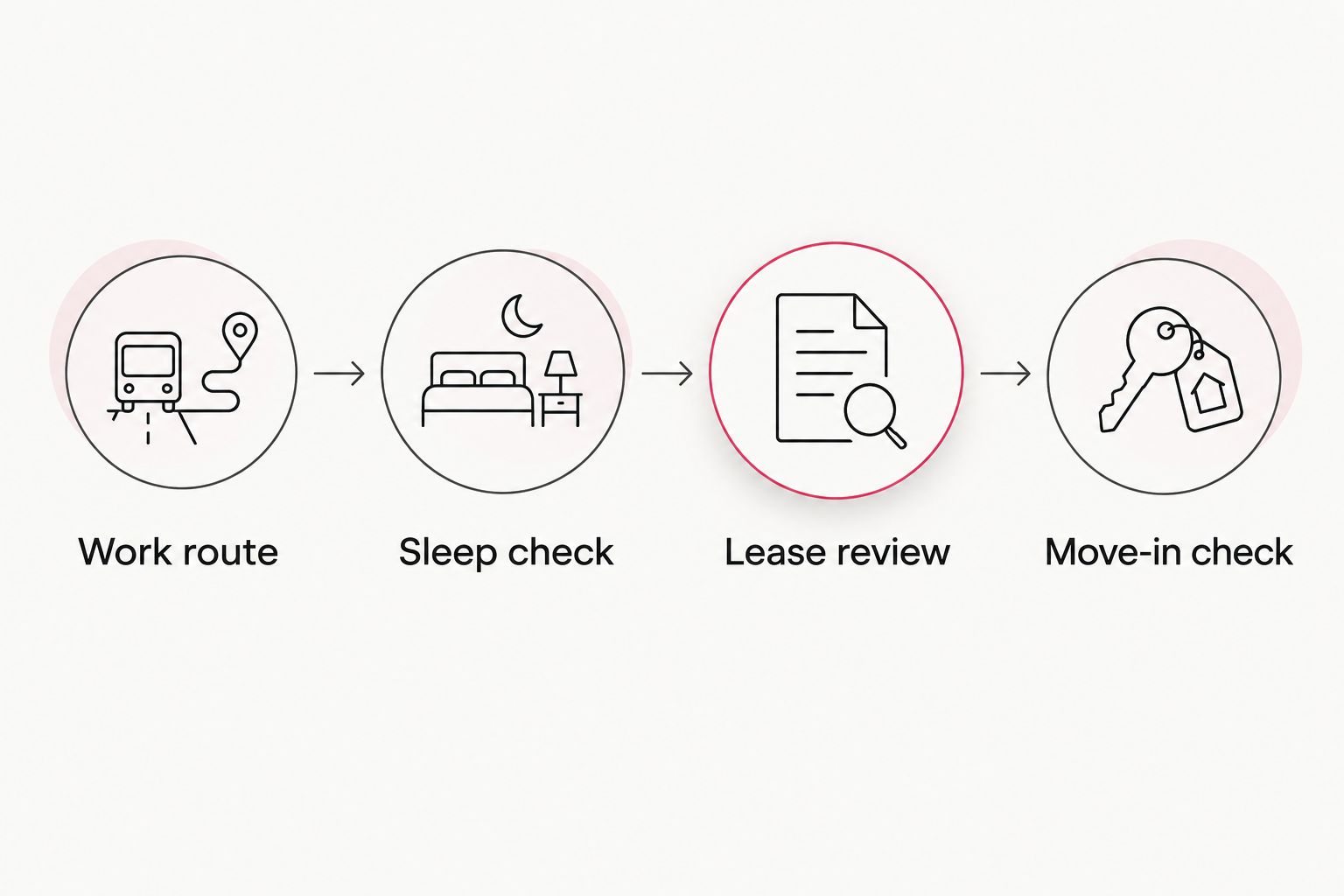
Write one reason to choose each apartment and one reason to reject it. This forces you to name the trade-off instead of relying on an overall impression from the tour.
- Work route: Compare complete journeys at relevant times.
- Sleep check: Evaluate bedroom conditions against your sleep schedule.
- Lease review: Resolve important questions in writing.
- Move-in check: Confirm access, utilities, and delivery arrangements.
7. Confirm the handoff before your first shift
After choosing an apartment, organize the move separately from the search. Signing a lease does not answer how you receive keys, access the garage, or arrange deliveries around work.
Ask the property to confirm its move-in instructions in writing. Keep those instructions alongside your employer’s arrival information, but do not mix up apartment access with employee parking or hospital access. Each organization controls its own procedures.
Before your first shift, make a practice trip from the apartment entrance to the work entrance. Use it to identify unresolved steps, not to promise yourself that every future trip will take the same time. Finding the wrong garage before work starts beats discovering it when you are already tired.
- Key handoff: Confirm the collection process and required identification.
- Building access: Check parking credentials, entry devices, and guest procedures.
- Utilities: Verify which services you must arrange yourself.
- Move-in condition: Follow the property’s inspection process and retain your records.
- First workday: Keep employer access instructions and a backup travel plan accessible.
Compare apartment-search options for Med Center staff
Choose a search method based on the work you want help with. Listing research, personalized neighborhood guidance, and confirmation from a specific property serve different purposes; none replaces reading the lease.
| Option | Best for | Main benefit | Key limitation |
|---|---|---|---|
| Manual map and spreadsheet | Staff who want to control every comparison | Keeps requirements and route notes in one place | You collect and update every detail yourself |
| Rental listing platforms | Renters building an initial list | Helps organize the discovery stage | A listing does not confirm the exact unit’s conditions or your work route |
| Direct property contact | Renters checking a specific apartment | Lets you request unit details and written lease information | Each conversation covers that property, not your whole neighborhood search |
| Taco Street Locating apartment locating | Houston renters seeking personalized research | Adds human help and local neighborhood knowledge | You still need to inspect the apartment and review property documents |
Use discovery tools to find candidates, personalized help to narrow them, and property documents to verify the decision. More listings do not solve an unanswered question about your bedroom or employee parking.
Common mistakes Houston Med Center staff make
Using the hospital name as the commute destination
A route to a public entrance does not include every employee’s parking and access arrangements. Replace the broad destination with the entrance and parking instructions for your role before comparing apartments.
Evaluating quiet only after work
An evening tour answers an evening question. If you sleep during the day, inspect daytime conditions and ask about activity near the exact bedroom rather than accepting a general description of a quiet community.
Letting an amenity override a work requirement
A pool, fitness room, or appealing kitchen does not fix an unsuitable lease or difficult journey to work. Keep requirements separate from preferences throughout your 2026 comparison, including the final decision.
Assuming employment determines lease flexibility
A medical role or assignment end date does not establish the terms of an apartment agreement. Ask about the proposed lease, required documentation, and termination provisions without assuming a special exception applies.
FAQ
What’s the best way to find an apartment near the Houston Med Center?
Start with your exact work entrance, shift schedule, and transportation arrangements, then compare apartments against those requirements. Inspect the bedroom and review the proposed lease before choosing.
Can Taco Street Locating help Houston Med Center staff?
Taco Street Locating helps Houston renters find and compare apartments through personalized research and local neighborhood knowledge. Share your work destination, housing requirements, and lease dates so the search reflects your routine.
Should I live within walking distance of my hospital?
Choose walking distance only after checking the actual route and your work schedule. Inspect crossings, sidewalks, lighting, building access, and an alternative way to travel.
How do I check an apartment if I work nights?
Evaluate the exact bedroom during the hours when you expect to sleep. Listen for nearby activity, inspect daylight control, and ask about maintenance and shared spaces near the unit.
Can I apply for an apartment with a new hospital job offer?
Ask each property whether it accepts an offer letter and what other screening documents it requires. Do not assume an employment offer satisfies every property’s criteria.
Is an apartment locator better than searching listings myself?
A locator fits renters who want personalized research, while a manual search fits renters who want to manage every comparison themselves. Either approach still requires confirmation from the property and your own lease review.
What should I verify before signing a Med Center apartment lease in 2026?
Verify the exact unit, complete work route, bedroom conditions, lease dates, and written agreement. Resolve important questions about access, documentation, and termination provisions before signing.
One last thing
Test the trip home as carefully as the trip to work. Your apartment needs to support the end of your shift, not just an on-time arrival. Before deciding, write down how you will get home, enter the building, and reach a bedroom that fits your sleep schedule.
Related guides
- Best month-to-month lease apartments in Houston
- Best apartments near Rice University in Houston
- Best pet-friendly apartments in Houston