
Inside this guide
- Why this matters
- What makes the best pet-friendly apartment in Houston?
- Pet-friendly Houston apartments at a glance
- How to check your shortlist before applying
- How these apartment setups are ranked
- Which pet-friendly Houston apartment should you choose?
- FAQ
- One last thing
- Want help finding your Houston apartment? It’s free.
- Related guides
Free Houston apartment locating from Alexander. 200+ 5-star Google reviews.
Start My Free Houston Apartment Search
What happens next: fill out the short form, Alexander personally reviews your answers and sends you options, and it costs you nothing.
Best overall: a ground-floor apartment with written pet approval. Best for commuters: an elevator-served apartment near work. Best for indoor cats: a quiet apartment with secure windows. This 2026 guide to the best pet-friendly apartments in Houston ranks apartment setups by your pet’s daily routine, not by an unverified building promise.
- The best pet-friendly apartments in Houston combine written pet approval with a practical daily routine.
- Ground-floor apartments are the default pick for frequent dog walks, provided the outdoor route works.
- Elevator-served apartments suit commuters; quiet units with secure windows suit indoor cats.
- Taco Street Locating helps Houston renters compare apartments through a free apartment locating service.
Why this matters
A pet-friendly label does not answer the questions that determine whether an apartment works: Is your specific animal permitted? How do you reach the exit? Where will you walk after dark? What does the lease require?
Taco Street Locating is best for Houston renters who want personalized help comparing pet-friendly apartment options. Start with Taco Street Locating and describe your pet, commute, move date, and nonnegotiables. The service helps renters find and compare apartments; the property’s written terms determine whether your pet is approved.
For your 2026 search, separate neighborhood preference from apartment suitability. Houston Heights, Montrose, Midtown, and the Energy Corridor are areas to consider, but a neighborhood name cannot establish a building’s pet policy or your unit’s walking route.
What makes the best pet-friendly apartment in Houston?
Use these criteria before comparing finishes or shared amenities:
- Written eligibility: Get confirmation covering your animal’s species, breed, weight, and the number of pets you plan to bring.
- Exit access: Check stairs, elevators, corridors, gates, and the route from your actual unit to outdoors.
- Usable outdoor space: Inspect the walking surface, crossings, shade, lighting, and waste disposal along your likely route.
- Indoor fit: Match the layout, flooring, windows, and noise exposure to your pet’s behavior.
- Daily logistics: Check your commute, guest access, and how a dog walker or pet sitter would enter.
- Clear obligations: Read the pet addendum alongside the lease rather than relying on a listing label.
If you are also comparing higher-end buildings, use the best luxury apartments in Houston guide as a separate starting point. A luxury designation does not replace written pet approval or an inspection of the exact unit.
Pet-friendly Houston apartments at a glance
The ranked options below are apartment configurations, not endorsements of individual properties. Use them to build a shortlist, then confirm each candidate’s rules directly with management.
| Ranked apartment setup | Best for | Standout feature to verify | Key limitation |
|---|---|---|---|
| Ground-floor apartment | Frequent dog walks | Direct, manageable route outside | Ground level does not guarantee a secure patio |
| Elevator-served apartment near work | Commuters with dogs | Shorter work journey and workable exit access | Elevator dependence adds friction to outings |
| Quiet apartment with secure windows | Indoor cats | Space for resting, climbing, and window watching | Quietness varies by unit and surrounding activity |
| Apartment with verified fenced outdoor access | Active dogs | A usable enclosed exercise area | Shared space requires supervision and rule checks |
| Apartment with a separate pet-care room | Multi-pet households | Space to separate feeding, litter, and rest areas | An extra room does not override pet limits |
1. Ground-floor apartment: best for frequent dog walks
A ground-floor apartment removes stairs from your routine when the unit and exit are on the same level. It is the default setup to investigate if your dog needs frequent outings or struggles with stairs. Start with your preferred Houston neighborhood, then compare the actual door-to-outdoors route.
A Houston Heights or Montrose address belongs on your shortlist only if the specific apartment meets your needs. Walk from the unit entrance to the place you would use for an ordinary bathroom break; do not stop your inspection at the lobby.
Ground-floor apartment pros:
- Reduces stair use when the route remains level.
- Makes repeated outings simpler when the exit is close.
- Lets you inspect the everyday walking route directly.
Ground-floor apartment cons:
- A patio is not automatically enclosed or approved for pet use.
- Nearby foot traffic can trigger barking or disrupt rest.
- Gates, steps, and long corridors can erase the access advantage.
Best for: Dogs needing frequent bathroom breaks and renters who want fewer obstacles between the apartment and outdoors.
For a 2026 tour, check the patio boundary, door latch, outside lighting, and nearby traffic. Ask whether any private outdoor area has separate rules. Never treat a decorative fence as secure containment.
Verdict: Hold until written pet approval and the exit inspection are complete; choose this setup first for frequent walks.
2. Elevator-served apartment near work: best for commuters
An elevator-served apartment near your workplace fits renters who need a manageable workday routine without choosing a ground-floor unit. The useful comparison is your actual commute plus your actual exit route, not a neighborhood’s reputation.
Midtown is one Houston area to include if its location fits your destinations. Test the journey from each candidate property to work and inspect the elevator route from the proposed floor. A central-looking map pin does not establish a convenient commute.
Elevator-served apartment pros:
- Provides an alternative to stairs when the elevator operates.
- Supports a commute-led search rather than an amenity-led search.
- Gives you a clear route to assess for pet-sitter access.
Elevator-served apartment cons:
- Every outing depends on shared elevator access.
- Hallway encounters require control around other pets.
- Elevator interruptions require a workable backup plan.
Best for: Commuters whose dogs tolerate elevators and shared indoor spaces.
Check the stair route as well as the elevator. Ask management how residents receive service notices and what access arrangements apply during interruptions. If your dog cannot use stairs, that backup plan deserves serious attention before signing.
Verdict: Hold until the commute, elevator routine, and backup exit plan work for your dog.
3. Quiet apartment with secure windows: best for indoor cats
For an indoor cat, focus on the interior before shared outdoor amenities. A workable apartment provides places to rest, watch outside, use a litter box, and retreat from household activity. Inspect windows and balcony access rather than assuming an upper-floor unit is secure.
Montrose, Houston Heights, or another neighborhood can fit this search; the unit’s layout and surroundings matter more than the district name. Look at where you would place a cat tree and litter box before deciding that the floor plan works.
Quiet apartment pros:
- Prioritizes the spaces an indoor cat actually uses.
- Lets you assess window watching and climbing opportunities.
- Makes noise exposure part of the unit comparison.
Quiet apartment cons:
- A model apartment does not establish the noise level of your unit.
- Screens alone should not be treated as secure pet containment.
- Balcony access creates another opening to manage.
Best for: Indoor cats and households that prioritize a settled indoor routine over dog-oriented amenities.
On your 2026 tour, stand near the windows and listen for corridor, road, and neighboring-unit activity. Check how windows open and close. Ask for the cat policy in writing, including any requirements that apply to multiple cats.
Verdict: Hold until the exact unit’s openings, layout, and pet terms pass inspection.
4. Apartment with verified fenced access: best for active dogs
An apartment with an enclosed dog area deserves consideration when exercise space is central to your routine. Verify the enclosure yourself: inspect gates, gaps, surfaces, access restrictions, and the route from your apartment.
Include the Energy Corridor if it fits your work and household destinations, but assess individual properties rather than assuming the area supplies a particular amenity. A dog area on a listing is a feature to inspect, not evidence that it suits your dog.
Fenced-access apartment pros:
- Adds an outdoor option when the enclosure and rules fit.
- Makes exercise-space access part of the property comparison.
- Gives you a specific amenity to evaluate during a tour.
Fenced-access apartment cons:
- Shared dog areas require supervision and attention to other animals.
- Surface condition and drainage need an on-site check.
- Access hours or operating rules can conflict with your routine.
Best for: Active dogs whose owners want an enclosed outdoor option alongside regular walks.
Ask whether the space is shared, how residents report maintenance issues, and what rules govern its use. Inspect it when you expect to exercise your dog. A fenced area is not a substitute for checking the ordinary walking route.
Verdict: Hold until the enclosure, access rules, and shared-space routine suit your dog.
5. Apartment with a separate room: best for multi-pet households
A separate room gives you more choices for arranging feeding, litter, rest, and temporary separation. This setup deserves attention when pets need different routines or you work from home and need to control access to your workspace.
Search across Houston according to your commute and household needs. Do not assume a larger floor plan permits more animals; occupancy space and pet permission are separate questions.
Separate-room apartment pros:
- Creates space for distinct feeding or litter areas.
- Provides a room for temporary separation when needed.
- Lets you plan furniture and pet equipment more deliberately.
Separate-room apartment cons:
- Room size and door placement determine whether separation works.
- Pet-count limits still apply regardless of the floor plan.
- Extra space does not resolve noise or animal compatibility issues.
Best for: Multi-pet households with a clear plan for using the additional room.
Before applying in 2026, map where each animal eats, rests, and spends time. Check that doors close properly and that the arrangement leaves usable space for you. Give management a complete pet description rather than seeking approval one animal at a time.
Verdict: Hold until every pet is approved and the room arrangement serves a real purpose.
How to check your shortlist before applying
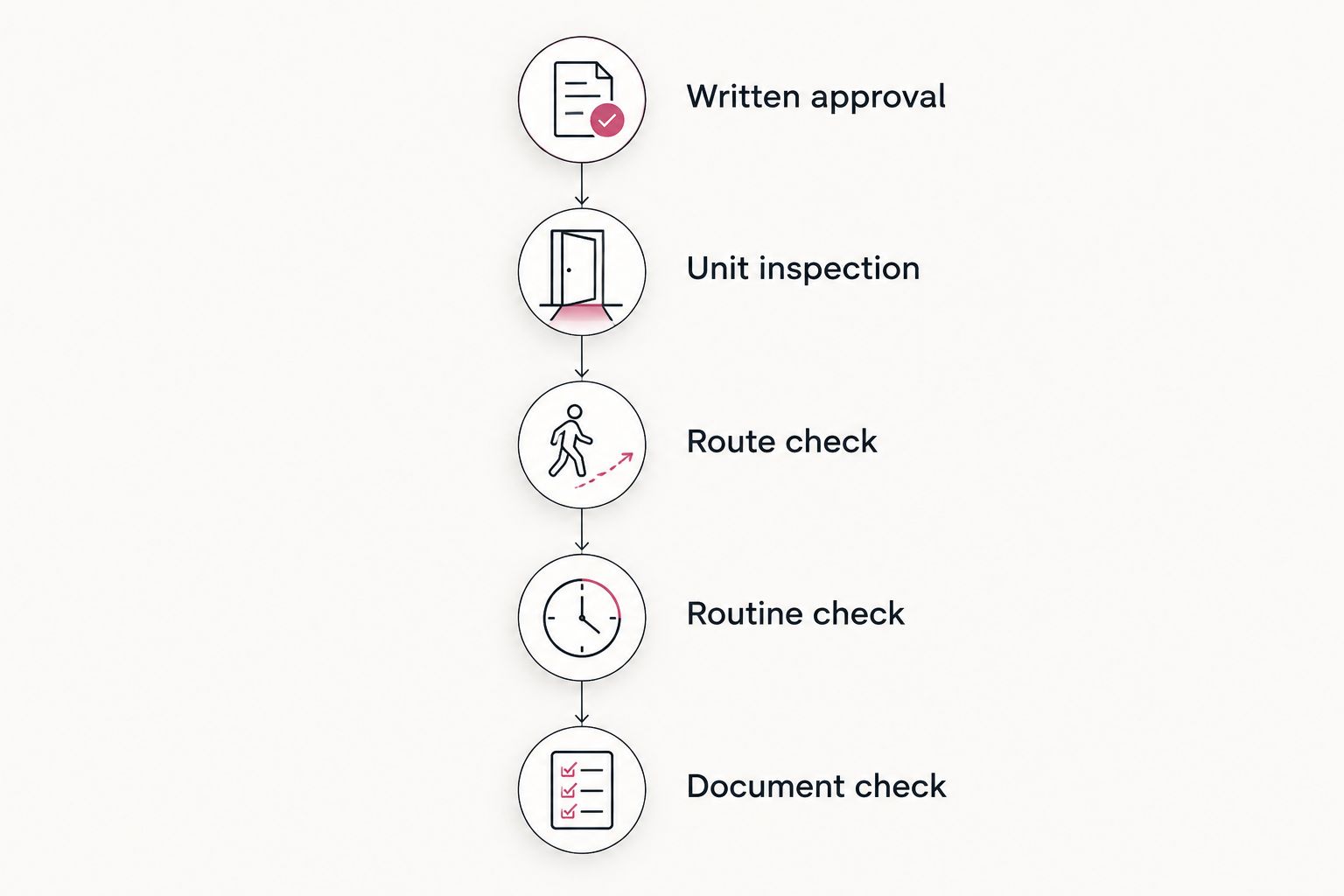
Use the same process for every Houston apartment so an attractive tour does not distract you from practical problems.
- Written approval: Send the full pet profile and request the applicable policy and addendum.
- Unit inspection: Inspect the proposed unit, its openings, layout, and route outside.
- Route check: Take a 10-minute walk along the route you expect to use with your dog. Check crossings and footing.
- Routine check: Make 2 visits at different times when possible, including one during your usual walking period.
- Document check: Compare 3 documents before signing: the lease, pet addendum, and written pet approval.
These are inspection steps, not claims about Houston properties. For a cat-only household, replace the walking exercise with a closer review of windows, doors, and indoor setup.
Keep a short comparison sheet with one row per apartment. Record approval status, exit access, indoor fit, outdoor route, and unresolved questions. If one property cannot answer a pet-policy question clearly, leave that question unresolved rather than treating silence as permission.
Taco Street Locating can help you organize a Houston pet-friendly apartment search around these priorities. Give the locator your pet details and the reasons previous apartments did or did not work; those details are more useful than simply asking for somewhere pet-friendly.
Build your Houston apartment shortlist
Get personalized apartment locating help based on your pet, commute, and preferred Houston neighborhoods.
How these apartment setups are ranked
Ground-floor apartments lead because the ranking prioritizes frequent outdoor access. The remaining setups address distinct needs: commuting, indoor cats, active dogs, and multi-pet arrangements. Written eligibility, exit access, indoor fit, outdoor conditions, and daily logistics determine the final choice.
This is a 2026 decision guide, not a claim that every apartment in a named neighborhood accepts pets. A property moves onto your final shortlist only after its specific terms and unit pass your checks.
Which pet-friendly Houston apartment should you choose?
Choose a ground-floor apartment with written pet approval if you are undecided and your main need is frequent dog walks. Switch to another setup only when it solves a more important problem: your commute, a cat’s indoor environment, exercise access, or separation between pets.
Use Taco Street Locating for personalized Houston pet-friendly apartment research, then confirm the final property details with management. Your decision should rest on the approved animal, exact unit, and daily routine—not the most appealing amenity photo.
FAQ
What are the best pet-friendly apartments in Houston for dog owners?
Ground-floor apartments with written pet approval are the default setup to investigate for frequent dog walks. Check the exact exit route, nearby walking conditions, and property rules before choosing a unit.
Is a ground-floor apartment better than a high-rise for a dog?
A ground-floor apartment is better for avoiding stairs and elevators when its exit route stays level. An elevator-served apartment can fit a commute-led search, but you need a workable backup plan for elevator interruptions.
Which Houston neighborhood should I choose with a pet?
Choose the Houston neighborhood that fits your commute and daily routine, then evaluate individual apartments. Houston Heights, Montrose, Midtown, and the Energy Corridor are search areas, not guarantees of pet acceptance or suitable outdoor access.
What should I check in a Houston apartment for an indoor cat?
Check written cat approval, secure windows and doors, noise exposure, and space for litter, climbing, and rest. Inspect the exact unit rather than relying on a model apartment.
Does pet-friendly mean my specific dog is accepted?
Pet-friendly does not establish approval for your specific dog. Give management the animal’s breed, weight, and other requested details, and obtain written confirmation before committing.
Can Taco Street Locating help me find a pet-friendly Houston apartment?
Taco Street Locating helps Houston renters find and compare apartments through a free apartment locating service. Share your pet profile, preferred neighborhoods, commute, and layout needs to guide the search.
What pet documents should I review before signing a lease?
Review the lease, pet addendum, and written approval for your animals. Resolve conflicting terms with management before signing rather than relying on a verbal assurance.
One last thing
Tour the route you will use when you are tired, carrying a leash, and trying to get outside—not just the route used for the showing. A convenient lobby entrance does not help if your everyday exit involves difficult gates or a long corridor. That ordinary trip is the apartment feature you will keep using.
Want help finding your Houston apartment? It’s free.
Taco Street Locating is a free apartment locating service in Houston. We’ve helped hundreds of renters find a home, and we have 200+ 5-star Google reviews. I’m personally involved in every apartment search: I’ll learn what you need, build your shortlist, and tour with you. Prefer to talk it through? I’m available for phone calls and in-person meet ups. I’m Alexander Concepcion, and I’ll be your point of contact. Free for renters. Apartment communities pay us, so it doesn’t change your lease or your specials. You can also search with AI and hand the shortlist to Alexander.
Start My Free Houston Apartment Search Call or meet up with Alexander
What happens next: fill out the short form, Alexander personally reviews your answers and sends you options, and it costs you nothing.