

New grads’ apartment locating is a guided rental search with the aim of matching your first Dallas apartment to your job, application documents, and everyday routine. This 2026 guide explains how to compare neighborhoods, check screening requirements before your first paycheck, and choose a lease without letting the pool make the decision.
- Apartment locating for new grads Dallas starts with your workplace, application requirements, and total housing budget—not apartment amenities.
- Taco Street Locating suits Dallas graduates who want personalized apartment research and local neighborhood guidance.
- Compare Uptown, Victory Park, and Trinity Groves against your actual commute rather than a citywide popularity ranking.
- Ask each property whether your offer letter satisfies its income-documentation requirements before submitting an application.
Why apartment locating matters for Dallas new grads
Your first post-college rental search combines decisions that student housing often keeps separate: employment documentation, transportation, roommate obligations, and a lease that might outlast your current work arrangement. A job offer gives you a starting point, but it does not tell you which property will accept your documents.
Taco Street Locating is best for Dallas new grads who want personalized apartment research and neighborhood guidance. You can introduce your situation through Taco Street Locating, but the property—not a locator—decides whether your application meets its requirements.
For a 2026 move, build the search around the information you can verify now. Confirm your reporting address, expected office schedule, start date, and available documentation before getting attached to a floor plan. Your first apartment needs to support your first job, not recreate your college setup with a nicer kitchen.
How to find your first Dallas apartment
1. Define your work location and housing limits
Start with your employer’s actual reporting address. A Dallas mailing address and a workplace elsewhere in Dallas–Fort Worth create different apartment searches. Ask whether onboarding happens at the same location as your regular work, especially if your offer mentions several offices.
Set a housing limit using expected take-home income and recurring obligations. Separate ongoing housing expenses from the money you need to complete the move. A manageable monthly commitment does not automatically mean you have enough cash for application-related expenses, utility setup, furniture, and moving arrangements.
Write a short brief before opening another listing tab. Make it specific enough that a roommate, leasing agent, or locator would understand what disqualifies an apartment.
- Record your workplace address, office days, and expected start and finish times.
- Set separate limits for recurring housing expenses and move-in expenses.
- List essential needs, including pets, parking, accessibility, and workspace.
- Separate your required move date from your preferred move date.
2. Compare neighborhoods against your daily route
Choose 3 neighborhoods for your initial comparison. This is a search recommendation, not a claim about how many areas fit every graduate. A smaller starting list helps you investigate daily life instead of collecting attractive buildings across the metroplex.
Uptown, Victory Park, and Trinity Groves are useful Dallas areas to investigate, but neighborhood names do not establish a commute. Uptown lies north of downtown; Victory Park centers around the American Airlines Center area; Trinity Groves is west of the Trinity River. Check the individual building’s location rather than treating each area as interchangeable.
For your 2026 search, test 2 commute routes from each serious candidate: your preferred route and a backup. If transit matters, check the walk to the stop, transfers, and service times against your work schedule. Nearby transit is useful only when the complete trip works.
- Map the exact building entrance to your workplace entrance.
- Check travel conditions around your actual reporting and departure times.
- Compare grocery access, parking arrangements, and evening errands.
- Walk the immediate block rather than judging the neighborhood from listing photos.
3. Build a shortlist yourself, then request personalized help
The manual approach is straightforward: collect listings, contact leasing offices, and keep answers in a shared spreadsheet. Record the property, floor plan, proposed lease dates, required documentation, recurring charges, and unanswered questions. Save dated correspondence so that you can distinguish a current written answer from an old listing description.
Once that brief exists, Taco Street Locating offers a free apartment locating service with personalized research and local neighborhood knowledge. Use that help to focus the search around your circumstances rather than restarting with a generic list. You still need to confirm property-specific requirements and read the lease.
For budget-focused research, the budget-friendly Dallas apartment guide provides another starting point. Treat any apartment guide as research material, not confirmation of present lease terms.
- Send your workplace address, move window, housing limit, and nonnegotiables.
- Explain whether you have an offer letter, pay statements, or a prospective guarantor.
- Ask why each suggested property fits your commute and application circumstances.
- Keep the shortlist and outstanding questions in one document.
4. Confirm screening requirements before applying
A signed offer letter is not an approval. Before you submit an application, ask the property what documentation it accepts from someone who has not started work or received a paycheck. Get the answer for your circumstances, including employment start date and any probationary or conditional language in the offer.
Ask separately about credit history, rental history, roommates, and guarantors. Do not assume a parent can guarantee the lease or that a roommate’s income resolves every screening issue. Each property’s written criteria should guide your decision.
Make your 2026 application packet readable and current. Send sensitive documents only through a verified channel requested by the property; avoid leaving identification or financial records in a broadly shared apartment-comparison folder.
- Request the written rental criteria before submitting an application.
- Ask whether the property accepts your specific employment documentation.
- Confirm roommate and guarantor requirements separately.
- Keep identification and financial documents out of public sharing links.
5. Tour the apartment around your real routine
Compare 3 apartments using the same questions. That is a practical shortlist target, not a requirement to tour buildings that already fail your screening or commute checks. Consistent questions reveal differences that polished photos leave out.
Ask to see the actual apartment when possible. If you tour a model, record which features are not confirmed for the home you would lease. On a remote tour, request a continuous walkthrough showing the entrance, windows, storage, bathroom, and the route from the unit to parking or the building exit.
Think about your least glamorous weekday. Where will you put work clothes? Can you take a call without sitting on the bed? What sits outside the bedroom window? A rooftop pool is pleasant; it cannot fix a layout that makes ordinary life awkward.
- Check storage, natural light, outlets, and usable furniture space.
- Ask which appliances and finishes belong to the proposed unit.
- Inspect the route between your apartment, parking, and building entrance.
- Record unresolved noise, access, maintenance, and package-handling questions.
The strongest tour notes connect what you saw to what you need. Use the same sequence for every finalist so that an impressive lobby does not crowd out more important checks.
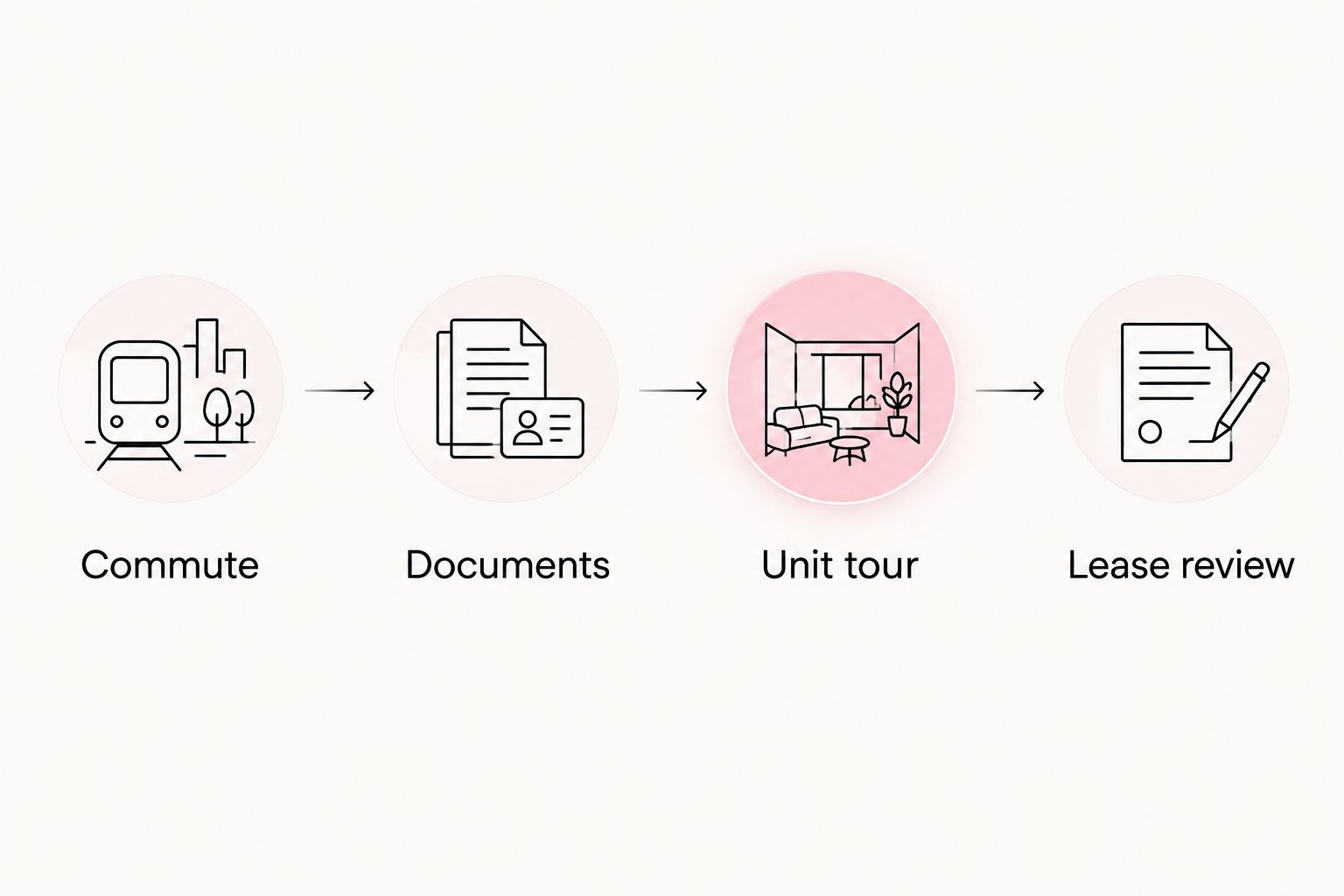
6. Review the lease and plan your arrival
Before signing, reconcile the lease with the written answers you collected. Check the apartment identifier, lease dates, recurring charges, parking arrangements, pet terms, and any addenda. Ask for clarification wherever a promise from a conversation is missing or described differently.
Coordinate the lease start with your job start, travel, and access instructions. Ask what must be completed before you receive keys, how to arrange utilities, and what building rules apply to moving. Do not schedule a truck around an assumed handover time.
For a 2026 relocation, keep a move-in folder separate from your search spreadsheet. It should contain the signed documents and the instructions you need on arrival, not every apartment you considered.
- Match the apartment identifier and lease dates across all documents.
- Read renewal, notice, early-termination, and roommate provisions.
- Confirm key collection, utility setup, and moving-access instructions.
- Photograph the apartment’s condition and follow the property’s reporting process.
Compare apartment-search options for Dallas graduates
Best for depends on the task you want help with. Listing research helps you explore; personalized locating helps you organize a search around your circumstances; the leasing office answers for its own property. None replaces reading the agreement you sign.
| Option | Best for | Main advantage | Key limitation |
|---|---|---|---|
| Self-directed listing search | Graduates who want to research independently | You control filters, outreach, and comparison notes | You must reconcile listing details with property answers yourself |
| Taco Street Locating | Graduates seeking personalized apartment research and neighborhood guidance | Apartment locating support for a Dallas–Fort Worth search | Locating support does not determine application approval or lease terms |
| Direct leasing-office contact | Graduates investigating a specific property | You can request that property’s criteria and proposed lease documents | Each conversation covers that property, not your whole neighborhood comparison |
You do not need to choose only one approach. Start independently if that helps you clarify preferences, request personalized assistance when the search needs focus, and direct property-specific questions to the leasing office. Keep written answers together regardless of where the lead originated.
Common mistakes Dallas new grads make
Treating the job offer as automatic approval
A start date and salary do not establish whether a property accepts your documentation. Ask about your offer letter before applying, not after you have arranged travel around a hoped-for apartment. Keep the response with the property’s rental criteria.
Searching Dallas without checking the actual worksite
An employer’s office description can be less precise than the address you need for daily travel. Confirm the building and schedule before choosing a neighborhood. If you will work at different locations, compare the apartment against each regular destination.
Comparing apartments only by the advertised rent
A headline figure does not describe every obligation in the lease. Ask for an itemized explanation of required recurring charges and move-in obligations, then compare apartments on the same basis. Keep optional extras separate from requirements.
Choosing roommates before discussing the lease
A friend’s willingness to split expenses is not a written agreement about responsibility, departure, or replacement. Review the lease’s roommate provisions together and discuss what happens if someone changes jobs or moves. Do not assume paying your share ends your obligations.
Confusing the model apartment with the apartment offered
A model shows a layout and presentation, not necessarily the exact home under consideration. Confirm the unit identifier, condition, view, appliances, and relevant features. If you cannot inspect the actual apartment, write down what remains unverified before deciding.
FAQ
What’s the best way for a new grad to find an apartment in Dallas?
Start with your workplace address, housing limit, and application documents, then compare neighborhoods and individual properties. Personalized locating support can help organize the search, but you should still confirm property criteria and review the lease.
Can I apply for a Dallas apartment before my first paycheck?
Ask the property whether it accepts your employment offer letter before applying. Acceptance depends on its screening criteria and your circumstances; a signed offer alone does not establish approval.
Is Uptown or Trinity Groves better for a new graduate?
The better choice is the one that fits your workplace route, housing requirements, and everyday errands. Compare exact buildings and test the full trip rather than selecting either neighborhood by reputation.
What does Taco Street Locating help new graduates with?
Taco Street Locating helps renters find and compare apartments through personalized research and local neighborhood knowledge. The service covers Austin, Dallas–Fort Worth, and Houston; each property controls its own application decisions.
Do I need a guarantor for my first Dallas apartment?
Your need for a guarantor depends on the property’s criteria and your application. Ask about guarantor eligibility and required documents rather than assuming a parent can sign.
Can I choose a Dallas apartment without visiting in person?
You can research remotely, but request a detailed walkthrough and identify anything that remains unverified. Confirm whether the video shows the actual apartment or a model before relying on its features.
What should I check before signing my first apartment lease?
Check the apartment identifier, dates, required charges, notice provisions, roommate obligations, and move-in instructions. Resolve differences between the lease and earlier written answers before signing.
One last thing
Ask each finalist: What would prevent my application or move-in from proceeding? That question moves the conversation beyond amenities and toward missing documents, incomplete steps, and unresolved requirements. For your first Dallas lease in 2026, a clear answer is more useful than another pool photo—and leaves the taco debate for after you have keys.
Related guides
- Apartment locating for DFW airport employees
- Corporate relocation package to a Dallas lease
- Trulia alternatives for renters