
Inside this guide
- Why this matters
- What makes the best Dallas apartment with EV charging?
- Dallas apartment charging options at a glance
- 1. Assigned EV charging: best for daily charging dependence
- 2. Shared resident charging: best for flexible schedules
- 3. Permitted outlet charging: best for light driving
- 4. Nearby public charging: best as a backup
- Match the charging plan to your Dallas neighborhood
- What to send before requesting an apartment shortlist
- How the charging arrangements are ranked
- Which Dallas EV apartment should you choose?
- FAQ
- One last thing
- Related guides
Best overall: an apartment with assigned EV charging. Best for flexible schedules: shared resident charging. Best for light driving: a permitted outlet at your parking space. This 2026 Dallas guide ranks charging arrangements—not unverified apartment names—so you can judge what a building’s EV amenity actually gives you.
- For apartments with EV charging Dallas renters should prioritize assigned access, vehicle compatibility, and written parking rules.
- Shared resident charging suits renters who can move their car when charging ends.
- A permitted outlet works only when its electrical setup and charging speed meet your needs.
- Taco Street Locating helps Dallas renters compare apartments through personalized research and neighborhood knowledge.
Why this matters
An EV-charging filter does not tell you whether you can charge where you park, who controls access, or what happens when equipment fails. Those details decide whether charging fits your routine or becomes another errand.
Taco Street Locating is a fit for Dallas renters who want personalized apartment research around EV charging. Use Taco Street Locating to explain your vehicle, commute, parking needs, and preferred neighborhoods before building a tour list.
For a 2026 move, separate three questions: does the property have charging equipment, can residents use it under workable rules, and does that setup meet your driving needs? A yes to the first question does not answer the other two.
What makes the best Dallas apartment with EV charging?
Judge the charging arrangement before the rooftop pool. These criteria determine the ranking below:
- Access: Distinguish an assigned charging space from a shared station or a public charger nearby.
- Compatibility: Confirm the connector, your vehicle’s requirements, and any manufacturer-approved adapter you need.
- Electrical setup: Level 1 charging uses 120 volts; Level 2 charging uses 240 volts. The label alone does not establish charging speed.
- Parking rules: Check reservations, time limits, overnight use, enforcement, and whether you must move after charging.
- Account responsibility: Identify the charging operator, payment process, and party responsible for repairs.
- Daily fit: Match charging access to your commute, arrival time, and realistic backup plan.
Ask management to answer these questions for the parking arrangement attached to your prospective lease. A general amenity description is not enough.
Dallas apartment charging options at a glance
| Rank and arrangement | Best for | Standout feature | Key limitation |
|---|---|---|---|
| 1. Assigned EV charging | Drivers who depend on home charging | A charging space tied to your parking arrangement | Requires explicit written access terms |
| 2. Shared resident charging | Drivers with flexible charging schedules | On-property charging without a dedicated charging bay | You must coordinate around other users and parking rules |
| 3. Permitted outlet charging | Light drivers with long parking periods | Charging from an approved outlet at your space | Electrical suitability and charging speed require confirmation |
| 4. Nearby public charging | Drivers with a dependable off-property routine | Charging independent of the apartment’s equipment | Adds a separate stop and is not an apartment amenity |
These are search priorities, not claims that a named Dallas property provides a particular setup. Apply the same questions to every apartment you tour in 2026.
1. Assigned EV charging: best for daily charging dependence
Assigned EV charging means your parking agreement identifies a charging space you can use under stated terms. It is the strongest starting point when you rely on home charging and do not want a shared-station rotation to control your evening.
Confirm that the assignment includes charging access—not just a parking space near equipment. Also establish whether the charger serves your space exclusively or shares access with another space.
Assigned EV charging pros:
- Makes charging part of your regular parking routine.
- Removes competition for a shared bay when exclusive access is confirmed.
- Gives you a specific space and agreement to evaluate before signing.
Assigned EV charging cons:
- A dedicated space does not prevent equipment failure.
- Parking and charging terms can sit in separate agreements.
Best for: Dallas renters whose commute makes dependable home charging a firm requirement.
During a tour, walk from the prospective apartment to the actual parking space. Check cable reach, access gates, and the route you would take with groceries. Ask who handles a blocked space and what written remedy applies if your assigned equipment stops working.
Verdict: Hold until the assigned space and charging rights are documented; then make this your first-choice arrangement.
2. Shared resident charging: best for flexible schedules
Shared resident charging puts equipment on the property without reserving a charger for your apartment. Your experience depends on how access works, when other drivers charge, and whether management enforces the rules.
This arrangement fits renters who can adjust charging times and move their cars when a session ends. It is a weaker match if you need to plug in immediately after every workday.
Shared resident charging pros:
- Keeps charging on the property.
- Lets you evaluate the charging area during your apartment tour.
- Fits a routine that does not require charging every night.
Shared resident charging cons:
- Another vehicle can occupy the charging space when you need it.
- Session limits or move-your-car rules can interrupt your evening.
Best for: Renters with flexible schedules and another workable charging option.
Ask whether access is first-come, reservation-based, or managed through an app. Request the written rules for overnight sessions and finished vehicles. Visit around your usual arrival time to observe the area, while remembering that one visit does not establish a reliable usage pattern.
Verdict: Hold until you understand the rotation rules and can live with them without depending on an empty bay.
3. Permitted outlet charging: best for light driving
Outlet charging means using an electrical outlet that management explicitly permits you to use for your vehicle. A visible outlet in a garage is not permission, and its appearance does not establish electrical suitability.
Level 1 charging uses a 120-volt supply, while Level 2 uses a 240-volt supply. Actual charging performance depends on the circuit, charging equipment, vehicle, and other operating conditions—not voltage alone.
Permitted outlet charging pros:
- Can fit a light-driving routine with long periods parked.
- Can keep charging at your own space when that use is authorized.
- Gives you a clear setup to assess against your vehicle’s needs.
Permitted outlet charging cons:
- Slower charging can fall short of your daily driving requirements.
- An outlet requires permission and an appropriate electrical setup before use.
Best for: Low-mileage renters who can leave their vehicle parked for extended periods.
Ask management to identify the approved outlet and explain who verifies its suitability. Follow your vehicle and charging-equipment instructions; do not assume an extension cord or adapter makes an unsuitable setup acceptable. Establish how electricity use is handled in writing.
Verdict: Hold until permission, electrical suitability, and your charging requirements all align.
4. Nearby public charging: best as a backup
Nearby public charging is a location advantage, not proof that an apartment has EV charging. Keep that distinction clear when comparing search results and neighborhood recommendations.
Public charging works best as a deliberate part of your routine: somewhere you already stop, with access conditions you have checked. A map pin alone does not establish a practical charging plan.
Nearby public charging pros:
- Gives you an alternative when residential equipment fails.
- Lets you consider apartments without on-property charging.
- Can align with an existing shopping or work routine.
Nearby public charging cons:
- Adds travel and charging stops outside your apartment.
- Access conditions and equipment status require separate checks.
Best for: Renters with dependable charging elsewhere who want a residential backup strategy.
Check the route from the apartment, connector compatibility, access hours, and any parking restrictions. Test the routine before committing to it. A charger across a difficult road or behind controlled access is not equivalent to charging beside your parking space.
Verdict: Skip as a substitute for required home charging; keep it as a backup unless your off-property routine is already proven.
Match the charging plan to your Dallas neighborhood
Start with your destination, not a neighborhood reputation. Uptown, Victory Park, Trinity Groves, and Knox-Henderson are useful places to organize a Dallas apartment search, but none of those names proves that a building’s charging arrangement suits you.
For an Uptown or Victory Park tour, trace the complete route through the property: street entrance, garage gate, charging space, elevator, and apartment. For Trinity Groves or Knox-Henderson, apply the same test and drive your actual commute. Compare addresses rather than assuming nearby buildings work alike.
In your 2026 shortlist, keep the commute and charging questions separate. A convenient drive does not fix restrictive charging rules, and a dedicated charger does not fix a location that fails your daily routine.
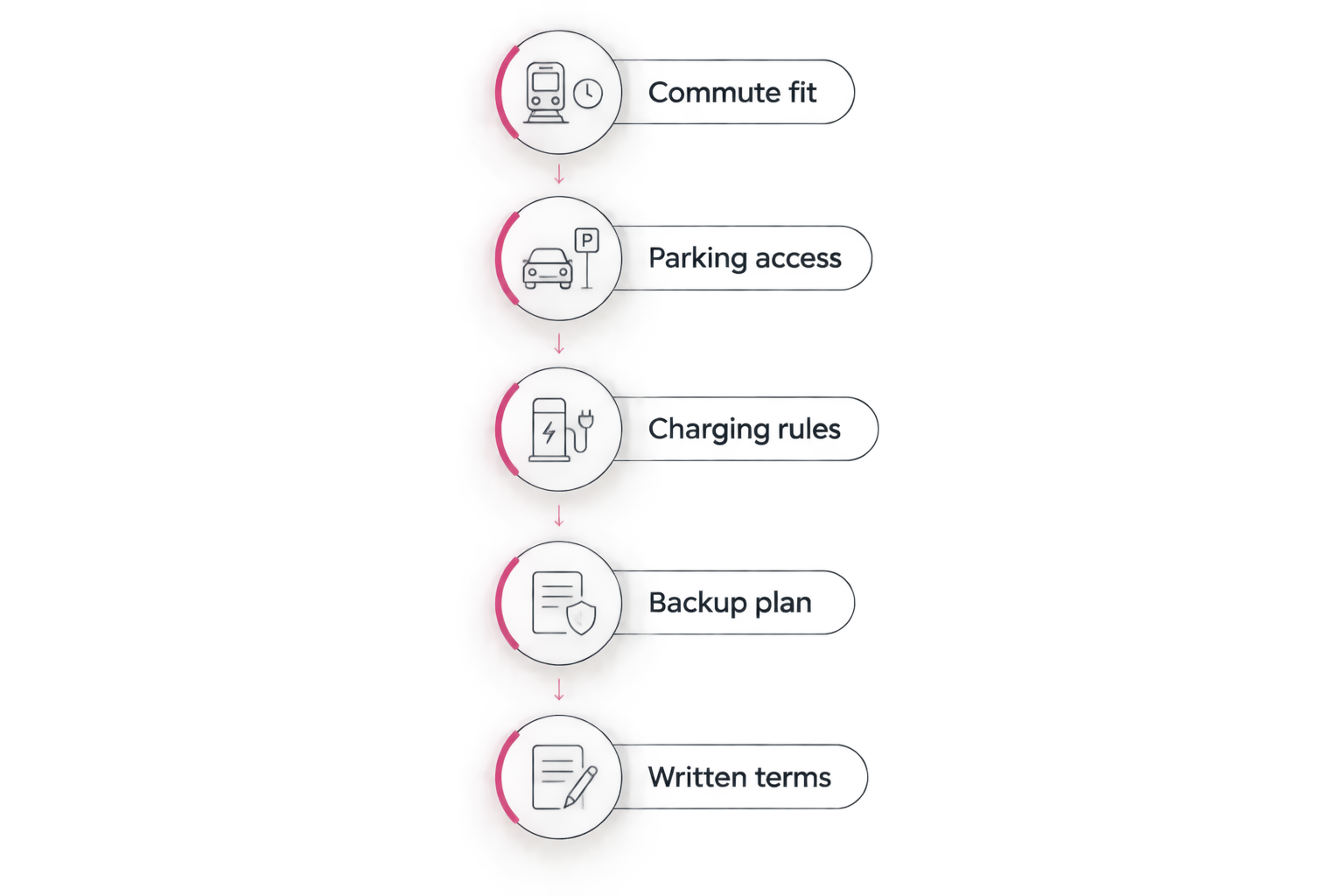
Use this tour sequence
- Commute fit: Check the route to your actual workplace or regular destination.
- Parking access: Walk to the proposed space and inspect the access route.
- Charging rules: Read the resident instructions and identify the operator.
- Backup plan: Check a separate charging option you could realistically use.
- Written terms: Match management’s answers to the parking agreement and lease documents.
What to send before requesting an apartment shortlist
Give Taco Street Locating the details that change an EV apartment search: your vehicle model, normal driving pattern, workplace address, parking requirements, move timing, and preferred Dallas neighborhoods. State whether home charging is essential or simply convenient.
Separate requirements from preferences. Assigned charging belongs in the first group if your routine depends on it; a particular view or pool belongs in the second if you can compromise. This keeps an attractive apartment from surviving the shortlist after failing your charging requirement.
If you prefer to begin digitally, use the AI apartment search to personalized locator match workflow to organize your search before requesting human help. Bring the charging questions into that conversation rather than treating an amenity filter as final confirmation.
Build your Dallas apartment shortlist
Share your commute, vehicle, and parking needs for personalized apartment research.
How the charging arrangements are ranked
This ranking puts control over everyday charging first, followed by compatibility, workable parking rules, and a credible backup. Assigned access leads because it removes the shared-bay question when the agreement confirms exclusive use.
Shared charging ranks next for schedule flexibility. Permitted outlet charging requires a closer match between electrical capability and driving needs; nearby public charging remains a separate routine rather than an on-property amenity. These priorities are a decision framework, not a property inspection or equipment-performance test.
Which Dallas EV apartment should you choose?
Choose the apartment with documented charging access that fits your ordinary week—not the most impressive amenity list. For drivers dependent on home charging, start with assigned access. For flexible drivers, shared resident charging deserves consideration after the operating rules pass inspection.
For your 2026 move, ask Taco Street Locating to keep charging requirements alongside commute and neighborhood preferences throughout the comparison. Do not leave verification until after choosing a favorite floor plan.
FAQ
What are the best apartments with EV charging in Dallas?
The best fit is an apartment with documented charging access that matches your vehicle and driving routine. Prioritize assigned charging if you depend on charging at home, then verify the specific property’s written terms before applying.
Is assigned EV charging better than shared apartment charging?
Assigned EV charging is the better fit when you need control over access to a charging space. Shared charging suits flexible schedules, provided its session limits and parking rules work for you.
Can I charge an electric car from an apartment garage outlet?
Use a garage outlet only with management’s explicit permission and an electrical setup suitable for your charging equipment. A visible outlet does not establish authorization or electrical suitability.
What is the difference between Level 1 and Level 2 charging?
Level 1 charging uses 120 volts, while Level 2 charging uses 240 volts. Actual charging speed also depends on the circuit, equipment, vehicle, and operating conditions.
Does EV charging mean I get a reserved parking space?
An EV-charging amenity does not establish a reserved parking right. Confirm whether the charging space is assigned, shared, or subject to a separate parking agreement.
Should I choose a Dallas apartment because public charging is nearby?
Choose that arrangement only if the off-property charging routine works for your needs. Check the actual route, connector, access conditions, and parking restrictions rather than relying on map distance.
Can Taco Street Locating help with a Dallas EV apartment search?
Taco Street Locating helps Dallas renters compare and find apartments through a free apartment locating service. Share your vehicle, commute, and charging requirements so those details guide the personalized research.
One last thing
Ask to see the charging space, not just the leasing office’s amenity sheet. Then ask who you contact when the charger fails. An answer that identifies the equipment operator, property contact, and written process is more useful than another photo of a car plugged in.
Related guides
- Best apartments in Uptown Dallas
- Best apartments in Knox-Henderson Dallas
- Best budget-friendly apartments in Dallas