

Inside this guide
- Why this matters
- What makes the best gated apartment community?
- Houston gated community profiles at a glance
- 1. Perimeter gate plus building entry: best for access boundaries
- 2. Controlled-access parking: best for regular drivers
- 3. Gated courtyard layout: best for shared outdoor space
- 4. Direct unit access: best for avoiding shared corridors
- 5. Gated pet-friendly community: best for dog owners
- How these profiles are ranked
- Turn your shortlist into a useful tour
- FAQ
- One last thing
- Related guides
Best overall: a perimeter-gated community with controlled building entry. Best for drivers: a community with controlled-access parking. Best for dog owners: a gated community with a separately enclosed dog area. To find the best gated apartment communities in Houston in 2026, compare these community profiles against your commute and inspect the actual entry routes; Taco Street Locating helps renters research and compare Houston apartments.
- The best gated apartment communities in Houston combine suitable access controls with a workable commute and floor plan.
- Perimeter gates and controlled building entry serve different purposes; inspect both before choosing an apartment.
- Controlled-access parking suits drivers, but check pedestrian routes and the walk from your assigned space.
- Taco Street Locating provides free apartment locating help for renters comparing Houston communities.
Why this matters
A gate is an access feature, not a safety guarantee. A community can control vehicle entry while leaving a separate pedestrian entrance open, or secure a parking garage without controlling access to residential hallways. Those differences matter more than whether the listing uses the word gated.
Your search also needs to work outside the entrance. Compare your actual destinations in the Texas Medical Center, Downtown, the Energy Corridor, or wherever you regularly travel. A gate does not fix an inconvenient route, an unsuitable apartment layout, or a parking arrangement you dislike.
Rank the apartment around your daily routine, then check how the property controls access. The profiles below rank community designs by renter needs, not individual properties or neighborhood safety.
What makes the best gated apartment community?
Use these criteria for your 2026 shortlist before considering finishes, pools, or clubhouse photos:
- Complete entry coverage: Identify vehicle gates, pedestrian entrances, garage doors, building entrances, and any route that bypasses them.
- Practical access: Understand how residents, visitors, deliveries, and rideshare drivers enter without creating an awkward daily routine.
- Clear maintenance responsibility: Ask how management handles a malfunctioning gate, lost credential, or door that does not latch.
- Suitable apartment placement: Inspect the actual unit's relationship to gates, parking, common paths, and shared spaces.
- Commute fit: Compare the property with your real work, school, shopping, and household destinations.
- Documented terms: Confirm parking assignments, access-device rules, guest procedures, and relevant pet policies before signing.
Ask management to demonstrate the access system rather than accepting a general description. A tour should show what happens at the entrance, not merely point toward it.
Houston gated community profiles at a glance
This 2026 comparison separates access designs that suit different routines. Treat each row as a shortlist category, then verify the features at the property you tour.
| Community profile | Best for | Standout feature to verify | Key limitation |
|---|---|---|---|
| Perimeter gate plus controlled building entry | Renters prioritizing separate access boundaries | Credentials required at both the property and residential entrance | Multiple access points add steps for residents and guests |
| Controlled-access parking | Renters who drive regularly | Restricted vehicle entry and a practical route to the apartment | A parking gate does not establish how pedestrian entry works |
| Gated courtyard layout | Renters wanting shared outdoor space inside the perimeter | Courtyard location and controlled pedestrian entrances | Shared paths and gathering areas can affect unit privacy |
| Gated community with direct unit access | Renters avoiding shared interior corridors | A usable route from parking to the apartment's own entrance | Unit entrances need separate evaluation from the perimeter gate |
| Gated pet-friendly community | Renters with dogs | Pet permission and a separately enclosed dog area | Community access controls do not establish pet-area containment |
1. Perimeter gate plus building entry: best for access boundaries
A perimeter-gated community with controlled building entry separates access to the grounds from access to residential interiors. You pass through the property entrance, then use another controlled entrance to reach the building. This is the default profile to investigate when access control is your main requirement.
Check whether that design applies to your actual building. A controlled lobby is not the whole picture if another entrance follows different rules, and a gate shown during the tour does not explain every pedestrian route.
Perimeter gate plus building entry pros:
- Separates property entry from residential entry.
- Gives you distinct access points to inspect during a tour.
- Lets you evaluate visitor access without assuming visitors need unrestricted building entry.
Perimeter gate plus building entry cons:
- Adds access steps when carrying groceries or meeting visitors.
- Depends on both systems functioning as intended.
- Does not establish crime conditions or guarantee resident safety.
Best for: Renters who want separate controls at the grounds and building, and accept the extra entry steps.
Ask management to walk you through the route from the sidewalk to the apartment door. Repeat the exercise from the garage or surface parking area.
Verdict: Choose this profile when both entry boundaries are demonstrated and the apartment fits your routine.
2. Controlled-access parking: best for regular drivers
Controlled-access parking restricts vehicle entry to a garage or parking area. Its usefulness depends on what happens after you park: your assigned space, walking route, building entrance, and visitor arrangements all deserve attention.
For a Houston renter driving to work, the route from parking space to apartment matters as much as the gate itself. Tour that route rather than judging the arrangement from the leasing office entrance.
Controlled-access parking pros:
- Establishes a defined vehicle entry point.
- Gives you a specific parking-to-apartment route to evaluate.
- Supports a focused comparison of resident and visitor parking procedures.
Controlled-access parking cons:
- Does not explain whether pedestrian entrances are controlled.
- Requires a workable backup procedure when the vehicle entrance malfunctions.
- Can introduce inconvenience if your assigned space is poorly positioned for your unit.
Best for: Renters whose daily routine involves driving and who want clear resident parking access.
Ask where guests park, whether spaces are assigned, and how you enter when your access device fails. Inspect the walking route for visibility, lighting, stairs, and elevator dependence rather than assuming every space offers the same experience.
Verdict: Choose controlled-access parking only after verifying the assigned space and pedestrian route.
3. Gated courtyard layout: best for shared outdoor space
A gated courtyard community places shared outdoor space within the property's access boundary. The courtyard might connect buildings, apartment entrances, or common facilities; inspect the actual arrangement rather than assuming the layout from a floor plan.
This profile suits renters who want outdoor space close to home. The trade-off is placement: an apartment facing a shared path or gathering area has a different privacy relationship than one facing away from it.
Gated courtyard layout pros:
- Places shared outdoor space inside the property's perimeter.
- Lets you assess apartment access and outdoor circulation together.
- Offers a clear layout to compare against your preference for shared space or separation.
Gated courtyard layout cons:
- Courtyard-facing windows can face shared activity.
- Outdoor paths require their own access and lighting checks.
- The perimeter gate does not establish how residential doors are controlled.
Best for: Renters who value shared outdoor space and are comfortable evaluating courtyard-facing privacy.
Stand outside the specific apartment you are considering. Look at the window position, nearby seating, pedestrian paths, and entrances; then ask about common-area use rules.
Verdict: Choose a courtyard layout when the exact unit's privacy and outdoor access suit you.
4. Direct unit access: best for avoiding shared corridors
A gated community with direct unit access lets residents enter their apartments without passing through a shared interior residential corridor. That describes the route, not the quality of the door hardware or the property's security performance.
Compare the actual entrance with your needs. Stairs, weather exposure, packages, and the distance from parking remain relevant even when the perimeter is gated.
Direct unit access pros:
- Avoids a shared interior corridor on the route home.
- Makes the apartment's immediate entrance easy to inspect.
- Allows a direct comparison of parking distance, stairs, and outdoor exposure.
Direct unit access cons:
- The apartment entrance requires separate scrutiny from the perimeter gate.
- Outdoor circulation exposes the route to weather.
- Upper-floor access needs checking if you want to avoid stairs.
Best for: Renters who prefer their own exterior entrance and accept the associated outdoor route.
During the tour, follow the same path you would use with groceries or a dog. Inspect the landing and doorway, then ask management how maintenance requests involving locks and exterior lighting are handled.
Verdict: Choose direct unit access when the entrance and everyday route meet your practical requirements.
5. Gated pet-friendly community: best for dog owners
For dog owners, community access and pet containment are separate questions. A vehicle gate does not establish whether an outdoor area is suitable for an off-leash dog, and a dog area does not establish the property's residential access rules.
Start with the pet policy, then inspect the outdoor setup. An enclosed dog area is a feature to verify, not something to infer from the word gated.
Gated pet-friendly community pros:
- Lets you assess resident entry and pet facilities as separate needs.
- Provides a clear reason to inspect the walking route from your actual apartment.
- Supports a practical comparison of pet rules, outdoor space, and unit location.
Gated pet-friendly community cons:
- Pet restrictions require confirmation for your specific animal.
- Shared dog areas require evaluating entrances, latches, and posted rules.
- A suitable pet area does not resolve an inconvenient daily walking route.
Best for: Dog owners who need confirmed pet permission and an outdoor arrangement that fits their routine.
Ask whether your pet is permitted before investing time in a tour. Then walk from the proposed apartment to the pet area and inspect the enclosure rather than relying on listing photos.
Verdict: Choose this profile after confirming both the pet policy and the physical walking setup.
How these profiles are ranked
The 2026 order starts with the broadest access-control requirement, then separates driving, shared outdoor space, direct entrances, and pet needs. It is a decision guide, not a claim that one design is safest or that every property within a category performs equally.
The criteria are entry coverage, daily usability, maintenance procedures, apartment placement, commute fit, and documented terms. A community fails your shortlist when a must-have remains unresolved, regardless of its position in the table.
Turn your shortlist into a useful tour
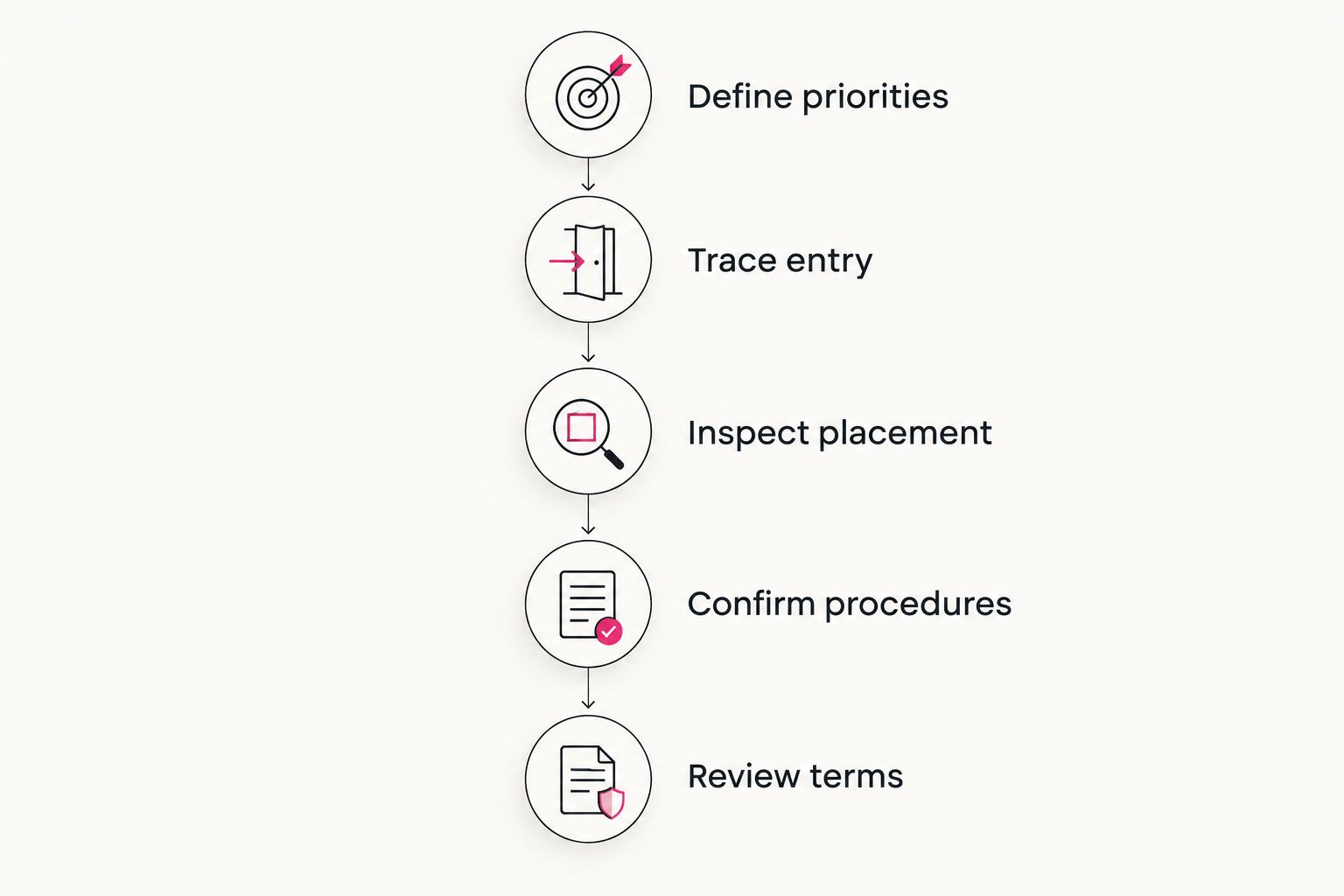
For your 2026 apartment search, give each community the same inspection. Comparing identical questions is more useful than collecting unrelated amenities.
- Define priorities: Write down your commute destination, preferred entrance style, parking needs, and pet requirements.
- Trace entry: Walk the vehicle and pedestrian routes that connect the outside of the property to your apartment.
- Inspect placement: Check the proposed unit's relationship to parking, gates, shared paths, and outdoor activity.
- Confirm procedures: Ask about visitors, deliveries, lost credentials, and access-system maintenance.
- Review terms: Match the explanations from your tour to the relevant documents before signing.
Keep notes against the exact apartment, not just the community name. A property-level feature does not explain a particular unit's route, outlook, or entrance position.
Taco Street Locating is a free apartment locating service for Houston renters who want help researching and comparing apartments. Share your practical requirements so personalized apartment research starts with your routine rather than a generic amenities list.
Build your Houston apartment shortlist
Get personalized apartment research and local neighborhood guidance for your Houston search.
FAQ
What’s the best type of gated apartment community in Houston?
A perimeter-gated community with controlled building entry is the default profile to investigate when separate access boundaries are your priority. Verify both systems at the actual property, then compare the commute, apartment placement, and daily entry procedures.
Does a gated apartment community guarantee safety?
No, a gate does not guarantee safety. It controls a particular access point; inspect pedestrian entrances, building doors, and maintenance procedures separately, and assess safety information independently.
Is controlled-access parking the same as a fully gated community?
No, controlled-access parking describes vehicle access to a parking area. It does not establish how someone enters the grounds on foot or reaches a residential building.
What should I ask when touring a gated Houston apartment?
Ask management to demonstrate the route from outside the property to your proposed apartment. Also ask how visitors enter, where guests park, and what residents do when an access device or gate fails.
Are gated apartments better for dog owners?
A gate alone does not establish whether an apartment is suitable for your dog. Confirm the pet policy, inspect any enclosed dog area, and walk the route from the proposed unit to the outdoor space.
How do I choose between a gated courtyard and direct unit access?
Choose a courtyard profile if shared outdoor space is your priority, and investigate direct unit access if you prefer avoiding shared interior corridors. Inspect privacy, stairs, weather exposure, and the actual route before deciding.
Can Taco Street Locating help me compare Houston apartments?
Yes, Taco Street Locating is a free apartment locating service that helps renters find and compare apartments in Houston, Austin, and Dallas–Fort Worth. Share your commute, parking, pet, and access preferences to guide personalized apartment research.
One last thing
On your final tour, approach the apartment from the entrance you will actually use—not only the route chosen for the showing. Choose the community that works on an ordinary weekday, not just during a guided visit. Your grocery bags deserve a sensible route, even when they are mostly tacos.
Related guides
- Explore luxury apartments in Houston
- Compare pet-friendly apartments in Houston
- Explore luxury apartments in Fort Worth