

Instead of manually revisiting apartment listings after your college acceptance, build one Austin housing workflow: confirm your campus and move-in needs, compare suitable leases, prepare your documents, and review the contract before signing. This 2026 guide takes you from an acceptance letter to a signed student lease without confusing admission, application approval, and a binding housing agreement.
- For your college acceptance apartment search Austin plan, confirm campus, lease structure, and qualification requirements before applying.
- Taco Street Locating suits Austin students who want apartment research and neighborhood guidance.
- Compare individual-bedroom and whole-apartment leases by responsibility, roommate arrangements, and written terms.
- An acceptance letter does not replace the property’s required qualification documents.
- Keep the completed lease, addenda, and move-in instructions together after signing.
Why this matters
A college acceptance confirms an academic decision. It does not establish an apartment's screening requirements, your roommate obligations, or when you can collect keys. Treat those as separate checkpoints, not details to resolve after submitting an application.
Taco Street Locating is best for Austin student renters who want personalized apartment research and local neighborhood guidance. Use Taco Street Locating to help compare apartments, while keeping qualification decisions and lease questions with the property responsible for them.
For a 2026 move, start with your actual campus destination rather than a broad search for student housing. A UT Austin student, a St. Edward's University student, and an Austin Community College student do not necessarily need the same search area.
Before you start
- Confirm your destination and dates. Have your campus address, required arrival date, intended occupancy period, and any university housing requirements ready. For Austin Community College, identify the campus you will attend rather than searching around the institution's name alone.
- Prepare access and documents. Set up an email you check, access to the property's application system when supplied, identification, and the financial or guarantor materials the property requests. Ask how sensitive documents should be submitted; do not send them through an unverified message thread.
- Resolve the hidden gotcha: what exactly are you leasing? Ask whether the contract covers an individual bedroom or an entire apartment. Roommate matching, responsibility for unpaid obligations, and guarantor paperwork must come from the written agreement, not assumptions about student housing.
Your housing brief
Create a document with your own labels below. These are planning headings, not names of buttons in a leasing portal; application screens differ by property.
- Campus destination: Record the building or campus you expect to visit regularly. Add any second destination, such as a job or clinical placement, that changes the search.
- Move-in window: Write your earliest workable arrival and latest acceptable key-pickup date. Include orientation, not just the first class, when it requires your presence.
- Monthly limit: Set your total housing ceiling and list the charges you need the property to explain. Separate your personal limit from the property's qualification calculation.
- Household plan: Record who will live with you, whether roommates are confirmed, and whether anyone expects to act as a guarantor.
- Must-haves: Choose essentials before extras: bedroom privacy, accessibility needs, pet rules, transportation, or furniture. Keep preferences in a separate list so a desirable amenity does not override a necessary condition.
Expected result: You can send one consistent brief to every property or locator. Each response can be checked against the same requirements instead of restarting the search with every listing.
For your 2026 search, keep a dated change log beneath the brief. If your campus assignment or arrival date changes, update that document before arranging more tours.
Your neighborhood and lease shortlist
- Choose search areas by destination. For UT Austin, include West Campus, North University, and Hyde Park as areas to investigate. These are starting points, not promises about any apartment's walking distance, transportation access, or suitability.
- Check the actual route. Compare 2 routes for each finalist, such as walking and transit or driving and transit. Check the exact address, your class destination, and the times you expect to travel; a neighborhood name alone cannot answer the commute question.
- Build a 3-property shortlist. Use that as a working limit, not a claim about how many apartments you must tour. Keep each candidate only if it meets your essential requirements or has a clearly identified compromise.
- Confirm the lease structure. Ask whether you are evaluating a bedroom agreement or a whole-apartment agreement. Request the applicable sample contract and roommate terms before treating the options as equivalent.
- Tour the relevant space. Ask whether you are seeing the intended apartment, the same floor plan, or a model. Record what remains unverified, including window orientation, furnishings, accessibility features, and the route from the entrance to the unit.
Expected result: You have a short list with known compromises, a checked route, and a clear explanation of what each contract covers.
Use this comparison to organize questions, not to substitute for the contract:
| Lease structure | Best for | Practical advantage | Trade-off to check |
|---|---|---|---|
| Individual-bedroom lease | Students seeking a separately defined bedroom agreement | Identifies your rented bedroom and shared-space arrangement | Verify roommate assignment, shared-space rules, and the exact scope of financial responsibility |
| Whole-apartment lease | A household planning to rent one apartment together | Lets the household evaluate the apartment as one shared home | Verify each signer's obligations if a roommate leaves or fails to meet the agreement |
Neither structure wins automatically. Choose the contract whose written responsibilities match your household plan. A separate bedroom agreement does not eliminate the need to read shared-area rules; a whole-apartment agreement needs particular attention when roommates have different departure plans.
For a closer route comparison, use the guide to choosing an Austin apartment around your commute. Treat a great-looking apartment with an unsuitable daily route as a mismatch, not a bargain you need to justify.
Your application packet
- Request written criteria. Ask the leasing team what it requires from a student applicant, a guarantor, and each intended occupant. An admission letter establishes admission; ask separately whether the property accepts it as part of its screening documentation.
- Confirm acceptable evidence. Explain your situation accurately: student, employed student, scholarship recipient, supported by family, or another arrangement. Ask which documents the property accepts rather than assuming a bank statement or award letter is sufficient.
- Resolve guarantor requirements. If a guarantor is needed, send that person the property's instructions and relevant agreement. Confirm what must be completed before the application can proceed.
- Submit through the verified channel. Follow the property's actual application instructions. Use matching legal names and consistent occupancy details; save the submission confirmation without storing unnecessary copies of sensitive information in shared folders.
- Track the decision. Record outstanding requests, deadlines provided by the property, and the named contact. Ask whether the application is complete, still under review, approved with conditions, or approved; do not infer approval from a successful upload.
Expected result: Every applicant knows what has been submitted, what remains outstanding, and who is responsible for the next action.
Taco Street Locating can help you organize apartment research and neighborhood questions. The limitation is clear: locating help does not replace the property's screening decision or your review of the agreement.
Your lease and signing check
- Match the contract to the selection. Check the property address, apartment or bedroom identifier, floor plan where specified, occupants, and contract dates. For a 2026 arrival, verify the full start date rather than accepting a reference to the academic year.
- Read every incorporated document. Review addenda, community rules, guarantor terms, and any furniture or utility arrangements included in the agreement. Ask for missing documents before signing.
- Check the complete obligation. Compare the payment schedule, recurring charges, deposits, service responsibilities, and end-of-term requirements with the written information you received. Ask the leasing team to resolve discrepancies in writing.
- Review changes and exits. Find the provisions governing roommate replacement, transfers, early departure, renewal, and notice. Do not assume that leaving school, changing campuses, or finding an internship ends a housing obligation.
- Complete and save the agreement. Follow the actual signature instructions, confirm all required parties have completed their portions, and obtain the fully executed copy. Keep it in 1 housing folder with the addenda, receipts, and written move-in instructions.
Expected result: You have the completed contract and a written explanation of the remaining move-in requirements, rather than only a submitted application or your own signature receipt.
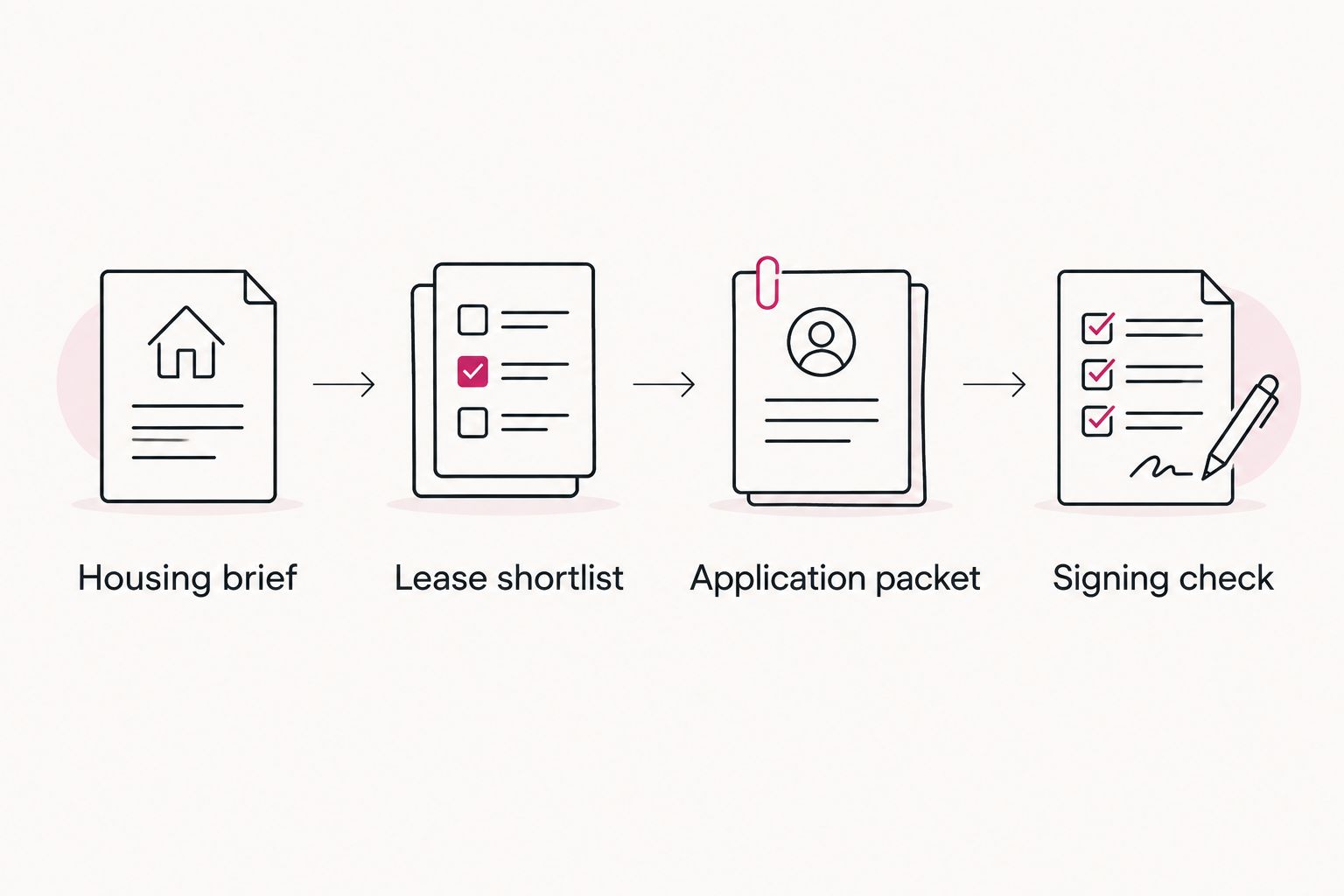
The checkpoints belong in this order. Choosing an apartment before checking qualification requirements creates avoidable rework; signing before reconciling the documents makes unresolved questions part of a binding decision.
Repeat the workflow when your acceptance changes
A different admission decision, program placement, or campus assignment changes the housing brief. Reuse the workflow rather than keeping the old shortlist by default.
- Before applying: Update the destination and dates, check the routes again, and remove apartments that no longer fit.
- While an application is pending: Notify the property in writing and ask what can be changed. Get the status of submitted documents and any obligations already accepted.
- After signing: Read the applicable contract provisions before making another housing commitment. Ask the property about the process relevant to your situation; do not assume a school change creates a cancellation right.
For a 2026 relocation from another city, replace an in-person tour with a live walkthrough only after confirming what the host will show. Request the relevant layout, building access route, and any important feature that listing photos leave unclear.
Troubleshooting
The property asks for income you do not have
Explain that you are a student and request the property's accepted qualification paths in writing. Ask specifically about guarantor documentation and other evidence it accepts; do not alter documents or present family support as employment income.
Your roommate has not completed the application
Ask whether the property can continue reviewing your submission independently and what remains blocked. Set a household decision deadline before making additional commitments, and confirm whether changing applicants requires new paperwork.
The tour and contract describe different arrangements
Stop the signing process and identify the discrepancy in writing. Ask the property to clarify or correct the document; verbal reassurance does not change the text you are being asked to sign.
Your preferred move-in date does not match the contract
Ask whether the property can provide a written agreement matching your required occupancy dates. Do not assume an early arrival request, luggage drop, or orientation schedule changes when possession begins.
Your portal shows a submission but no completed lease
Ask which stage is complete and which signatures or conditions remain. Save the final agreement when supplied; an upload confirmation, application approval, and fully executed lease are different records.
Customize your workflow
Add a separate column for any requirement that affects daily life: accessibility, pet rules, furniture, parking arrangements, or a partner's commute. Mark each entry as confirmed in writing, observed during the tour, or still unresolved.
For Taco Street Locating apartment research, share those unresolved items alongside your housing brief. That gives personalized human help a specific task: narrow the search around your campus, household, and neighborhood preferences without asking anyone to guess what matters.
FAQ
How do I start an Austin apartment search after college acceptance?
Confirm your campus destination, arrival window, household plan, and housing limit first. Then compare lease structures and request each property’s student qualification requirements before applying.
Can I use my college acceptance letter to qualify for an apartment?
An acceptance letter alone does not establish that you meet a property’s screening criteria. Ask the property which student, financial, and guarantor documents it requires and whether the letter serves any part of that process.
Is an individual-bedroom lease better than a whole-apartment lease?
Neither lease structure is automatically better. Compare the written responsibilities for your bedroom, shared spaces, roommates, and unpaid obligations against your household’s plans.
Which Austin neighborhoods should a UT Austin student investigate?
West Campus, North University, and Hyde Park are starting points for a UT Austin housing search. Check each apartment’s exact route to your campus destination rather than assuming the neighborhood guarantees a suitable commute.
Can I sign an Austin student lease before visiting?
You can evaluate a remote signing process, but first verify the property, the apartment being offered, and every contract document. Request a live walkthrough and identify anything that remains unverified before deciding.
Does an approved apartment application mean my lease is complete?
No, application approval and a completed lease are separate stages. Confirm required signatures, obtain the fully executed agreement, and ask what conditions remain before key pickup.
Can I cancel my apartment lease if I choose another college?
Do not assume a different college decision creates a cancellation right. Read the signed agreement and ask the property about applicable termination, replacement, or transfer procedures; seek legal advice for questions about your rights.
One last thing
Save a copy of the exact agreement you signed, not just the email announcing it. Before closing your 2026 housing search, open the saved file and confirm that the lease, addenda, and completed signatures are actually there. Future-you needs the contract, not a screenshot celebrating the move.
Related guides
- Apartments for UT Austin students
- Tour an Austin apartment from another city
- Credit check to an approved apartment application