
If you’re deciding between East Austin and Downtown Austin for renting, here’s the bottom line: East Austin offers affordability and a relaxed vibe, while Downtown delivers urban convenience at a premium price.
- East Austin: Known for its artsy charm, food trucks, and local bars, this area is budget-friendly, with one-bedroom apartments averaging $1,683. It’s ideal for those seeking a laid-back lifestyle, bike-friendly streets, and proximity to parks. Downsides include construction noise, limited parking, and higher petty theft rates. (Check out the safest neighborhoods in Austin for more secure options.)
- Downtown Austin: Perfect for those who thrive in a fast-paced, urban setting. High-rise apartments average $2,822 for a one-bedroom, offering luxury amenities, walkability, and easy access to nightlife and major employers. However, expect higher costs, crowded streets, and frequent construction.
Quick Comparison
| Feature | East Austin | Downtown Austin |
|---|---|---|
| 1-Bedroom Rent | $1,683 | $2,822 |
| Lifestyle | Relaxed, local-focused | Fast-paced, urban living |
| Walkability | High (outside Downtown) | Very high |
| Bike-Friendly | Excellent | Moderate |
| Noise Levels | Moderate (festivals) | High (constant activity) |
| Commute | 5 mins to Downtown | Central location |
| Parking | Easier, some fees | Expensive, limited |
Choose East Austin if you value affordability, local culture, and a quieter pace. Choose Downtown if you prioritize convenience, nightlife, and proximity to work.
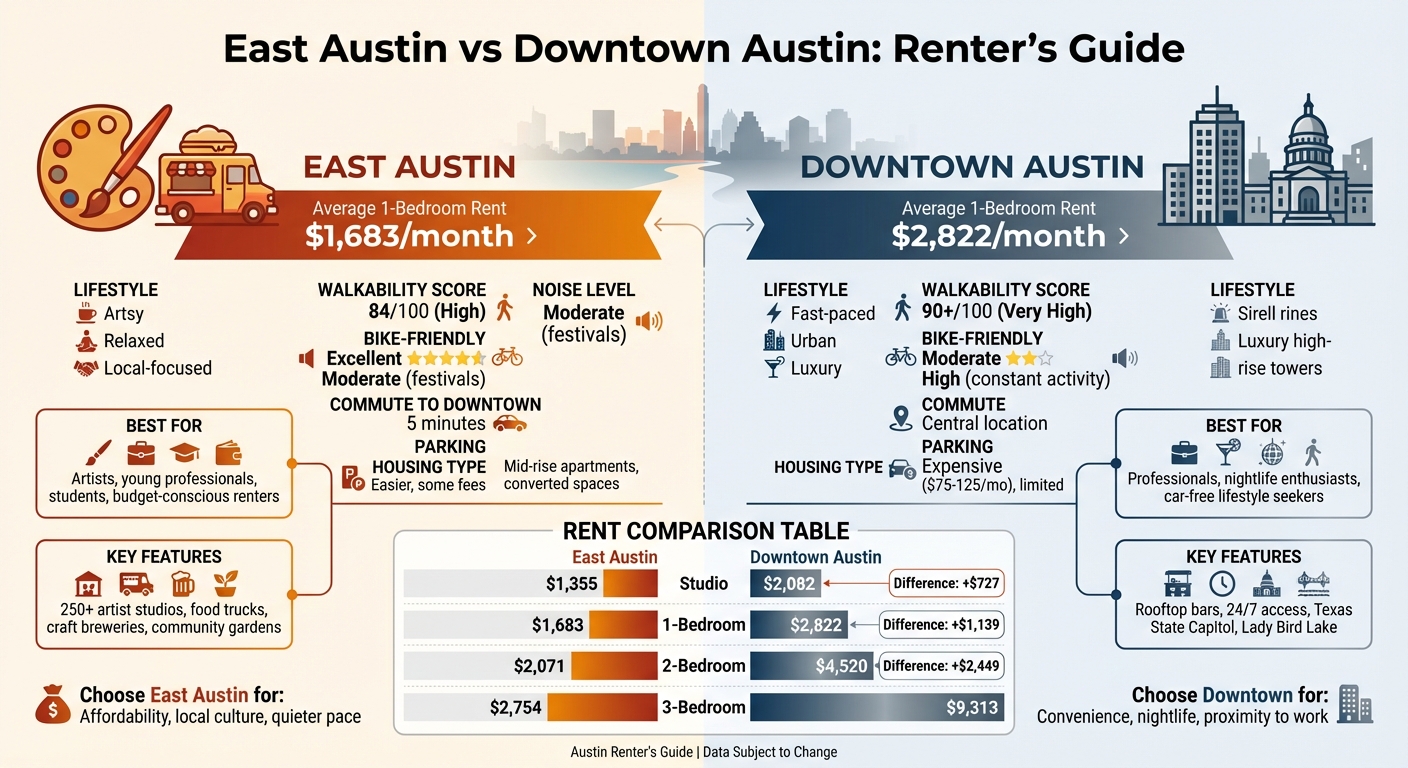
East Austin vs Downtown Austin Rental Comparison: Prices, Lifestyle, and Amenities
Neighborhood Vibe and Lifestyle
East Austin: Artsy and Relaxed
East Austin radiates a creative and community-centered energy. With over 250 artist studios, colorful murals, and a lineup of independent coffee shops, the neighborhood thrives on supporting local businesses. It’s also home to several community gardens and urban farms, emphasizing a close connection to sustainability and fresh, local produce.
"East Austin is often referred to as an ‘authentic’ view of Austin due to its unique vibe and culture." – Compass
A typical day in East Austin might start with a visit to a cozy coffee shop and end with casual bites from a beloved food truck or a lively evening at a honky-tonk bar. The area is known for its walkable streets, craft breweries, and welcoming community spaces. While historic bungalows dot the neighborhood, the skyline is gradually changing with the addition of modern luxury apartments, reflecting the area’s ongoing transformation.
In contrast, Downtown Austin offers an entirely different pace and atmosphere.
Downtown Austin: High-Energy Urban Core
Downtown Austin buzzes with the energy of city life. With 12,000 residents sharing the space with business professionals, tourists, and entertainment seekers, the sidewalks are always alive with activity. Events like South by Southwest bring an extra level of excitement, often packing the streets with festival-goers.
"Downtown: Where Austin’s dynamic past meets its ambitious future." – Compass
Living downtown means having 24/7 access to some of Austin’s best dining, nightlife, and cultural attractions. You’re steps away from iconic landmarks like the Texas State Capitol, upscale restaurants led by top chefs, luxury high-rise apartments with rooftop amenities, and the city’s central business district. The vibe here swaps East Austin’s eclectic charm for sleek high-rises, carefully designed green spaces, and a seamless blend of work and play. If you’re drawn to the idea of city views from a high-rise balcony rather than a backyard, Downtown Austin captures the essence of urban living.
sbb-itb-b58f532
Apartment Types and Building Styles
East Austin: Mid-Rise and Converted Spaces
East Austin offers a mix of mid-rise apartments, small multi-family properties (with fewer than 10 units), townhomes, and duplexes. What sets this area apart is its historic charm, often showcased in apartments converted from former industrial spaces or tech offices into residential units.
This blend of old and new creates a neighborhood where modern buildings share streets with early-20th-century bungalows, resulting in a distinctive architectural feel. As of January 2026, studio apartments in East Austin average 514 sq ft, one-bedroom units 713 sq ft, and three-bedroom apartments 1,395 sq ft. Many newer developments in the area—often cited among the best Austin neighborhoods for young professionals—come with lifestyle-focused amenities such as courtyard pools, dog parks, fitness centers, and even on-site coffee shops. While East Austin embraces a mix of styles, Downtown Austin takes a more vertical approach to living.
Downtown Austin: High-Rise Towers
Downtown Austin’s skyline is defined by luxury high-rise towers, with single-family homes being a rarity in this bustling district. These sleek skyscrapers feature contemporary designs, concrete construction, and private balconies that provide sweeping views of the city. The abundance of construction cranes in the area is a running joke among locals, symbolizing the rapid pace of new developments.
In terms of space, studios average 506 sq ft, one-bedroom apartments 794 sq ft, and three-bedroom units 2,069 sq ft, all boasting luxury finishes and impressive city views. These high-rise residences cater to those who prefer vertical living, trading traditional backyards for proximity to the central business district and its conveniences.
Rent Prices and What You Get
The cost of renting in Austin varies significantly depending on the neighborhood, especially for larger spaces. As of January 2026, renting a one-bedroom apartment in Downtown Austin costs $1,139 more per month compared to East Austin. For three-bedroom units, the difference is staggering – Downtown averages $9,313, while East Austin comes in at $2,754, creating a monthly gap of over $6,500.
Here’s a breakdown of the rent differences across various unit types:
| Unit Type | East Austin Avg Rent | Downtown Austin Avg Rent | Price Difference |
|---|---|---|---|
| Studio | $1,355 | $2,082 | +$727 |
| 1 Bedroom | $1,683 | $2,822 | +$1,139 |
| 2 Bedroom | $2,071 | $4,520 | +$2,449 |
| 3 Bedroom | $2,754 | $9,313 | +$6,559 |
Data as of January 2026 [2][3]
The price disparities reflect the distinct lifestyles and amenities offered by these neighborhoods. East Austin is known for its local charm, featuring attractions like food truck courts, craft breweries such as Hops & Grain and Lazarus, and outdoor spaces like Boggy Creek greenbelt. On the other hand, Downtown Austin commands higher rents due to its luxury services, including concierge amenities, rooftop bars, and proximity to entertainment hubs like Rainey Street and the Warehouse District. Downtown’s median rent of $3,145 is 66% higher than the national average, with an average cost of $3.29 per square foot.
Interestingly, Downtown one-bedroom apartments provide more space – 794 square feet compared to East Austin’s 713 square feet – but come with a hefty price tag. Recent data shows a slight easing in rents, with a 3.9% drop in East Austin and a 2.2% decline Downtown. For those seeking a balance between cost and convenience, Central East Austin (East Downtown) offers one-bedroom units averaging $2,167, which is approximately $650 less than Downtown’s average.
Walkability, Dining, Nightlife, and Daily Errands
East Austin: Food Trucks and Local Gems
East Austin stands out as one of the top Austin neighborhoods for renters outside of Downtown, with much of its pedestrian-friendly charm centered around key spots like East 6th Street, Cesar Chavez, and Manor Road. This neighborhood has become a haven for food enthusiasts, offering everything from casual taquerias to creative food trucks and chef-led restaurants. Food trucks, in particular, have become a defining feature of the area – famous names like Via 313 and la Barbecue got their start as mobile kitchens before evolving into permanent fixtures. These culinary hotspots reflect the neighborhood’s vibrant, community-driven vibe.
The dining options here are as diverse as they are exciting, featuring cuisines like Caribbean, Korean-American, Peruvian, and Northern Italian. For instance, Juniper offers a five-course prix-fixe menu for $85, catering to those seeking an upscale experience. Nightlife in East Austin is equally dynamic, with craft breweries like Hops & Grain and Lazarus setting a laid-back tone, while honky-tonk venues such as the White Horse bring a touch of local flair. For everyday needs, the area provides a mix of independent markets and specialty grocers, though those seeking a fully pedestrian lifestyle will find the most convenience near East 6th, Manor Road, or Rainey Street.
"East Austin is the most walkable neighborhood in Austin outside of Downtown. Skipping the strip-mall stage, East Austin went from poor old decrepit buildings to high-end modern apartments and office buildings." – Alexander Concepcion, Taco Street Locating
While East Austin charms with its unique local spots and walkable streets, Downtown offers a different kind of urban convenience.
Downtown Austin: Rooftop Bars and Around-the-Clock Access
Downtown Austin is a dream for those aiming to live car-free, partly due to parking costs that range from $75 to $125 per month. Apartments here boast walk scores well above 90, with daily essentials conveniently clustered around the 2nd Street District. Dining options are upscale and varied, from the omakase experience at Otoko to refined Chinese dishes at Qi. Nightlife thrives across micro-neighborhoods like 6th Street and the Warehouse District, offering everything from iconic rooftop bars such as Maggie Mae’s and The Belmont to creative venues like Garage and Container Bar.
What sets Downtown apart is its energy that extends far beyond happy hour. With 24/7 access to services and entertainment, the area remains vibrant at all hours.
"Downtown Austin is one of the better downtowns that I’ve seen in the US. It stays alive well after happy hour. People actually live here, they aren’t just downtown to work and then go home." – Alexander Concepcion, Taco Street Locating
Noise Levels, Crowds, and Event Traffic
East Austin: Festival Noise and Growing Crowds
East Austin’s noise levels are largely centered around its lively, walkable areas like East 6th Street, East Cesar Chavez, and the Rainey Street bungalow district. While the neighborhood is generally quieter during weekdays, weekends and festivals bring a significant spike in activity and sound.
Adding to the mix is the ongoing construction as the area evolves from its industrial roots into a more modern residential hub. Renters near bustling commercial streets like Manor Road and Chicon Street will notice higher traffic noise, while those living closer to I-35 will hear the hum of highway traffic along the neighborhood’s western edge. The transformation of East Austin has also brought vibrant venues like The White Horse, which features live music every night of the week, into previously quieter residential blocks.
Morning crowds are another hallmark of the area. For instance, lines at Franklin Barbecue start forming as early as 6:00 AM, hours before its 11:00 AM opening. If peace and quiet are priorities, consider looking for homes away from East 6th, Manor Road, or Chicon Street. Neighborhoods like Holly, Govalle, and Mueller offer more tranquil residential pockets.
In comparison, Downtown Austin provides a constant energy, driven by its urban vibe and steady influx of visitors.
Downtown Austin: Daily Crowds and Major Events
Unlike East Austin’s periodic noise spikes, Downtown Austin maintains a continuous hum of activity. With just around 12,000 residents but thousands of daily visitors, the area is alive with office workers, tourists, and nightlife enthusiasts. Key entertainment areas like the Red River Cultural District, the Warehouse District, and the iconic 6th Street keep the streets buzzing day and night.
Major events like SXSW and the nightly bat viewings near the Congress Street Bridge only add to the nonstop action. For those looking to escape the street noise, higher floors in newer high-rise towers are a solid option. These buildings often feature better soundproofing compared to the mid-rise and converted spaces typical of East Austin. Additionally, areas near the Texas State Capitol or around Wooldridge Square tend to be less crowded and offer a quieter atmosphere than the main entertainment districts.
Commute and Transportation Options
East Austin: Quick Downtown Access and Bike-Friendly Routes
Living in East Austin means you’re just a 5-minute drive from downtown during off-peak hours. Plus, it’s closer to Austin-Bergstrom International Airport, taking only about 10 minutes to get there, compared to the 19-minute drive from Downtown.
Public transit in East Austin is a solid option, thanks to the MetroRail Red Line. With stops at Plaza Saltillo and MLK Jr. Station, it’s a dependable way to dodge freeway traffic during rush hour. Monthly MetroRail and bus passes range from $41 to $80, which is a fraction of the $500–$900 monthly cost of owning a car. If biking is your thing, East Austin shines with its excellent protected bike lanes, making eco-friendly commutes a breeze.
Parking here is also more manageable than downtown. Most residential areas offer street parking, and newer walkable apartments in East Austin include structured parking. While hotspots like East 6th Street can get packed on weekends, residents generally avoid the daily parking headaches that come with downtown living.
Meanwhile, Downtown Austin focuses on pedestrian-friendly living and easy access to public transit.
Downtown Austin: Walkability and Transit at Your Doorstep
If you’re in Downtown Austin, you’ll find a lifestyle centered around walking and public transit. For those working in the urban core, commuting can be as simple as a short walk. Downtown serves as the city’s main transit hub, offering access to MetroRail, MetroRapid, and a variety of bus routes that all connect at the Downtown Station.
Parking downtown, however, is both scarce and pricey, which encourages a car-light approach. While rush hour traffic can be a hassle, adjusting your schedule by 30–45 minutes can cut travel times by up to 25%. For short trips, e-scooters and bike-share stations are widely available, but relying on them as your main mode of transport could set you back $150–$500+ per month.
Ultimately, the transportation options in East Austin and Downtown reflect two distinct ways of living – one prioritizing quick commutes and bike lanes, and the other embracing walkability and transit convenience.
East Austin: Pros and Cons
Here’s a closer look at the highlights and challenges of renting in East Austin.
East Austin combines affordable living with a creative, artsy vibe, making it an appealing option for renters. On average, renting a one-bedroom here can save you around $1,100 per month compared to other areas.
The neighborhood is known for its vibrant lifestyle, featuring colorful street art, bustling food trucks, and a strong sense of community. It also boasts top-rated bike lanes, easy access to parks, and urban farms, offering a mix of nature and city living. Plus, getting to downtown is convenient, often taking just five minutes by car during off-peak hours.
That said, East Austin isn’t without its downsides. The area faces frequent construction, limited parking (which often comes with hefty garage fees), and poorly maintained roads, which can be a daily hassle. Noise from festivals and nightlife can also disrupt the peace. Additionally, crime – especially petty theft – is higher than the national average, with 2,849.7 incidents per 100,000 residents, compared to the national rate of 2,042.8. Gentrification is another concern, driving rent increases in some areas and altering the neighborhood’s historic charm.
Here’s a quick breakdown of the pros and cons:
| Pros | Cons |
|---|---|
| Affordable rent for budget-conscious renters | Rising rents in certain areas due to gentrification |
| A lively, creative atmosphere with street art and local culture | Ongoing construction and redevelopment noise |
| Excellent walkability and bike-friendly infrastructure | Limited parking options and high garage fees |
| Access to food trucks and unique local bars | Noise from festivals and nightlife |
| Close to parks, urban farms, and community gardens | Higher rates of petty theft compared to national averages |
Downtown Austin: Pros and Cons
Downtown Austin offers a vibrant urban lifestyle with plenty of perks but also a few trade-offs to consider.
renting an apartment in Downtown Austin means you’ll enjoy unmatched walkability, with easy access to major employers, the iconic nightlife of Sixth Street and Rainey Street, and scenic spots like Lady Bird Lake and its surrounding urban trails. The area also serves as the city’s central transit hub, making it convenient for those who rely on public transportation. Plus, the luxury high-rises in Downtown come packed with modern features – think pools, gyms, concierge services, and breathtaking views. But, as with any bustling city center, there are some challenges to navigate.
For one, living Downtown comes with a hefty price tag. Renters here pay significantly more compared to areas like East Austin, with prices exceeding both local and national averages. The area’s popularity also means you’ll often find yourself navigating crowded sidewalks, especially during major events like SXSW or on weekend nights. Construction noise is another common complaint. As the Compass Neighborhood Guide humorously notes, “the official bird of Austin is the construction crane”.
Practical hurdles include limited parking options and the lack of single-family homes – many residents trade the idea of a private yard for a balcony. While the constant energy of Downtown is an undeniable draw, it also brings persistent noise from nightlife hotspots and large-scale events.
Here’s a quick breakdown of the pros and cons:
| Pros | Cons |
|---|---|
| Walkable access to errands, work, and entertainment | Higher rent compared to East Austin |
| Central transit hub for easy commuting | Crowded sidewalks during peak events |
| Luxury high-rises with top-tier amenities | Frequent construction noise and road closures |
| Proximity to Lady Bird Lake and urban trails | Limited single-family housing – balconies replace yards |
| Thriving restaurant and bar scene | Expensive and difficult parking for drivers |
Downtown Austin is a mix of convenience, excitement, and challenges, making it a unique choice for those who thrive in an energetic urban setting.
Who Should Choose East Austin
If you’re looking for a neighborhood that blends affordability with a creative vibe, East Austin might just be your perfect match.
This area buzzes with urban energy and a strong sense of community, all at a lower cost compared to Downtown. It’s a haven for artists, boasting over 250 studios and vibrant street art that adds character to the streets. Local galleries, independent shops, and makers create a thriving creative scene. For young professionals, particularly those in tech, East Austin offers easy access to downtown job hubs while providing a more laid-back atmosphere to unwind after hours.
Students will find East Austin appealing thanks to its close proximity to the University of Texas at Austin and Huston-Tillotson University. Plus, with an impressive walkability score of 84/100, getting around is a breeze.
Food lovers are spoiled here, with a dining scene that includes everything from iconic barbecue joints and food trucks like Veracruz All Natural to craft breweries and honky-tonks along East 6th Street. For those who enjoy outdoor activities, the neighborhood is close to Lady Bird Lake trails (and nearby luxury apartments) and the Boggy Creek Greenbelt, offering plenty of opportunities to connect with nature.
And for renters on a budget, East Austin is a standout choice. One-bedroom apartments average $1,683 – far more affordable than Downtown’s $2,822.
Who Should Choose Downtown Austin
Downtown Austin is a prime spot for professionals who want to skip long commutes. Nestled in the heart of the city, it’s close to the Texas State Capitol and surrounded by tech companies and startups. Here, walking or biking to work isn’t just possible – it’s practical. While you might trade a suburban yard for a sleek high-rise, you gain stunning city views and a lifestyle that blends work and play seamlessly.
Living Downtown means embracing a lively, urban vibe. If you’re into nightlife and culture, you’ll love being steps away from hotspots like Sixth Street, Rainey Street, the Red River Cultural District, and the Warehouse District. From rooftop bars and live music to late-night eats, the energy of the city is always within reach. Of course, this comes with a cost – Downtown’s median rent sits at $3,145, which is 66% higher than the national average.
For those who prefer getting around without a car, Downtown makes it easy. Its walkability and public transit options are a huge draw, with the MetroRail station serving as a central hub for connecting to the rest of Austin. Plus, there are plenty of electric vehicle charging stations for eco-conscious drivers. Outdoor enthusiasts aren’t left out either – Lady Bird Lake offers paddleboarding, kayaking, and access to the Ann and Roy Butler Hike & Bike Trail.
Downtown Austin is home to about 12,000 residents, and 63% of them are renters. This compact, vibrant community comes with a premium, as one-bedroom rental prices here are higher than those in East Austin apartments. But for those who crave a dynamic and convenient urban lifestyle, Downtown delivers.
Find Your Austin Apartment
Looking at the differences between these neighborhoods, it’s clear they cater to distinct lifestyles. Downtown Austin offers a sleek, urban vibe with high-rise living, easy access to work, nightlife, and public transit. On the other hand, East Austin provides a more artistic and laid-back atmosphere, just a short hop from the city center. The cost difference reflects this contrast – renting a one-bedroom apartment Downtown averages $2,822, while in East Austin, it’s a more budget-friendly $1,683. Both areas are highly walkable, but the overall feel sets them apart: Downtown appeals to professionals seeking convenience and energy, while East Austin attracts those who appreciate its creative, local charm.
If you’re trying to decide which neighborhood suits you best, Taco Street Locating can make the process easier. They offer free, personalized apartment-finding services tailored to your preferences. Whether you’re drawn to Downtown’s skyline views and buzzing nightlife or East Austin’s food trucks and colorful street art, their team handles everything – from consultations and research to apartment tours and application assistance – all at no cost to you.
Thanks to recent market trends, renters now have more negotiating power. Many leases include move-in perks like "1 Month Free" or "2 Months Free" deals. Taco Street Locating stays on top of these offers, ensuring you get the best deals and incentives in either neighborhood.
FAQs
What’s the difference in lifestyle between living in East Austin and Downtown Austin?
East Austin and Downtown Austin cater to two distinct lifestyles, each with its own charm and personality.
East Austin has a relaxed, creative vibe that blends historic charm with modern touches. Picture streets lined with murals, food trucks serving up delicious bites, and boutique coffee shops where locals gather. The area also boasts a growing craft beer scene and offers easy access to outdoor activities, like the trails around Lady Bird Lake and nearby parks. It’s a neighborhood that thrives on community connections and a laid-back atmosphere.
Downtown Austin, by contrast, is the heart of the city’s urban energy. High-rise apartments dominate the skyline, and walkability is a key feature here. From trendy restaurants to the buzzing nightlife of Sixth Street and Rainey Street, the area is alive with activity. Live music venues add to the excitement, making it a prime spot for those who love being in the thick of things, with all the conveniences of city living just steps away.
If you’re drawn to an artsy, community-focused environment, East Austin might feel like home. But if you’re all about the fast-paced, dynamic city life, Downtown Austin is where you’ll want to be.
How do rental prices differ between East Austin and Downtown Austin?
Renting in Downtown Austin comes with a hefty price tag compared to East Austin. As of 2025, studio apartments in Downtown average around $1,977 per month, while similar spaces in East Austin cost about $1,406 per month. If you’re looking for a one-bedroom, Downtown units are priced at approximately $2,811 per month, significantly higher than East Austin’s $1,733 per month. The gap widens further with two-bedroom apartments, which average $4,556 per month downtown – more than double East Austin’s $2,121 per month. For families or roommates needing a three-bedroom, Downtown rents soar to $9,035 per month, compared to just $2,696 per month in East Austin.
The steep prices in Downtown Austin are tied to its upscale high-rises, bustling urban atmosphere, and easy access to top amenities. On the other hand, East Austin provides a more affordable alternative, offering a relaxed and creative vibe. Recent trends show Downtown rents inching up slightly (a 0.8% year-over-year increase), while East Austin has seen a 4.2% drop, making it an attractive option for budget-conscious renters.
What are the transportation options in East Austin and Downtown Austin?
East Austin boasts a variety of transportation options to suit different needs. The area is well-served by Capital Metro’s bus network and nearby MetroRail stations, making it easy to reach downtown and other key destinations. For cyclists, the neighborhood shines with its expanding network of protected bike lanes and access to the scenic Ann and Roy Butler Hike-and-Bike Trail. If driving is more your speed, major highways like I-35 and 183 ensure convenient access. Rideshare services like Uber and Lyft are also readily available, offering another layer of flexibility.
Downtown Austin, on the other hand, is a hub of convenience for those who love to walk or bike. With most daily errands manageable on foot or two wheels, the area is both walkable and bikeable. Capital Metro buses and the Red Line MetroRail provide strong public transit links, while scooter and bike rentals add even more options for short trips. For drivers, municipal parking garages and metered street parking are easy to find, and rideshare services are always just a tap away. Whether you prefer walking, biking, or taking public transit, Downtown Austin makes getting around a breeze.
Looking for an apartment that matches your commuting needs? Let us help you find the perfect place!