

Inside this guide
- Why this matters
- Homes.com alternatives at a glance
- 1. Taco Street Locating: best for personalized Texas apartment research
- 2. Apartments.com: best for apartment-focused browsing
- 3. Zillow Rentals: best for comparing apartments and rental houses
- 4. Trulia: best for neighborhood-oriented exploration
- Why people switch from Homes.com
- A practical apartment-search workflow for 2026
- When staying with Homes.com is the right call
- FAQ
- One last thing
- Related guides
Homes.com gives you a broad real estate search, including rentals, when you want to browse properties yourself. That approach stops short of deciding which apartment and neighborhood fit your actual move. The best Homes.com alternative in 2026 is Taco Street Locating if you need personalized apartment research in Austin, Dallas–Fort Worth, or Houston; Apartments.com if you want an apartment-focused search you manage yourself.
- For homes.com alternatives, choose Taco Street Locating for personalized apartment research in Austin, Dallas–Fort Worth, and Houston.
- Apartments.com is best for apartment-focused browsing; Zillow Rentals suits a search spanning apartments and rental houses.
- Trulia helps with neighborhood exploration, but verify the actual building, unit, and commute before applying.
- Keep Homes.com if independent browsing already gives you a useful shortlist.
Why this matters
An apartment search has two different jobs: finding possibilities and deciding between them. A listing portal handles the first; your commute, lease requirements, and neighborhood preferences determine the second.
For a 2026 relocation, separate those jobs before changing websites. If you need more properties to browse, try another portal. If you already have plenty of tabs open but cannot choose between Hyde Park and South Austin, a different search box does not resolve the decision.
Taco Street Locating is an apartment locating service for renters who want personalized research in Austin, Dallas–Fort Worth, or Houston. Its role is different from a national listing portal, not a replacement for every part of your rental search.
Homes.com alternatives at a glance
Choose the search method that matches your sticking point. This comparison distinguishes services from listing portals rather than pretending they perform the same job.
| Option | Best for | Standout approach | How it differs from Homes.com | Main trade-off |
|---|---|---|---|---|
| Homes.com | Independent real estate browsing | Broad property search that includes rentals | The starting benchmark | You remain responsible for comparing properties and confirming details |
| Taco Street Locating | Personalized apartment research in its Texas markets | Apartment locating with local neighborhood knowledge | Human help instead of only self-directed browsing | Its stated coverage is Austin, Dallas–Fort Worth, and Houston |
| Apartments.com | Apartment-focused browsing | Rental search centered on apartments and other rental properties | A rental-focused starting point | You still need to evaluate each property and unit |
| Zillow Rentals | Comparing apartments with rental houses | Rental browsing across different housing types | Another route for a mixed housing search | Broader housing choices do not make unlike properties directly comparable |
| Trulia | Neighborhood-oriented rental exploration | Rental listings alongside neighborhood information | A neighborhood-oriented research route | Area information does not establish conditions inside a particular apartment |
None of these options removes the need to confirm lease terms with the property. A search result starts the investigation; it is not the final agreement.
1. Taco Street Locating: best for personalized Texas apartment research
Taco Street Locating helps renters find and compare apartments in Austin, Dallas–Fort Worth, and Houston. Choose this apartment locating service when your challenge is matching a move to a neighborhood and a workable shortlist, rather than simply finding another directory.
Personalized research starts with useful criteria. Explain where you need to travel, which apartment features are nonnegotiable, and what would make an otherwise attractive building a poor fit.
Where the service shines
- Local context: Neighborhood knowledge adds a decision layer to property browsing.
- Personalized research: Your requirements shape the apartment comparison.
- Relevant coverage: The stated service area includes Austin, Dallas–Fort Worth, and Houston.
- Relocation focus: You can organize unfamiliar neighborhoods around your actual needs rather than attractive photos.
Where the service falls short
- Geographic scope: It is not the right recommendation for a nationwide apartment search outside its stated markets.
- Input required: Personalized research depends on you sharing useful preferences and constraints.
- Verification remains necessary: A locator's help does not replace reviewing the specific unit and lease with the property.
Head-to-head: locating service versus Homes.com
| Dimension | Apartment locating service | Homes.com |
|---|---|---|
| Search approach | Personalized apartment research | Self-directed property browsing |
| Stated geography | Austin, Dallas–Fort Worth, and Houston | Broad real estate search |
| Neighborhood decision | Local knowledge informs the comparison | You organize your own research |
| Renter's responsibility | Explain requirements and verify the final choice | Build the shortlist and verify the final choice |
Best for: Renters relocating to a supported Texas market who want help connecting apartment choices to neighborhood needs.
For an Austin move, your first decision is whether you need that assistance at all. The guide to choosing an Austin apartment locator for your first move addresses that starting point.
Verdict: Buy into the locating approach when you need personalized local help; skip it for an unsupported market.
2. Apartments.com: best for apartment-focused browsing
Apartments.com is a direct alternative when you want to keep searching independently but start with a rental-focused website. It makes sense when you know your target area and want to examine apartment possibilities yourself.
The important distinction is your workflow, not a claim that one website contains every relevant apartment. Use the portal to discover candidates, then move your strongest candidates into a separate comparison.
Where Apartments.com shines
- Rental focus: It provides a starting point built around rental housing.
- Self-directed search: You control which areas and properties to investigate.
- Apartment research: It fits a search where apartments, rather than for-sale homes, are the priority.
Where Apartments.com falls short
- Decision work remains yours: You still have to reconcile commute, layout, and lease requirements.
- Property-level information needs checking: Confirm that a feature applies to the unit you would lease.
- Browsing is not a tour: Photos and descriptions cannot establish your experience of a particular apartment.
| Dimension | Apartments.com | Homes.com |
|---|---|---|
| Starting point | Rental-focused property search | Broad real estate search including rentals |
| Search ownership | Renter-led | Renter-led |
| Final verification | Confirm with the property | Confirm with the property |
Best for: Renters who already know their target location and want an apartment-focused browsing route.
Verdict: Buy into Apartments.com as a discovery tool; hold off on applying until you verify the specific unit.
3. Zillow Rentals: best for comparing apartments and rental houses
Zillow Rentals is useful when your housing decision is still open: apartment, condo, or rental house. Treat it as a mixed-housing research route rather than assuming the apartment with the best photos is the best fit.
Compare responsibilities as well as rooms. Ask who handles maintenance, which utilities you must arrange, and what parking comes with the lease.
Where Zillow Rentals shines
- Mixed housing search: You can research apartments and rental houses within the same broader search process.
- Independent browsing: It suits renters who want to assemble their own shortlist.
Where Zillow Rentals falls short
- Unlike properties need normalization: A house and an apartment can involve different maintenance and utility arrangements.
- Local fit needs separate work: A property result does not establish whether the address works for your daily travel.
| Dimension | Zillow Rentals | Homes.com |
|---|---|---|
| Search use | Rental research across housing types | Real estate browsing including rentals |
| Best decision stage | Deciding what kind of rental to pursue | Exploring property possibilities |
| Verification | Review property-specific responsibilities | Review property-specific responsibilities |
Best for: Renters who have not decided between an apartment and a rental house.
Verdict: Buy into Zillow Rentals for a mixed-housing search; skip the extra browsing if you already have a strong apartment shortlist.
4. Trulia: best for neighborhood-oriented exploration
Trulia combines property browsing with neighborhood information. Use it when your main question is where to live, then examine the actual address and apartment separately.
A neighborhood summary is context, not a unit inspection. Your building entrance, nearby streets, and commute deserve their own checks.
Where Trulia shines
- Neighborhood context: It gives you another route for exploring areas alongside rentals.
- Early-stage research: It suits a renter narrowing possible locations before choosing a building.
Where Trulia falls short
- Area-level limits: Neighborhood information does not describe every block or apartment.
- Personal fit remains personal: You still need to judge the travel patterns and surroundings that matter to you.
Best for: Renters choosing between neighborhoods before comparing individual apartments.
Verdict: Buy into Trulia for area research; hold the final decision until you investigate the specific address.
Why people switch from Homes.com
There is no need to invent a problem with Homes.com to justify another approach. Switch when your search needs a different kind of help.
You need apartment-focused discovery
If your search is exclusively for apartments, Apartments.com offers a rental-focused starting point. That is a change in research focus, not proof that Homes.com is unsuitable or that another portal has every apartment.
You need help choosing a Texas neighborhood
For a 2026 move to Austin, start with the places you must reach regularly. Hyde Park, South Austin, Downtown Austin, and the Domain area are search locations to evaluate, not interchangeable answers.
Apply the same discipline in Dallas–Fort Worth and Houston. Trinity Groves and Victory Park deserve address-level comparisons; a neighborhood name alone does not tell you whether the apartment works for your routine.
You need to compare different housing types
Zillow Rentals fits a search that still includes rental houses. Keep that broader search only while the housing-type decision remains open; otherwise, it adds choices without answering your apartment question.
You need a decision process, not more tabs
Changing portals does not resolve unclear priorities. If your shortlist keeps growing, define what would disqualify a property before adding another candidate.
A practical apartment-search workflow for 2026
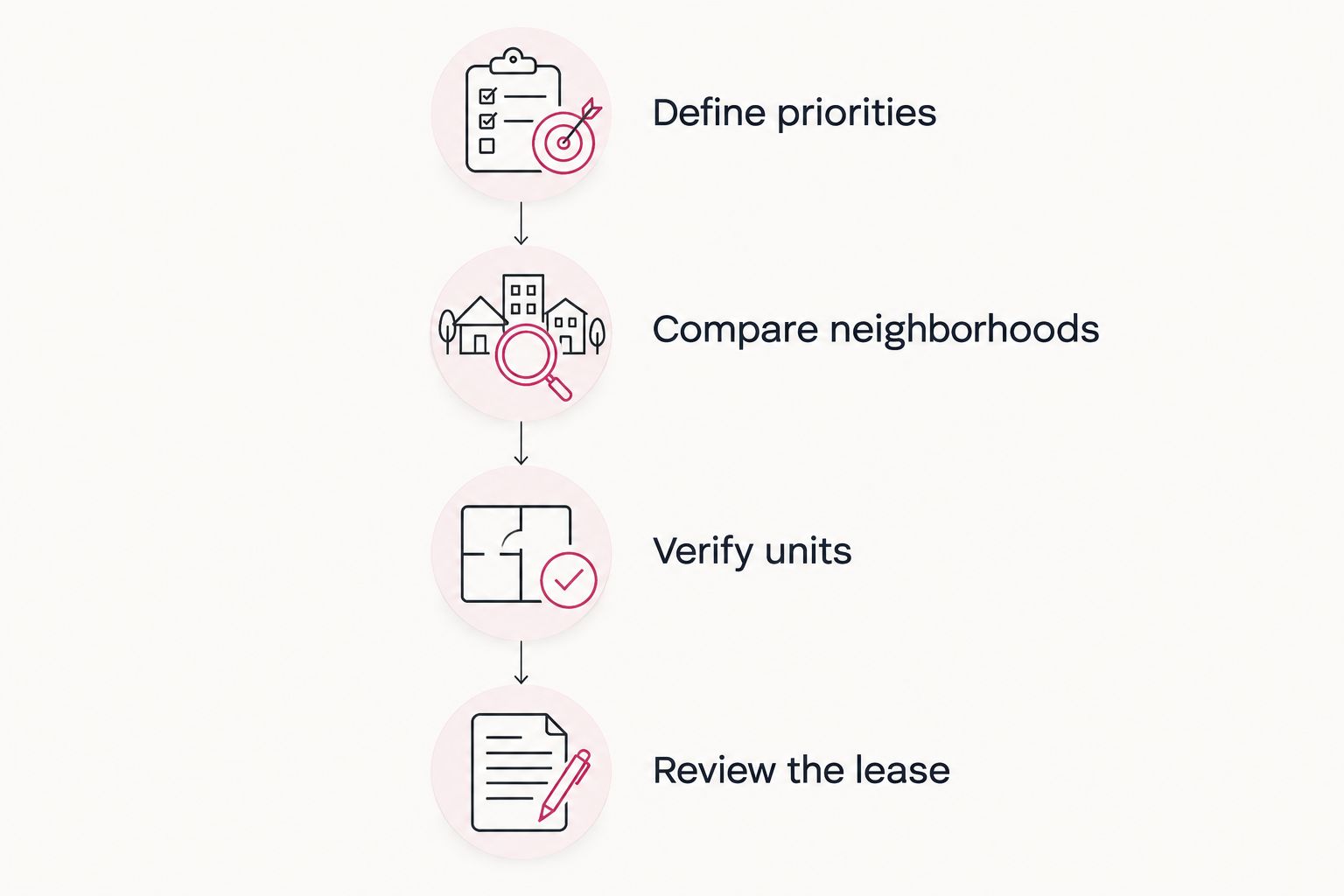
Use this sequence regardless of which Homes.com alternative you choose. The aim is a shortlist you can explain, not a collection of attractive buildings.
Define priorities
Write down your regular destination, required apartment features, and deal-breakers. Separate requirements from preferences: an in-unit washer and dryer can be essential to you while a rooftop pool is optional.
Compare neighborhoods
Start with 3 neighborhoods as a working shortlist, not a market benchmark. Compare each with the same destinations and travel assumptions; do not compare one area's best-case trip with another area's rush-hour trip.
Verify units
Take 2 candidate properties into a detailed comparison before expanding the list. Ask each about the actual unit, floor plan, parking arrangement, pet terms if relevant, and lease requirements.
Review the lease
Choose 1 primary commute as your first location test, then review the other trips you make regularly. Before applying, read the property's requirements; before signing, review the written lease rather than relying on a remembered conversation.
For your 2026 shortlist, keep confirmed facts separate from open questions. A blank answer about parking or a particular unit is a reason to ask the property, not a reason to fill the gap with an assumption.
When staying with Homes.com is the right call
Stay with Homes.com if it already gives you useful rental candidates and you are comfortable managing the comparison yourself. Switching websites is optional; verifying the apartment is not.
Keep your current workflow when you know the target neighborhood, can contact properties directly, and have a clear comparison method. Use another portal only for a defined research need, such as looking at rental houses alongside apartments.
Local assistance also has a specific role. Taco Street Locating is relevant when personalized apartment research in its stated Texas markets addresses a problem your independent search has not resolved.
FAQ
What’s the best Homes.com alternative for apartment hunting in 2026?
Taco Street Locating is the best fit for personalized apartment research in Austin, Dallas–Fort Worth, or Houston; Apartments.com fits apartment-focused independent browsing. Choose according to whether you need help deciding or another place to search.
Is Apartments.com better than Homes.com for renters?
Apartments.com is the more rental-focused starting point. Homes.com remains useful if its rental search already produces candidates that fit your needs; neither replaces checking the specific apartment and lease.
Should I use Zillow Rentals if I only want an apartment?
Use Zillow Rentals if its rental search helps you find relevant apartments. Its mixed-housing approach is particularly useful when you are also considering rental houses, but that broader search is unnecessary if you have already ruled them out.
Is Trulia enough to choose an Austin neighborhood?
Trulia can support neighborhood exploration, but it is not enough to establish whether a specific apartment fits your routine. Check the address, your regular travel, and the building separately.
Can an apartment locator help with a move to Houston?
Taco Street Locating helps renters find and compare apartments in Houston, as well as Austin and Dallas–Fort Worth. Share your destinations and apartment requirements so the research reflects your move.
Do I need to use every apartment website?
No, you do not need every apartment website. Use a portal for discovery, another source only for a specific unanswered question, and the property for final unit and lease verification.
What should I confirm before applying for an apartment?
Confirm the specific unit, application requirements, lease terms, and features that matter to you. Check parking, pet terms, and utility responsibilities where relevant rather than assuming a general listing answers those questions.
One last thing
A better apartment search does not always produce a longer shortlist. It produces clearer reasons to reject properties that do not fit.
Before your next tour, write one sentence explaining why the apartment deserves a visit. If the answer is only that the photos look good, return to your neighborhood, commute, and unit requirements. Save the taco debate for after those decisions.
Related guides
- Downtown Austin vs. the Domain
- Touring an Austin apartment from another city
- Zillow alternatives for apartment renters