
Inside this guide
- How much does an apartment locator cost in Texas?
- Why this matters
- Free locating and apartment expenses are separate
- Property-paid commissions: understand the arrangement
- Why apartment-search expenses vary
- How to confirm your locator arrangement before applying
- Is a free locator or a self-directed search better for you?
- Where personalized apartment help fits
- Does a free apartment locator mean my application is free?
- Does using a locator guarantee a cheaper apartment?
- Can a locator guarantee my application will be approved?
- FAQ
- One last thing
- Related guides
A free apartment locating service charges you no locator fee, but Texas renters should confirm the payment arrangement before agreeing to any service in 2026. Free locating does not mean a free apartment application or lease: the property's charges remain separate, and a locator's agreement should explain any renter-paid obligations.
- How much does an apartment locator cost? A free service charges no locator fee; confirm the agreement before proceeding.
- Taco Street Locating is a free apartment locating service for renters in Austin, Dallas–Fort Worth, and Houston.
- Apartment application charges, deposits, and lease expenses are separate from apartment locating.
- Ask who pays the locator, which properties the search covers, and whether any renter-paid obligations apply.
How much does an apartment locator cost in Texas?
A free apartment locator charges the renter no locating fee. That does not establish a universal fee for every Texas locator or every type of rental search. Before you share documents or authorize work, ask for the service's payment terms in writing.
The distinction is between paying someone to help you search and paying a property to apply, reserve a home, or move in. Those are different transactions. A free search does not erase the property's application requirements or lease obligations.
If you're comparing services for an Austin move, start with the practical questions in this guide to choosing an Austin apartment locator for your first move. Confirm the financial arrangement before discussing a shortlist.
| Expense or payment | What it covers | What you should confirm |
|---|---|---|
| Locator service fee | Help finding and comparing apartments | Whether you owe anything for the service |
| Property-paid commission | Compensation under a property's referral arrangement | Who pays and what referral steps apply |
| Application-related charges | The property's application process | Amounts, refund terms, and when payment is due |
| Deposit or other move-in charges | Obligations associated with the apartment | Which charges apply to your chosen home |
| Recurring lease expenses | The apartment and required ongoing services | The complete written monthly charge breakdown |
Use this separation throughout your 2026 search. A locator's fee disclosure answers one question; the property's written quote answers another.
Why this matters
A search can be free while the apartment still stretches your budget. If you focus only on the absence of a locator fee, you can overlook required charges, transportation expenses, or a lease term that doesn't fit your plans.
Treat the locator question as an early screening step, not the final affordability test. Once you understand who pays for the search, compare the actual apartments using the same move-in date, lease length, and household requirements.
This matters especially when you're relocating. A neighborhood name isn't enough to judge whether a home works for your commute, pets, parking needs, and daily errands.
Free locating and apartment expenses are separate
For a free apartment locating service, the renter-facing benefit is straightforward: you can get search help without paying a locating fee. The limitation is just as important. That arrangement doesn't determine whether a particular property approves your application or whether its lease fits your budget.
Before applying anywhere, request an itemized statement from the property. Separate charges due with the application from charges due before receiving keys, then distinguish both from recurring expenses.
Ask about these categories rather than assuming every property handles them the same way:
- Application charges: What must each applicant pay, and what happens if the application is denied?
- Deposits: What is required, when is it due, and what written refund conditions apply?
- Administrative charges: Are there separate processing or move-in charges?
- Parking and pets: Which charges apply to your household and selected parking arrangement?
- Required services: Which utilities or service packages are separate from the apartment's advertised rent?
These questions are a checking list, not a claim that every property charges every item. Get answers for the exact home you're considering. A sample quote for another floor plan is not your lease breakdown.
Property-paid commissions: understand the arrangement
In a property-paid referral arrangement, the apartment community pays the locator under its agreement with that locator. The renter should still ask how the referral is recorded and whether any separate agreement creates obligations for the renter.
Don't substitute assumptions for a written explanation. Ask whether you must identify the locator when contacting the property, arranging a tour, or submitting an application. Follow the instructions that actually apply to that service and property.
Compensation also raises a useful search question: does the shortlist include every property you want considered, or only properties participating in the locator's referral network? A short list can be helpful, but it shouldn't be mistaken for a complete inventory of every rental in a city.
If you've already contacted a community, say so before the locator starts work. Share the property's name and explain whether you requested information, toured, or applied. That gives the locator an opportunity to clarify whether a referral arrangement still applies.
Why apartment-search expenses vary
The absence of a locator fee doesn't make apartments financially interchangeable. For your 2026 comparison, keep the search service separate from the choices that determine your housing obligations.
- Service scope: Ask whether the agreement covers apartment locating alone or includes separately described work. Don't assume every relocation service follows the same terms.
- Property requirements: Request the chosen property's application and move-in charge schedule rather than relying on another community's paperwork.
- Lease length: Compare apartments using the lease term you actually need. Different terms aren't an equal comparison.
- Household needs: Include pets, vehicles, accessibility requirements, and other needs when requesting a complete quote.
- Included services: Establish which services are included and which are separately billed before judging affordability.
- Location: Evaluate transportation and parking alongside the apartment itself. A neighborhood match must work on an ordinary workday, not just during a tour.
The point isn't to predict an amount without a property quote. It's to prevent a missing category from making an apartment look more affordable than it is.
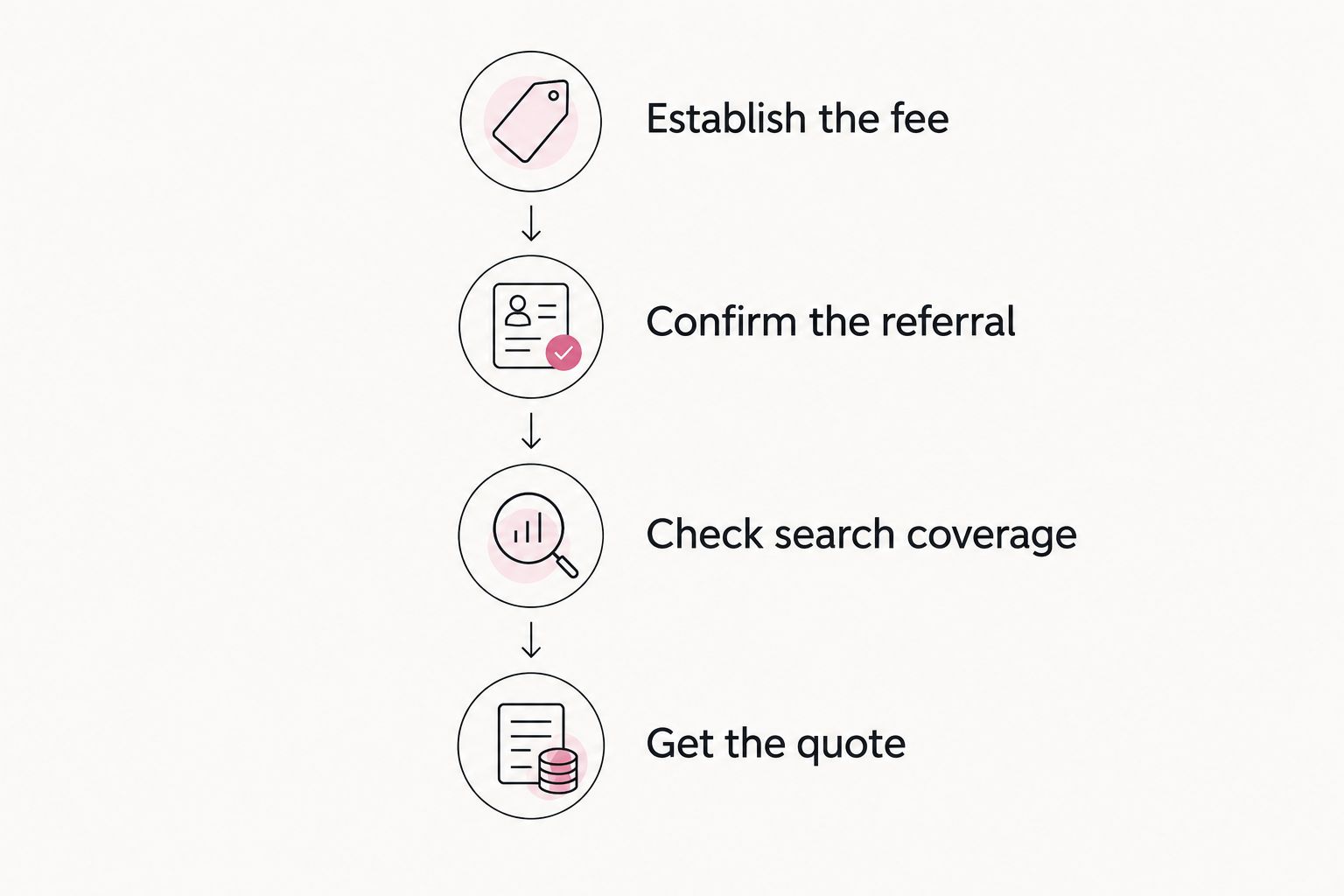
How to confirm your locator arrangement before applying
You don't need a complicated spreadsheet to establish who pays for apartment locating. You do need clear answers before you commit.
Establish the service fee
Ask whether the locating service is free to you and whether any circumstance creates a renter-paid obligation. Request the answer in writing, including the scope of the service. Read any agreement before signing it.
Don't interpret a casual statement about free help as an explanation of every document you receive. If the written terms appear inconsistent with the conversation, resolve that difference first.
Confirm the referral
Ask who compensates the locator and what you need to do when contacting a property. Tell the locator about previous conversations, tours, and applications so the referral instructions reflect your actual search history.
Save those instructions with your apartment notes. You shouldn't have to reconstruct the arrangement from scattered messages while completing an application.
Check search coverage
Describe your must-haves, then ask whether the locator works with properties that fit them. Include your preferred neighborhoods, move timing, commute destination, and any unusual housing requirements.
Ask what happens if a property you find independently isn't included. That answer helps you decide whether you need to continue a separate search alongside the locator's recommendations.
Get the property quote
Request the apartment's own written charge breakdown and application criteria. Confirm the selected floor plan, lease dates, required payments, and included services directly with the property before paying or signing.
Keep the service agreement and the property quote separate. One explains your relationship with the locator; the other explains the apartment transaction.
Is a free locator or a self-directed search better for you?
Choose based on the help you need, not the assumption that either route guarantees a better apartment. A locator offers another person to help with the search; searching independently leaves you responsible for organizing it.
| Search approach | Best for | Practical advantage | Limitation to check |
|---|---|---|---|
| Free apartment locator | Renters who want personalized apartment research and neighborhood guidance | Human help comparing apartments against your requirements | Confirm property coverage and the service agreement |
| Self-directed search | Renters who want to manage property research and outreach themselves | You choose which properties to investigate | You handle the comparison, follow-up, and verification |
| Combined search | Renters who want guidance while checking independently found properties | You can discuss your own finds with a locator | Coordinate outreach and referral instructions before applying |
A combined approach doesn't require turning every listing into a tour. Start with a clear brief, identify unresolved questions, and investigate only the apartments that meet your nonnegotiable requirements.
Keep one comparison sheet regardless of the search route. Record the source and date of each quote, then update it when the property provides new terms. For a 2026 move, old screenshots are research notes, not current commitments.
Where personalized apartment help fits
Taco Street Locating is best for renters who want free apartment locating help in Austin, Dallas–Fort Worth, or Houston. Its role is helping renters find and compare apartments through personalized research and local neighborhood knowledge.
Bring Taco Street Locating a specific brief rather than a request for somewhere nice. Include where you need to travel, what your household needs, and which compromises you're willing to make.
For example, ask whether Hyde Park or South Austin better fits your Austin search criteria. In Dallas, make the same practical comparison between Trinity Groves and Victory Park. These are questions to investigate, not a promise that any neighborhood or apartment meets your needs.
The service doesn't replace your review of the lease or the property's approval process. Its stated coverage is Austin, Dallas–Fort Worth, and Houston; don't assume a search elsewhere in Texas is included.
Start your apartment search
Get free apartment locating help in Austin, Dallas–Fort Worth, or Houston.
Does a free apartment locator mean my application is free?
A free locator service does not make the property's application free. Ask the property for its current application requirements and payment terms before submitting personal information or payment.
Treat the application as its own decision. Confirm that the apartment fits your needs and that you understand the screening requirements before proceeding.
Does using a locator guarantee a cheaper apartment?
A free locator service does not guarantee a lower apartment quote. Compare the same apartment, lease term, move-in date, and required services before deciding that one offer is financially better.
Ask the property to explain any difference between quotes. Don't assume the difference comes from using a locator, and don't treat an expired promotion as part of your current offer.
Can a locator guarantee my application will be approved?
A free locator service does not guarantee application approval. The property evaluates the application under its requirements, so direct eligibility questions to the property before paying application-related charges.
Explain documentation concerns early. A useful shortlist still needs to lead to apartments whose application requirements you understand.
FAQ
How much does an apartment locator cost in Texas?
A free apartment locating service charges the renter no locating fee. Confirm the particular service’s written agreement rather than assuming all Texas locators use identical terms.
Is Taco Street Locating free for renters?
Taco Street Locating is a free apartment locating service for renters in Austin, Dallas–Fort Worth, and Houston. The property’s application, deposit, and lease obligations remain separate.
Who pays an apartment locator if the service is free?
In a property-paid referral arrangement, the apartment community compensates the locator under their agreement. Ask the service to explain its own arrangement and any referral instructions before applying.
Will I still have to pay an apartment application fee?
Free apartment locating does not waive a property’s application charges. Request the chosen property’s current written requirements and refund terms before paying.
Do I need to put my locator’s name on my application?
Ask your locator and the property how the referral must be recorded. Explain any previous contact with the property before submitting an application.
Can I use a locator and search on my own?
You can discuss independently found apartments with a locator while continuing your own research. Confirm the service agreement, property coverage, and referral instructions so your outreach stays coordinated.
Does a locator guarantee that I’ll get approved?
A locator does not guarantee property approval. Confirm the property’s screening requirements and acceptable documentation before deciding to apply.
One last thing
Before you judge an apartment quote, check that it describes the home you would actually lease. A different move-in date, lease term, or parking arrangement can turn an apparent comparison into two different offers.
For your 2026 search, save the locator agreement and property quote together, but review them separately. Free locating answers who pays for search help; the lease determines what you're committing to.
Related guides
- Is using an apartment locator in Austin worth it?
- Choose an Austin apartment around your commute
- Credit check to an approved apartment application workflow