
Inside this guide
- Why this matters
- How much does renters insurance cost in Texas?
- Which renters insurance coverage should you compare?
- Why renters insurance costs vary
- How do you compare quotes without buying the wrong policy?
- Does your apartment’s insurance requirement protect your belongings?
- How should you document belongings before moving?
- What should Austin, DFW, and Houston renters check locally?
- Does Texas require renters insurance for every apartment?
- Does renters insurance cover a roommate’s belongings?
- Should renters insurance start before you collect the keys?
- FAQ
- One last thing
- Related guides
Your Texas apartment’s renters insurance cost depends on the address, coverage limits, deductible, and insurer; a quote for your specific apartment is the amount to use in your 2026 budget. The premium is not your only exposure: deductibles, excluded losses, and limits on valuables determine what you pay yourself after a claim.
- How much does renters insurance cost in Texas? Get address-specific quotes with matching coverage before comparing premiums.
- A landlord’s insurance generally covers the building, not your personal belongings.
- Compare personal property, liability coverage, deductibles, and exclusions—not just the payment.
- Taco Street Locating suits Texas renters seeking free apartment-search help; insurance selection remains a separate decision.
Why this matters
An insurance payment belongs in your apartment budget, but a low premium does not prove you have enough protection. A policy that satisfies a lease requirement can still leave gaps in coverage for your belongings.
Before your 2026 move, put insurance verification beside utilities and key pickup on your Austin apartment arrival readiness checklist. Confirm what the property requires before buying coverage, then check what the policy actually protects. Those are separate tasks, even when the leasing office presents them together.
How much does renters insurance cost in Texas?
The useful answer is the premium an insurer quotes for your address and chosen protection—not a statewide figure applied to every apartment. An apartment in Hyde Park, a unit in Victory Park, and a Houston rental are different addresses with different underwriting details. Their quotes need not match.
For your 2026 comparison, ask each insurer to use the same personal-property limit, liability limit, deductible, and coverage start date. Otherwise, the cheaper quote might simply cover less.
Separate the insurance decision into these parts:
| Item | What it means for your budget | What to verify |
|---|---|---|
| Premium | The payment for maintaining the policy | Total policy-term premium and payment schedule |
| Deductible | Your share of a covered loss before applicable insurance payments | Whether different losses have different deductibles |
| Coverage limit | The maximum available under a particular coverage | Limits for belongings, liability, and additional living expenses |
| Special limit | A separate cap applying to certain property or losses | Treatment of jewelry, bicycles, electronics, and other valuables |
| Exclusion | A loss the policy does not cover | Flood, business-related property, and other policy-specific exclusions |
Ask for the total premium over the full policy term, not just the first payment shown during checkout. For an annual policy, compare the annual total with the complete schedule of 12 monthly payments, including any installment charges disclosed by the insurer.
Keep the premium and deductible in separate budget categories. One maintains coverage; the other affects your cash needs when a covered claim happens.
Which renters insurance coverage should you compare?
A standard renters policy commonly combines several protections, but each has its own conditions and limits. Read the coverage summary and policy language rather than assuming the word renters means every apartment-related loss is included.
| Coverage or option | Best for | Main benefit | Main limitation |
|---|---|---|---|
| Personal property | Renters protecting their own belongings | Covers eligible belongings against covered causes of loss | Exclusions, deductibles, and special limits apply |
| Personal liability | Renters protecting against covered liability claims | Addresses covered claims involving injury or property damage | Does not cover every accident or liability obligation |
| Additional living expenses | Renters displaced by a covered loss | Helps with qualifying extra living costs | Requires a covered event and remains subject to policy limits |
| Replacement-cost coverage | Renters prioritizing replacement over depreciated value | Values eligible property without deducting depreciation, subject to policy terms | Claim procedures and replacement requirements still apply |
| Actual-cash-value coverage | Renters willing to accept depreciation | Provides coverage based on depreciated value | Payment can fall short of buying a new replacement |
Replacement cost: best for replacing everyday belongings
Replacement-cost coverage is the stronger fit when your priority is replacing a damaged sofa, clothing, or kitchen equipment with comparable new items. Confirm whether the insurer initially pays depreciated value and requires receipts before paying the remaining eligible amount.
The trade-off is not just the premium. You also need to understand deadlines, documentation, and how the policy defines comparable replacement.
Actual cash value: best for renters accepting depreciation
Actual-cash-value coverage accounts for depreciation when valuing eligible damaged or stolen belongings. That distinction matters if your apartment contains older furniture or electronics that would still be expensive to replace.
Do not treat actual cash value and replacement cost as equivalent quotes. Ask the insurer to explain the settlement method before choosing between them.
Why renters insurance costs vary
These factors change what you are asking an insurer to cover or how the insurer evaluates the policy:
- Apartment address and building details. Insurers use location and property information when evaluating risk. Enter the actual rental address rather than relying on a quote from your previous home.
- Personal-property limit. Covering more belongings changes the amount of protection requested. Build an inventory before selecting the limit.
- Liability limit. The lease can establish a minimum requirement, while your own protection needs are a separate consideration.
- Deductible selection. A higher deductible shifts more of an eligible loss to you. Compare the premium difference against cash you can realistically access.
- Coverage terms and endorsements. Replacement-cost coverage and added protection for particular belongings change the coverage package.
- Insurer underwriting and discounts. Insurers evaluate applications differently. Ask which discounts apply without assuming that a bundle produces the lowest combined total.
For your 2026 move, use consistent application details across quotes. A typo in the unit address or a different deductible makes the comparison less useful.
How do you compare quotes without buying the wrong policy?
Use this sequence before committing. The goal is a policy that meets the lease and protects what you actually own—not merely a document that clears the move-in portal.
- Read the lease. Find the required liability coverage, effective date, proof-of-insurance instructions, and any requirements concerning listed parties. Ask management to clarify unfamiliar wording in writing.
- List belongings. Record furniture, clothes, electronics, kitchen items, and other possessions. Think about replacement needs rather than what you originally paid for everything.
- Match coverage. Request at least 2 quotes using the same limits, deductible, settlement method, and start date. Keep optional endorsements consistent too.
- Check exclusions. Ask about flood, water backup, valuables, business property, and other exposures relevant to your situation. Coverage depends on the policy and any endorsements.
- Confirm acceptance. Send the required proof to management and verify that the property accepts it. Save the policy documents and the confirmation together.
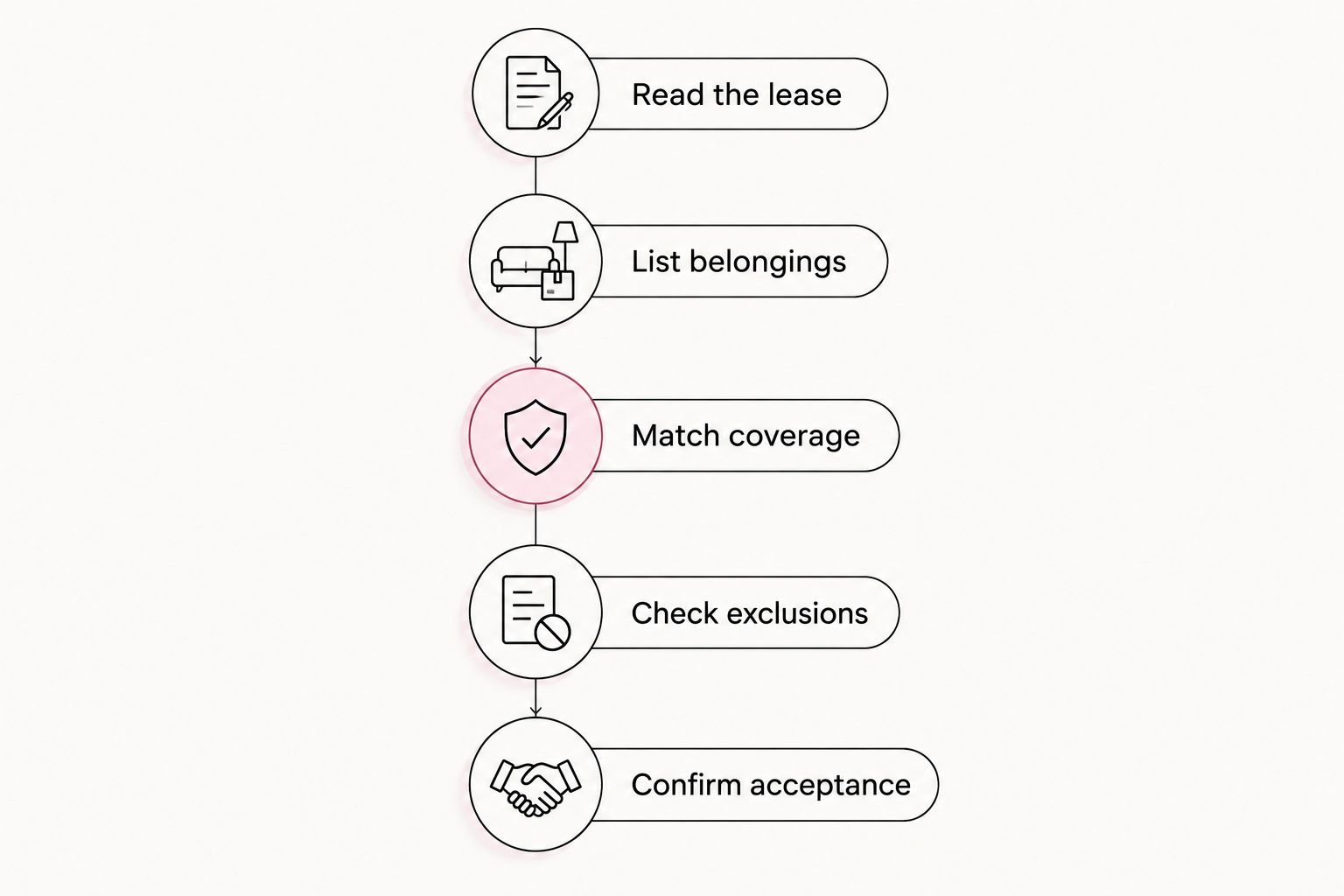
Keep one comparison sheet rather than switching between checkout screens from memory. Include the insurer, policy term, coverage limits, deductible, settlement method, exclusions you asked about, and total premium.
If a quote changes after you enter the complete address or application details, compare the revised version. A preliminary estimate is not the same as the policy you ultimately purchase.
Does your apartment’s insurance requirement protect your belongings?
Meeting a lease requirement and insuring your possessions are not necessarily the same thing. A property’s required program might address liability or damage to the landlord’s property without covering your furniture, clothes, or laptop.
Ask management what the required charge or program actually provides. Then read its documents to identify who is insured, what property is protected, and whether you need separate personal-property coverage.
Also distinguish an interested party from an additional insured. Those terms serve different purposes; do not substitute one for the other when completing an application. Send the lease wording to the insurer and ask how it should appear on the policy.
When relocating to Austin in 2026, make this check before your move-in appointment. Discovering a mismatch while collecting keys turns an insurance question into a moving-day problem.
How should you document belongings before moving?
Create an inventory while packing, when your belongings are already organized by room. Photograph items, record identifying details for valuable possessions, and keep receipts or purchase records when you have them. Store a copy somewhere you can access even if your phone or computer is lost.
Keeping a home inventory app aligned with your packing list helps you distinguish possessions in the apartment from boxes placed in storage. That distinction gives you clearer information to discuss with the insurer about off-premises coverage and applicable limits; the app itself does not establish insurance protection.
Pay particular attention to items with special limits. An overall personal-property limit does not automatically provide that entire amount for every individual category of belongings.
Update the inventory after the move. New furniture, a replacement computer, or a valuable bicycle can change what you need to insure, even when your apartment address stays the same.
What should Austin, DFW, and Houston renters check locally?
Neighborhood names help you choose an apartment, but they do not replace address-specific insurance questions. Hyde Park, Trinity Groves, and Victory Park each contain individual buildings and units whose details need checking.
Ask about the unit’s floor, the building’s documented security features, and any insurance information management requires. Give the insurer accurate details rather than assuming every property in the neighborhood receives the same treatment.
For Houston moves, keep flood coverage separate from ordinary renters-policy assumptions. Standard renters insurance generally excludes flood damage; discuss your belongings and the address with an insurer rather than assuming an upper-floor apartment removes every concern.
Taco Street Locating is a fit for renters seeking free apartment-search help in Austin, Dallas–Fort Worth, and Houston. Its apartment locating service helps you find and compare rentals; that is separate from choosing insurance terms. Use Taco Street Locating for personalized apartment research and neighborhood guidance, then take policy questions to the insurer or a licensed insurance agent.
Does Texas require renters insurance for every apartment?
Texas does not impose a blanket requirement that every renter buy renters insurance. Your lease can still require coverage as a condition of renting the apartment.
Read the insurance addendum before signing. Ask management which coverage is required and whether you can choose your own insurer under the lease terms.
Does renters insurance cover a roommate’s belongings?
Your renters policy does not automatically insure everyone sharing the apartment. Check who qualifies as an insured and whether the policy covers an unrelated roommate.
If you plan to share coverage, ask the insurer how claims, limits, and named insureds work. Separate policies can make individual belongings easier to distinguish, but confirm the appropriate arrangement for your household.
Should renters insurance start before you collect the keys?
Your policy should meet the lease’s effective-date requirement and cover the period when you need protection. Confirm the exact start date with management and the insurer rather than assuming the moving truck’s arrival determines it.
For a 2026 relocation, also ask how the policy treats belongings in transit or at a previous address. Do not cancel existing coverage until you understand the transition.
FAQ
How much does renters insurance cost in Texas for my apartment?
Your apartment’s renters insurance cost is the premium quoted for its address, your coverage selections, and your application details. Compare quotes with matching limits, deductibles, and settlement methods rather than applying a statewide figure to your unit.
Is the cheapest renters insurance enough for a Texas lease?
The cheapest policy is enough for the lease only if it meets the lease’s actual requirements. Separately check whether its personal-property coverage and exclusions meet your needs.
Does my landlord’s insurance cover my furniture?
Your landlord’s insurance generally does not cover your personal furniture or other belongings. A renters policy provides personal-property protection subject to covered causes of loss, limits, deductibles, and exclusions.
Does renters insurance cover flooding in Houston?
Standard renters insurance generally excludes flood damage. Ask an insurer about separate flood protection for your belongings and distinguish flooding from other kinds of water damage.
Should I choose a higher renters insurance deductible?
Choose a higher deductible only if you can comfortably pay that share of a covered loss. Compare matching quotes and weigh the premium difference against your available emergency savings.
Can I use my own renters insurance instead of the apartment’s program?
Check your lease and ask management whether your own policy satisfies the property’s requirements. Verify required limits, listed parties, proof of coverage, and whether any property charge still applies.
Can Taco Street Locating help me find an apartment before I arrange insurance?
Taco Street Locating provides free apartment locating help in Austin, Dallas–Fort Worth, and Houston. Use the service to compare rentals, then confirm insurance requirements with management and policy coverage with your insurer.
One last thing
A proof-of-insurance document is not a coverage review. It can show management that you bought a policy without answering whether your bike, work equipment, or replacement furniture is adequately protected. Before filing it away, read the declarations page alongside the exclusions and endorsements. That final check matters more than how quickly the upload portal accepts it.
Related guides
- How much do you need to earn to afford an apartment in Austin?
- Tour an Austin apartment from another city
- How much notice do you need before moving out of a Texas apartment?