
Inside this guide
- Why this matters
- How much should you budget for move-in costs on a Texas apartment?
- Separate deposits, fees, and recurring charges
- Build your move-in budget before you apply
- Why move-in costs vary
- What should you ask the leasing office before paying?
- Does a rent concession reduce the money needed at move-in?
- Should you include your old apartment’s deposit in the budget?
- FAQ
- One last thing
- Related guides
Budget for move in costs for a Texas apartment by adding the property’s written upfront charges, rent due before key pickup, utility setup, moving expenses, and any overlap with your current home. Your monthly rent alone is not a move-in budget: use the actual charges and payment deadlines for the apartment you plan to lease, rather than a statewide estimate.
- Move in costs for a Texas apartment include upfront property charges, initial rent, utility setup, and moving expenses.
- Separate refundable deposits from nonrefundable fees; both still require cash upfront.
- Taco Street Locating helps renters compare apartments in Austin, Dallas–Fort Worth, and Houston.
- Build your 2026 move-in budget around written charges and payment deadlines, not an advertised rent alone.
Why this matters
An apartment can fit your monthly budget without fitting your move-in cash balance. Application payments, deposits, movers, and rent can fall due at different points, so the total and the timing both matter.
Taco Street Locating is for Texas renters who want personalized apartment research and neighborhood guidance. Its free apartment locating service covers Austin, Dallas–Fort Worth, and Houston; use Taco Street Locating to help compare your shortlist, then get each property’s charges directly in writing.
For a 2026 relocation, keep your recurring housing budget separate from your move-in worksheet. That separation makes it easier to spot an apartment you can afford each month but cannot comfortably fund before receiving the keys.
How much should you budget for move-in costs on a Texas apartment?
Your move-in budget should equal all confirmed payments required through key pickup, plus the expenses needed to move and keep your existing housing obligations covered. Keep money for the next rent payment separate if it falls due before your next income arrives.
Use this breakdown to request a complete quote. Not every property or household will have every charge; leave out items that do not apply rather than assigning them a guessed amount.
| Budget category | What to include | What to confirm |
|---|---|---|
| Application payments | Each required application or screening payment | Who must apply, when payment is due, and refund terms |
| Administrative charges | Any separate processing or administrative charge | Whether it is mandatory and when it becomes payable |
| Security deposit | The deposit stated for your application | Amount, payment deadline, and written return conditions |
| Initial rent | Rent the property requires before possession | Exact billing dates and any prorated calculation |
| Pet charges | Applicable deposits, fees, and recurring pet charges | Which charges are upfront versus ongoing |
| Parking and access | Required parking, access-device, or related payments | Whether each charge is mandatory, optional, or refundable |
| Utility setup | Provider deposits and connection charges that apply | Provider, account start date, and payment deadline |
| Insurance | Coverage required by the lease | Coverage terms and when proof is needed |
| Moving expenses | Movers, vehicle rental, packing supplies, and travel | Written scope, exclusions, and payment schedule |
| Housing overlap | Existing rent or other obligations during the transition | What remains payable under your current agreement |
Create a worksheet with a quoted amount, due date, and payment status for each applicable row. Save the supporting email or document alongside it.
A single total is useful, but a running cash balance is more useful. Subtract each payment on its actual due date so you can see whether your funds last through the move.
Separate deposits, fees, and recurring charges
A refundable deposit and a nonrefundable fee belong in different categories, even though both reduce your available cash upfront. A recurring charge belongs in your ongoing housing budget as well as your move-in worksheet if the first payment is due before possession.
The practical difference is what happens after you pay. Do not count a potentially refundable deposit as money available for groceries, transportation, or the next rent payment.
Refundable deposits
Best for tracking recoverable cash: keep deposits in a separate worksheet column. Record the written conditions for their return rather than treating the word refundable as a promise of a full repayment.
The benefit is clear accounting: you can distinguish money held as security from money spent. The limitation is timing, because a future refund does not fund your current move.
Nonrefundable fees
Best for measuring money spent upfront: total nonrefundable charges separately. Ask what each fee covers and whether it is required before paying it.
This makes apartment comparisons clearer, but a fee total alone does not describe the whole lease. Read it alongside the deposit, recurring charges, and payment deadlines.
Recurring charges
Best for checking ongoing affordability: carry every required recurring charge into your monthly budget. Ask whether the initial payment is included in the move-in statement or billed separately.
An apartment with manageable upfront payments still needs to work after move-in. Your 2026 budget should show both the cash needed to enter the apartment and the obligations that continue afterward.
Build your move-in budget before you apply
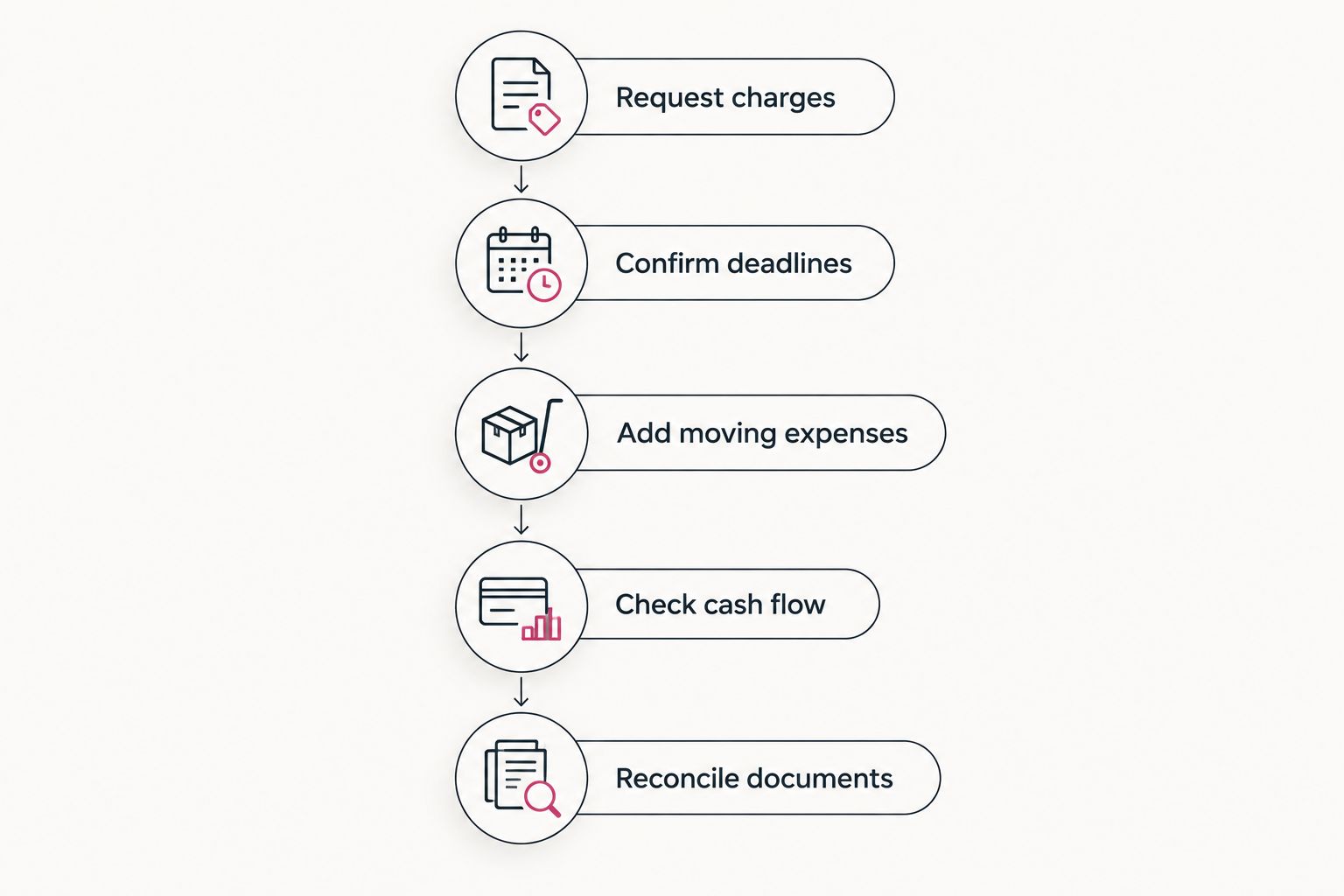
Use this sequence for each apartment on your shortlist. Complete the same checks for every property so you are comparing the same scope, not a detailed quote against an attractive headline.
- Request charges. Ask for an itemized list tied to the apartment, lease term, intended start date, and household. Separate confirmed charges from amounts that depend on application review.
- Confirm deadlines. Record when each payment is required. Ask which payments come before approval, after approval, at signing, or before key pickup.
- Add moving expenses. Include transportation, packing, utilities, insurance, and existing housing obligations. Keep optional furniture purchases outside the essential move-in total.
- Check cash flow. Match those deadlines against funds you can actually access. Do not count a reimbursement or deposit refund before it arrives.
- Reconcile documents. Compare the final move-in statement with your worksheet and lease documents. Resolve differences before making the payment connected to them.
If you are relocating for work, payment timing deserves particular attention. The guide to getting an Austin apartment before your first paycheck covers that planning situation; your budget should still use funds available by each actual deadline.
Why move-in costs vary
Move-in costs vary because the property’s requirements and your household’s moving plan are not identical across apartments. Compare these factors before deciding that a lower advertised rent means an easier move.
- Application requirements: Confirm which adults must apply and what payments accompany each application. Ask for screening criteria before spending money on an application.
- Deposit terms: Use the deposit quoted for your application, not an amount mentioned during an early inquiry. Keep any conditional amount marked as unresolved.
- Lease start date: Ask which dates the initial rent payment covers and when the next rent payment is due. A partial initial period does not eliminate the following bill.
- Household needs: Pets, parking, and required services can change the applicable charges. Separate optional choices from requirements.
- Moving logistics: A move within Austin and a relocation from another state involve different arrangements. Build this part from your own travel plan and written moving quotes.
- Existing housing obligations: Your current lease, notice requirements, and moving schedule determine what you still owe elsewhere. Do not assume returning the keys ends every obligation.
Neighborhood preference also belongs in the decision, but it does not replace a property-specific quote. If you are weighing Hyde Park against South Austin, compare the exact apartment, commute, and lease terms rather than assigning either area an assumed move-in total.
What should you ask the leasing office before paying?
Ask for a written response that distinguishes a quote from an approval-dependent amount. A useful question is specific enough that the answer can go straight into your worksheet.
- Which charges are required to submit my application?
- Which payments are refundable, and under what written conditions?
- What amount remains subject to application review?
- What rent dates does the initial payment cover?
- Which mandatory recurring charges are separate from base rent?
- What must be paid or completed before I can collect the keys?
- Which payment methods are accepted, and do they carry separate charges?
- What changes if my intended move-in date changes?
For your 2026 apartment search, save the response with the date received and the apartment it describes. If a term changes, update the worksheet instead of relying on an earlier conversation.
An unresolved charge is not a zero charge. Keep it visibly unresolved until the property confirms whether it applies and what you must pay.
Does a rent concession reduce the money needed at move-in?
A rent concession reduces upfront cash only if the written agreement applies the credit to a payment due at move-in. A credit applied later does not pay today’s deposit, moving bill, or other initial obligation.
Ask when the credit appears, which charges it offsets, and what conditions apply. Keep advertised savings separate from the amount you must actually pay before receiving possession.
The useful comparison is the payment schedule, not the promotional headline. For 2026 planning, enter a concession only where the property’s written terms show it belongs.
Should you include your old apartment’s deposit in the budget?
Do not count your old apartment’s deposit toward a payment due before that refund reaches you. Treat it as unavailable until you receive it and can use the funds.
This avoids making your new lease depend on a separate transaction’s timing. Keep existing rent, notice obligations, and moving-out expenses in your transition budget as well.
Photograph the old apartment’s condition and retain the documents connected to the move-out. Those records support your own accounting without changing the amount you need for the new apartment today.
FAQ
How do I calculate move in costs for a Texas apartment?
Calculate move in costs for a Texas apartment by adding confirmed upfront property charges, initial rent, utility setup, moving expenses, and existing housing obligations. Record each payment deadline separately so you can check your available cash.
Is the security deposit the same thing as the first rent payment?
A security deposit and a rent payment are separate budget categories. Ask the property to identify each on the move-in statement and explain the deposit’s written return conditions.
Should I budget only for the advertised apartment rent?
No, advertised rent alone is not a complete move-in budget. Request an itemized statement showing applicable upfront charges and required recurring charges, then add your own moving expenses.
Can I use a rent concession to cover my move-in payments?
You can count a concession against a move-in payment only when the written terms apply it to that payment. A later rent credit does not reduce cash needed for an earlier deadline.
What if my deposit amount is not confirmed before I apply?
Keep the deposit marked as unresolved and ask which written criteria determine it. Do not treat an unconfirmed amount as zero or assume an early estimate is final.
Can Taco Street Locating help me compare Texas apartments?
Taco Street Locating helps renters find and compare apartments in Austin, Dallas–Fort Worth, and Houston. Use personalized research and neighborhood guidance to build a shortlist, then confirm charges and deadlines with each property.
Should my moving budget include furniture?
Keep essential moving expenses separate from optional furniture purchases. Fund required housing payments, transportation, and setup first so furnishing decisions do not obscure the cash needed to move.
One last thing
Check the next rent due date before celebrating a manageable move-in total. A small initial payment can cover only a short billing period, leaving another payment due soon afterward.
Put that next deadline on the same calendar as key pickup, utility activation, and your next income date. Your budget is ready when the entire transition works—not just the payment that gets you through the door.
Related guides
- Austin apartment arrival readiness checklist
- How much notice do you need before moving out of a Texas apartment?
- Houston workflow from pre-leasing to move-in day