

Inside this guide
- Why this matters
- Is it cheaper to live in Austin than Chicago in 2026?
- Why the Austin–Chicago cost comparison varies
- Compare Austin neighborhoods around your actual routine
- Build a like-for-like budget before choosing
- Check utilities and appliance responsibilities
- Account for the move, not just the destination
- Where personalized apartment help fits
- FAQ
- One last thing
- Related guides
Austin is not automatically cheaper than Chicago in 2026: your rent, transportation needs, and take-home pay determine which city leaves you with more money. Texas has no individual state income tax, but adding a car or choosing a more expensive apartment can erase that advantage. Compare the same household, apartment requirements, and work schedule before treating a move as a money-saving decision.
- Is Austin cheaper than Chicago 2026? Not automatically; compare your complete household budget, not state income tax alone.
- Texas has no individual state income tax; Illinois taxes individual income at 4.95%.
- Austin apartment savings depend on neighborhood, lease terms, transportation, and mandatory charges.
- Taco Street Locating is best suited to Texas renters seeking personalized apartment research and neighborhood guidance.
Why this matters
A citywide cost-of-living comparison cannot tell you whether your particular move saves money. Keeping your Chicago salary, accepting a different offer, bringing a car, and changing apartment size all produce different answers.
Taco Street Locating offers free apartment locating in Austin and other Texas metros. Personalized apartment research helps narrow the housing side of the decision; you still need to account for transportation, taxes, and moving expenses yourself.
Compare the life you would actually live in each city, not an average household that looks nothing like yours. A cheaper apartment is not a cheaper lifestyle when reaching work adds another major expense.
Is it cheaper to live in Austin than Chicago in 2026?
Austin is cheaper for your household only when its total recurring expenses, adjusted for take-home pay, fall below your Chicago alternative. A lower state income-tax burden helps, but it does not settle the comparison.
Use this table to identify what belongs in your calculation. Neither city wins every row, and neighborhood-level decisions matter more than a broad city label.
| Budget category | Austin comparison | Chicago comparison | What to verify |
|---|---|---|---|
| Housing | Compare specific apartments near your destinations | Compare apartments with equivalent space and access | Lease term, mandatory charges, and included utilities |
| State income tax | Texas has no individual state income tax | Illinois has a 4.95% individual income-tax rate | Your taxable income and payroll withholding |
| Transportation | Price the routes and travel methods you will use | Include the transit or vehicle expenses you actually pay | Whether the move adds or removes a vehicle |
| Utilities | Ask about electricity, water, and billing arrangements | Check heating responsibility and included services | Comparable usage and what the lease includes |
| Move-in expenses | Obtain a written breakdown before applying | Include the expense of leaving your current lease | Deposits, moving services, and overlapping housing |
| Daily spending | Build a budget around your own habits | Use your actual spending as the baseline | Groceries, dining, subscriptions, and travel |
The tax distinction is established by the Texas Comptroller and the Illinois Department of Revenue: Texas does not impose an individual state income tax, and Illinois lists a 4.95% individual income-tax rate. For a 2026 relocation, use those rules as inputs, not as a promise that your paycheck increases by the full rate difference. Taxable income, deductions, and your employment situation affect the calculation.
Is Austin cheaper if I keep my Chicago salary?
Keeping your salary makes the comparison simpler, but it does not guarantee savings. Compare expected take-home pay after the move with your complete Austin budget, including any new vehicle expenses.
Ask your employer to confirm location-based pay rules and withholding before signing a lease. A verbal assumption about remote work is not a substitute for a confirmed employment arrangement.
Is Chicago cheaper if I can live without a car?
Chicago can be cheaper for your household when a workable car-free routine avoids expenses you would otherwise incur in Austin. Test the actual home-to-work route rather than assuming every Chicago address supports that routine.
Likewise, do not assume every Austin renter needs the same transportation setup. Your workplace, grocery access, mobility needs, and schedule decide whether a particular address works.
Does a cheaper Austin apartment guarantee a cheaper move?
A cheaper Austin apartment does not guarantee lower overall spending. Mandatory building charges, transportation, lease overlap, and the move itself belong beside rent in the comparison.
Separate ongoing savings from upfront spending. A move can improve your monthly budget while requiring more cash than you can comfortably spare at signing.
Why the Austin–Chicago cost comparison varies
These factors change the answer without requiring either city's average to change:
- Neighborhood and destination: Compare where you need to go, not just where you want to live. Downtown Austin, Hyde Park, and the Domain are different search areas, not interchangeable addresses.
- Apartment requirements: Match bedroom count, usable workspace, laundry arrangements, parking needs, and pet requirements before judging value.
- Transportation setup: A vehicle purchase changes the calculation differently from keeping a car you already own. Include insurance, maintenance, fuel, and parking where applicable.
- Employment and taxes: Compare confirmed compensation and expected take-home pay. A salary adjustment can matter more than the tax difference.
- Lease structure: Lease duration, mandatory charges, utility responsibilities, and any written concession terms affect the total obligation.
- Moving friction: Overlapping leases, temporary accommodation, furniture, and travel create expenses that do not appear in a normal monthly budget.
Your priorities also create trade-offs. A home office can justify more space, while a shorter commute can justify accepting less space. Neither choice is automatically wasteful; the useful question is whether you will use what you are paying for.
Compare Austin neighborhoods around your actual routine
Start with your destinations, then select neighborhoods to investigate. Austin's name on a lease tells you much less than the apartment's relationship to your workplace and daily errands.
For example, a UT Austin destination makes Hyde Park and other nearby search areas relevant to investigate. A job near the Domain calls for a different route comparison than an office downtown. These are starting points for research, not promises of an easy commute.
| Austin search area | Best for investigating | Main trade-off to test |
|---|---|---|
| Downtown Austin | Renters whose regular destinations are central | Whether proximity justifies the apartment's total charges |
| Hyde Park | Renters comparing access to UT Austin and nearby destinations | Whether the specific building, layout, and route fit daily needs |
| Domain area | Renters with destinations around the Domain | Whether trips elsewhere undermine the location's convenience |
| South Austin | Renters whose work and regular activities are south of the river | Whether cross-city travel adds unwanted expense or time |
Choose the address around your recurring trips, not a neighborhood's reputation. The same apartment can be practical for one household and inconvenient for another.
Use the Austin apartment commute guide to organize that search. Check routes at your expected departure times and include the trip home, grocery runs, and any recurring appointments.
Do the same work on the Chicago side. Comparing a carefully selected Austin neighborhood with a poorly matched Chicago apartment would answer the wrong question.
Build a like-for-like budget before choosing
For your 2026 decision, use a 12-month comparison rather than a single advertised monthly figure. Keep refundable deposits separate from nonrefundable expenses: both require cash, but they are not the same kind of obligation.
- Match the household. Use the same residents, pets, bedroom requirements, work arrangements, and essential amenities in both cities.
- Confirm take-home pay. Use a payroll estimate based on the actual job and location. Do not apply a tax rate directly to gross salary and call the result guaranteed savings.
- Collect housing terms. Request written details for the apartment and lease term you would sign, including required charges and utility responsibilities.
- Add transportation. Include the vehicle or transit setup you would genuinely use, not an idealized version of your routine.
- Separate move-in cash. List deposits, moving arrangements, lease overlap, and other upfront obligations outside your recurring budget.
- Test ordinary months. Check whether the plan works after any temporary concession ends and during months with heavier utility use.
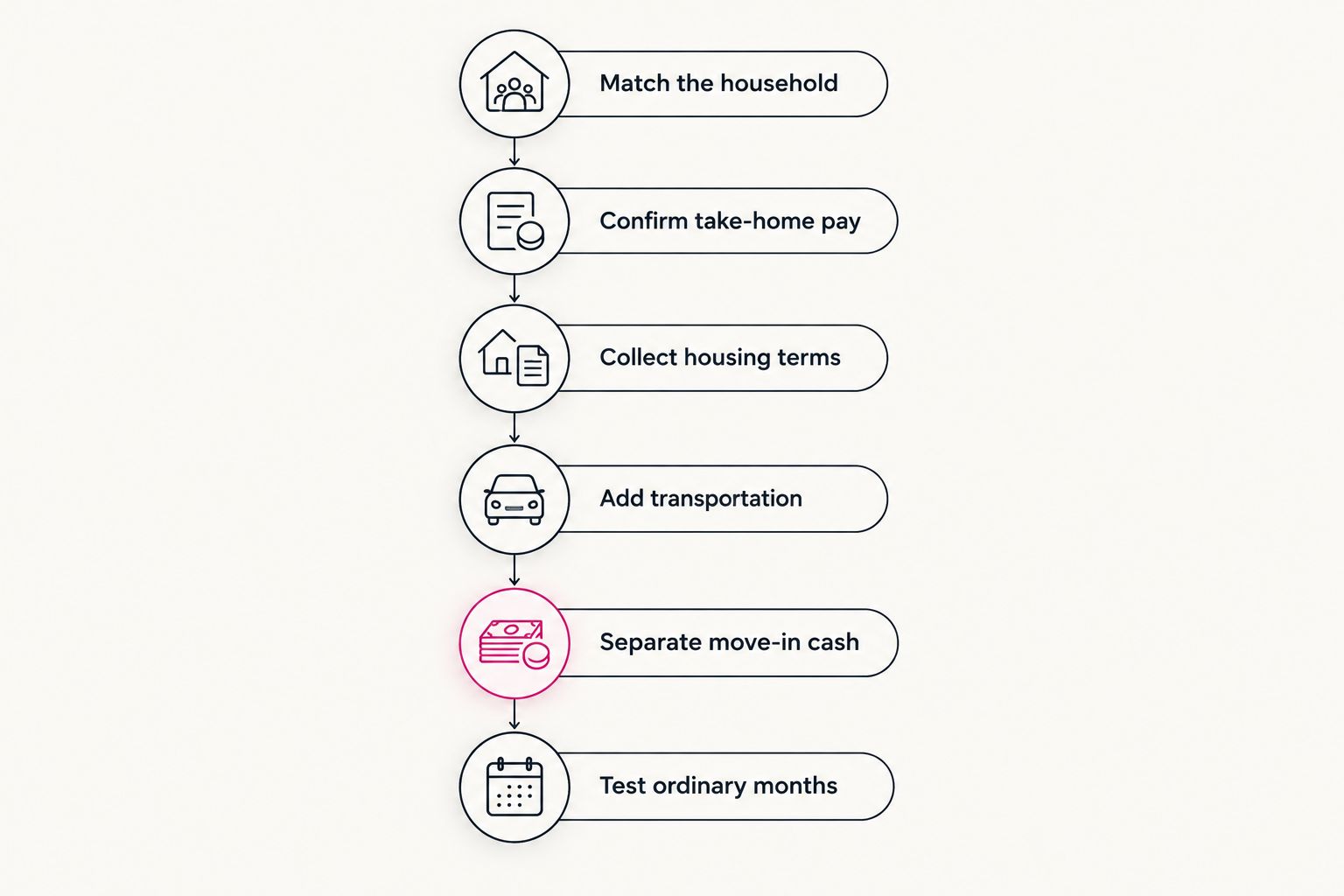
After filling in the worksheet, compare what remains after essential expenses. That remainder tells you more about affordability than a rent comparison alone because it reflects both income and spending.
Then test your biggest uncertainty. If the plan depends on living without a car, verify the route before applying. If it depends on a particular apartment charge being optional, get that answer in writing.
Check utilities and appliance responsibilities
Utilities deserve their own comparison because apartment listings do not always describe billing arrangements consistently. Ask which services you establish directly, which charges appear on the property bill, and which services the lease includes.
For your 2026 shortlist, request available usage history or billing information tied to the apartment or a comparable layout. A building-wide estimate is not the same as evidence for the unit you are considering, particularly when orientation, insulation, or equipment differs.
Appliances add another distinction: having an appliance in the apartment does not, by itself, explain who maintains it. Your lease and applicable law govern responsibilities, so understanding appliance repair costs for renters starts with identifying who owns the appliance and who must arrange repairs—not assuming every breakdown belongs in your personal budget.
Before signing, ask these questions:
- Which appliances are included in the lease?
- How do you report a maintenance problem?
- What does the lease say about damage, ordinary wear, and repair responsibilities?
- Does the apartment require you to provide any appliances yourself?
Do not authorize repairs to landlord-provided equipment without checking the required process. An appliance issue should not become an avoidable lease dispute while you are still unpacking.
Account for the move, not just the destination
A relocation budget needs an exit column as well as an arrival column. Review your current Chicago lease for notice requirements and any obligations that apply to your planned departure.
Next, map out when your Austin lease begins and when you can physically move. If those dates do not align, include the resulting housing overlap, storage, or temporary accommodation in your decision.
A refundable deposit still affects whether you can afford to move. Track the cash required before arrival separately from the expenses you expect to recover later, and do not depend on a refund reaching you before it is actually due.
For a 2026 move, keep a dated copy of each written apartment quote and the terms attached to it. Compare offers collected for the same intended move-in period; otherwise, you risk comparing different lease situations rather than different cities.
Where personalized apartment help fits
Taco Street Locating's apartment locating service is best suited to Texas renters seeking personalized apartment research and local neighborhood guidance. That help addresses the housing search, not your tax return or the entire economics of leaving Chicago.
Send a clear brief: workplace destinations, move date, household requirements, transportation plans, and the total monthly housing amount you can manage. Explain which preferences are flexible and which are deal-breakers.
The benefit is a search organized around your situation. The limitation is equally clear: no locator can establish that Austin is cheaper for you without your income, transportation, and household spending information.
FAQ
Is Austin cheaper than Chicago in 2026 for renters?
Austin is not automatically cheaper than Chicago in 2026 for renters. Compare specific apartments, take-home pay, transportation, utilities, and moving expenses before deciding.
Will I save money on state income tax by moving from Chicago to Austin?
Texas has no individual state income tax, while Illinois has a 4.95% individual income-tax rate. Your actual change in take-home pay depends on taxable income, employment arrangements, and withholding.
Is Chicago cheaper if I don’t own a car?
Chicago can be cheaper for your household if your actual routine works without a car and the Austin alternative adds vehicle expenses. Verify routes and schedules for the addresses you are comparing.
Which Austin neighborhood should I compare with my Chicago apartment?
Compare Austin neighborhoods around your workplace and recurring destinations, then match apartment requirements. Downtown Austin, Hyde Park, the Domain area, and South Austin serve different location needs.
Should I compare monthly rent or the full lease?
Compare the full lease obligation and keep a separate monthly cash-flow budget. Mandatory charges, utility responsibilities, and written concession terms belong in that comparison.
What should I verify before moving from Chicago to Austin?
Verify compensation, lease obligations, transportation, utility billing, and upfront cash requirements before moving. Written apartment terms and a realistic commute test make the comparison more dependable.
Can Taco Street Locating help me compare Austin apartments?
Taco Street Locating offers free apartment locating in Austin, including personalized apartment research and neighborhood guidance. Share your destinations, household needs, move date, and housing budget to focus the search.
One last thing
Before committing, write down what would have to be true for Austin to save you money. Perhaps you must keep your salary, avoid adding a vehicle, or stay within a particular total housing budget.
Then verify that condition first. If the entire plan depends on a commute you have never tested, another apartment tour will not answer the most important question. Get the practical decision right; the taco research can follow.
Related guides
- How much should you budget for move-in costs on a Texas apartment?
- Tour an Austin apartment from another city
- Downtown Austin vs. the Domain