

Instead of tracking lease notices, apartment tours, and application emails separately, use one deadline-led workflow to move from a Dallas apartment lease non-renewal notice to a new apartment in 2026. Confirm your current lease obligations, document notice delivery, and connect your next lease to a verified key-handoff date.
- Dallas apartment lease non-renewal new apartment workflow: document notice, compare rentals, confirm approval, and coordinate keys.
- Taco Street Locating helps Texas renters compare apartments; your lease and property management determine your notice requirements.
- Keep your notice deadline, lease end, next lease start, and key collection separate.
- Application approval alone does not confirm your new apartment handoff.
Why this matters
Your current lease and your next apartment search run on different clocks. Sending notice does not secure another home, and finding an apartment does not change your existing lease obligations. For a 2026 Dallas move, your tracking document needs both timelines.
Start with the notice requirements before moving out of a Texas apartment, then check your signed lease and any amendments. Do not substitute a general notice rule for the requirements that apply to your tenancy.
Taco Street Locating is best for Texas renters seeking free apartment locating help. Personalized apartment research and local neighborhood knowledge support the search; they do not replace your notice, application, or signed lease.
Before you start
- Collect your lease documents. Have your signed lease, amendments, renewal correspondence, resident account access, and management contact details. If management sent the non-renewal notice, keep the original message and its delivery details.
- Prepare your search materials. Gather identification and the income, rental-history, household, and pet information prospective properties request. Send sensitive documents through the property's designated application process, not a shared apartment-comparison sheet.
- Check the delivery requirement before calculating the deadline. A notice drafted before the deadline is not the same as a notice delivered through the required method. Confirm the recipient, delivery method, and applicable receipt requirements before relying on email or a portal message.
Use one worksheet and one document folder. The worksheet keeps decisions visible; the folder preserves evidence. Neither updates itself, so assign yourself a calendar reminder to review both.
Lease and notice record
- Create the date fields. Add Lease end, Notice deadline, Notice delivery method, Notice recipient, and Delivery evidence to your worksheet. Copy dates from your documents rather than reconstructing them from memory.
- Identify who initiated non-renewal. Record whether you plan to leave or management has notified you that the tenancy will not renew. Keep a management-issued notice separate from any response you send.
- Resolve conflicting dates before sending notice. If your lease, renewal message, and resident account show different information, request written clarification. Ask management to identify the document supporting its answer.
- Deliver and preserve your notice. Follow the applicable requirements, retain the exact notice, and save delivery evidence. Request written acknowledgment of the recorded move-out date without treating that request as a substitute for proper delivery.
- Add planning reminders. Set reminders 7 days, 3 days, and 1 day before your confirmed notice deadline. These are suggested planning buffers, not Texas legal notice periods.
Expected result: You have a documented lease-end date, a supported notice deadline, and a record of delivery. If a dispute remains, mark it unresolved rather than filling the worksheet with an assumed answer.
For a lease ending in 2026, retain the actual calendar date, including the year. A note that says only “end of month” is not precise enough to coordinate two properties.
Dallas search brief
- Separate requirements from preferences. Create Required, Preferred, and Deal-breaker fields. Put your move window, household needs, pet requirements, accessibility needs, and maximum acceptable housing commitment in the appropriate fields.
- Use exact destinations. Record your workplace, school, or other recurring destination, along with the time you need to arrive. Compare travel from each property's address rather than assuming every apartment in Dallas fits the same commute.
- Choose neighborhoods to investigate. Include areas such as Uptown, Oak Lawn, Bishop Arts, or Trinity Groves when they match your search brief. Treat neighborhood names as starting points, not proof of a building's noise level, parking arrangement, or daily convenience.
- Build a property comparison. Track the address, floor plan, proposed lease dates, required payments, parking terms, pet rules, and questions awaiting written answers. Date each confirmation and keep the supporting message.
Expected result: Every apartment on your shortlist has a reason to be there. Remove properties that fail a requirement instead of letting attractive photos keep them in contention.
Choose a search approach based on the constraint you cannot change:
| Search approach | Best for | Benefit | Trade-off |
|---|---|---|---|
| Commute-first | Renters tied to a recurring destination | Tests apartments against a specific daily trip | Narrows the neighborhoods you consider |
| Neighborhood-first | Renters committed to a particular area | Concentrates tours within your preferred location | Leaves less flexibility when buildings fail your requirements |
| Move-date-first | Renters with a firm handoff deadline | Keeps the search tied to the required lease-start window | Requires flexibility on other preferences |
Taco Street Locating's apartment locating service adds personalized research and neighborhood guidance to this brief. You still need written property confirmation of application requirements, lease terms, and handoff arrangements; a recommendation is not an approval.
Application and lease record
- Request the property's screening requirements. Ask what documents the property needs and how household members, guarantors, or pets affect the application. Get unclear requirements answered before submitting sensitive information.
- Track the exact application status. Add Submitted, Documents requested, Decision received, and Lease signed as separate tracking fields. Mark only the stage supported by the property's communication.
- Resolve conditions before treating approval as complete. If management requests additional documents or another step, record the requirement and who must complete it. Keep the original approval message rather than relying on a phone-call summary.
- Read the lease against your comparison sheet. Check the address, unit designation, lease dates, occupants, required payments, parking terms, pet terms, and relevant addenda. Ask for corrections before signing if the documents conflict with what you were told.
- Confirm the handoff separately. Request written instructions for collecting keys, completing any required move-in tasks, and accessing the building. Record the contact responsible for the handoff.
Expected result: You can distinguish an application submission, an approval, a signed lease, and confirmed key collection. None of those entries substitutes for the others.
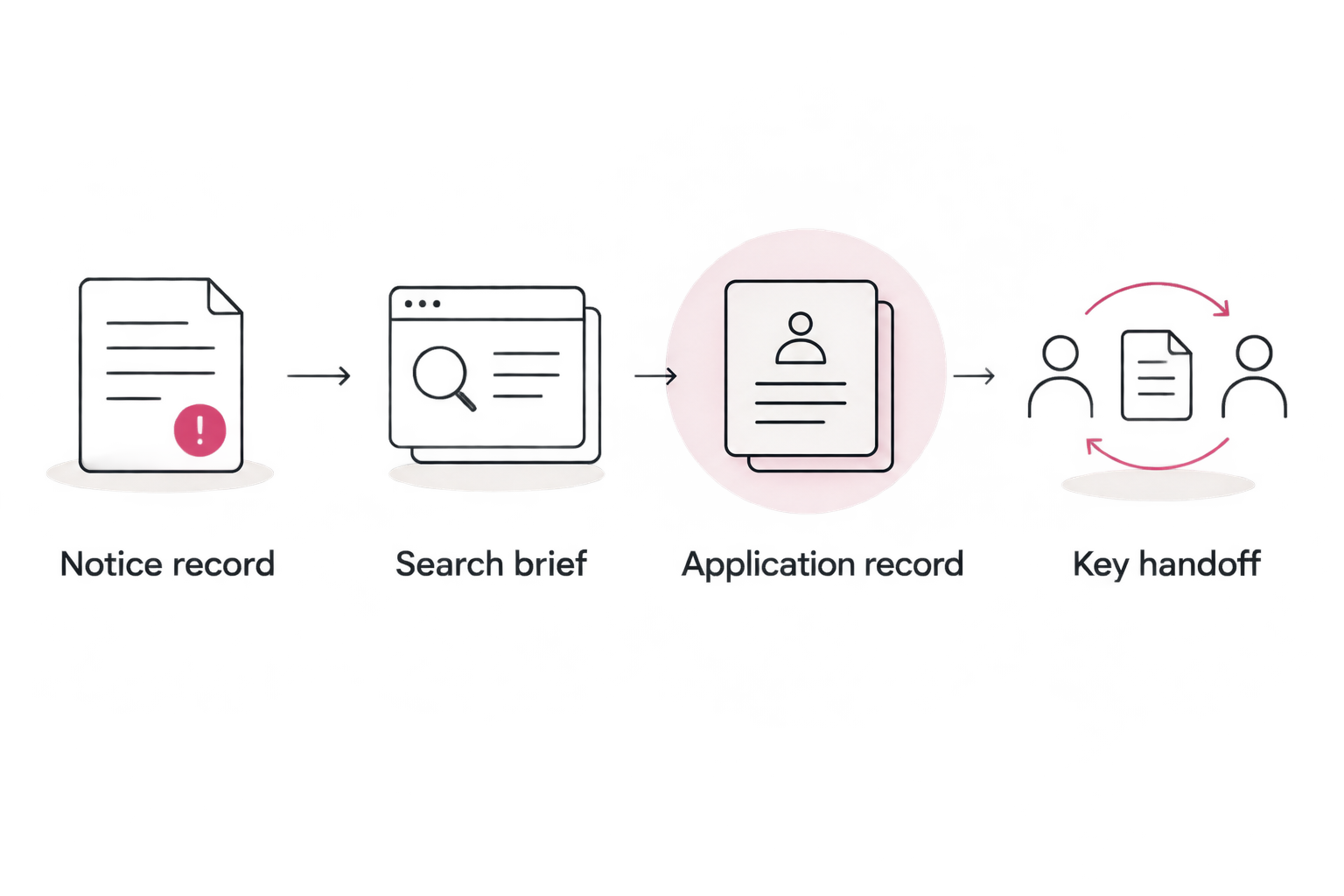
Use these checkpoints in order: Notice record, Search brief, Application record, Key handoff. The diagram shows the sequence, not permission to postpone an existing notice deadline while searching.
Move-out and key handoff
- Compare the two property schedules. Put your current lease-end date beside the new lease-start date and confirmed key-collection appointment. Identify any gap or overlap explicitly; do not assume either property will adjust its schedule.
- Confirm moving access. Ask each property about the loading route, elevator reservations where applicable, vehicle access, and any required mover documentation. Record only requirements the property actually provides.
- Schedule service changes. Follow the new property's instructions for utilities and required insurance documentation. Coordinate the old property's service end dates with your remaining responsibilities there.
- Document both apartments. Photograph the old apartment after clearing it and the new apartment before unpacking. Complete any property-required condition report within its stated deadline and retain your copy.
- Close the old tenancy record. Follow the key-return instructions, request a receipt, and provide your forwarding information through the appropriate channel. Keep move-out correspondence with your notice and lease documents.
Expected result: Your records show when you left, how you returned access devices, and how you received access to the new apartment. Movers receive a confirmed schedule rather than an estimated one.
For your 2026 move, keep a copy of essential documents accessible outside the moving boxes. Your lease, handoff instructions, identification, and management contacts should travel with you.
When management sends the non-renewal notice
The adjacent workflow starts with a received notice rather than one you draft. Preserve the notice first; do not assume it is an eviction filing or that its stated date answers every lease question.
- Save the original letter or message, attachments, and delivery details. Record the date you received it.
- Compare the stated termination date with your lease and amendments. Request written clarification of any discrepancy.
- Ask management what move-out instructions and responses it requires. Keep those instructions separate from any disagreement about the notice itself.
- Start the same Dallas search brief and application record. Tell prospective properties your required move window without promising a date you have not confirmed.
- Seek qualified Texas tenant-law advice promptly if you dispute the notice, suspect unlawful conduct, or receive court papers. Apartment search assistance does not resolve a legal dispute.
If your 2026 move begins with a management-issued notice, identify any response or court deadlines before spending the afternoon booking tours. Housing research and legal deadlines need separate attention.
Troubleshooting
Management has not acknowledged your notice
Check the lease's delivery requirements and preserve your evidence. Follow up in writing with the original notice attached, asking management to confirm the recorded termination date. Do not assume silence proves acceptance or that resending automatically corrects a missed requirement.
The notice deadline is approaching before you have a new lease
Separate the decisions. Determine your existing obligations and ask management, in writing, whether any extension or other arrangement is possible. Continue the apartment search without assuming that approval elsewhere will arrive before the deadline.
Your application is approved but keys are not confirmed
Ask the new property for its remaining move-in requirements and written handoff instructions. Keep mover arrangements adjustable until you have a confirmed schedule; an approval message alone does not settle building access.
The apartment details differ from the tour or email
Identify the discrepancy precisely: unit, floor plan, dates, parking, pet terms, or another written condition. Request corrected documents before signing. Keep the original and revised versions together so you can follow what changed.
Your move-out and move-in dates do not connect
Ask both properties about permitted scheduling changes and get any agreement in writing. If the dates remain incompatible, compare a different apartment or a separate temporary-housing plan rather than assuming early access or a late departure is allowed.
Customize your workflow
Keep your 2026 worksheet focused on the decision that matters next. Add pet documentation, accessibility questions, roommate responsibilities, or employer relocation requirements only when they apply to your household.
For help turning your requirements into apartment research, review how apartment locators work in Texas. Taco Street Locating can support the comparison process while you retain control of applications, lease review, and notice delivery.
Assign an owner to every unresolved task. “Ask about parking” is easy to forget; a named person, a specific question, and a follow-up date make it actionable. Even a taco run gets easier when someone knows who's ordering.
FAQ
How do I go from a Dallas lease non-renewal notice to a new apartment?
Document your current lease obligations, preserve notice delivery or receipt, and build a Dallas apartment shortlist around your move window. Track application approval, lease signing, and key collection as separate checkpoints.
Does my apartment lease ending mean I can leave without notice?
Do not assume the lease-end date removes a notice requirement. Check your signed lease, amendments, and applicable requirements before deciding when and how to notify management.
Should I give notice before my new apartment application is approved?
Your existing notice deadline still needs attention while your next application is pending. Check your obligations and request any proposed extension in writing rather than assuming you can wait for approval.
Is an apartment non-renewal notice the same as an eviction?
A non-renewal notice is not the same document as an eviction lawsuit. Review what you actually received and seek qualified legal help promptly if there is a dispute or court paperwork.
Can Taco Street Locating help me find another Dallas apartment?
Yes. Taco Street Locating provides apartment locating help in Dallas–Fort Worth, including personalized apartment research and neighborhood guidance. Property management handles application decisions and lease terms.
What should I save after sending my move-out notice?
Save the exact notice, delivery evidence, management’s responses, and the documents establishing your deadline. Keep them together with your lease and move-out instructions.
What if my new apartment starts after my current lease ends?
Treat the gap as an unresolved housing requirement. Request written scheduling options from both properties, then compare another apartment or a separate temporary-housing arrangement if the dates cannot connect.
One last thing
Add key return to your calendar, not just moving day. Carrying the last box out and completing the property's access-return process are different tasks. Get a receipt for the keys and other access devices you return, and keep it with your move-out record.
Related guides
- How long apartment application approval takes in Texas
- Apartments in Uptown Dallas
- Budgeting for move-in costs on a Texas apartment