

Inside this guide
- Why this matters
- At a glance
- Personalized help wins for an unfamiliar move
- A Texas-focused locator wins for a move within its service area
- Personalized research wins when neighborhood trade-offs are unresolved
- RentCafe wins when you want to direct the search yourself
- A locator wins when your shortlist needs interpretation
- Neither route wins on confirming lease terms
- Neither route wins on application approval
- Pricing: separate search help from the lease commitment
- Final verdict: choose help or choose independent browsing
- FAQ
- One last thing
- Related guides
Choose Taco Street Locating if you want personalized apartment research and neighborhood guidance in Austin, Dallas–Fort Worth, Houston or San Antonio; choose RentCafe if you prefer searching rental listings yourself and contacting properties directly. This 2026 comparison separates help choosing an apartment from the tools used to browse one.
- Taco Street Locating vs RentCafe comes down to personalized apartment locating versus self-directed rental search.
- Choose the locator for neighborhood guidance across Austin, Dallas–Fort Worth, Houston and San Antonio.
- Choose RentCafe for independent apartment browsing when you want to control the search yourself.
- Neither search route replaces property confirmation of lease terms, screening requirements or the apartment you will rent.
Why this matters
A rental website helps you discover apartments. A locator helps you decide which apartments fit your life. Those jobs overlap, but they are not interchangeable.
If you are relocating to Austin in 2026, a polished listing does not resolve whether Hyde Park, Mueller or South Austin belongs on your shortlist. Start with your workplace, household needs and tolerance for travel—not the pool photograph.
The Taco Street Locating apartment locating service focuses on personalized research and local neighborhood knowledge. RentCafe fits the renter who wants to browse independently; its trade-off is that you own the comparison work.
Choose assistance when the decision is unclear; choose self-service when the search criteria are already clear. Neither route removes the need to ask questions before applying.
At a glance
| Dimension | Taco Street Locating | RentCafe |
|---|---|---|
| Best for | Relocating renters who want personalized help | Independent renters comfortable evaluating listings |
| Geographic fit | Apartment locating in four Texas markets | Location-based rental browsing beyond a local locating brief |
| Standout feature | Personalized research and neighborhood guidance | Self-directed rental search |
| Search control | Collaborative search shaped by your requirements | You direct browsing and property inquiries |
| Shortlist decisions | Help comparing apartments against your priorities | You build and evaluate your shortlist |
| Lease verification | Property confirmation still required | Property confirmation still required |
| Application approval | Property screening still applies | Property screening still applies |
| Pricing model | Free apartment locating service | Rental-search platform; distinguish the search from property charges |
The useful comparison is not which option produces the longest list. It is which option helps you reach a defensible decision with the amount of research you want to handle yourself.
Personalized help wins for an unfamiliar move
Taco Street Locating is best for renters who want personalized apartment locating in its four Texas markets. That is the clearest reason to choose the service rather than treating it as another listing website.
Consider an Austin relocation where you know your office address but not your preferred neighborhood. You need to compare the route to work, the surrounding streets and the apartment itself. Personalized research gives those questions a place in the search brief instead of leaving them as separate browser tabs.
RentCafe is the better starting point when you already know what you want. If your neighborhood, bedroom count and household requirements are settled, independent browsing lets you pursue those criteria without first explaining them to a locator.
The drawback on each side is straightforward:
- Personalized locating: You need to explain your priorities and respond when recommendations miss the mark.
- Independent browsing: You must identify unsuitable options and investigate unresolved questions yourself.
A useful service still needs a useful brief. “Somewhere nice in Austin” leaves too much undecided.
A Texas-focused locator wins for a move within its service area
The locating service covers Austin, Dallas–Fort Worth, Houston and San Antonio. Those are 4 Texas markets, not a promise of help everywhere you might move.
That focus makes sense when your decision involves neighborhoods within one of those areas. For an Austin move, compare Hyde Park, Mueller and East Austin against your actual destination. For a Dallas move, start with the same practical questions when considering Trinity Groves or Victory Park rather than treating their neighborhood names as sufficient evidence of fit.
RentCafe is the more appropriate starting route when your search extends beyond the locator's stated service area. Use its location-based browsing to investigate the destination instead of assuming a Texas-focused service covers it.
Neither geographic scope proves complete inventory. Ask about a particular community rather than assuming any search route includes every property.
For an Austin move, the guide to choosing an apartment around your commute provides a more useful starting question than which neighborhood looks best in photographs.
Personalized research wins when neighborhood trade-offs are unresolved
The locator's standout feature is personalized research informed by local neighborhood knowledge. That matters when your criteria conflict: you want a particular setting, a workable commute and an apartment layout that supports your daily routine.
Turn those preferences into questions a person can investigate. Instead of asking for the “best Austin apartment,” explain where you need to travel, whether you work from home and which compromises you reject.
Keep the brief concrete:
- Work destination: Give the actual workplace or campus, not just the city.
- Household needs: Explain pets, accessibility needs and how you use the space.
- Neighborhood priorities: Separate necessary conveniences from nice extras.
RentCafe remains useful for seeing what attracts your attention before that conversation. Its limitation is not that browsing lacks value; it is that browsing alone leaves you to interpret the trade-offs.
Local guidance also has a boundary. It does not replace inspecting the particular apartment, reviewing the lease or checking a route at the time you expect to use it.
RentCafe wins when you want to direct the search yourself
RentCafe is best for independent renters who want to browse rental listings and make their own property inquiries. Choose that route when you enjoy comparing options and do not need help deciding what belongs on your list.
Self-directed searching lets you change your criteria as you learn. You can examine a neighborhood, reject it and move on without turning each adjustment into a conversation.
That control comes with responsibility. You need a consistent way to record property responses, distinguish confirmed information from listing descriptions and track unanswered questions.
A locator introduces collaboration into that process. For some renters, discussing priorities is useful; for others, it is an unnecessary step because the target neighborhood and requirements are already settled.
For your 2026 search, choose independence because it suits how you make decisions—not because opening more listings necessarily produces a better apartment choice. More options help only when you can evaluate them consistently.
A locator wins when your shortlist needs interpretation
A shortlist should explain why each apartment remains under consideration. A collection of attractive buildings is not yet a decision.
Personalized locating fits renters who want help connecting apartment choices to their stated needs. Independent browsing fits renters who are comfortable doing that interpretation themselves, but it does not perform the judgment for you.
Use 3 nonnegotiables to keep either route focused. These are your chosen decision rules, not a claim about how many requirements every renter should have.
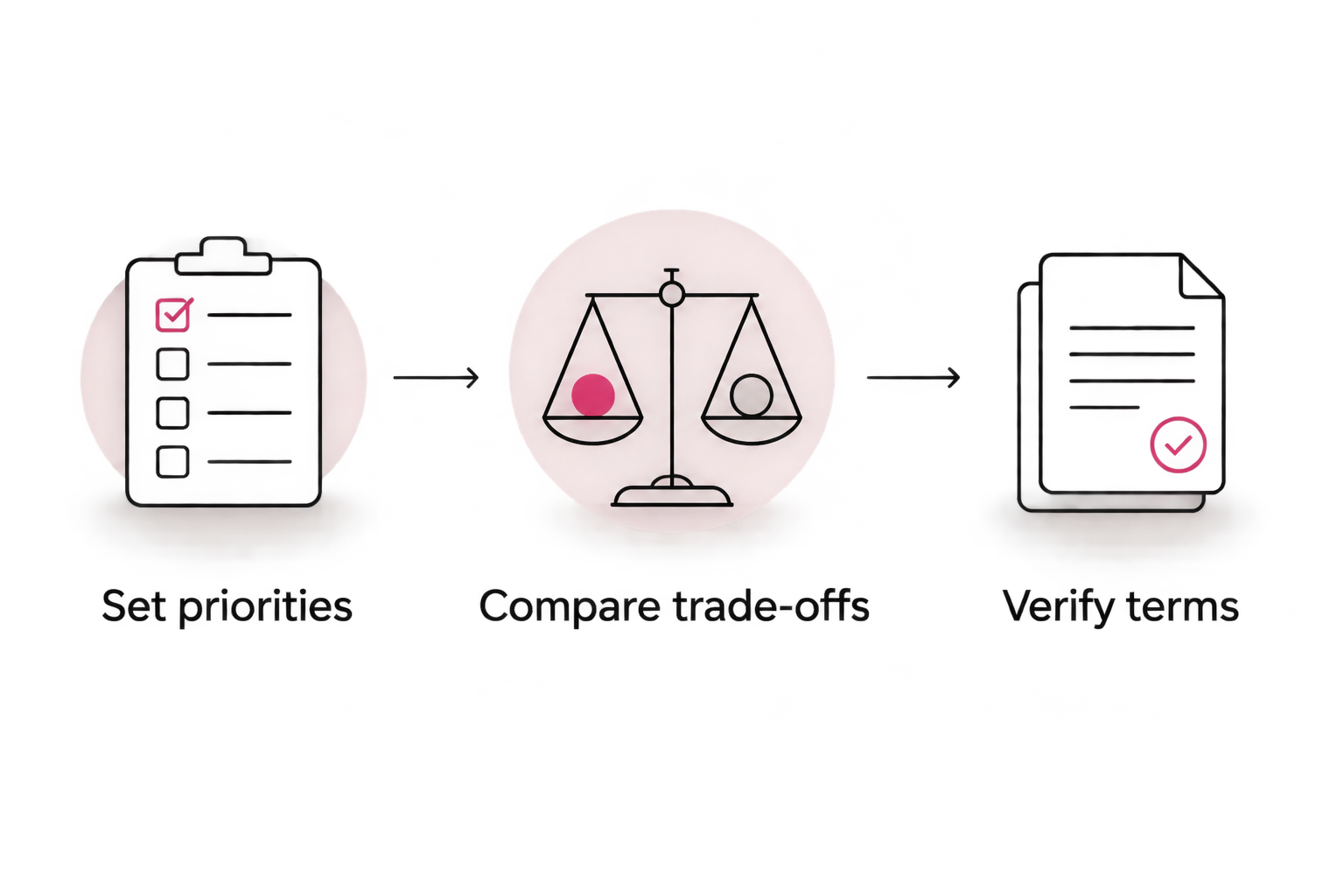
For example, build the comparison around these steps:
- Set priorities: Write down what would make an apartment unsuitable.
- Compare trade-offs: Explain what each remaining apartment gives up as well as what it offers.
- Verify terms: Resolve important questions with the property before applying.
Keep the same criteria across properties. If you ask one community about parking, pet policies and the exact apartment location, ask the others too. Otherwise, the most detailed response can look like the best option simply because you know more about it.
Neither route wins on confirming lease terms
Treat property confirmation as a separate step, regardless of how you found the apartment. A listing description and a personalized recommendation serve different purposes from the written terms you will sign.
For a 2026 move, ask the leasing office for a written breakdown tied to the apartment and lease term you are considering. Keep recurring charges separate from one-time charges, and ask which items depend on your household or application.
Confirm the details that affect daily use:
- The exact floor plan and apartment location.
- Parking arrangements and applicable restrictions.
- Pet rules that apply to your animal.
- Included appliances and responsibility for utilities.
- Lease dates and any conditions attached to quoted terms.
The locator can help you organize questions; independent browsing can help you identify properties to question. Neither makes an unanswered question disappear.
This is an honest tie. Choose the route that helps you research, then get the property's answers in writing.
Neither route wins on application approval
Finding an apartment and qualifying for it are separate decisions. Neither the locator nor RentCafe replaces the property's screening process.
If your situation involves a new job, a guarantor, variable income or a prior rental issue, ask about the property's written criteria before submitting an application. Explain the relevant circumstances accurately rather than assuming a recommendation means approval.
For a 2026 relocation, organize the documents the property requests and check how it wants them submitted. Do not assume every community accepts the same evidence or follows the same procedure.
This is another tie, with an important practical consequence: judge a search service by how it helps you find and compare apartments, not by an assumed ability to override leasing requirements. Ask the property to resolve eligibility questions directly.
Pricing: separate search help from the lease commitment
Taco Street Locating is a free apartment locating service. That describes the service offered to renters; it does not mean the apartment application, move or lease has no associated charges.
RentCafe is a rental-search platform rather than the personalized locating service compared here. Keep any property application or lease charges separate from your assessment of the browsing experience, and review the terms shown for the property and transaction you are considering.
The practical trade-off is your involvement. With personalized help, you explain your needs and evaluate recommendations. With self-directed search, you handle discovery, comparison and follow-up yourself.
Choose on the work you want help with, not on an assumed rent advantage. Neither search method, by itself, establishes that a particular apartment has better lease terms.
Final verdict: choose help or choose independent browsing
Choose Taco Street Locating if you are a relocating renter
Best for: renters moving to Austin, Dallas–Fort Worth, Houston or San Antonio who want personalized apartment research. Choose the service when neighborhood fit and competing priorities need discussion.
Give the locator a clear brief, explain your nonnegotiables and challenge recommendations that do not fit. Personalized help works as a conversation, not a substitute for your judgment.
Choose RentCafe if you are a self-directed apartment hunter
Best for: renters who know their criteria and want to browse and contact properties independently. Choose RentCafe when direct control matters more than having someone help interpret your shortlist.
Keep written notes and use the same questions across properties. Independent search works best when your comparison process is as deliberate as your browsing.
| Dimension | Winner |
|---|---|
| Help with an unfamiliar move | Personalized locator |
| Local guidance within the stated Texas service area | Personalized locator |
| Personalized neighborhood research | Personalized locator |
| Independent browsing and search control | RentCafe |
| Interpreting a shortlist against personal priorities | Personalized locator |
| Confirming lease terms | Tie—property confirmation required |
| Application approval | Tie—property screening applies |
| Pricing decision | Choose by service format, not assumed lease savings |
FAQ
Is Taco Street Locating better than RentCafe for moving to Austin?
Taco Street Locating is the better fit when you want personalized apartment research and neighborhood guidance for an Austin move. RentCafe is the better fit when you prefer browsing and evaluating rental listings yourself.
Should I use RentCafe if I already know my neighborhood?
RentCafe fits renters who already know their target neighborhood and want to conduct the search independently. You still need to compare properties and confirm important details with each leasing office.
Can I use a rental website and an apartment locator together?
Yes, you can browse rental listings and discuss the properties you find with a locator. Ask whether the locator can help with those particular communities rather than assuming every property is included.
Does using an apartment locator guarantee approval?
No, using an apartment locator does not replace a property’s screening process. Ask the leasing office about its written requirements before submitting an application.
What should I tell an apartment locator before starting?
Share your destination, move requirements, household needs and nonnegotiables. Explain which trade-offs you will accept so recommendations address your actual decision.
Does finding an apartment on RentCafe confirm the lease terms?
No, finding an apartment on RentCafe does not replace confirming its lease terms with the property. Request written details for the apartment and lease term you are considering.
What should I compare besides the apartment itself?
Compare the route to your regular destinations, neighborhood fit, property rules and the full lease commitment. Apply the same questions to every finalist so missing information does not distort your choice.
One last thing
Before applying, write one sentence explaining why you would reject each finalist. An unresolved commute, unclear pet rule or unsuitable layout deserves attention before the application—not after you have mentally moved in.
For your 2026 search, keep 2 search routes available: independent browsing for discovery and personalized help for unresolved decisions. You do not need to turn a useful apartment search into loyalty to a single method.
Related guides
- RentCafe alternatives
- Touring an Austin apartment from another city
- Budgeting for move-in costs on a Texas apartment